Tonight is poetry night and I'm so spoiled with all of C.I.'s bookcases. I've learned the system and it's as intense as a library. (I believe C.I.'s books are filed under the Library of Congress system.) So I found a real treat. Beatrice M. Murphy was the editor of this boo published in 1948 by The Exposition Press.
The title? Ebony Rhythm: An Anthology of Contemporary Negro Verse. This was so wonderful to read, every single one of the poems was a real treat. They were both art and history. In the preface, it's noted that some may compare this to anothe volume they edited entitled Negro Voices. I'd love to find that one.
I really loved all the poems. But I'm going with Helen C. Harris after reading them to my kids out loud to see which of my five favorites was their favorite. They voted on Harris. This is her "I Heard Your Heart's Soft Tears:"
In the lightness of the breeze
I heard your heart's soft tears
Drop -- one by one -- upon a rim.
They balanced there, then fell
Into the pool of life
And weled there
A part of something called tomorrow's dream.
There are so many tears that you have wept
In laughter, awe, in terpidation.
Never, some say, have you learned to cry --
Your wings forever upward fly,
Strong, shipping against wind and time.
How would others know of angguish in your heart?
Inside the pulse of night,
Outside the door of yesterday,
I heard a sigh -- and ran to let you in,
Only to find the silent one who stood outside
Was I.
This is from the book:
Helen C. Harris, a graduate of St. Augustine's College and Boston University, is co-author of Triad, a book of verse. During the war she was employed as Engineer's Assistant in the Signal Corps Development Laboratory; she has returned to teaching and writing.
I found this online about the editor of the book:
Murphy, Beatrice M. (1908–1992), poet, editor, columnist, and reviewer. Born in Monessen, Pennsylvania, Beatrice Murphy lived most of her life in Washington, D.C. In 1928 she graduated from Dunbar High School and published her first poem. From 1933 to 1935 she was a columnist and for the next two years an editor at the Washington Tribune. Converting to Catholicism in 1938, she also became book review editor that year for the Afro-American and published her first poetry anthology, Negro Voices. She was also a secretary at Catholic University and part owner of a circulating library and stenography shop. She became a regular columnist for the Associated Negro Press and contributed poetry and reviews to numerous serials and collections. In the 1940s and 1950s she worked for the Office of Price Administration and then the Veterans Administration. In 1954 she was suspended without pay from her job as procurement clerk for supposedly having joined a subversive organization. She disproved the allegations and was reinstated four months later. She reported great bitterness over the incident but succeeded in recovering her fundamental optimism.
I could not find any information online about Helen C. Harris. Which honestly just makes me love the poem more. Hidden history and all.
"Iraq snapshot" (The Common Ills):
Tuesday, April 7, 2009. Chaos and violence continue, Barack makes a Bully Boy visit to Iraq, the White House is ignorant of military jargon, in the US veterans deal with the possibility that VA hospitals have infected them with HIV, San Francisco wants action on the murders of Iraqi gay men, Talabani says there are assassination plots, and more.
Hit is Stevie Nicks:
She is like a cat in the dark
And then she is the darkness
She rules her life like a fine skylark
And when the sky is starless
Barack hand-holder Jeff Zeleny (New York Times) isn't again whining about Barry referring to Muslim roots/ties (as usual, Barry was really saying nothing to invert the old girl group song) but how when Jeffy did it there was fallout. No, all is happy in Vaselineville and the paper even handed him a box of tissues allowing him to blog that Barack made a surprise trip to Baghdad. The official White House transcript (remember, under Barry these transcripts are often 'incomplete' and/or 'improved on') paints a horrific scene where Barry addresses service men and women assembled as "guys" and an audience member (apparently unaware of what it means to wear a uniform) gushes, "We love you!" Barack replies, "I love you back." The military is now screaming, "I love you" at a president? And a president of the United States mistakes appearing before the military with a night at the Grammys? Eisenhower would have been embarrassed but then Eisenhower could point to many ways he actually served his country. Barack's got a traveling White House crew who has also never served -- well never served anything that didn't come in a frosted glass. Which is how "Ooh-ah" ends up in the transcript. Did the soft-handed White House fools believe Diana, Mary and Cindy were present and about to perform "Baby Love"? Do the soft-handed White House fools have no idea of military jargon? Do they just want to confess to the whole world how little they value the military? Yes, yes and, apparently, yes. "Ooh-ah." What fools, what ignorant, pampered fools. (Click here if you're also in the dark.)
Our Church Of Latter Day Evita uttered "I" nineteen times which might be shocking, however, it should have been twenty times. The One Let Into Harvard As A Legacy never mastered English which is why he ended up stating "that Michelle and myself are doing everything" -- he meant "I."
Barry tossed out the same hokum Bully Boy Bush used to. Regarding Iraq and Iraqis ("they" as he so enjoyed putting it), Barack declared, "It is time for us to transition to the Iraqis. They need to take responsibility for their country and for their soveriengty." They need to? Have they been slacking? Has the US been stuck in Iraq this entire time because those slackers wanted the US to stay? That's certainly how he made it sound. He continued, "And in order for them to do that [take responsibility], they have got to make political accomodations." They HAVE? His poor grammer is always problematic; however, here it's not only offenisve, it seems to allow him more wiggle room. Translation, in a few months he can declare, "The US has to remain because they [Iraq] didn't live up to their end."
"They're going to have to decide that they want to resolve their differences through constitutional means and legal means," declared the Infant Obama, apparently unaware that "they" did not install the Shi'ite thugs, the US did. Apparently unaware that when the US finally does leave, there will be a serious challenge to the the US hand-picked exiles installed into power.
"They are going to have to focus on providing government services that encourage confidence among their citizens," Barack insisted. "All those things they have to do. We can't do it for them." Then why the hell is the US still in Iraq? That of course was the question that lingered over the hopium. It was no different than anything Bully Boy Bush would have said and frequently did say. It's the same speech we've heard year after year. So why is the US still in Iraq? There's no reason for them to be. But you can almost hear this same speech, given repeatedly over the last six years, trotted out in 2011, 2012, 2013, 2014 . . .
Why are US forces still in Iraq? Compare Barack's words with the column the UK Secretary of State for Foreign and Commonwealth Affairs David Miliband wrote for The New Statesman but grasp that Miliband is citing these things as reasons why the UK is drawing down over the next four months (leaving behind approximately 400 troops). Nothing ever changes, no it doesn't. Which was the point of opening with the Stevie Nicks song "Rhiannon" (reminder, Fleetwood Mac is on tour currently): Just like Bush, Barack had to sneak into Iraq. Robert Hendin (CBS News) explains how secretive the White House was:
Usually, the White House press leaves a location a few hours after the president does. After the press was told that our departure from Istanbul was delayed a few hours, this after the president took off from here, supposedly to go home, reporters grew even more suspicious.
Many here tried to figure out how long the flight was from Istanbul to Baghdad or Kabul in Afghanistan so we could get a sense of how long the president would be flying before anyone on Air Force One could call and tell us where they were. After two and a half hours of flight time, the tension in the press filing center in Istanbul was intense. No one knew where Mr. Obama was going, when he would get there and what was going to happen to us. When would we leave Istanbul and would we have enough time to file reports? Then, in a flash, a White House press aide came running through the filing center, screaming "the pool report is out!!" He was referring to a print pool report filed by Richard Wolf of USA TODAY, who drew the rotation of being the print pool reporter for the day. Wolf's report said it all: "Air Force One landed at Baghdad Intl Airport at 4:42."
This CBS and AP report contains an audio link to Barack's speech (and Hendin's report contains a link to CBS' Chip Reid's audio report of the trip to Baghdad). Steven Lee Myers and Helene Cooper (New York Times) report on the "unnaounced trip" and they offer what the "Associated Press reported" on a meeting between Nouri al-Maliki and Barack that the paper was apparently shut out of. They state, 'Air Force One landed at Baghdad International Airport under heavy security at 4:42 in the afternoone after military officials shut down the airport." From which he was whisked to US base Camp Victory which Myers and Cooper hilariously describe as being "near the Baghdad International Airport." Near? Let's get even more specific. As Friends Committee On National Legislation explains, "Camp Victory is a U.S. Army base situated on airport grounds about 5 kilometers from Baghdad from Baghdad International Airport. The base can house up to 14,000 troops. Al Faw Palace on Camp Victory is surrounded by a man-made lake and serves as an unofficial conference center for the Army." Click here for Google maps image (satellite). The US Justice Dept has explained it this way (Dec. 22, 2008), "Camp Victory is the primary component of the Victory Base Complex, which occupies the area surrounding the Baghdad International Airport." Ernesto London, Michael D. Shear and William Branigin (Washington Post) cover the "unnannounced trip" and the applause getter of his speech, noting Barack "drew wild cheers from U.S. troops when he declared that it was time for Iraqis to 'take responsibility for their country'." Please note the Washington Post knows the difference between a Supreme's chorus and an army exclamation. Unlike Myers and the Bobble Headed Pundit, the Post explains that Barack spoke at al-Faw Palace and that it "was built by former Iraqi president Saddam Hussein and was captured by U.S. forces when they seized Baghdad and ousted Hussein from power." It really takes a lot of nerve for any foreign leader to go to Iraq and stand on the grounds of one of the country's palaces while insisting that Iraqis need to take responsibility for their country. He wasn't able to stand in front of as many photo-opped troops as the White House wanted. Leila Fadel and Steven Thomma (McClatchy Newspapers) report, "Commanders had hoped to have 1,500 troops there to meet the commnader in chief but were unable to gather them in time . . . Weather prevented Obama from taking a helicopter to visit Maliki and President Jalal Talabani as he'd hoped, aides said. Maliki traveled to the camp instead." The Post notes Talabani also traveled to meet the 'visiting' Barack. (Visitors, for those not up on etiquette, traditionally travel to the host.) At the US State Dept, Robert Wood was spinning like he hadn't done since his spokesperson days during the Bush administration. Asked about a story that Barack was speaking with Nouri over the phone instead of in person, Wood replied, "No, my understanding is that he had to speak with Maliki by telephone because apparently there were some wet climate conditions . . . ["Dust" was supplied to him] Dust and what have you." Wood was then corrected that Nouri and Barack met face to face and tried to glide over that by stating, "Oh, okay. You got a futher update than I have." In a move that did not save face, Wood then went on to insist:
So, look, violence in Iraq, I think, overall has been on the decline. You're going to see terrorists continuing to try to disrupt the functioning of the Iraqi government. What's importat is that we help Iraqis to be able to help themselves and provide their own security and help give the people of Iraq hope. And you know, as I said, violence in Iraq overall has been on the decline. And the Iraqi government, with our help and the help of others in the international community, is going to -- We're gong to do what we can to try to give the Iraqi people a much better future, something that they so truly deserve.
Where to begin? January saw a decrease in violence. That was months ago. A trend requires multiple months. February saw an increase in violence from January. March saw one from February. The trend is an increase in violence. Wood is incorrect. Help them help themselves? Is that the logic? So the US is trying to play the victim here and paint itself as a co-dependent enabler? As for "international community," Wood stopped himself when he seemed to grasp, everyone is gone or going. It is just the US now.
Like a cat in the dark or a thief in the night, Barack traveled to Iraq. Jane Arraf (Christian Science Monitor) reports the stop-over lasted five hours. Hopefully, that is correct. The number she gives for US troops present is wrong. We hear endlessly how 'safe' Iraq is yet time and again, the Oval Office occupant cannot travel to Iraq without secrecy. Though the photo op was supposed to be feel good, the reality is that nothing's changed. One up to Barack's visit is Iraq will now make the evening news. As noted this morning, The NewsHour (PBS) did manage to at least mention the bombings. Gwen Ifill: "In Iraq, a string of six bombings tore through Shia nieghborhoods in Baghdad. Iraqi police reported at least 37 people were killed and more than 100 wounded. The blast sites were littered with mangled wreckage and burned out cars. The deadliest attack happened at a busy market in the western part of Baghdad." ABC, CBS and NBC? Too busy with fluff. (CBS offered a lengthy advertisement for a candy store and then, after, helpfully explained, "By the way the owners of that desert bar alerted us to that bright spot in the economy.") 37 dead and one hundred wounded from a series of bombings in Baghdad and ABC, CBS and NBC didn't think that was news. They had so much more 'important' things to cover. They should all be ashamed. But today, watch them pretend interest in Iraq . . . at least until the commercial break. Shameful. Thomas E. Ricks (Foreign Policy) offers a kinder assessment (than mine) of Barack's for-show visit, "Take responsibility for your country, President Obama lectures. Likely Iraqi response: Thanks for your interest. The next 18 months are 'critical,' Mr. Obama says. Alas, they always are in Iraq. It all feels depressingly like the Bush administration." Ricks is the author of the new bestseller The Gamble.
Those with thirty seconds to fill prior to the commercial break may toss in Muntadar al-Zaidi. al-Zaidi is the Iraqi journalist who found international fame when Bully Boy Bush was making his December 14th secret trip to Baghdad. At the press conference, al-Zaidi threw both of his shoes at Bush. March 12th Muntadhar was sentenced to three years. Today brings news of a sentence reduction. BBC reports that the sentence has been dropped to one year. Aseel Kami (Reuters) quotes the judiciary spokesperson Abdul Sattar al-Birqdar stating, "The appeal court issued its decision today to decrease the sentence against Muntazer al-Zaidi from three years in prison to one year, taking into consideration that he's still young and doesn't have any previous convictions." Or maybe the anchors will use that time to note Monday's violence?
Caroline Alexander (Bloomberg News) reports Jalal Talabani, Iraq's president, appears alarmed by the visible increase in violence as evidence by his statement that Iraq's security forces need to make "rapid steps" because, according to Talabani, there are plots "to carry out assassinations on leading politicians" and he is quoted stating, "We warn all, and call on all Iraqis to support national unity and confront anyone trying to ignite sectarian conflict in Iraq." But isn't it a bit hard to call on unity when Nouri's targeting Sunnis? Isn't that a bit weak assed and pathetic? While Sahwa's hit in the face with a two-by-four repeatedly, Talabani wants to ask them to chant "Unity"? The president of a country has stated publicly that assassinations are being planned on politicians. How much coverage will this receive from the press? And who are the politicians? With Talabani having stated he won't run for re-election (his term is up in December), it's hard to believe he'd top the targeted list. But resentment at Kurds or the office of the presidency could put him on a list of targets. If the press covers this, it will be interesting to see if anyone presses for a list of alleged targets.
Over the weekend (see yesterday's snapshot) came news of seven brutal murders. KTVU (link has text and video) reports on San Francisco's Board of Supervisors decision to adopt "a resolution supporting gay rights in Iraq".
Deborah Villalon: Well Ken [Wayne], it's been described as "Don't Ask, Just Kill." International observers say any new found stability in Iraq does note extend to gays and lesbians. In fact their plight has worsened with the rise of religious militias and the bodies of two men found shot to death over the weekend.
Supervisor Bevan Duffy: Six gay men murdered with words put on their dead bodies to vilify them.
Deborah Villalon: The word "pervert" in Arabic was written on the Iraqi victims leaving no doubt why they were targeted and triggering outrage among local gay leaders. At the corner of Castro and Market Street, they dubbed this spot "Tomb of the Unknown Gay" for the dead men.
Bevan Duffy: This is the beginning of what could be untold slaughter of innocent people. Tribal councils basically put out death sentences to people. I mean that is certainly far afield to anything related to democracy.
Deborah Villalon: Human rights group have documented the persecution of gays in Iraq counting at least 400 murders in the past several years -- at least that they know about. In recent weeks, religious clerics condemnded homosexuality from their pulpits, triggering a new wave of violence.
Gary Virginia: I think people around the world can all go to their political leaders and demand an inquiry to find out who these six men were who were murdered and for what reason and hold somebody accountable for it.
Lyanne Melendez (San Francisco's KGO -- link has text and video) adds, "Gay leaders in San Francisco hope Monday's small rally and others around the world, will send a message around the world that these killings will not be tolerated."
Superviser Bevan Duffy made the motion in this morning's meeting and it will be introduced in Thursday's meeting. If passed, it would call for an investigation into the murders as well as for a public statement condemning them. This would be the White House, the US State Dept and the Congress. This is needed. It's not binding in that the White House, et al can ignore it. But we all need to grasp that the United Nations and specifically UNHCR regularly condemns murders of Iraqis. For example, if a politician or Christian is murdered, the UN or one of its bodies will issue a statement condemning it. But there's been no statement from them. There's been no statement from any governing body. These killings have been going on forever and they've never been called out. Our State Dept has never called them out and today's briefing -- not one question about the murders.
Turning to some of today's reported violence . . .
Bombings?
Jomana Karadsheh (CNN) reports a Baghdad car bombing today which has claimed at least 9 people and left at least eighteen injured. Aseel Kami, Tim Cocks, Abdul-Rahman Taher, Tim Cocks and Michael Christie (Reuters) add an intriguing note in the speculation over who's responsible for the recent bombings: "But a senior Iraqi intelligence source, who declined to be named, said there was evidence the bombs could be the work of the militant Badr Organisation, the armed wing of the Supreme Islamic Iraqi Council (ISCI). ISCI is allied to Prime Minister Nuri al-Maliki's Dawa party in parliament, but the two have become somewhat estranged." Sahar Issa (McClatchy Newspapers) reports a Baghdad grenade attack which destroyed a store and notes a taxi cab bomber who "targeted the motorcade of Saad Abu Qutaiba, a high ranking member in the Support councils" left Abu Qutaiba wounded and claimed the life of 1 police officer leaving eight people wounded (four were members of the police).
Shootings?
Sahar Issa (McClatchy Newspapers) reports Falah Mohammed Younis (just "elected to lead the local government" was shot dead in Mosul last night.
Corpses?
Sahar Issa (McClatchy Newspapers) reports the corpse of Sahwa member Mohammed al Janabi was discovered in Iskanderiya ("evidence of torture" and "shot many times") -- Sahwa is the term for "Awakening" Council members.
While Barack pranced and preened yet again for the cameras today, back in the US veterans continued to wait for care. Jason Whitely (WFAA, ABC station in Dallas, owned be Belo -- link has text and video) reports on Steven Farmer, in Baghdad April 9, 2003 now home with Planters Fasicitis a condition reuslitng "from wearing an drunning boots" requiring him to use a cane for the last few weeks and being told that it will be a year to eighteen months before he can get surgery. Famer tells Whitely, "When they asked me to go to Iraq, I didn't ask them to hold on. I packed up, said goodby to my family and friends and I was off serving my country. Now, it's time for me to get help with my problems so I can go on and live my life and they're telling me to hold on." And Whitely reports that many other veterans requiring surgery are being told that non-emergency surgeries will wait and wait. WFAA's report resulted in Steven Farmer being moved up the list but the others will remain waiting. And yet Barack wanted to his end for-show speech today declaring, "The main point I want to make is we have not forgotten what you have already done, we are grateful for what you will do, and as long as I am in the White House, you are going to get the support that you need and the thanks that you deserve from a grateful nation." Of course, technically Princess Tiny Meat wasn't at the White House. He was finishing up his Oh Come Let Us Adore Me Tour. Jennifer Pifer-Bixler (CNN -- link has text and video) reports, "The Department of Veterans Affairs has launched an investigation into whether there is connection between improperly sterilized endoscopy equipment and a veteran's postive HIV test. This comes after more than 10,000 veterans were possibley exposed to HIV and hepatitis at three VA facilities while undergoing colonoscopies and other procedures with equipment that had not been properly cleaned. The VA sent letters to those veterans offering free testing for hepatitis B, hepatitis C and HIV." Free testing, oh that's good. We'd hate to think the VA would charge veterans to see whether or not the VA had infected them. It takes a lot of gall to grandstand in front of US troops today with that news out there.
In legal news, yesterday's snapshot noted jury selection for USA v. Steven D. Green began yesterday. Rebecca caught some interesting items including Alsumaria:
The selection of the jury panel in the trial of US soldier Steven Green has started today. Green has raided with four others the house of Abir Qassem Hamza Al Jinabi and raped the girl while they killed her family and set the house afire to hide their crimes. The soldier believed to have led the group is sentenced to death. Four soldiers involved in this incident were sentenced in March 2006. The conjunctures of the incident were uncovered during the soldiers' trial.
As Rebecca pointed out, that might be more of a desire (an understandable one) since Green is not yet sentenced to anything. A desire was expressed by one Iraqi politician. 3news.co.nz reports Jabir al-Hamdani has called for the death sentence for Green if Green is convcited.
iraq
the washington posternesto londono
michael d. shear
william branigin
mcclatchy newspapers
leila fadel
cbs news
caroline alexander
the new york timeshelene cooperjeff zeleny
steven lee myers
cnnjomana karadshehaseel kamiabdul-rahman tahertim cocksmichael christiepbsthe newshour
thomas e. ricks
lyanne melendez
Tuesday, April 07, 2009
Monday, April 06, 2009
The Mommy Diary
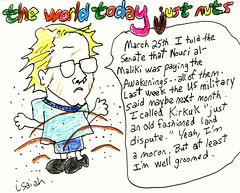
Sunday Kat's "Kat's Korner: When you build your house . . ." and Isaiah's The World Today Just Nuts "The Pig-Pen Ambassador" both went up and here's Isaiah's comic.
Mondays are the worst days of the week for Moms. Am I right?
And look at me complain when I've got Ty, Dona, Jim and Jess all willing and eager to help (and all helping). But my oldest didn't want to go to school. He's not a skipper. He was up when I was getting ready to leave (Ty takes them to school, Dona and Jim pick them up) [Jess fills in for drop offs and pick ups]. I asked if he was feeling bad. No. Was he sick? No. Was he scared?
No.
I didn't scream, "What's the problem then!" At least I can say that.
But I told him if he wasn't sick and he wasn't scared, he was going to school. And I grabbed my keys and headed out. I was two streets down when I turned the car around.
Today's my dad's birthday. And unless you count me as Daddy, that's the only Daddy my son really knew. So I drove back and asked him, "Is this about Grandpa?" It was. He was homesick. They haven't been. And that's great but they can be. Homesick on his grandfather's birthday was reason enough to not go.
C.I. has a housekeeper (who is a wonderful woman as is her sister and everyone else who works in C.I.'s home) and she was listening and said not to worry that he'd be fine. He was too. And I thank her for that and thank Dona and Jim also who ended up cutting class to stay home. Dona and my son made several birthday cards for my father and faxed them.
When I got home, we called and wished him a Happy Birthday and I told him, "Dad, do not rush the kids off the phone, they're really missing you today." So he ended up staying on the phone for a half-hour and after started saying, "Let me know how much to spend." He thinks I'm a liar about cell phones. He grew up in another era where long distance was an arm and a leg. But that was my day and I'm exhausted. Mainly from guilt all day, honestly.
I couldn't believe that I didn't realize there was something real up. My daughter will use any reason to skip. She forever has a tummy ache (that vanishes anytime I say, "Well I thought Stephanie was going to be at school . . ." -- her best friend here). My youngest son will say he is not going and forget it. He's not going. You will not convince him. You will not change his mind. I learned that when he was 5.
My father even said, "I'm going to spank you." He hopped over my father's lap and told him go ahead and he still wasn't going.
He's stubborn. But he has his reasons. And he doesn't play that card too many times a year but when he does, he will get his way.
So I'm used to dealing with those two. But my oldest is the rock of the three and that actually makes me feel worse because he's that and he asks for so very little. I should have just said, "Stay home." Without asking questions. Because he really does not skip and he asks so little. So I was guilting all day. And it wore me out.
"Iraq snapshot" (The Common Ills):
Monday, April 6, 2009. Chaos and violence continue, the US miltiary announces deaths over the weekend, violence sweeps Baghdad today, jury pool selection for USA v. Steven D. Green began today, and more.
Cindy Sheehan's latest Soapbox (her weekly internet radio program) went up Sunday. Her guests were Sara Rich (sexual assault activist, peace activist and mother of Suzanne Swift) and retired Army Col and retired State Dept diplomat Ann Wright. Cindy's son Casey Sheehan died at age 24 in Iraq April 4, 2004. During this show she spoke about counter-recruitment and she and her guests spoke about a number of other topics including Janis Karpinski being the fall person for Abu Ghraib. From the broadcast, we'll note intros in case anyone doesn't know Cindy's guests and then focus on sexual assaults and traumas.
Cindy Sheehan: And you were concerned with -- in your career, being in the military and being in the diplomatic corps -- you were concerned with US foreign policy a lot but there was one thing that finally pushed you over the edge, wasn't there?
Ann Wright: Well indeed. It was the decision of the Bush administration to invade and occupy an oil rich Arab Muslim country that had not attacked the United States and had nothing to do with 9-11. And that was the decision to invade and occupy Iraq. And I ended up resigning in March of 2003 in opposition to that war and ever since then I've been working with people like yourself and Sara Rich on stopping wars and proper treatment of our veterans when they return.
Cindy Sheehan: And Ann actually is one of the hardest working people in the peace movement. She helped me at Camp Casey every single time we went to Crawford [Texas}. She helped coordinate the volunteers and coordinate activities and she just is very admirable.
[. . .]
Sara Rich: Well I've always been a human rights activist -- even before she [her daughter Suzanne Swift] joined the military. And when she joined the military she was told by the recruiter that she -- if she signed up for five years, that she wouldn't be deployed to a combat zone.
Cindy Sheehan: Right.
Sara Rich: And basically she was sent to a combat zone. Neither of us had any idea about military sexual assault or that there was a term called military sexual trauma -- MST -- or anything about command rape. Suzanne was more than just harassed, she was actually raped by her commanding officer in Iraq and we didn't understand quite what was going on but it was she was harassed by one of her commanding officers, raped by another and then harassed by another. So it was three different men, all who had direct authority over her in a combat zone because she did see combat. It wasn't that she was stationed somewhere safe. She was shot at, she was doing combat patrol. She was the driver of a Humvee doing combat patrol in Karbala '04 - '05. And the whole time she was there I kept thinking this isn't right, something's wrong, what can I do and then finally when she got out of Iraq I said "Now can we say something? Can we do something?" Because she was too scared for me to say something while she was in Iraq because you know we have cases like LaVena Johnson.
Cindy: Absolutely
Sara Rich: Where, you know, women speak out and their murdered. So she was too scared to say anything and finally she was being redeployed to Iraq for a second time and her PTSD and Military Sexual Trauma just exploded and she went AWOL instead of returning which was a huge turning point in our whole family. She refused to go back. She went AWOL. We got an attorney and a psychologist and that's when we finally started coming out about the sexual assault and the rape and all of the trauma that she experienced while in Iraq because up until that point it was just too raw for her to talk about. So she was seeing a psychologist, we had an attorney, we were trying to work with the army to get her so that she could turn herself in and get the help she needed but nobody would work with us so finally the AWOL Apprehension Team called their good buddies down here in Eugene [Oregon] at Eugene police department and they sent people to our home at ten-thirty on a Sunday night and took her in handcuffs. You know here we have this -- by then she's how old was she about 22 by then. A 22-year-old who had been raped, who had Combat Trauma and they put her in handcuffs and threw her in jail.
Cindy Sheehan: She had been raped, she had been the victim of a crime actually while she was stationed in another profound crime -- a crime against humanity, an international crime, the occupation of Iraq. Were her assaulters, were her rapists and harassers, were they hauled off in handcuffs at any time?
Sara Rich: No. [. . .] They just stripped of her rank and sent her to prison.
Cindy Sheehan: And ultimately nothing has happened to the people who raped her?
Sara Rich: No. No. The one, the man who raped her, his wife ended up calling us about a year ago saying she was divorcing him. I always called him the molester because his name is Mark Lester
Cindy Sheehan: Uh-huh
Sara Rich: And she told me that he had been hired as a police officer in Kent, Washington and so I put a blast to my friends saying, you know, call the mayor, call the police chief and by the end of the week he was fired.
Cindy Sheehan: Well at least he had a little bit of accountability but you know there was Mark Lester that raped Suzanne but actually the entire system raped Suzanne.
Sara Rich: You better believe it.
Cindy Sheehan: And this is an absolute tragedy. I have read statistics where at least 30% of females are sexually harassed or raped in the military and of course that's probably a much higher number and we read and are still hearing about cases where female soldiers have died of dehydration in Iraq because they don't drink water because they don't want to get up to use the latrine in the middle of the night because they don't want to be raped so here Suzanne was in a war zone battling the resistance -- the Iraqi resistance -- but she also had to battle her own, her fellow soldiers -- her colleagues. You know, to me, if this isn't a reason to not join the military, I don't know what could be the reason. So thank you, Sara, we'll come back to you in a second. Ann, Sara talked about the case of LaVena Johnson and I know you have worked with the family and you know about the case. Can you tell my listeners about the case of LaVena Johnson?
Ann Wright: Sure I -- I will tell them about it. Let me just mention though that on the statistics on sexual harassment well over 90% of the women who are in the military say that they have been sexually harassed. Sexual assault and rape, the crimes of sexual assault and rape, that's where one-in-three soliders, service members, are saying that they have been sexually assaulted or raped while they've been in the military and these are figures, statistics, that are given by the Veterans Administration
Cindy Sheehan: So but sexual harassment -- sexual harassment is almost 100%?
Ann Wright: That's right. That's right. Yes, it is. The case of LaVena Johnson, a young woman, twenty-one-years-old who had -- or pardon me, nineteen-years-old. Nineteen-years-old who had gone to Iraq. Within two weeks of her having been there, she ended up being found in a tent, a burning tent, she had been shot in the head and uh when her parents uh were notified of her uh death uhm they were told she was dead of a noncombat related incident. [. . .] 104 have been killed in Iraq and 43 have been killed in what they call noncombat related incidents and of that 43, there are 15 of them that when you look at the cases you think, "Mmm, there's something really strange." And one of them is LaVena Johnson who was found shot in a tent. When her body came back to her home in Missouri and they had the body at the funeral home, her mom and dad touched their daughter's body. The mother tried to rub her [LaVena's} hand and the gloves the military had put on her hands would not move and they looked at the gloves and they had been glued on. And so they went to the morturary guy and said, "What's going on here? We want to see why these things were glued on." And when they cut those off they saw that her hand had been burned and indeed her whole body, one side of her body, had been burned. So how was this noncombat related incident? Why was she burned? Well over a period of two and a half years as the family kept begging the military for information -- first to get the autoposy, then, later on, to try to find documetns about the death. Try to get information that is held by the military but they won't give it to the families unless you file a Freedom of Information Act on it. Well ultimately, after two and a half years they finally got the CD that contained the photographs of her body as her body was undressed in Iraq before it was shipped back to the United States and the -- the body showed that she had been beaten in the face that her nose had been broken, that there were -- the father says that it appears that there were bite marks on her body, that one of her arms had been distended and dislocated that there were -- that her vaginal area looked as though she had been sexually assaulted and then a caustic acid poured in her genital area. So, um, the Johnson family has been demanding that the US military review thsi case. That they do not believe that um, well, the military has said that she comitted suicide. that on one killed her, that she comited suicide. With all of those injuries, she committed suicide. So I've been assisting the family to try to get a hearing before the army to make the army reopen that case. And we've gone to Congress to try to get Congress men and women involved in this and it's a real slow process of making the army reopen cases. You know, the Pat Tillman case, here after three Congressional hearings on his death in Afghansitan we now know that he was shot by friendly fire, he was shot in the head, it looks like he was assassinated and yet after three Congressional hearings, the parents of Pat Tillman don't know who among that small unit that Pat Tilman was a part of, who killed Pat Tillman and why? So for a family like LaVena Johnson's who have no political pull, there daughter was not an NFL star, she was just one of hundreds of thousands of young men and women who decide to join the military and then terrible things happen to them. The family is still pushing very, very hard on the military to try to get more answers on what happened to their daughter. But one thing for sure, they do not believe that she comitted suicide nor do I.
[. . .]
Sara Rich: It's interesting when I -- when I found out about LaVena's case, it just sent absolute shivers up my spine, thinking this is what would have happened to my daughter if she had told about what was going on to her to her superior officers in Iraq. This is what would have happened, she would have been murdered, they would have said it was a suicide. Their birthdays are very close to each other, there a few years apart, but their birthdays are within a couple of days of each other. And it just, it made me feel so -- so thankful for my -- that my daughter was -- you know, still with us.
Cindy Sheehan: Right.
Sara Rich: LaVena is not. And it made me feel the Johnsons and I have a real heart connection. They're very protective of Suzanne and I think about LaVena every day. It's just, we have a very deep, very deep connection about that. And when Ann and the Johnsons and I were going to Congress men and Congress women and senators, trying to talk to them about reopening LaVena's case and showing them that it was not a suicide, it was a murder, they were treated in a way that just infurated me. I mean here they have a fallen soldier who is obviously raped and murdered and they were seeing -- taken to these little teeny rooms with junior staffers and weren't even given the respect and care that we as military parents of combat veterans should be absolutely demanding from people that say that they run our country.
Sara Rich is holding a retreat this weekend in Portland, Oregon, "It's going to be in the Applegate Valley which is in southern Oregon. This is actually a pilot program. We're really trying to find a way that we can take this on the road and start providing healing retreats in every state because the need is so great in women veterans, the need to connect, the need to heal and I'm one of three trauma informed therapists that's going to be helping facilitate this weekend and we're going to come together and really take care of each other and take care of our veterans because that's what needs to happen. We're trying to offer it as low-cost as possible so that it's available and accessible for everybody and just create a place that's safe." To get in touch with Sara Rich you can e-mail her through the Suzanne Swift website.
Today jury selection began in Paducah, Kentucky for USA v Steven D. Green. Green's trial is set to start April 27, 2009. Who is Steven D. Green? Who is Abeer Qassim Hamza al-Janabi -- or rather, who was Abeer. March 12, 2006 Abeer's parents -- Qassim Hamza Raheem and Fakhriya Taha Muhasen -- were murdered as was Abeer's five-year-old sister Hadeel Qassim Hamza. Abeer was gang-raped during the murders. After the murders, the gang-rape continued and then she was murdered. Remember how LaVena Johnson had acid or lye poured on her to destroy evidence? Abeer's attackers attempted to set her body on fire in an attempt to destroy evidence. The crime was blamed on 'insurgents.' As Gregg Zoroya (USA Today) reported, Justin Watt came forward (Watt was not involved in the rape, murder or conspiracy to commit the War Crimes) with some troubling things he was hearing, the 'incident' was looked into anew. The military immediately went into major spin control as it became obvious that US soldiers were responsible. In an attempt to 'lessen' the gang-rape and murder of Abeer, they insisted she was 26-years-old. She wasn't. She was fourteen-years-old but if she had been twenty-six, it wouldn't have made the events any less horrible or any less criminal.
Friday, June 20, 2006, Steven D. Green was arrested in the US (Asheville, North Carolina) having already been discharged in May. He was charged with murder and with rape. Green appeared in a Kentucky federal court November 8, 2006 and entered a plea of not guilty. Green was out of the US military, Paul Cortez, Jesse Spielman, Bryan Howard and James P. Barker were still in. An Article 32 hearing was scheduled for August (2006) and, strangely, Robert F. Worth and Carolyn Marshall (New York Times), ahead of the Article 32 hearing, presented the defense's argument. That was strange not only because the defense hadn't presented their argument yet but also because the defense argument was a strange one. After the defense had made the argument, Andy Mosher (Washington Post) would quote the go-to-military law expert for the press, Eugene Fidell stating, "This is not a defense known to the law. But this kind of evidence could come in during the court-martial, and it might be pertinent to the sentence. They could be setting the stage to avoid a death penalty." Wow. So will Robert F. Worth and Carolyn Marshall ever be asked to explain how they offered the defense -- excuse me, how they made the defense argument in an alleged article of reporting? They didn't quote the defense. They didn't have to. They didn't present this as an argument, they presented it as what happened. It sure is good to know that the New York Times will work it, whore it out, when they feel the need. This is, remember, the same paper that has REFUSED to ever print Abeer's name. They have rendered her invisible and victimized her all over again. But by rendering her invisible, by refusing to print her name, they have made her a non-entity and that was their point.
At the Article 23 hearing, Captain Alex Pickands, for the prosecution, responded to the defense's argument: "Murder, not war. Rape, not war. That's what we're here talking about today. Not all that business about cold food, checkpoints, personnel assignments. Cold food didn't kill that family. Personnel assignments didn't rape and murder that 14-year-old little girl."
During the hearing, Pickands would explain, "They gathered over cards and booze to come up with a plan to rape and murder that little girl. She was young and attractive. They knew where she was because they had seen her on a previous patrol. She was close. She was vulnerable." Though the New York Times was happy to carry propaganda for the US military and to render Abeer invisible, they weren't interested in the actual Article 32 hearing. Which is why you'd have to go elsewhere for that coverage. Elsa McLaren (Times of London) reported:
Special Agent Benjamin Bierce recalled how Specialist James Barker described how the couple and their youngest child were put in another room, while the teenager was kept in the living room. Barker said that he held the girl's hands while Sergeant Paul Cortez raped her or tried to rape her. Barker then switched positions with Cortez and attempted to rape the girl, but said he was not sure if he had done so, Special Agent Bierce told the hearing. Some shots were fired in the other room and Private Steven Green emerged, saying "They're all dead. I just killed them." Green put down an AK-47 assault rifle and raped the girl while Cortez held her down, the hearing heard. Special Agent Bierce said Green then picked up the weapon and shot the girl once, paused, and shot her several more times. Kerosene from a lamp was poured over the girl and someone - it was not clear who - set her alight.
Back then, we had to say "alleged" when speaking of the soldiers. Alleged murder or alleged rapist or alleged co-conspirator. We don't have to do that now with anyone except Green. The others have all either been convicted or entered a plea of guilty. Cortez and Barker offered confessions in court when they entered their plea. Some found the confessions emotionally compelling. Others of us noted the weasel words such as "kind of". In his confession, he admited that while "Cortzed pushed her to the ground. I went towards the top of her and kind of held her hands down while Cortez proceeded to lift her dress up." Kind of. He kind of held her hands down. Her parents are being shot and killed in the next room, her sister is being shot and killed in the next room, these Americans dressed in black are in her home, they are lifting up her dress and Barker wants the world to know he "kind of" held her hands. Kind of. Well he "kind of" took repsonsibility when he admitted to his guilt. Kind of.
They plotted it. They have fingered Steven D. Green as the ringleader. They said he plotted it, he came up with the conspiracy. Iraqis have spoken of how Green made Abeer uncomfortable (had she lived, her parents had already arranged to get her out of the area), how, at the US checkpoint he supervised, he would stop her, he would touch her face, he would intimidate her. AFP reminded yesterday, "Cortez testified that he raped Abeer Kassem Hamza al-Janabi while Barker pinned the sobbing girl to the floor. The men switched positions and then heard about four or five shots from a bedroom where Green had taken the girl's father, mother and six-year-old sister, Cortez said. Green shot the girl when he was finished raping her and the soldiers set the home on fire by tossing a lighter onto a Kerosene-soaked blanket covering her naked body, the other soldiers said." Today Brett Barrouquere (AP) reports, "Assistant U.S. Attorney Marisa Ford, who is prosecuting the case, said at least three of those soldiers as well as members of the slain girl's suriving family may be called as witnesses in the case." Darren Wolff, one of Green's attorneys and apparently insane, wants to ask of the prospective jury, "How can they accurately get the impression of a battelfield in Paducah?" Yeah, it was real torture for Green -- grilling chicken breasts and downing booze after the gang-rape and murders. And of course, "battlefield" excuses rape, right Wolff? That's what you're saying. And not just any rape, mind you, but the rape of a young girl. They were better off flirting with the insanity plea. If this is where they're headed and this is the sort of defense they intend to mount, they're just inviting outrage. Brett Barrouquere, by the way, always included Abeer's name in his reports. As did other AP reporters. Gregg Zoroya at USA Today (already noted) also didn't shy from reporting the victims' names nor did Ellen Knickmeyer (Washington Post) who did one of the most intensive reports when the crimes were revealed. Mentioning the victims names was never a problem for foreign outlets and it wasn't a real problem in the US except for one outlet, the alleged paper of record, the New York Times.
Today violence sweeps through Iraq at the sort of levels the Operation Happy Talkers had told us was long gone. Thomas E. Ricks (Foreign Policy) explains, "former secretary of State Condoleezza Rice thinks that Iraq is 'on its way to becoming a strategic asset' of the United States. Someone in Baghdad who didn't get that memo set off a bunch of car bombs that killed about three dozen people today." Ricks is the author of the new bestseller The Gamble. Leila Fadel and Sahar Issa (McClatchy Newspapers) report there were at least 7 bombings in Baghdad resulting in multiple deaths and multiple wounded, "All but one explosion had detonated by 9 a.m. in markets and other gathering places in Baghdad. The bloody morning was a reminder of how fragile the country's security gains are, after a series of fatal bombings in March." Deborah Haynes (Times of London) reports the bombings "tore through Baghdad . . . as [UK Secretary of State for Business, Enterprise and Regulatory Reform"] Peter Mandelson passed through with a delegation of British businessmen to spread the message that it is safe to invest in Iraq." Steven Lee Myers (New York Times) reveals, "Most of the bombs struck largely Shiite neighborhood, but there did not appear to be any obvious pattern to the attacks. There were no claims of responsibility, and Iraqis disagreed on whom to blame." Myers quotes MP Abbas al-Bayati blaming the "Awakening" Council members for the violence. Abbas al-Bayati does a lot of public blather for Nouri al-Maliki so when he speaks, he's usually repeating what he's been told. (As when the news broke about the US spying on Nouri al-Maliki.) Usama Redha, Caesar Ahmed and Ned Parker (Los Angeles Times) add, "The string of explosions came just three months before U.S. combat troops are expected to withdraw to bases outside cities and a week after Iraqi forces put down an insurrection by Sunni paramilitary fighters in eastern Baghdad, which has raised fear that Sunnis, who had turned on groups such as Al Qaeda in Iraq, could return to fighting the Shiite-led government." Anthony Shadid (Washington Post) observes, "The strikes called into question statements by Iraqi military officials that insurgents had lost their ability to attack in the heart of the capital with ease and reflected a sense by many in Baghdad and elsewhere that violence may be worsening, as the American military begins a withdrawal of combat troops slated to end by August 2010." Sahar Issa and Laith Hammoudi (McClatchy Newspapers) break down the Baghdad bombings as follows Baghdad car bombing at seven in the morning 4 dead, fifteen wounded, Baghdad car bombing "targeted the motorcade of Brigadier General Sadoun" at eight in the morning 2 dead and four wounded, Baghdad car bombing at eight-thirty this morning 10 dead sixty-five wounded, another Baghdad car bombing at eight-thirty 4 dead and twenty wounded, a Baghdad sticky bombing which wounded two, two Baghdad car bombings at one this afternoon killing 12 and leaving twenty-five wounded and a five o'clock this evening Baghdad roadside bombing which left three wounded. They note that the tolls were expected to rise. Aseel Kami, Mohammed Abbas, Hadir Abbas, Tim Cox, Wisam Mohammed, Tim Cocks and Charles Dick (Reuters) count at least 37 dead and (check my math) one-hundred and fourteen people injured. They also note speculation that Sahwa, "Awakening" or "Sons of Iraq" (all the same group, different names) might have been involved but quote the US military going with their catch-all: al Qaeda in Iraq. Golly, I thought Baghdad was said to be protected from them and they'd all been driven out of that area. Weren't they allegedly just hanging around in and outside Mosul? The official story changes so frequently you can never pin it down. Independent journalist Dahr Jamail contributes "The Growing Storm" (Dissident Voice) and notes the fall out from the attacks on Sahwa and the fears from the response in Baghdad two weekends ago: "This distrubing event is the realization of what most Iraqis have long feared -- that the relative calm in Iraq today would eventually be broken when fighting erupts between these two entities." Sahwa was under attack over the weekend and while today's violence is garnering press attention, yesterday's violence was an increase as well and saw a variety of groupings targeted.
Reuters noted two Baghdad home bombings which claimed the life of 1 man and left two women injured -- one home was of a Sahwa leader and "It was not clear if the target was the 'Sahwa' leader's house." Sahar Issa (McClatchy Newspapers) reported Dr. Yasir Khdaiyir ("well known surgeon") was assassinated Saturday night in Baghdad, the Ministry of the Interior's Brig Gen Ahmed Kathum Breesem was shot dead in Baghdad tonight, a Sahwa ("Awakening") was shot dead in Baquba (in the latest of continual attacks on Sahwa) and 1 Peshmerga (Kurdish security forces) was shot dead in Kirkuk City, 1 person shot dead in Mosul. In addition, Issa noted 1 police officer killed in Samarra by either "a thermal charge or an armour-penetraing grenade" (four more were wounded), a Falluja roadside bombing which claimed the life of 1 police officer and left another wounded, a second Falluja roadside bombing resulted in one police officer being injured, a Kirkuk roadside bombing which wounded seven people, a Mosul roadside bombing which claimed the life of 1 "small boy" and left his mother wounded, one al Jazair (Ninevah Province) grenade attack which injured one Iraqi soldier and one Mailyah (Ninevah Province) grenade attack which injured another Iraqi soldier and 1 corpse discovered Saturday night in Mosul with signs of torture. Today's violence didn't spring out in total surprise. Also today Sahar Issa and Laith Hammoudi (McClatchy Newspapers) report a Kirkuk suicide bombing which left seven Iraqi soldiers wounded and that Iraqi police state the US military shot dead an innocent civilian by mistake in Nineveh Province.
Over the weekend, the US military had announcements. Saturday the US military announced: "AL ANBAR PROVINCE, Iraq -- A Multi National Force -- West Marine died as the result of a non-combat related incident in Al Anbar Province April 3. The Marine's name is being withheld pending next-of-kin notification and release by the Department of Defense. The incident is under investigation." Sunday the US military announced: "TIKRIT, Iraq – A U.S. Coalition forces Soldier died as a result of operations in Diyala province, Iraq, April 5. The name of the deceased is being withheld pending notification of next-of-kin and release by the Department of Defense." The announcements brought to 4266 the number of US service members killed in Iraq since the start of the illegal war.
In other violence noted over the weekend, Wisam Mohammed and Khalid al-Ansary (Reuters) reported Saturday that gays are being targeted in Baghdad, with four corpses discovered March 25th and 2 gay men murdered Thursday 'after clerics urged a crackdown'." Sunday Mohammed Tawfeeq (CNN) reported the two were first "disowned" (by their homophobic and hateful families) and "The shootings came after a tribal meeting was held and the members decided to go after the victims." Tawfeeq reports the other were also disowned (and gives the date of their deaths as March 26th) and states a cafe in Sadr City was torched when it was said to be an LGBT hangout in Baghdad. The Dallas Morning News wrote a brief on the topic and UPI summarized Tawfeeq's report. AFP reported Sunday that the two corpses discovered Thursday "had pieces of paper attached on which was written the word 'Pervert" and that the two men were aged sixteen and eighteen and had also had "their arms and legs broken". In addition, AFP reports another man presumed to be gay was found on Friday -- which would bring the toll to seven -- and this follows Sheikh Jassem al-Muatairi's 'inspiring' sermon denouncing "new private practices by some men who dress like women, who are effeminate. I call on families to prevent their children from following such a lifestyle."
Meanwhile in the US,independent journalist David Bacon, author of (most recently) Illegal People -- How Globalization Creates Migration and Criminalize Immigrants (Beacon Press), writes (at ZNet) of what's coming up on May Day:
In a little over a month, hundreds of thousands, perhaps even millions, of people will fill the streets in city after city, town after town, across the US. This year these May Day marches of immigrant workers will make an important demand on the Obama administration: End the draconian enforcement policies of the Bush administration. Establish a new immigration policy based on human rights and recognition of the crucial economic and social contributions of immigrants to US society.
This year's marches will continue the recovery in the US of the celebration of May Day, recognized in the rest of the world as the day recognizing the contributions and achievements of working people. That recovery started on Monday, May 1, 2006, when over a million people filled the streets of Los Angeles, with hundreds of thousands more in Chicago, New York and cities and towns throughout the United States. Again on May Day in 2007 and 2008, immigrants and their supporters demonstrated and marched, from coast to coast.
One sign found in almost every march said it all: "We are Workers, not Criminals!" Often it was held in the calloused hands of men and women who looked as though they'd just come from work in a factory, cleaning an office building or picking grapes. The sign stated an obvious truth. Millions of people have come to the United States to work, not to break its laws. Some have come with visas, and others without them. But they are all contributors to the society they've found here.
The protests have seemed spontaneous, but they come as a result of years of organizing, educating and agitating - activities that have given immigrants confidence, and at least some organizations the credibility needed to mobilize direct mass action. This movement is the legacy of Bert Corona, immigrant rights pioneer and founder of many national Latino organizations. He trained thousands of immigrant activists, taught the value of political independence, and believed that immigrants themselves must conduct the fight for immigrant rights. Most of the leaders of the radical wing of today's immigrant rights movement were students or disciples of Corona.
Immigrants, however, feel their backs are against the wall, and they came out of their homes and workplaces to show it. In part, their protests respond to a wave of draconian proposals to criminalize immigration status, and work itself for undocumented people. But the protests do more than react to a particular congressional or legislative agenda. They are the cumulative response to years of bashing and denigrating immigrants generally, and Mexicans and Latinos in particular.
In other news, Bob Somerby takes on Rachel Maddow's 'strength' and other nonsense here.
iraq
cindy sheehanann wrightsara rich
brett barrouquere
the new york timesrobert f. worthcarolyn marshall
the washington postellen knickmeyer
the new york timessteven lee myerscampbell robertsonthe washington postanthony shadid
thomas e. ricks
mcclatchy newspapersleila fadel
deborah haynes
usama redhathe los angeles timesned parker
caeser ahmed
dahr jamail
mohammed tawfeeqaseel kami
wisam mohammedsami al-jumailiwaleed ibrahimkhalid al-ansarymohammed abbas
david bacon
Mondays are the worst days of the week for Moms. Am I right?
And look at me complain when I've got Ty, Dona, Jim and Jess all willing and eager to help (and all helping). But my oldest didn't want to go to school. He's not a skipper. He was up when I was getting ready to leave (Ty takes them to school, Dona and Jim pick them up) [Jess fills in for drop offs and pick ups]. I asked if he was feeling bad. No. Was he sick? No. Was he scared?
No.
I didn't scream, "What's the problem then!" At least I can say that.
But I told him if he wasn't sick and he wasn't scared, he was going to school. And I grabbed my keys and headed out. I was two streets down when I turned the car around.
Today's my dad's birthday. And unless you count me as Daddy, that's the only Daddy my son really knew. So I drove back and asked him, "Is this about Grandpa?" It was. He was homesick. They haven't been. And that's great but they can be. Homesick on his grandfather's birthday was reason enough to not go.
C.I. has a housekeeper (who is a wonderful woman as is her sister and everyone else who works in C.I.'s home) and she was listening and said not to worry that he'd be fine. He was too. And I thank her for that and thank Dona and Jim also who ended up cutting class to stay home. Dona and my son made several birthday cards for my father and faxed them.
When I got home, we called and wished him a Happy Birthday and I told him, "Dad, do not rush the kids off the phone, they're really missing you today." So he ended up staying on the phone for a half-hour and after started saying, "Let me know how much to spend." He thinks I'm a liar about cell phones. He grew up in another era where long distance was an arm and a leg. But that was my day and I'm exhausted. Mainly from guilt all day, honestly.
I couldn't believe that I didn't realize there was something real up. My daughter will use any reason to skip. She forever has a tummy ache (that vanishes anytime I say, "Well I thought Stephanie was going to be at school . . ." -- her best friend here). My youngest son will say he is not going and forget it. He's not going. You will not convince him. You will not change his mind. I learned that when he was 5.
My father even said, "I'm going to spank you." He hopped over my father's lap and told him go ahead and he still wasn't going.
He's stubborn. But he has his reasons. And he doesn't play that card too many times a year but when he does, he will get his way.
So I'm used to dealing with those two. But my oldest is the rock of the three and that actually makes me feel worse because he's that and he asks for so very little. I should have just said, "Stay home." Without asking questions. Because he really does not skip and he asks so little. So I was guilting all day. And it wore me out.
"Iraq snapshot" (The Common Ills):
Monday, April 6, 2009. Chaos and violence continue, the US miltiary announces deaths over the weekend, violence sweeps Baghdad today, jury pool selection for USA v. Steven D. Green began today, and more.
Cindy Sheehan's latest Soapbox (her weekly internet radio program) went up Sunday. Her guests were Sara Rich (sexual assault activist, peace activist and mother of Suzanne Swift) and retired Army Col and retired State Dept diplomat Ann Wright. Cindy's son Casey Sheehan died at age 24 in Iraq April 4, 2004. During this show she spoke about counter-recruitment and she and her guests spoke about a number of other topics including Janis Karpinski being the fall person for Abu Ghraib. From the broadcast, we'll note intros in case anyone doesn't know Cindy's guests and then focus on sexual assaults and traumas.
Cindy Sheehan: And you were concerned with -- in your career, being in the military and being in the diplomatic corps -- you were concerned with US foreign policy a lot but there was one thing that finally pushed you over the edge, wasn't there?
Ann Wright: Well indeed. It was the decision of the Bush administration to invade and occupy an oil rich Arab Muslim country that had not attacked the United States and had nothing to do with 9-11. And that was the decision to invade and occupy Iraq. And I ended up resigning in March of 2003 in opposition to that war and ever since then I've been working with people like yourself and Sara Rich on stopping wars and proper treatment of our veterans when they return.
Cindy Sheehan: And Ann actually is one of the hardest working people in the peace movement. She helped me at Camp Casey every single time we went to Crawford [Texas}. She helped coordinate the volunteers and coordinate activities and she just is very admirable.
[. . .]
Sara Rich: Well I've always been a human rights activist -- even before she [her daughter Suzanne Swift] joined the military. And when she joined the military she was told by the recruiter that she -- if she signed up for five years, that she wouldn't be deployed to a combat zone.
Cindy Sheehan: Right.
Sara Rich: And basically she was sent to a combat zone. Neither of us had any idea about military sexual assault or that there was a term called military sexual trauma -- MST -- or anything about command rape. Suzanne was more than just harassed, she was actually raped by her commanding officer in Iraq and we didn't understand quite what was going on but it was she was harassed by one of her commanding officers, raped by another and then harassed by another. So it was three different men, all who had direct authority over her in a combat zone because she did see combat. It wasn't that she was stationed somewhere safe. She was shot at, she was doing combat patrol. She was the driver of a Humvee doing combat patrol in Karbala '04 - '05. And the whole time she was there I kept thinking this isn't right, something's wrong, what can I do and then finally when she got out of Iraq I said "Now can we say something? Can we do something?" Because she was too scared for me to say something while she was in Iraq because you know we have cases like LaVena Johnson.
Cindy: Absolutely
Sara Rich: Where, you know, women speak out and their murdered. So she was too scared to say anything and finally she was being redeployed to Iraq for a second time and her PTSD and Military Sexual Trauma just exploded and she went AWOL instead of returning which was a huge turning point in our whole family. She refused to go back. She went AWOL. We got an attorney and a psychologist and that's when we finally started coming out about the sexual assault and the rape and all of the trauma that she experienced while in Iraq because up until that point it was just too raw for her to talk about. So she was seeing a psychologist, we had an attorney, we were trying to work with the army to get her so that she could turn herself in and get the help she needed but nobody would work with us so finally the AWOL Apprehension Team called their good buddies down here in Eugene [Oregon] at Eugene police department and they sent people to our home at ten-thirty on a Sunday night and took her in handcuffs. You know here we have this -- by then she's how old was she about 22 by then. A 22-year-old who had been raped, who had Combat Trauma and they put her in handcuffs and threw her in jail.
Cindy Sheehan: She had been raped, she had been the victim of a crime actually while she was stationed in another profound crime -- a crime against humanity, an international crime, the occupation of Iraq. Were her assaulters, were her rapists and harassers, were they hauled off in handcuffs at any time?
Sara Rich: No. [. . .] They just stripped of her rank and sent her to prison.
Cindy Sheehan: And ultimately nothing has happened to the people who raped her?
Sara Rich: No. No. The one, the man who raped her, his wife ended up calling us about a year ago saying she was divorcing him. I always called him the molester because his name is Mark Lester
Cindy Sheehan: Uh-huh
Sara Rich: And she told me that he had been hired as a police officer in Kent, Washington and so I put a blast to my friends saying, you know, call the mayor, call the police chief and by the end of the week he was fired.
Cindy Sheehan: Well at least he had a little bit of accountability but you know there was Mark Lester that raped Suzanne but actually the entire system raped Suzanne.
Sara Rich: You better believe it.
Cindy Sheehan: And this is an absolute tragedy. I have read statistics where at least 30% of females are sexually harassed or raped in the military and of course that's probably a much higher number and we read and are still hearing about cases where female soldiers have died of dehydration in Iraq because they don't drink water because they don't want to get up to use the latrine in the middle of the night because they don't want to be raped so here Suzanne was in a war zone battling the resistance -- the Iraqi resistance -- but she also had to battle her own, her fellow soldiers -- her colleagues. You know, to me, if this isn't a reason to not join the military, I don't know what could be the reason. So thank you, Sara, we'll come back to you in a second. Ann, Sara talked about the case of LaVena Johnson and I know you have worked with the family and you know about the case. Can you tell my listeners about the case of LaVena Johnson?
Ann Wright: Sure I -- I will tell them about it. Let me just mention though that on the statistics on sexual harassment well over 90% of the women who are in the military say that they have been sexually harassed. Sexual assault and rape, the crimes of sexual assault and rape, that's where one-in-three soliders, service members, are saying that they have been sexually assaulted or raped while they've been in the military and these are figures, statistics, that are given by the Veterans Administration
Cindy Sheehan: So but sexual harassment -- sexual harassment is almost 100%?
Ann Wright: That's right. That's right. Yes, it is. The case of LaVena Johnson, a young woman, twenty-one-years-old who had -- or pardon me, nineteen-years-old. Nineteen-years-old who had gone to Iraq. Within two weeks of her having been there, she ended up being found in a tent, a burning tent, she had been shot in the head and uh when her parents uh were notified of her uh death uhm they were told she was dead of a noncombat related incident. [. . .] 104 have been killed in Iraq and 43 have been killed in what they call noncombat related incidents and of that 43, there are 15 of them that when you look at the cases you think, "Mmm, there's something really strange." And one of them is LaVena Johnson who was found shot in a tent. When her body came back to her home in Missouri and they had the body at the funeral home, her mom and dad touched their daughter's body. The mother tried to rub her [LaVena's} hand and the gloves the military had put on her hands would not move and they looked at the gloves and they had been glued on. And so they went to the morturary guy and said, "What's going on here? We want to see why these things were glued on." And when they cut those off they saw that her hand had been burned and indeed her whole body, one side of her body, had been burned. So how was this noncombat related incident? Why was she burned? Well over a period of two and a half years as the family kept begging the military for information -- first to get the autoposy, then, later on, to try to find documetns about the death. Try to get information that is held by the military but they won't give it to the families unless you file a Freedom of Information Act on it. Well ultimately, after two and a half years they finally got the CD that contained the photographs of her body as her body was undressed in Iraq before it was shipped back to the United States and the -- the body showed that she had been beaten in the face that her nose had been broken, that there were -- the father says that it appears that there were bite marks on her body, that one of her arms had been distended and dislocated that there were -- that her vaginal area looked as though she had been sexually assaulted and then a caustic acid poured in her genital area. So, um, the Johnson family has been demanding that the US military review thsi case. That they do not believe that um, well, the military has said that she comitted suicide. that on one killed her, that she comited suicide. With all of those injuries, she committed suicide. So I've been assisting the family to try to get a hearing before the army to make the army reopen that case. And we've gone to Congress to try to get Congress men and women involved in this and it's a real slow process of making the army reopen cases. You know, the Pat Tillman case, here after three Congressional hearings on his death in Afghansitan we now know that he was shot by friendly fire, he was shot in the head, it looks like he was assassinated and yet after three Congressional hearings, the parents of Pat Tillman don't know who among that small unit that Pat Tilman was a part of, who killed Pat Tillman and why? So for a family like LaVena Johnson's who have no political pull, there daughter was not an NFL star, she was just one of hundreds of thousands of young men and women who decide to join the military and then terrible things happen to them. The family is still pushing very, very hard on the military to try to get more answers on what happened to their daughter. But one thing for sure, they do not believe that she comitted suicide nor do I.
[. . .]
Sara Rich: It's interesting when I -- when I found out about LaVena's case, it just sent absolute shivers up my spine, thinking this is what would have happened to my daughter if she had told about what was going on to her to her superior officers in Iraq. This is what would have happened, she would have been murdered, they would have said it was a suicide. Their birthdays are very close to each other, there a few years apart, but their birthdays are within a couple of days of each other. And it just, it made me feel so -- so thankful for my -- that my daughter was -- you know, still with us.
Cindy Sheehan: Right.
Sara Rich: LaVena is not. And it made me feel the Johnsons and I have a real heart connection. They're very protective of Suzanne and I think about LaVena every day. It's just, we have a very deep, very deep connection about that. And when Ann and the Johnsons and I were going to Congress men and Congress women and senators, trying to talk to them about reopening LaVena's case and showing them that it was not a suicide, it was a murder, they were treated in a way that just infurated me. I mean here they have a fallen soldier who is obviously raped and murdered and they were seeing -- taken to these little teeny rooms with junior staffers and weren't even given the respect and care that we as military parents of combat veterans should be absolutely demanding from people that say that they run our country.
Sara Rich is holding a retreat this weekend in Portland, Oregon, "It's going to be in the Applegate Valley which is in southern Oregon. This is actually a pilot program. We're really trying to find a way that we can take this on the road and start providing healing retreats in every state because the need is so great in women veterans, the need to connect, the need to heal and I'm one of three trauma informed therapists that's going to be helping facilitate this weekend and we're going to come together and really take care of each other and take care of our veterans because that's what needs to happen. We're trying to offer it as low-cost as possible so that it's available and accessible for everybody and just create a place that's safe." To get in touch with Sara Rich you can e-mail her through the Suzanne Swift website.
Today jury selection began in Paducah, Kentucky for USA v Steven D. Green. Green's trial is set to start April 27, 2009. Who is Steven D. Green? Who is Abeer Qassim Hamza al-Janabi -- or rather, who was Abeer. March 12, 2006 Abeer's parents -- Qassim Hamza Raheem and Fakhriya Taha Muhasen -- were murdered as was Abeer's five-year-old sister Hadeel Qassim Hamza. Abeer was gang-raped during the murders. After the murders, the gang-rape continued and then she was murdered. Remember how LaVena Johnson had acid or lye poured on her to destroy evidence? Abeer's attackers attempted to set her body on fire in an attempt to destroy evidence. The crime was blamed on 'insurgents.' As Gregg Zoroya (USA Today) reported, Justin Watt came forward (Watt was not involved in the rape, murder or conspiracy to commit the War Crimes) with some troubling things he was hearing, the 'incident' was looked into anew. The military immediately went into major spin control as it became obvious that US soldiers were responsible. In an attempt to 'lessen' the gang-rape and murder of Abeer, they insisted she was 26-years-old. She wasn't. She was fourteen-years-old but if she had been twenty-six, it wouldn't have made the events any less horrible or any less criminal.
Friday, June 20, 2006, Steven D. Green was arrested in the US (Asheville, North Carolina) having already been discharged in May. He was charged with murder and with rape. Green appeared in a Kentucky federal court November 8, 2006 and entered a plea of not guilty. Green was out of the US military, Paul Cortez, Jesse Spielman, Bryan Howard and James P. Barker were still in. An Article 32 hearing was scheduled for August (2006) and, strangely, Robert F. Worth and Carolyn Marshall (New York Times), ahead of the Article 32 hearing, presented the defense's argument. That was strange not only because the defense hadn't presented their argument yet but also because the defense argument was a strange one. After the defense had made the argument, Andy Mosher (Washington Post) would quote the go-to-military law expert for the press, Eugene Fidell stating, "This is not a defense known to the law. But this kind of evidence could come in during the court-martial, and it might be pertinent to the sentence. They could be setting the stage to avoid a death penalty." Wow. So will Robert F. Worth and Carolyn Marshall ever be asked to explain how they offered the defense -- excuse me, how they made the defense argument in an alleged article of reporting? They didn't quote the defense. They didn't have to. They didn't present this as an argument, they presented it as what happened. It sure is good to know that the New York Times will work it, whore it out, when they feel the need. This is, remember, the same paper that has REFUSED to ever print Abeer's name. They have rendered her invisible and victimized her all over again. But by rendering her invisible, by refusing to print her name, they have made her a non-entity and that was their point.
At the Article 23 hearing, Captain Alex Pickands, for the prosecution, responded to the defense's argument: "Murder, not war. Rape, not war. That's what we're here talking about today. Not all that business about cold food, checkpoints, personnel assignments. Cold food didn't kill that family. Personnel assignments didn't rape and murder that 14-year-old little girl."
During the hearing, Pickands would explain, "They gathered over cards and booze to come up with a plan to rape and murder that little girl. She was young and attractive. They knew where she was because they had seen her on a previous patrol. She was close. She was vulnerable." Though the New York Times was happy to carry propaganda for the US military and to render Abeer invisible, they weren't interested in the actual Article 32 hearing. Which is why you'd have to go elsewhere for that coverage. Elsa McLaren (Times of London) reported:
Special Agent Benjamin Bierce recalled how Specialist James Barker described how the couple and their youngest child were put in another room, while the teenager was kept in the living room. Barker said that he held the girl's hands while Sergeant Paul Cortez raped her or tried to rape her. Barker then switched positions with Cortez and attempted to rape the girl, but said he was not sure if he had done so, Special Agent Bierce told the hearing. Some shots were fired in the other room and Private Steven Green emerged, saying "They're all dead. I just killed them." Green put down an AK-47 assault rifle and raped the girl while Cortez held her down, the hearing heard. Special Agent Bierce said Green then picked up the weapon and shot the girl once, paused, and shot her several more times. Kerosene from a lamp was poured over the girl and someone - it was not clear who - set her alight.
Back then, we had to say "alleged" when speaking of the soldiers. Alleged murder or alleged rapist or alleged co-conspirator. We don't have to do that now with anyone except Green. The others have all either been convicted or entered a plea of guilty. Cortez and Barker offered confessions in court when they entered their plea. Some found the confessions emotionally compelling. Others of us noted the weasel words such as "kind of". In his confession, he admited that while "Cortzed pushed her to the ground. I went towards the top of her and kind of held her hands down while Cortez proceeded to lift her dress up." Kind of. He kind of held her hands down. Her parents are being shot and killed in the next room, her sister is being shot and killed in the next room, these Americans dressed in black are in her home, they are lifting up her dress and Barker wants the world to know he "kind of" held her hands. Kind of. Well he "kind of" took repsonsibility when he admitted to his guilt. Kind of.
They plotted it. They have fingered Steven D. Green as the ringleader. They said he plotted it, he came up with the conspiracy. Iraqis have spoken of how Green made Abeer uncomfortable (had she lived, her parents had already arranged to get her out of the area), how, at the US checkpoint he supervised, he would stop her, he would touch her face, he would intimidate her. AFP reminded yesterday, "Cortez testified that he raped Abeer Kassem Hamza al-Janabi while Barker pinned the sobbing girl to the floor. The men switched positions and then heard about four or five shots from a bedroom where Green had taken the girl's father, mother and six-year-old sister, Cortez said. Green shot the girl when he was finished raping her and the soldiers set the home on fire by tossing a lighter onto a Kerosene-soaked blanket covering her naked body, the other soldiers said." Today Brett Barrouquere (AP) reports, "Assistant U.S. Attorney Marisa Ford, who is prosecuting the case, said at least three of those soldiers as well as members of the slain girl's suriving family may be called as witnesses in the case." Darren Wolff, one of Green's attorneys and apparently insane, wants to ask of the prospective jury, "How can they accurately get the impression of a battelfield in Paducah?" Yeah, it was real torture for Green -- grilling chicken breasts and downing booze after the gang-rape and murders. And of course, "battlefield" excuses rape, right Wolff? That's what you're saying. And not just any rape, mind you, but the rape of a young girl. They were better off flirting with the insanity plea. If this is where they're headed and this is the sort of defense they intend to mount, they're just inviting outrage. Brett Barrouquere, by the way, always included Abeer's name in his reports. As did other AP reporters. Gregg Zoroya at USA Today (already noted) also didn't shy from reporting the victims' names nor did Ellen Knickmeyer (Washington Post) who did one of the most intensive reports when the crimes were revealed. Mentioning the victims names was never a problem for foreign outlets and it wasn't a real problem in the US except for one outlet, the alleged paper of record, the New York Times.
Today violence sweeps through Iraq at the sort of levels the Operation Happy Talkers had told us was long gone. Thomas E. Ricks (Foreign Policy) explains, "former secretary of State Condoleezza Rice thinks that Iraq is 'on its way to becoming a strategic asset' of the United States. Someone in Baghdad who didn't get that memo set off a bunch of car bombs that killed about three dozen people today." Ricks is the author of the new bestseller The Gamble. Leila Fadel and Sahar Issa (McClatchy Newspapers) report there were at least 7 bombings in Baghdad resulting in multiple deaths and multiple wounded, "All but one explosion had detonated by 9 a.m. in markets and other gathering places in Baghdad. The bloody morning was a reminder of how fragile the country's security gains are, after a series of fatal bombings in March." Deborah Haynes (Times of London) reports the bombings "tore through Baghdad . . . as [UK Secretary of State for Business, Enterprise and Regulatory Reform"] Peter Mandelson passed through with a delegation of British businessmen to spread the message that it is safe to invest in Iraq." Steven Lee Myers (New York Times) reveals, "Most of the bombs struck largely Shiite neighborhood, but there did not appear to be any obvious pattern to the attacks. There were no claims of responsibility, and Iraqis disagreed on whom to blame." Myers quotes MP Abbas al-Bayati blaming the "Awakening" Council members for the violence. Abbas al-Bayati does a lot of public blather for Nouri al-Maliki so when he speaks, he's usually repeating what he's been told. (As when the news broke about the US spying on Nouri al-Maliki.) Usama Redha, Caesar Ahmed and Ned Parker (Los Angeles Times) add, "The string of explosions came just three months before U.S. combat troops are expected to withdraw to bases outside cities and a week after Iraqi forces put down an insurrection by Sunni paramilitary fighters in eastern Baghdad, which has raised fear that Sunnis, who had turned on groups such as Al Qaeda in Iraq, could return to fighting the Shiite-led government." Anthony Shadid (Washington Post) observes, "The strikes called into question statements by Iraqi military officials that insurgents had lost their ability to attack in the heart of the capital with ease and reflected a sense by many in Baghdad and elsewhere that violence may be worsening, as the American military begins a withdrawal of combat troops slated to end by August 2010." Sahar Issa and Laith Hammoudi (McClatchy Newspapers) break down the Baghdad bombings as follows Baghdad car bombing at seven in the morning 4 dead, fifteen wounded, Baghdad car bombing "targeted the motorcade of Brigadier General Sadoun" at eight in the morning 2 dead and four wounded, Baghdad car bombing at eight-thirty this morning 10 dead sixty-five wounded, another Baghdad car bombing at eight-thirty 4 dead and twenty wounded, a Baghdad sticky bombing which wounded two, two Baghdad car bombings at one this afternoon killing 12 and leaving twenty-five wounded and a five o'clock this evening Baghdad roadside bombing which left three wounded. They note that the tolls were expected to rise. Aseel Kami, Mohammed Abbas, Hadir Abbas, Tim Cox, Wisam Mohammed, Tim Cocks and Charles Dick (Reuters) count at least 37 dead and (check my math) one-hundred and fourteen people injured. They also note speculation that Sahwa, "Awakening" or "Sons of Iraq" (all the same group, different names) might have been involved but quote the US military going with their catch-all: al Qaeda in Iraq. Golly, I thought Baghdad was said to be protected from them and they'd all been driven out of that area. Weren't they allegedly just hanging around in and outside Mosul? The official story changes so frequently you can never pin it down. Independent journalist Dahr Jamail contributes "The Growing Storm" (Dissident Voice) and notes the fall out from the attacks on Sahwa and the fears from the response in Baghdad two weekends ago: "This distrubing event is the realization of what most Iraqis have long feared -- that the relative calm in Iraq today would eventually be broken when fighting erupts between these two entities." Sahwa was under attack over the weekend and while today's violence is garnering press attention, yesterday's violence was an increase as well and saw a variety of groupings targeted.
Reuters noted two Baghdad home bombings which claimed the life of 1 man and left two women injured -- one home was of a Sahwa leader and "It was not clear if the target was the 'Sahwa' leader's house." Sahar Issa (McClatchy Newspapers) reported Dr. Yasir Khdaiyir ("well known surgeon") was assassinated Saturday night in Baghdad, the Ministry of the Interior's Brig Gen Ahmed Kathum Breesem was shot dead in Baghdad tonight, a Sahwa ("Awakening") was shot dead in Baquba (in the latest of continual attacks on Sahwa) and 1 Peshmerga (Kurdish security forces) was shot dead in Kirkuk City, 1 person shot dead in Mosul. In addition, Issa noted 1 police officer killed in Samarra by either "a thermal charge or an armour-penetraing grenade" (four more were wounded), a Falluja roadside bombing which claimed the life of 1 police officer and left another wounded, a second Falluja roadside bombing resulted in one police officer being injured, a Kirkuk roadside bombing which wounded seven people, a Mosul roadside bombing which claimed the life of 1 "small boy" and left his mother wounded, one al Jazair (Ninevah Province) grenade attack which injured one Iraqi soldier and one Mailyah (Ninevah Province) grenade attack which injured another Iraqi soldier and 1 corpse discovered Saturday night in Mosul with signs of torture. Today's violence didn't spring out in total surprise. Also today Sahar Issa and Laith Hammoudi (McClatchy Newspapers) report a Kirkuk suicide bombing which left seven Iraqi soldiers wounded and that Iraqi police state the US military shot dead an innocent civilian by mistake in Nineveh Province.
Over the weekend, the US military had announcements. Saturday the US military announced: "AL ANBAR PROVINCE, Iraq -- A Multi National Force -- West Marine died as the result of a non-combat related incident in Al Anbar Province April 3. The Marine's name is being withheld pending next-of-kin notification and release by the Department of Defense. The incident is under investigation." Sunday the US military announced: "TIKRIT, Iraq – A U.S. Coalition forces Soldier died as a result of operations in Diyala province, Iraq, April 5. The name of the deceased is being withheld pending notification of next-of-kin and release by the Department of Defense." The announcements brought to 4266 the number of US service members killed in Iraq since the start of the illegal war.
In other violence noted over the weekend, Wisam Mohammed and Khalid al-Ansary (Reuters) reported Saturday that gays are being targeted in Baghdad, with four corpses discovered March 25th and 2 gay men murdered Thursday 'after clerics urged a crackdown'." Sunday Mohammed Tawfeeq (CNN) reported the two were first "disowned" (by their homophobic and hateful families) and "The shootings came after a tribal meeting was held and the members decided to go after the victims." Tawfeeq reports the other were also disowned (and gives the date of their deaths as March 26th) and states a cafe in Sadr City was torched when it was said to be an LGBT hangout in Baghdad. The Dallas Morning News wrote a brief on the topic and UPI summarized Tawfeeq's report. AFP reported Sunday that the two corpses discovered Thursday "had pieces of paper attached on which was written the word 'Pervert" and that the two men were aged sixteen and eighteen and had also had "their arms and legs broken". In addition, AFP reports another man presumed to be gay was found on Friday -- which would bring the toll to seven -- and this follows Sheikh Jassem al-Muatairi's 'inspiring' sermon denouncing "new private practices by some men who dress like women, who are effeminate. I call on families to prevent their children from following such a lifestyle."
Meanwhile in the US,independent journalist David Bacon, author of (most recently) Illegal People -- How Globalization Creates Migration and Criminalize Immigrants (Beacon Press), writes (at ZNet) of what's coming up on May Day:
In a little over a month, hundreds of thousands, perhaps even millions, of people will fill the streets in city after city, town after town, across the US. This year these May Day marches of immigrant workers will make an important demand on the Obama administration: End the draconian enforcement policies of the Bush administration. Establish a new immigration policy based on human rights and recognition of the crucial economic and social contributions of immigrants to US society.
This year's marches will continue the recovery in the US of the celebration of May Day, recognized in the rest of the world as the day recognizing the contributions and achievements of working people. That recovery started on Monday, May 1, 2006, when over a million people filled the streets of Los Angeles, with hundreds of thousands more in Chicago, New York and cities and towns throughout the United States. Again on May Day in 2007 and 2008, immigrants and their supporters demonstrated and marched, from coast to coast.
One sign found in almost every march said it all: "We are Workers, not Criminals!" Often it was held in the calloused hands of men and women who looked as though they'd just come from work in a factory, cleaning an office building or picking grapes. The sign stated an obvious truth. Millions of people have come to the United States to work, not to break its laws. Some have come with visas, and others without them. But they are all contributors to the society they've found here.
The protests have seemed spontaneous, but they come as a result of years of organizing, educating and agitating - activities that have given immigrants confidence, and at least some organizations the credibility needed to mobilize direct mass action. This movement is the legacy of Bert Corona, immigrant rights pioneer and founder of many national Latino organizations. He trained thousands of immigrant activists, taught the value of political independence, and believed that immigrants themselves must conduct the fight for immigrant rights. Most of the leaders of the radical wing of today's immigrant rights movement were students or disciples of Corona.
Immigrants, however, feel their backs are against the wall, and they came out of their homes and workplaces to show it. In part, their protests respond to a wave of draconian proposals to criminalize immigration status, and work itself for undocumented people. But the protests do more than react to a particular congressional or legislative agenda. They are the cumulative response to years of bashing and denigrating immigrants generally, and Mexicans and Latinos in particular.
In other news, Bob Somerby takes on Rachel Maddow's 'strength' and other nonsense here.
iraq
cindy sheehanann wrightsara rich
brett barrouquere
the new york timesrobert f. worthcarolyn marshall
the washington postellen knickmeyer
the new york timessteven lee myerscampbell robertsonthe washington postanthony shadid
thomas e. ricks
mcclatchy newspapersleila fadel
deborah haynes
usama redhathe los angeles timesned parker
caeser ahmed
dahr jamail
mohammed tawfeeqaseel kami
wisam mohammedsami al-jumailiwaleed ibrahimkhalid al-ansarymohammed abbas
david bacon


Friday, April 03, 2009
Friday
So it is Friday and we all made it through the week. I'm with Mike, this has been a long and exhuasting week. I can't think of a week when I've been more tired. I think it's in part the weather. But something that just hit me today was how quickly the year passed.
I was thinking about how it was going to be May and I was suddenly realizing that May last year, we were going to Puerto Rico to get the word out on Hillay's campaign and that really doesn't seem like nearly a year ago. Things have just moved so quickly.
On another topic, actually still this one, my oldest sister called this evening and I was sharing with her what I wrote about over. She agreed itwas hard to believe how quickly the year had passed. She also suggested we just do a fun edition at Third.
And that and my response is why I think we're so tired.
We haven't done a fun edition, an edition where we can be silly. Every week, due to the Barack propaganda, we've had to do hard hitting features. We've had to call it like it is and then some because so few on the left will.
So we can have a 'light' and 'fun' edition when other people start doing their jobs. Until then, I just don't know.
This is from Ranj Alaaldin's "The US is failing Iraq's Kurds" (Guardian):
Tensions between Baghdad and Kurdistan are on the rise. An attack on a Kurdish funeral that killed 30 in the disputed territory of Khanaqin provided a stark reminder to President Obama that all will not be well until the US plays peacemaker between age-old enemies, Arab Baghdad and the Kurdish north.
When Kurdistan's regional president Masoud Barzani visited the UK, his message was simple: democracy, the rule of law and respect for Iraq's constitutional integrity are the order of the day.
Such has been the brutality of Middle East geopolitics for them, that one would expect Iraq's Kurds to be the last to place their trust in law and democracy. Enemies, external and internal, have historically sought their obliteration; they have been victims of genocide and mass expulsion, and have been sacrificed to convenience by western and regional powers, with disastrous consequences.
With the US withdrawal now imminent, a chain of events suggests the Kurds will end up losers once again. They face a post-election resurgent Prime Minister Maliki who seeks greater power for Baghdad and less for Kurdistan, while tensions are increasing over Kirkuk and the distribution of oil. The US still refuses to meddle in Iraq's internal affairs beyond security and stabilisation – despite Maliki's continued use of Iraqi forces to undermine Kurdish authority with, perhaps, the long-term goal of coercing the Kurds into submission over outstanding issues.
Like a number of people, I think the above is the tension simmering that's going to flare up and no one's going to expect. No one's really paying attention.
"Iraq snapshot" (The Common Ills):
Friday, April 3, 2009. Chaos and violence continue, the US military announces another death, an earlier death announced this week is surrounded with mystery, the US military air bombs "Awakenings," Iraqi refugees garner some attention, and more.
Starting with the topic of Iraq refugees, Fahed Khamas has been expelled. Alsumaria reports Switzerland expelled him yesterday and notes "he used to work as an Iraqi interpreter with the US military in Baghdad" and he stated elements in Iraq had made threats on his life. Meanwhile Assyrian International News Agency reports, "The International Federation of Iraqi Refugees has called a protest on 16-17 April in Geneva about the plight of Iraqi refugees. It says: The situation of the Iraqi refugees in Syria, Jordan, Lebanon, Egypt, Pakistan, Iran and Europe is a tragedy. Many thousands of Iraqi refugees have resorted to begging, prostitution, selling their internal organs to avoid destitution." At the center-right Brookings Institution, Roberta Cohen contributes a lengthy article on Iraqi refugees (here for HTML intro, here for PFD format article in full) entitled "Iraq's Displaced: Where to Turn?" Cohen opens by sketching out how refugees were an Iraq 'industry' when Saddam Hussein was in power but the US war on Iraq "far from resolving the problem, however, made it worse. It catapulted the country into a near civil war between Shi'a, who had largely been excluded by Saddam Hussein's regime, and Sunnis who until then had dominated the government." Combining external refugees (2.7 million) with internal ones (2 million), Cohen notes that "4.7 million people out of a total population of 27 million -- remained displaced." While their numbers have increased, the sympathy for them throughout the world appears to have decreased and Cohen postulates that this is due to the fact that their displacement (due to the Iraq War) is "seen as a problem largely of the United States' making and one that the United States should therefore 'fix'." It's felt, she continues, that the US and the oil-rich government in Iraq should be footing the bill for host countries such as Jordan and Syria. "Even though Iraq's budget surplus from oil revenues is projected to be $79 billion by the end of 2008," Cohen writes, "the Shi'a-dominated government of Nuri Kamal al-Maliki has delivered only minimal amounts of funding to neighboring states for the refugees. Some believe it is because many of the refugees are Sunni and Christian or because the refugees humiliated the government by departing. Still others argue that support for the refugees will discourage their returning home. Nor has the government been forthcoming with support for its internally displaced population, again dampening other countries' willingness to contribute." The post-9/11 world is noted by Cohen. Tuesday Senator Bob Casey Jr. chaired a Senate Foreign Relations Subcommittee hearing on "The Return and Resettlement of Displaced Iraqis" and one of the witnesses appearing before the subcommittee was Ellen Laipson of the Henry L. Stimson Center who noted that the 'security' measures post-9/11 were harming Iraqi refugees. Cohen notes the "intense screening" refugees have to go through from the US Department of Homeland Security and that the number of Iraqi refugees the US accepted while Saddam Hussein was Iraq's president was much greater than the number the US has currently accepted. Cohen notes the stereotypes of Iraqi refugees which include that, struggling for cash, they "could easily fall prey to militant groups" and how those stereotypes harm their attempts at garnering asylum. These stereotypes are re-enforced (I'm saying this, Cohen touches on it but doesn't state it -- see page 314) when those attempting to help refugees make the case that, if you don't, there will be "security consequences." Cohen quotes Brookings' Elizabeth Ferris arguing that if aid is not provided "there is a very real danger that political actors will seek to fill the gap." Cohen notes that the bulk of Iraqi refugees are not the perpetrators of violence but refugees because they have been targeted with violence.
Cohen notes countries neighboring Iraq already had taken in Palestinian refugees and there were concerns re: large influxes of refugees as to cohesive societies. Palestinian refugees from Iraq suffer, Cohen argues, because neighboring countries already which might take them in already have a large Palestinian refugee population with Jordan listed as having 70%.
The claims that these refugees are 'temporary' and will soon be returning is explored by Cohen who notes the small number of returnees to Iraq and cites the UNHCR for explaining that those who did return did so "because their resources or visas ran out in Syria and Jordan." Cohen notes the 'guest'-like status of refugees in Syria and Jordan where they do not "have a clear legal status". Neither Syria nor Jordan signed onto 1951's Convention Relating to the Status of Refugees so they do not recognize this agreement popularly known as the "Refugee Convention" which requires rights such as the right to work. The agreement also recognizes the rights of refugee children to education and Syria does have free access but the bulk of Iraqi children are not enrolled. Jordan officially allows all Iraqi children to attend public schools; however, 1/5 of the Iraqi refugee children is the number enrolled. In both countries, they also have more medical needs than are being met. Not noted in the report is that having 'guest' status means a number of refugee children may not be enrolled for the reason that the parents are attempting to stay off the grid -- especially important in Syria where you are required to leave every six months and re-enter the country. Staying off the grid allows them to avoid that. (PDF format warning, click here for Bassem Mroue's AP article on this six month policy at Refugees International.) Cohen notes how the economies in Syria and Jordan (mirroring the economices worldwide) have begun to slide and there is a growing hostility to the refugees in both countries where they are [unfairly] blamed for the economy. She notes that the UNHCR maintains their request that neither Syria or Jordan forcibly deport any Iraqi refugees.
Cohen documents the US government's refusal to take responsibility for the Iraqi refugee crisis such as the State Dept's Ellen Sauerbrey telling Congress in 2007 that the situation was a "'very top priority' for the United States, but [she] expressed little urgency about expediting refugee resettlement. As former U.S. Ambassador to the U.N. John Bolton explained it, sectarian violence, not American actions, created the refugee problem so it was therefore not the United States' responsibility" and Cohen quotes Bolton's pompous comments, "Our obligation . . . was to give them new institutions and provide security. We have fulfilled that obligation. I don't think we have an obligation to compensate for the hardships of war." Bolton -- and this is me, not Cohen -- should have been required to explain how the "sectarian violence" he credits for creating the refugee crisis came about because the US seeded and grew it. Back to Cohen. She notes fiscal year 2006 saw the US admit a paltry 202 Iraqi refugees, while in 2007 the figure rose to the still tiny 1,608. Cohen doesn't note it but neither of those figures met the target goal the administration had itself set for admittance of Iraqi refugees. Fiscaly year 2008 saw 12,000 Iraqi refuees admitted. While the US does grant refugee status to those admitted and Syria and Jordan do not, note the difference in numbers with Jordan and Syria both having over 750,000 each by the most conservative estimate (that's me, not Cohen). Cohen notes that Syria and Jordan are said to need $2.6 billion in aid for their refugees but that the US in 2008 was offering a meager $95.4 million. [Me, under Barack, it should be noted, that figure is the meager $150 million and that's for the Iraqi refugee crisis period -- not just for Syria and Jordan -- neither of whom will directly receive any funds from the US.]. Cohen contrasts that meager $95.4 million with the $70 billion the Congress granted for the US military effort in Iraq for fiscal year 2008. Cohen notes that al-Malikis government gave $25 billion to neighboring states towards the costs of sheltering Iraqi refugees. (That is a shameful figure.) She tosses out that the Bully Boy Bush administration might have been less than eager to help Iraqi refugees due to the fact that doing so might be seen as admission of the failures of the Iraq War to create "peace and stability in Iraq" and she notes Barack Obama, campaigning for president, promised an increase to $2 billion in aid for the Iraqi refugees. (In the words of Diana Ross, "I'm still waiting . . . I'm waiting . . . Ooooh, still waiting . . . Oh, I'm a fool . . . to keep waiting . . . for you . . .")
Cohen then turns to the issue of the internally displaced and notes "radical Sunni and Shi'a militias who drove the 2006-07 sectarian violence were tired to political parties, police and army units. The Ministry of the Interior is still widely reported to be infiltrated by Shi'a militias, which assaulted and expelled people from their homes, sometimes in police uniforms. In such a political environment, it is not surprising that the government has failed to exhibit the will, resources or skills to deal with the needs of the displaced. In the Ministry of Displacement and Migration, it is not unusual to find staff that sees the displaced only from the perspective of their own ethnic or religious group." Cohen observes that when displaced, Sunnis and Shi'ites tend to relocate to an area where their sect is dominant while Iraqi Christians flee "to parts of Ninewah province and Kurds to the northern Kurdish areas." A large percentage (40%) state they do not intend to return to their homes. As with external refugees, Iraq's internal refugees "face extreme hardship, many with urgent needs for shelter, food, medicine, clean water, employment and basic security." Cohen observes, "Thus far, the national government has not demonstrated that it has the skills, resources, or political will to take care of its displaced population or provide the security, access to basic services, and livelihoods needed for the return of large numbers to their homes." Cohen notes that while the government provides no assistance "radical sectarian Sunni and Shi'a groups" rush to fill the void. Robert Cohen offers several proposals for helping both the external and internal refugees and you can read her report for that (and we may or may not note them next week).
Sahar S. Gabriel is an Iraqi media worker for the New York Times who was granted refugee status in the US. She (at the paper's Baghdad Bureau) reports on her initial impressions of the US:
After spending 21 hours waiting in airports and 13 hours in flying I arrived at the windy city of Detroit, Michigan. It is raining, always a good sign to me. My sister and I put on our gloves and jackets as we get off the plane. While I follow the baggage claim sign, I keep repeating to myself: "Don't panic, but you've made it." I am now on the other side of this war. The less violent side.
Iraqi refugees in the US have found how quickly initial benefits dry up and how few the opportunities often are -- to the point that some refugees are considering returning for economic reasons only. And think how sad that is, refugees to the US think they'd have better economic chances in Iraq. (As noted before, those refugees who want to should be offered jobs at various US bases where they could provide cultural training to those due to ship out to Iraq for the first time -- and to those who've been to Iraq as well.) If the paper were smart, it would set up a fund for Sahar and any other Iraqi media worker who came to the US because, without them, the paper's coverage of Iraq would not have been as strong as it was and a large number of readers grasp that and would contribute to a fund. But let's turn to the violent side.
New news in the continued attacks on Sahwa (e.g. "Awakenings," "Sons of Iraq," etc.). This morning Ernesto Londono (Washington Post) broke the news that US "aircraft opened fire Thursday night on Sons of Iraq members who were allegedly spotted placing a roadside bomb north of Baghdad". Mohammed Abbas, Khalid al-Ansary and Dominic Evans (Reuters) add, "The incident could further heighten tensions with the Sunni forces, who number some 90,000 and whom the U.S. military had backed to steer Iraq's Sunni Arabs away from an anti-U.S. insurgency. The arrest of Adil al-Mashhadani, a Baghdad Sunni Arab force leader, last week started clashes between his supporters and Shi'ite led government forces." UPI reports, "A U.S. military official said an air weapons team spotted four men placing a roadside bomb near Taji 'near a critical road juncture' in a rural area close to a U.S. military base, and where several attacks were carried out in recent months." Ernesto Londono calls the bombing "the latest sign of the fraying allegiance between the paramilitary groups and the U.S. military." Amazingly, this is how this weekend starts -- amazing after last weekend's violence. Last weekend's violence was kicked off by the arrest of Adel Mashhadani and the slowly revealed of arrest of Raad Ali. Though Mashhadani remains imprisoned, Raad Ali has just been released. Ned Parker and Saif Hameed (Los Angeles Times) report Raad Ali was released by a judge (who dismissed the charges) Wendesday and quotes him stating, "They've accused me many times. I went to court and they listened to me and said I am clean. If anyone wants to talk about me, every time they have a charge against me, I have shown that I am clean." He also states he was imprisoned in a "secret" location and that the US military had no idea where he was. Leila Fadel (McClatchy Newspapers) observes that Raad Ali "returned home to a rain of celebratory shooting by neighbors and supporters. He told McClatchy that he'd been charged with seven crimes, including kidnapping a man who'd already accused someone else of the crime, planting roadside bombs, displacing Shiite families and killing two police officers, one of whom had been his own follower. He said that all of the charges were bogus." Deborah Haynes (Times of London) quotes an unnamed Sahwa leader in Diayla Province explaining "that the Government did not trust the Awakening movement because it was made up of Sunni arabs. 'We fought al-Qaeda, so how could it be that my guys are terrorists?' said the man, who goes by the nickname of Abu Iraq (father of Iraq). 'I do not trust my Government'." Haynes notes al-Maliki's pledge to take on responsibility for Sahwa from the US and that only 5% have been provided with jobs (al-Maliki pledged 20%) and that Thursday saw the transfer of the last thousands of Sahwa to al-Maliki's government. For "Abu Iraq," he has seen half of the 1,000 of the men working under him "laid off without the prospect of further employment and there was no sign that the 530 still with jobs would be accepted into the security forces soon." Haynes notes the Baghdad located Abu Safar "said a quarter of his force was on strike because of the lack of wages" (the Iraqi government has not been making their payments). But one Sahwa isn't worried. Hamza Hednawi (AP) reports the Abu Risha 'clan' is positively glowing and Shakey Sheik Ahmed Abu Risha is thrilled to be in bed with Nouri al-Maliki -- wet spot or not -- and that "he and al-Maliki arleady have discussed joining up in the government that will emerge from parliamentary elections expected late this year." Really? First off, as Dahr Jamail explained back in February, Shakey is in the "construction business" -- Iraqi mafia -- and a real thug. Second of all, imagine that, Shakey Risha being thrilled with al-Maliki. Now why would that be? Let's drop back to the US Defense Dept report [PDF format warning] entitled "Measuring Stability and Security in Iraq March 2009" which we were discussing yesterday. The report went out of the way to lavish the provincial elections held in 14 of Iraq's 18 provinces on January 31st. You had to go deep to find out 'irritating' facts such as only 51% of Iraqis voted (many -- largely Shia -- have lost faith in the process as a result of the ones elected in 2005 having done little; Sunnis boycotted the 2005 elections and had they done the same this year, the percentage would have been even lower). Deep in, it did note that "no party won the majority of votes in any province. As a result, most of the 14 prvoinces where elections were held will face a period of complex coalition-building before they can form governments." It also included the laughable assertion that "parties pledged to accept the outcome of the democratic vote." Did they? Which brings us back to Shakey Risha. Did he make that pledge? Well damned if he didn't abandon it lickety-split. From the Feburary 4th snapshot:
Ned Parker, Caesar Ahmed and Saif Hameed (Los Angeles Times) quote Sheik Ahmed Buzaigh abu Risha vowing, "If the percentage is true, then we will transfer our entity from a political to a military one, to fight the Islamic Party and the commission." If the Iraqi Islamic Party is declared the winner in Anbar, the "Awakenings" say they will begin a slaughter. And instead of being called out, they're getting catered to. [. . .] Leila Fadel (McClatchy Newspapers) observes how "quickly" the officials go into motion for the ones making threats in Anbar, "The Independent High Electoral Commission sent a committee from Baghdad Wednesday to recount ballot boxes from some polling stations in the province after tribal leaders accused the Iraqi Islamic Party, IIP, which currently controls the provincial council, of rigging the vote. The accusations of vote rigging came from an especially important source, Ahmed Abu Risha, the head of the province's Awakening Council, which is widely credited with bringing calm to Anbar." Oh, yes, that voice of peace Sheik Risha. And what did LAT quote him saying? "If the percentage is true, then we will transfer our entity from a political to a military one, to fight the Islamic Party and the commission." [. . .] And Monte Morin and Caesar Ahmed (Los Angeles Times) quote the menacing Sheik Risha promsing, "There will be very harsh consequences if this false election stands. We won't let them form a government."
From the February 5th snapshot:
Turning to Anbar Province. As noted yesterday, Sheik Ahmed Buzaigh abu Risha has been threatening violence over the possibility that the Iraqi Islamic Party might have done better in the polls than his own party. Mu Xuequan (Xinhua) observes, "In Anbar province, in western Iraq, tension between rival Sunni parties have been running high after leaders of the Awakening Council groups, or Sahwa militant groups who fought al-Qaida militants in their areas, accused the Iraqi Islamic Party (IIP), headed by Vice President Tariq al-Hashimi, of committing fraud to win majority of the 29-seat provincial council. IIP vehemently denied the accusation." Sam Dagher (New York Times) reports "al-Maliki sent a deputy, Rafie al-Issawi, a Sunni who is an Anbar native" to speak with Shik Risha and that the meeting was also attended by the Iraqi military. He threatens violence -- he continues to threaten violence -- and he gets his way. All the people who peacefully demonstrated against not being permitted to vote? They're ignored. But it's rush down to make nice with Sheik Risha when, if it was anyone else, the US military would be rushing down to arrest him. And al-Maliki can't stand Risha. The fact that the sheik is being catered to indicates just how little control al-Maliki still has. Dahger speaks with another tribe leader from the area, Sheik Ali al-Hatem, who has (like many in Anbar) frequently been in conflict with Sheik Risha (al-Hatem has also had issues with the Iraqi Islamic Party)who notes that each tribe put up their own candidates so you had slates competing against each other as well as competing against IIP. He states that Risha is "sowing rifts among the tribes" and that the violence could become "intratribal": "Ahmed is playing with fire. We will confront him if he acts this way and divides the tribes." al-Hatem doesn't call on al-Maliki to reign in Risha, he calls on the US military to do so. (If that happens, it may take place during today's meet-up in Anbar.) Sudarsan Raghavan (Washington Post) reports the US Marines are back in "Ramadi in observation roles, patrolling areas from which they had largely withdrawn." Again, Risha stamps his feet and threatens violence and gets his way. All the people turned away from the polls and refused the right to vote? All Faraj al-Haidari has to offer them is this 'pithy' little comment, "It's not our fault that some people couldn't vote because they are lazy, because they didn't bother to ask where they should vote." Again, they should have ditched the peaceful protest and run around threatening violence -- that's the only way al-Haidari would have listened. Sheik Risha works the commission the way he wants to.
Now what had Shakey Risha so upset was the fact that he lost big. He knew it, the pollsters knew it. And instead of telling him "tough cookies," he got catered too. The mafia don threatened violence and Iraqis and Americans rushed to soothe him. Many believe the election was tossed to him in the 'counting' as a result of his tantrum. The fact that he and al-Maliki will be building so many alliances begs the question of what was offered during those February talks that, honestly, should have resulted in Shakey Risha's ass being hauled off to jail?
International Christian Concern notes that on the first two days of this month, "four Iraqi Christians were killed [in] Baghdad and Kirkuk." Sabah Aziz Suliamn was murdered in Kirkuk and the Baghdad killings, taking place on April 2nd, were of Nimrud Khuder Moshi, Glawiz Nissan and Hanaa Issaq. The organization's president, Julian Taimoorzy, states, "The killing of four innocent people within the last two days has put renewed fear in our hearts. What is important to keep these continuous atrocities in the media and on the policy makers' radars. What we need is a more safe and secure Iraq for all of Iraq, especially for the Christians who have faced ethno-religious cleansing." And they quote Jonathan Racho, ICC's Regional Manager for Africa and the Middle East, declaring, "The suffering of Iraqi Christians has been beyond description and is not yet over. More than ever, the Iraqi Christians need our prayer and support. The latest martyrdom of our brothers should serve to awaken churches in the Western countries to come to the aid of their Iraqi brothers and sisters. We call upon Iraqi officials and the allied forces in Iraq to avert further attacks against Iraqi Christians. It is simply unacceptable to watch the extinction of the Christian community from Iraq." Sabah is the Iraqi Christian Betty was noting last night who was beheaded. Betty also noted Daniel Graeber (UPI) reporting on the fears of Iraq's Christian community quoting Chaldean Archbishop of Kirkuk Louis Sako declaring, "Under Saddam's regime, we had security but no freedom. Today we have freedom, but the problem is security." The Archbishop also pointed out the hundreds of thousands of Iraqi Christians who have fled Iraq. On Iraqi refugees, an Iraqi correspondent for BBC News shares this popular joke in Iraq, "A Jordanian finds a magic lamp. A genie appears and asks him what is his heart's desire. 'Send all these Iraqi refugees back across the border,' the man says. 'Why?' asks the genie. 'Whatever have we done to you?'"
Laith Hammoudi and Hussein Kadhim (McClatchy Newspapers) report a Bgahdad roadside bombing which wounded four people, a Baghdad mortar attack which left four children wounded, a Baghdad sticky bombing which claimed the life of 1 "official of the oil products directorate" and left his wife and their child injured, and another Baghdad sticky bombing which left Lt Gen Hussein Breisamn injured.
Today the US military announced: "JOINT BASE BALAD, Iraq -- A 3rd Sustainment Command (Expeditionary) Soldier died as a result of non-combat related causes Apr. 3. The Soldier's name is being withheld pending next of kin notification and release by the Department of Defense." The announcement brings to 4262 the number of US service members killed in Iraq since the start of the illegal war.
Meanwhile, on the heels of the news that David H. Sharrett II was not shot to death by 'insurgents' in January of 2008, a new mysterious death makes the news. Yesterday the Defense Dept identified a March 31st death in Iraq: "The Department of Defense announced today the death of a Marine who was supporting Operation Iraqi Freedom. Lance Cpl. Nelson M. Lantigua, 20, of Miami, Fla., died March 31 as a result of a non-hostile incident in Anbar province, Iraq. He was assigned to 2nd Battalion, 10 Marine Regiment, 2nd Marine Division, II Marine Expeditionary Force, Camp Lejeune, N.C. The incident is currently under investigation." Sharrie Williams (CBS4) reports Nelson will be buried in the Dominican Republic and quotes his cousin Milagros Santos stating, "He didn't deserve this." Robert Samuels and Luisa Yanez (Miami Herald) spoke with the family who state Nelson died from an apparent shooting and was discovered in his bed this week with "less than a week" left in his tour of Iraq. He'd spoken to an uncle, Francisco Santos, on the phone in the last few days and to his grandmother. The reporters quote Santos stating of Nelson's wife Rossana, "She's so upset she can't even speak." Marine Times notes that Nelson was 20-years-old and "An English-language media outlet in the Dominican Republic, saying Lantigua was born near Santiago, reported Wednesday that 'companions' found him facedown in bed around 2:30 a.m., having suffered a single gunshot wound to the head. His aunt, Arelis Torres, told Dominican Today that she didn't have any additional details about Lantigua's death, saying only that he was married shortly before his unit deployed and that he likely will be buried locally." Jose Pagliery and Robert Samuels (Miami Herald) note Nelson was "born in the Dominican Republic, joined the Marines on Oct. 29, 2007" and while in Iraq for the last six months had "received the Global War on Terrorism Service Medal and the National Defense Service Medal."
Turning to legal news, Rick Rogers (San Diego Union-Tribune) reports on Sgt Ryan Weemer's murder trial where he's represented by War Hawk Paul Hackett and notes 'pride of the Marines' Hackett is arguing 'no one saw my client shoot the man dead!' but yesterday saw Paul Prichard, Chief Warrant Officer who "ran prisoner operations" during the assault on Falljua, explain on the witness stand that prisoners were taken to an area "in a train station north of the city," not killed. Tony Perry (Los Angeles Times) states, "Although Weemer confessed to killing the Iraqi in two tape-recorded interviews in 2006, the prosecution is hampered by lack of forensic evidence and lack of a name for the alleged victim." Apparently, kill an unnamed Iraq and be presented with a get-out-of-jail free card. 'Pride of the Marines' Hackett is attempting the same cowardly behavior of Jose Luis Nazario who is refusing to testify which, Perry points out, is what Weemer did during Nazario's trial for the same crimes and allowed Nazario to walk. At that time, Hackett wanted a deal for Weemer and bragged/bullied, "Granting Ryan immunity and ordering him to testify would be the only way . . . (to prosecute Nazario) because to my knowledge, there is not physical evidence that supports the prosecution's case." Play-Marines like Paul Hackett fail to grasp what a disgrace they are when they refuse to follow the judicial process. They fail to grasp what chickens and cowards they appear to be and how little respect for the US Constitution they appear to have. Hackett won't defend his client's actions because there is no defense for them. So instead, he'll try to -- as with Nazario -- win by cheating. What a proud, proud moment for Paul Hackett.
Maybe next he can defend rapists in the ranks as well? Oh wait they and the killers of American family members don't get charged very often, do they? Ann Jones (Znet) covered "Death on the Home Front" this week:
In April 2000, after three soldiers stationed at Fort Campbell, Kentucky, murdered their wives and CBS TV's "60 Minutes" broke a story on those deaths, the Pentagon established a task force on domestic violence. After three years of careful work, the task force reported its findings and recommendations to Congress on March 20, 2003, the day the United States invaded Iraq. Members of the House Armed Services Committee kept rushing from the hearing room, where testimony on the report was underway, to see how the brand new war was coming along. What the task force discovered was that soldiers rarely faced any consequences for beating or raping their wives. (Girlfriends didn't even count.) In fact, soldiers were regularly sheltered on military bases from civilian orders of protection and criminal arrest warrants. The military, in short, did a much better job of protecting servicemen from punishment than protecting their wives from harm. Years later the military seems as much in denial as ever. It has, for instance, established "anger management" classes, long known to be useless when it comes to men who assault their wives. Batterers already manage their anger very well -- and very selectively -- to intimidate wives and girlfriends; rarely do they take it out on a senior officer or other figure of authority. It's the punch line to an old joke: the angry man goes home to kick his dog, or more likely, his wife. Anger may fire the shot, but misogyny determines the target. A sense of male superiority, and the habitual disrespect for women that goes with it, make many men feel entitled to control the lesser lives of women -- and dogs. Even Hollywood gets the connection: in Paul Haggis's stark film on the consequences of the Iraq War, In the Valley of Elah, a returned vet drowns the family dog in the bathtub -- a rehearsal for drowning his wife. The military does evaluate the mental health of soldiers. Three times it evaluated the mental health of Robert H. Marko (the Fort Carson infantryman who raped and murdered a girl), and each time declared him fit for combat, even though his record noted his belief that, on his twenty-first birthday, he would be transformed into the "Black Raptor," half-man, half-dinosaur. In February 2008, after the ninth homicide at Fort Carson, the Army launched an inquiry there too. The general in charge said investigators were "looking for a trend, something that happened through [the murderers'] life cycle that might have contributed to this." A former captain and Army prosecutor at Fort Carson asked, "Where is this aggression coming from?... Was it something in Iraq?"
The topic of sexual assault in the military will be explored by Cindy Sheehan on her internet radio program The Soapbox this week with her guests Sara Rich (sexual assault activist, peace activist and mother of Suzanne Swift) and retired Army Col and retired State Dept diplomat Ann Wright. Turning to TV programming notes, NOW on PBS begins airing tonight on most PBS stations (check local listings and true of all PBS programs noted here) and tonight's stories include:"Coming Home?" & "Paradise Lost, Revisited"Has the Army been denying care to its neediest soldiers?Thousands of U.S. troops are getting discharged out of the army. Many suffer from post traumatic stress disorders and brain injuries, and haven't been getting the care they need. The Army's been claiming these discharged soldiers had pre-existing mental illnesses. But health advocates say these are wrongful discharges, a way for the army to get rid of "problem" soldiers quickly, without giving them the treatment to which they're entitled.NOW covered this issue last summer, and this week we revisit the army's controversial position and follow up with affected soldiers we met.As a result of the media attention from our report and others, the Department of Defense revised its criteria for diagnosing pre-existing conditions and, now, fewer soldiers are receiving the diagnosis, making more of them eligible for care.This is an update to the NOW investigation: Fighting the Army
They also cover how global warming is effecting Kiribati. On Washington Week, Gwen sits around the table with David Wessel (Wall St. Journal), Martha Raddatz (ABC News), Pete Williams (NBC News) and John Harwood (New York Times and CNBC). Topics include the economy, Russia, China and Iran, GM and the case of former US senator Ted Stevens. And lastly on PBS, To The Contrary finds Bonnie Erbe addressing the week's topics with: "U.S. News & World Report's Dr. Bernadine Healy; The Global Summit of Women President Irene Natividad; The National Council of Negro Women's Dr. Avis Jones-Weever; and Conservative Commentator Tara Setmayer." All three PBS programs will offer their programs in podcasts. In addition, streaming will be up tonight for NOW with the others adding the streaming option on Monday. Washington Week and To The Contrary will post transcripts early next week, ideally by Monday afternoon. Turning to broadcast TV, Sunday CBS' 60 Minutes offers:
Closing The ClinicThe economic crisis is affecting society's most vulnerable as a county hospital is forced by budget cuts to close an outpatient cancer clinic. Scott Pelley reports.
Torture In IranIn his first U.S. television interview, Ahmad Batebi tells CNN's Anderson Cooper how he was tortured during his eight years in an Iranian prison and how he was finally able to escape.
DollyDolly Parton, the oh-so-country music superstar with the city-slicker sense of show business talks to Morley Safer about her childhood, her career and the Broadway production of her film, "9 to 5." Watch Video
60 Minutes, Sunday, April 5, at 7 p.m. ET/PT.
The one and only Dolly Parton, Sunday on 60 Minutes. By the way, though the e-mail arrived in plenty of time to make this snapshot, I'm not interested in a sexist essay which refers to a woman with condescending remarks of "Baywatch." I wouldn't have gone if I were Miss Universe (I'd never be Miss Universe -- at my age, nor would I have when I was younger) but disagreeing with her trip doesn't give you the right to insult her leering, sexist insults. And considering the program and its long, long history of sexism, you should all be ashamed of yourselves. Naturally, that garbage is posted at Sexist Robert Parry's Consortium News. And I'm not sure what's more frightening, that PBS funds paid for this vile sexism or that the idiots involved don't even know how to spell? Miss Universe is not "Dyanna Mendoza." Her name is Dayana Mendoza. But hey, who needs basic facts when you're in a rush to flaunt what a sexist pig you are? While I won't note that garbage, I will gladly note Liz Smith (wowOwow) on Marlo Thomas leading the cast of Arthur Laurents new play "New Year's Eve" which plays from April 17th through May 10th at the George Street Playhouse in New Brunswick, New Jersey. I know Marlo and am sure she'll be wonderful but the cast (which also includes Keith Carradine) features Natasha Gregson Wagner and I'll note the item for that reason (disclosure, I knew her mother -- a wonderful woman who is sorely missed). I'm sure it will be amazing play with an amazing cast and I hope to see it.
Lastly, David Solnit, author with Aimee Allison of Army Of None (Allison co-hosts KPFA's The Morning Show with Philip Maldari), notes this event which takes place tonight and is sponsored by Courage to Resist, Bay Area Iraq Veterans Against the War & Unconventional Action in the Bay:
Friend and filmmaker Rick Rowley comes to town with three films just shot on the ground in Iraq-- in typical high energy in-your-face style. Rick is joined by local IVAW organizer Carl "Davey" Davison and cutting-edge movement analyst Antonia Juhasz to do some collective thinking-discussing about how we can take on Obama to make the world a better place. Hope you can join us! Please Invite your friends: Bay Area Premiere from the makers of "Fourth World War" & "This is What Democracy Looks Like"OBAMA'S IRAQ A Big Noise Film followed by a Public Discussion: How Do We End Occupation & Empire Under Obama? Carl Davison, organizer with Iraq Veterans Against the War, served in the Marines and the Army, and refused deployment to Iraq. Antonia Juhasz, analyst, activist, author of Tyrany of Oil; The World's Most Powerful Industry--and What We Must Do to Stop It Rick Rowley, Big Noise film maker recently returned for Iraq. Friday April 3, 7pm ATA THEATER 992 Valencia Street (at 21st), SF Everyone welcome, $6 donation requested, not required. Obama's Iraq is an evening of short films never before seen in America. Shot on the other side of the blast shields in Iraq's walled cities, it covers a very different side of the war than is ever seen on American screens. It reports unembedded from war-torn Falluja, from the giant US prison at Umm Qasr, from the Mehdi Army stronghold inside Sadr City -- from the places where mainstream corporate channels can not or will not go. Obama's Iraq asks the questions -- what is occupation under Obama, and how can we end the war in Iraq and the empire behind it? After the film, a public discussion will begin to answer that question. Join us.
iraq
the washington post
ernesto londonothe los angeles timesiraqned parkermcclatchy newspapersleila fadel
roberta cohen
sharrie williamsrobert samuelsluisa yanezsandra colethe new york timessahar s. gabriel
sam daghercaeser ahmedsudarsan raghavanmonte morinrick rogerssan diego union-tribune
dahr jamail
ann jones
cindy sheehan
dolly parton
60 minutescbs newsnow on pbspbsto the contrarybonnie erbe
aimee allisonphilip maldaridavid solnitobama's iraq
I was thinking about how it was going to be May and I was suddenly realizing that May last year, we were going to Puerto Rico to get the word out on Hillay's campaign and that really doesn't seem like nearly a year ago. Things have just moved so quickly.
On another topic, actually still this one, my oldest sister called this evening and I was sharing with her what I wrote about over. She agreed itwas hard to believe how quickly the year had passed. She also suggested we just do a fun edition at Third.
And that and my response is why I think we're so tired.
We haven't done a fun edition, an edition where we can be silly. Every week, due to the Barack propaganda, we've had to do hard hitting features. We've had to call it like it is and then some because so few on the left will.
So we can have a 'light' and 'fun' edition when other people start doing their jobs. Until then, I just don't know.
This is from Ranj Alaaldin's "The US is failing Iraq's Kurds" (Guardian):
Tensions between Baghdad and Kurdistan are on the rise. An attack on a Kurdish funeral that killed 30 in the disputed territory of Khanaqin provided a stark reminder to President Obama that all will not be well until the US plays peacemaker between age-old enemies, Arab Baghdad and the Kurdish north.
When Kurdistan's regional president Masoud Barzani visited the UK, his message was simple: democracy, the rule of law and respect for Iraq's constitutional integrity are the order of the day.
Such has been the brutality of Middle East geopolitics for them, that one would expect Iraq's Kurds to be the last to place their trust in law and democracy. Enemies, external and internal, have historically sought their obliteration; they have been victims of genocide and mass expulsion, and have been sacrificed to convenience by western and regional powers, with disastrous consequences.
With the US withdrawal now imminent, a chain of events suggests the Kurds will end up losers once again. They face a post-election resurgent Prime Minister Maliki who seeks greater power for Baghdad and less for Kurdistan, while tensions are increasing over Kirkuk and the distribution of oil. The US still refuses to meddle in Iraq's internal affairs beyond security and stabilisation – despite Maliki's continued use of Iraqi forces to undermine Kurdish authority with, perhaps, the long-term goal of coercing the Kurds into submission over outstanding issues.
Like a number of people, I think the above is the tension simmering that's going to flare up and no one's going to expect. No one's really paying attention.
"Iraq snapshot" (The Common Ills):
Friday, April 3, 2009. Chaos and violence continue, the US military announces another death, an earlier death announced this week is surrounded with mystery, the US military air bombs "Awakenings," Iraqi refugees garner some attention, and more.
Starting with the topic of Iraq refugees, Fahed Khamas has been expelled. Alsumaria reports Switzerland expelled him yesterday and notes "he used to work as an Iraqi interpreter with the US military in Baghdad" and he stated elements in Iraq had made threats on his life. Meanwhile Assyrian International News Agency reports, "The International Federation of Iraqi Refugees has called a protest on 16-17 April in Geneva about the plight of Iraqi refugees. It says: The situation of the Iraqi refugees in Syria, Jordan, Lebanon, Egypt, Pakistan, Iran and Europe is a tragedy. Many thousands of Iraqi refugees have resorted to begging, prostitution, selling their internal organs to avoid destitution." At the center-right Brookings Institution, Roberta Cohen contributes a lengthy article on Iraqi refugees (here for HTML intro, here for PFD format article in full) entitled "Iraq's Displaced: Where to Turn?" Cohen opens by sketching out how refugees were an Iraq 'industry' when Saddam Hussein was in power but the US war on Iraq "far from resolving the problem, however, made it worse. It catapulted the country into a near civil war between Shi'a, who had largely been excluded by Saddam Hussein's regime, and Sunnis who until then had dominated the government." Combining external refugees (2.7 million) with internal ones (2 million), Cohen notes that "4.7 million people out of a total population of 27 million -- remained displaced." While their numbers have increased, the sympathy for them throughout the world appears to have decreased and Cohen postulates that this is due to the fact that their displacement (due to the Iraq War) is "seen as a problem largely of the United States' making and one that the United States should therefore 'fix'." It's felt, she continues, that the US and the oil-rich government in Iraq should be footing the bill for host countries such as Jordan and Syria. "Even though Iraq's budget surplus from oil revenues is projected to be $79 billion by the end of 2008," Cohen writes, "the Shi'a-dominated government of Nuri Kamal al-Maliki has delivered only minimal amounts of funding to neighboring states for the refugees. Some believe it is because many of the refugees are Sunni and Christian or because the refugees humiliated the government by departing. Still others argue that support for the refugees will discourage their returning home. Nor has the government been forthcoming with support for its internally displaced population, again dampening other countries' willingness to contribute." The post-9/11 world is noted by Cohen. Tuesday Senator Bob Casey Jr. chaired a Senate Foreign Relations Subcommittee hearing on "The Return and Resettlement of Displaced Iraqis" and one of the witnesses appearing before the subcommittee was Ellen Laipson of the Henry L. Stimson Center who noted that the 'security' measures post-9/11 were harming Iraqi refugees. Cohen notes the "intense screening" refugees have to go through from the US Department of Homeland Security and that the number of Iraqi refugees the US accepted while Saddam Hussein was Iraq's president was much greater than the number the US has currently accepted. Cohen notes the stereotypes of Iraqi refugees which include that, struggling for cash, they "could easily fall prey to militant groups" and how those stereotypes harm their attempts at garnering asylum. These stereotypes are re-enforced (I'm saying this, Cohen touches on it but doesn't state it -- see page 314) when those attempting to help refugees make the case that, if you don't, there will be "security consequences." Cohen quotes Brookings' Elizabeth Ferris arguing that if aid is not provided "there is a very real danger that political actors will seek to fill the gap." Cohen notes that the bulk of Iraqi refugees are not the perpetrators of violence but refugees because they have been targeted with violence.
Cohen notes countries neighboring Iraq already had taken in Palestinian refugees and there were concerns re: large influxes of refugees as to cohesive societies. Palestinian refugees from Iraq suffer, Cohen argues, because neighboring countries already which might take them in already have a large Palestinian refugee population with Jordan listed as having 70%.
The claims that these refugees are 'temporary' and will soon be returning is explored by Cohen who notes the small number of returnees to Iraq and cites the UNHCR for explaining that those who did return did so "because their resources or visas ran out in Syria and Jordan." Cohen notes the 'guest'-like status of refugees in Syria and Jordan where they do not "have a clear legal status". Neither Syria nor Jordan signed onto 1951's Convention Relating to the Status of Refugees so they do not recognize this agreement popularly known as the "Refugee Convention" which requires rights such as the right to work. The agreement also recognizes the rights of refugee children to education and Syria does have free access but the bulk of Iraqi children are not enrolled. Jordan officially allows all Iraqi children to attend public schools; however, 1/5 of the Iraqi refugee children is the number enrolled. In both countries, they also have more medical needs than are being met. Not noted in the report is that having 'guest' status means a number of refugee children may not be enrolled for the reason that the parents are attempting to stay off the grid -- especially important in Syria where you are required to leave every six months and re-enter the country. Staying off the grid allows them to avoid that. (PDF format warning, click here for Bassem Mroue's AP article on this six month policy at Refugees International.) Cohen notes how the economies in Syria and Jordan (mirroring the economices worldwide) have begun to slide and there is a growing hostility to the refugees in both countries where they are [unfairly] blamed for the economy. She notes that the UNHCR maintains their request that neither Syria or Jordan forcibly deport any Iraqi refugees.
Cohen documents the US government's refusal to take responsibility for the Iraqi refugee crisis such as the State Dept's Ellen Sauerbrey telling Congress in 2007 that the situation was a "'very top priority' for the United States, but [she] expressed little urgency about expediting refugee resettlement. As former U.S. Ambassador to the U.N. John Bolton explained it, sectarian violence, not American actions, created the refugee problem so it was therefore not the United States' responsibility" and Cohen quotes Bolton's pompous comments, "Our obligation . . . was to give them new institutions and provide security. We have fulfilled that obligation. I don't think we have an obligation to compensate for the hardships of war." Bolton -- and this is me, not Cohen -- should have been required to explain how the "sectarian violence" he credits for creating the refugee crisis came about because the US seeded and grew it. Back to Cohen. She notes fiscal year 2006 saw the US admit a paltry 202 Iraqi refugees, while in 2007 the figure rose to the still tiny 1,608. Cohen doesn't note it but neither of those figures met the target goal the administration had itself set for admittance of Iraqi refugees. Fiscaly year 2008 saw 12,000 Iraqi refuees admitted. While the US does grant refugee status to those admitted and Syria and Jordan do not, note the difference in numbers with Jordan and Syria both having over 750,000 each by the most conservative estimate (that's me, not Cohen). Cohen notes that Syria and Jordan are said to need $2.6 billion in aid for their refugees but that the US in 2008 was offering a meager $95.4 million. [Me, under Barack, it should be noted, that figure is the meager $150 million and that's for the Iraqi refugee crisis period -- not just for Syria and Jordan -- neither of whom will directly receive any funds from the US.]. Cohen contrasts that meager $95.4 million with the $70 billion the Congress granted for the US military effort in Iraq for fiscal year 2008. Cohen notes that al-Malikis government gave $25 billion to neighboring states towards the costs of sheltering Iraqi refugees. (That is a shameful figure.) She tosses out that the Bully Boy Bush administration might have been less than eager to help Iraqi refugees due to the fact that doing so might be seen as admission of the failures of the Iraq War to create "peace and stability in Iraq" and she notes Barack Obama, campaigning for president, promised an increase to $2 billion in aid for the Iraqi refugees. (In the words of Diana Ross, "I'm still waiting . . . I'm waiting . . . Ooooh, still waiting . . . Oh, I'm a fool . . . to keep waiting . . . for you . . .")
Cohen then turns to the issue of the internally displaced and notes "radical Sunni and Shi'a militias who drove the 2006-07 sectarian violence were tired to political parties, police and army units. The Ministry of the Interior is still widely reported to be infiltrated by Shi'a militias, which assaulted and expelled people from their homes, sometimes in police uniforms. In such a political environment, it is not surprising that the government has failed to exhibit the will, resources or skills to deal with the needs of the displaced. In the Ministry of Displacement and Migration, it is not unusual to find staff that sees the displaced only from the perspective of their own ethnic or religious group." Cohen observes that when displaced, Sunnis and Shi'ites tend to relocate to an area where their sect is dominant while Iraqi Christians flee "to parts of Ninewah province and Kurds to the northern Kurdish areas." A large percentage (40%) state they do not intend to return to their homes. As with external refugees, Iraq's internal refugees "face extreme hardship, many with urgent needs for shelter, food, medicine, clean water, employment and basic security." Cohen observes, "Thus far, the national government has not demonstrated that it has the skills, resources, or political will to take care of its displaced population or provide the security, access to basic services, and livelihoods needed for the return of large numbers to their homes." Cohen notes that while the government provides no assistance "radical sectarian Sunni and Shi'a groups" rush to fill the void. Robert Cohen offers several proposals for helping both the external and internal refugees and you can read her report for that (and we may or may not note them next week).
Sahar S. Gabriel is an Iraqi media worker for the New York Times who was granted refugee status in the US. She (at the paper's Baghdad Bureau) reports on her initial impressions of the US:
After spending 21 hours waiting in airports and 13 hours in flying I arrived at the windy city of Detroit, Michigan. It is raining, always a good sign to me. My sister and I put on our gloves and jackets as we get off the plane. While I follow the baggage claim sign, I keep repeating to myself: "Don't panic, but you've made it." I am now on the other side of this war. The less violent side.
Iraqi refugees in the US have found how quickly initial benefits dry up and how few the opportunities often are -- to the point that some refugees are considering returning for economic reasons only. And think how sad that is, refugees to the US think they'd have better economic chances in Iraq. (As noted before, those refugees who want to should be offered jobs at various US bases where they could provide cultural training to those due to ship out to Iraq for the first time -- and to those who've been to Iraq as well.) If the paper were smart, it would set up a fund for Sahar and any other Iraqi media worker who came to the US because, without them, the paper's coverage of Iraq would not have been as strong as it was and a large number of readers grasp that and would contribute to a fund. But let's turn to the violent side.
New news in the continued attacks on Sahwa (e.g. "Awakenings," "Sons of Iraq," etc.). This morning Ernesto Londono (Washington Post) broke the news that US "aircraft opened fire Thursday night on Sons of Iraq members who were allegedly spotted placing a roadside bomb north of Baghdad". Mohammed Abbas, Khalid al-Ansary and Dominic Evans (Reuters) add, "The incident could further heighten tensions with the Sunni forces, who number some 90,000 and whom the U.S. military had backed to steer Iraq's Sunni Arabs away from an anti-U.S. insurgency. The arrest of Adil al-Mashhadani, a Baghdad Sunni Arab force leader, last week started clashes between his supporters and Shi'ite led government forces." UPI reports, "A U.S. military official said an air weapons team spotted four men placing a roadside bomb near Taji 'near a critical road juncture' in a rural area close to a U.S. military base, and where several attacks were carried out in recent months." Ernesto Londono calls the bombing "the latest sign of the fraying allegiance between the paramilitary groups and the U.S. military." Amazingly, this is how this weekend starts -- amazing after last weekend's violence. Last weekend's violence was kicked off by the arrest of Adel Mashhadani and the slowly revealed of arrest of Raad Ali. Though Mashhadani remains imprisoned, Raad Ali has just been released. Ned Parker and Saif Hameed (Los Angeles Times) report Raad Ali was released by a judge (who dismissed the charges) Wendesday and quotes him stating, "They've accused me many times. I went to court and they listened to me and said I am clean. If anyone wants to talk about me, every time they have a charge against me, I have shown that I am clean." He also states he was imprisoned in a "secret" location and that the US military had no idea where he was. Leila Fadel (McClatchy Newspapers) observes that Raad Ali "returned home to a rain of celebratory shooting by neighbors and supporters. He told McClatchy that he'd been charged with seven crimes, including kidnapping a man who'd already accused someone else of the crime, planting roadside bombs, displacing Shiite families and killing two police officers, one of whom had been his own follower. He said that all of the charges were bogus." Deborah Haynes (Times of London) quotes an unnamed Sahwa leader in Diayla Province explaining "that the Government did not trust the Awakening movement because it was made up of Sunni arabs. 'We fought al-Qaeda, so how could it be that my guys are terrorists?' said the man, who goes by the nickname of Abu Iraq (father of Iraq). 'I do not trust my Government'." Haynes notes al-Maliki's pledge to take on responsibility for Sahwa from the US and that only 5% have been provided with jobs (al-Maliki pledged 20%) and that Thursday saw the transfer of the last thousands of Sahwa to al-Maliki's government. For "Abu Iraq," he has seen half of the 1,000 of the men working under him "laid off without the prospect of further employment and there was no sign that the 530 still with jobs would be accepted into the security forces soon." Haynes notes the Baghdad located Abu Safar "said a quarter of his force was on strike because of the lack of wages" (the Iraqi government has not been making their payments). But one Sahwa isn't worried. Hamza Hednawi (AP) reports the Abu Risha 'clan' is positively glowing and Shakey Sheik Ahmed Abu Risha is thrilled to be in bed with Nouri al-Maliki -- wet spot or not -- and that "he and al-Maliki arleady have discussed joining up in the government that will emerge from parliamentary elections expected late this year." Really? First off, as Dahr Jamail explained back in February, Shakey is in the "construction business" -- Iraqi mafia -- and a real thug. Second of all, imagine that, Shakey Risha being thrilled with al-Maliki. Now why would that be? Let's drop back to the US Defense Dept report [PDF format warning] entitled "Measuring Stability and Security in Iraq March 2009" which we were discussing yesterday. The report went out of the way to lavish the provincial elections held in 14 of Iraq's 18 provinces on January 31st. You had to go deep to find out 'irritating' facts such as only 51% of Iraqis voted (many -- largely Shia -- have lost faith in the process as a result of the ones elected in 2005 having done little; Sunnis boycotted the 2005 elections and had they done the same this year, the percentage would have been even lower). Deep in, it did note that "no party won the majority of votes in any province. As a result, most of the 14 prvoinces where elections were held will face a period of complex coalition-building before they can form governments." It also included the laughable assertion that "parties pledged to accept the outcome of the democratic vote." Did they? Which brings us back to Shakey Risha. Did he make that pledge? Well damned if he didn't abandon it lickety-split. From the Feburary 4th snapshot:
Ned Parker, Caesar Ahmed and Saif Hameed (Los Angeles Times) quote Sheik Ahmed Buzaigh abu Risha vowing, "If the percentage is true, then we will transfer our entity from a political to a military one, to fight the Islamic Party and the commission." If the Iraqi Islamic Party is declared the winner in Anbar, the "Awakenings" say they will begin a slaughter. And instead of being called out, they're getting catered to. [. . .] Leila Fadel (McClatchy Newspapers) observes how "quickly" the officials go into motion for the ones making threats in Anbar, "The Independent High Electoral Commission sent a committee from Baghdad Wednesday to recount ballot boxes from some polling stations in the province after tribal leaders accused the Iraqi Islamic Party, IIP, which currently controls the provincial council, of rigging the vote. The accusations of vote rigging came from an especially important source, Ahmed Abu Risha, the head of the province's Awakening Council, which is widely credited with bringing calm to Anbar." Oh, yes, that voice of peace Sheik Risha. And what did LAT quote him saying? "If the percentage is true, then we will transfer our entity from a political to a military one, to fight the Islamic Party and the commission." [. . .] And Monte Morin and Caesar Ahmed (Los Angeles Times) quote the menacing Sheik Risha promsing, "There will be very harsh consequences if this false election stands. We won't let them form a government."
From the February 5th snapshot:
Turning to Anbar Province. As noted yesterday, Sheik Ahmed Buzaigh abu Risha has been threatening violence over the possibility that the Iraqi Islamic Party might have done better in the polls than his own party. Mu Xuequan (Xinhua) observes, "In Anbar province, in western Iraq, tension between rival Sunni parties have been running high after leaders of the Awakening Council groups, or Sahwa militant groups who fought al-Qaida militants in their areas, accused the Iraqi Islamic Party (IIP), headed by Vice President Tariq al-Hashimi, of committing fraud to win majority of the 29-seat provincial council. IIP vehemently denied the accusation." Sam Dagher (New York Times) reports "al-Maliki sent a deputy, Rafie al-Issawi, a Sunni who is an Anbar native" to speak with Shik Risha and that the meeting was also attended by the Iraqi military. He threatens violence -- he continues to threaten violence -- and he gets his way. All the people who peacefully demonstrated against not being permitted to vote? They're ignored. But it's rush down to make nice with Sheik Risha when, if it was anyone else, the US military would be rushing down to arrest him. And al-Maliki can't stand Risha. The fact that the sheik is being catered to indicates just how little control al-Maliki still has. Dahger speaks with another tribe leader from the area, Sheik Ali al-Hatem, who has (like many in Anbar) frequently been in conflict with Sheik Risha (al-Hatem has also had issues with the Iraqi Islamic Party)who notes that each tribe put up their own candidates so you had slates competing against each other as well as competing against IIP. He states that Risha is "sowing rifts among the tribes" and that the violence could become "intratribal": "Ahmed is playing with fire. We will confront him if he acts this way and divides the tribes." al-Hatem doesn't call on al-Maliki to reign in Risha, he calls on the US military to do so. (If that happens, it may take place during today's meet-up in Anbar.) Sudarsan Raghavan (Washington Post) reports the US Marines are back in "Ramadi in observation roles, patrolling areas from which they had largely withdrawn." Again, Risha stamps his feet and threatens violence and gets his way. All the people turned away from the polls and refused the right to vote? All Faraj al-Haidari has to offer them is this 'pithy' little comment, "It's not our fault that some people couldn't vote because they are lazy, because they didn't bother to ask where they should vote." Again, they should have ditched the peaceful protest and run around threatening violence -- that's the only way al-Haidari would have listened. Sheik Risha works the commission the way he wants to.
Now what had Shakey Risha so upset was the fact that he lost big. He knew it, the pollsters knew it. And instead of telling him "tough cookies," he got catered too. The mafia don threatened violence and Iraqis and Americans rushed to soothe him. Many believe the election was tossed to him in the 'counting' as a result of his tantrum. The fact that he and al-Maliki will be building so many alliances begs the question of what was offered during those February talks that, honestly, should have resulted in Shakey Risha's ass being hauled off to jail?
International Christian Concern notes that on the first two days of this month, "four Iraqi Christians were killed [in] Baghdad and Kirkuk." Sabah Aziz Suliamn was murdered in Kirkuk and the Baghdad killings, taking place on April 2nd, were of Nimrud Khuder Moshi, Glawiz Nissan and Hanaa Issaq. The organization's president, Julian Taimoorzy, states, "The killing of four innocent people within the last two days has put renewed fear in our hearts. What is important to keep these continuous atrocities in the media and on the policy makers' radars. What we need is a more safe and secure Iraq for all of Iraq, especially for the Christians who have faced ethno-religious cleansing." And they quote Jonathan Racho, ICC's Regional Manager for Africa and the Middle East, declaring, "The suffering of Iraqi Christians has been beyond description and is not yet over. More than ever, the Iraqi Christians need our prayer and support. The latest martyrdom of our brothers should serve to awaken churches in the Western countries to come to the aid of their Iraqi brothers and sisters. We call upon Iraqi officials and the allied forces in Iraq to avert further attacks against Iraqi Christians. It is simply unacceptable to watch the extinction of the Christian community from Iraq." Sabah is the Iraqi Christian Betty was noting last night who was beheaded. Betty also noted Daniel Graeber (UPI) reporting on the fears of Iraq's Christian community quoting Chaldean Archbishop of Kirkuk Louis Sako declaring, "Under Saddam's regime, we had security but no freedom. Today we have freedom, but the problem is security." The Archbishop also pointed out the hundreds of thousands of Iraqi Christians who have fled Iraq. On Iraqi refugees, an Iraqi correspondent for BBC News shares this popular joke in Iraq, "A Jordanian finds a magic lamp. A genie appears and asks him what is his heart's desire. 'Send all these Iraqi refugees back across the border,' the man says. 'Why?' asks the genie. 'Whatever have we done to you?'"
Laith Hammoudi and Hussein Kadhim (McClatchy Newspapers) report a Bgahdad roadside bombing which wounded four people, a Baghdad mortar attack which left four children wounded, a Baghdad sticky bombing which claimed the life of 1 "official of the oil products directorate" and left his wife and their child injured, and another Baghdad sticky bombing which left Lt Gen Hussein Breisamn injured.
Today the US military announced: "JOINT BASE BALAD, Iraq -- A 3rd Sustainment Command (Expeditionary) Soldier died as a result of non-combat related causes Apr. 3. The Soldier's name is being withheld pending next of kin notification and release by the Department of Defense." The announcement brings to 4262 the number of US service members killed in Iraq since the start of the illegal war.
Meanwhile, on the heels of the news that David H. Sharrett II was not shot to death by 'insurgents' in January of 2008, a new mysterious death makes the news. Yesterday the Defense Dept identified a March 31st death in Iraq: "The Department of Defense announced today the death of a Marine who was supporting Operation Iraqi Freedom. Lance Cpl. Nelson M. Lantigua, 20, of Miami, Fla., died March 31 as a result of a non-hostile incident in Anbar province, Iraq. He was assigned to 2nd Battalion, 10 Marine Regiment, 2nd Marine Division, II Marine Expeditionary Force, Camp Lejeune, N.C. The incident is currently under investigation." Sharrie Williams (CBS4) reports Nelson will be buried in the Dominican Republic and quotes his cousin Milagros Santos stating, "He didn't deserve this." Robert Samuels and Luisa Yanez (Miami Herald) spoke with the family who state Nelson died from an apparent shooting and was discovered in his bed this week with "less than a week" left in his tour of Iraq. He'd spoken to an uncle, Francisco Santos, on the phone in the last few days and to his grandmother. The reporters quote Santos stating of Nelson's wife Rossana, "She's so upset she can't even speak." Marine Times notes that Nelson was 20-years-old and "An English-language media outlet in the Dominican Republic, saying Lantigua was born near Santiago, reported Wednesday that 'companions' found him facedown in bed around 2:30 a.m., having suffered a single gunshot wound to the head. His aunt, Arelis Torres, told Dominican Today that she didn't have any additional details about Lantigua's death, saying only that he was married shortly before his unit deployed and that he likely will be buried locally." Jose Pagliery and Robert Samuels (Miami Herald) note Nelson was "born in the Dominican Republic, joined the Marines on Oct. 29, 2007" and while in Iraq for the last six months had "received the Global War on Terrorism Service Medal and the National Defense Service Medal."
Turning to legal news, Rick Rogers (San Diego Union-Tribune) reports on Sgt Ryan Weemer's murder trial where he's represented by War Hawk Paul Hackett and notes 'pride of the Marines' Hackett is arguing 'no one saw my client shoot the man dead!' but yesterday saw Paul Prichard, Chief Warrant Officer who "ran prisoner operations" during the assault on Falljua, explain on the witness stand that prisoners were taken to an area "in a train station north of the city," not killed. Tony Perry (Los Angeles Times) states, "Although Weemer confessed to killing the Iraqi in two tape-recorded interviews in 2006, the prosecution is hampered by lack of forensic evidence and lack of a name for the alleged victim." Apparently, kill an unnamed Iraq and be presented with a get-out-of-jail free card. 'Pride of the Marines' Hackett is attempting the same cowardly behavior of Jose Luis Nazario who is refusing to testify which, Perry points out, is what Weemer did during Nazario's trial for the same crimes and allowed Nazario to walk. At that time, Hackett wanted a deal for Weemer and bragged/bullied, "Granting Ryan immunity and ordering him to testify would be the only way . . . (to prosecute Nazario) because to my knowledge, there is not physical evidence that supports the prosecution's case." Play-Marines like Paul Hackett fail to grasp what a disgrace they are when they refuse to follow the judicial process. They fail to grasp what chickens and cowards they appear to be and how little respect for the US Constitution they appear to have. Hackett won't defend his client's actions because there is no defense for them. So instead, he'll try to -- as with Nazario -- win by cheating. What a proud, proud moment for Paul Hackett.
Maybe next he can defend rapists in the ranks as well? Oh wait they and the killers of American family members don't get charged very often, do they? Ann Jones (Znet) covered "Death on the Home Front" this week:
In April 2000, after three soldiers stationed at Fort Campbell, Kentucky, murdered their wives and CBS TV's "60 Minutes" broke a story on those deaths, the Pentagon established a task force on domestic violence. After three years of careful work, the task force reported its findings and recommendations to Congress on March 20, 2003, the day the United States invaded Iraq. Members of the House Armed Services Committee kept rushing from the hearing room, where testimony on the report was underway, to see how the brand new war was coming along. What the task force discovered was that soldiers rarely faced any consequences for beating or raping their wives. (Girlfriends didn't even count.) In fact, soldiers were regularly sheltered on military bases from civilian orders of protection and criminal arrest warrants. The military, in short, did a much better job of protecting servicemen from punishment than protecting their wives from harm. Years later the military seems as much in denial as ever. It has, for instance, established "anger management" classes, long known to be useless when it comes to men who assault their wives. Batterers already manage their anger very well -- and very selectively -- to intimidate wives and girlfriends; rarely do they take it out on a senior officer or other figure of authority. It's the punch line to an old joke: the angry man goes home to kick his dog, or more likely, his wife. Anger may fire the shot, but misogyny determines the target. A sense of male superiority, and the habitual disrespect for women that goes with it, make many men feel entitled to control the lesser lives of women -- and dogs. Even Hollywood gets the connection: in Paul Haggis's stark film on the consequences of the Iraq War, In the Valley of Elah, a returned vet drowns the family dog in the bathtub -- a rehearsal for drowning his wife. The military does evaluate the mental health of soldiers. Three times it evaluated the mental health of Robert H. Marko (the Fort Carson infantryman who raped and murdered a girl), and each time declared him fit for combat, even though his record noted his belief that, on his twenty-first birthday, he would be transformed into the "Black Raptor," half-man, half-dinosaur. In February 2008, after the ninth homicide at Fort Carson, the Army launched an inquiry there too. The general in charge said investigators were "looking for a trend, something that happened through [the murderers'] life cycle that might have contributed to this." A former captain and Army prosecutor at Fort Carson asked, "Where is this aggression coming from?... Was it something in Iraq?"
The topic of sexual assault in the military will be explored by Cindy Sheehan on her internet radio program The Soapbox this week with her guests Sara Rich (sexual assault activist, peace activist and mother of Suzanne Swift) and retired Army Col and retired State Dept diplomat Ann Wright. Turning to TV programming notes, NOW on PBS begins airing tonight on most PBS stations (check local listings and true of all PBS programs noted here) and tonight's stories include:"Coming Home?" & "Paradise Lost, Revisited"Has the Army been denying care to its neediest soldiers?Thousands of U.S. troops are getting discharged out of the army. Many suffer from post traumatic stress disorders and brain injuries, and haven't been getting the care they need. The Army's been claiming these discharged soldiers had pre-existing mental illnesses. But health advocates say these are wrongful discharges, a way for the army to get rid of "problem" soldiers quickly, without giving them the treatment to which they're entitled.NOW covered this issue last summer, and this week we revisit the army's controversial position and follow up with affected soldiers we met.As a result of the media attention from our report and others, the Department of Defense revised its criteria for diagnosing pre-existing conditions and, now, fewer soldiers are receiving the diagnosis, making more of them eligible for care.This is an update to the NOW investigation: Fighting the Army
They also cover how global warming is effecting Kiribati. On Washington Week, Gwen sits around the table with David Wessel (Wall St. Journal), Martha Raddatz (ABC News), Pete Williams (NBC News) and John Harwood (New York Times and CNBC). Topics include the economy, Russia, China and Iran, GM and the case of former US senator Ted Stevens. And lastly on PBS, To The Contrary finds Bonnie Erbe addressing the week's topics with: "U.S. News & World Report's Dr. Bernadine Healy; The Global Summit of Women President Irene Natividad; The National Council of Negro Women's Dr. Avis Jones-Weever; and Conservative Commentator Tara Setmayer." All three PBS programs will offer their programs in podcasts. In addition, streaming will be up tonight for NOW with the others adding the streaming option on Monday. Washington Week and To The Contrary will post transcripts early next week, ideally by Monday afternoon. Turning to broadcast TV, Sunday CBS' 60 Minutes offers:
Closing The ClinicThe economic crisis is affecting society's most vulnerable as a county hospital is forced by budget cuts to close an outpatient cancer clinic. Scott Pelley reports.
Torture In IranIn his first U.S. television interview, Ahmad Batebi tells CNN's Anderson Cooper how he was tortured during his eight years in an Iranian prison and how he was finally able to escape.
DollyDolly Parton, the oh-so-country music superstar with the city-slicker sense of show business talks to Morley Safer about her childhood, her career and the Broadway production of her film, "9 to 5." Watch Video
60 Minutes, Sunday, April 5, at 7 p.m. ET/PT.
The one and only Dolly Parton, Sunday on 60 Minutes. By the way, though the e-mail arrived in plenty of time to make this snapshot, I'm not interested in a sexist essay which refers to a woman with condescending remarks of "Baywatch." I wouldn't have gone if I were Miss Universe (I'd never be Miss Universe -- at my age, nor would I have when I was younger) but disagreeing with her trip doesn't give you the right to insult her leering, sexist insults. And considering the program and its long, long history of sexism, you should all be ashamed of yourselves. Naturally, that garbage is posted at Sexist Robert Parry's Consortium News. And I'm not sure what's more frightening, that PBS funds paid for this vile sexism or that the idiots involved don't even know how to spell? Miss Universe is not "Dyanna Mendoza." Her name is Dayana Mendoza. But hey, who needs basic facts when you're in a rush to flaunt what a sexist pig you are? While I won't note that garbage, I will gladly note Liz Smith (wowOwow) on Marlo Thomas leading the cast of Arthur Laurents new play "New Year's Eve" which plays from April 17th through May 10th at the George Street Playhouse in New Brunswick, New Jersey. I know Marlo and am sure she'll be wonderful but the cast (which also includes Keith Carradine) features Natasha Gregson Wagner and I'll note the item for that reason (disclosure, I knew her mother -- a wonderful woman who is sorely missed). I'm sure it will be amazing play with an amazing cast and I hope to see it.
Lastly, David Solnit, author with Aimee Allison of Army Of None (Allison co-hosts KPFA's The Morning Show with Philip Maldari), notes this event which takes place tonight and is sponsored by Courage to Resist, Bay Area Iraq Veterans Against the War & Unconventional Action in the Bay:
Friend and filmmaker Rick Rowley comes to town with three films just shot on the ground in Iraq-- in typical high energy in-your-face style. Rick is joined by local IVAW organizer Carl "Davey" Davison and cutting-edge movement analyst Antonia Juhasz to do some collective thinking-discussing about how we can take on Obama to make the world a better place. Hope you can join us! Please Invite your friends: Bay Area Premiere from the makers of "Fourth World War" & "This is What Democracy Looks Like"OBAMA'S IRAQ A Big Noise Film followed by a Public Discussion: How Do We End Occupation & Empire Under Obama? Carl Davison, organizer with Iraq Veterans Against the War, served in the Marines and the Army, and refused deployment to Iraq. Antonia Juhasz, analyst, activist, author of Tyrany of Oil; The World's Most Powerful Industry--and What We Must Do to Stop It Rick Rowley, Big Noise film maker recently returned for Iraq. Friday April 3, 7pm ATA THEATER 992 Valencia Street (at 21st), SF Everyone welcome, $6 donation requested, not required. Obama's Iraq is an evening of short films never before seen in America. Shot on the other side of the blast shields in Iraq's walled cities, it covers a very different side of the war than is ever seen on American screens. It reports unembedded from war-torn Falluja, from the giant US prison at Umm Qasr, from the Mehdi Army stronghold inside Sadr City -- from the places where mainstream corporate channels can not or will not go. Obama's Iraq asks the questions -- what is occupation under Obama, and how can we end the war in Iraq and the empire behind it? After the film, a public discussion will begin to answer that question. Join us.
iraq
the washington post
ernesto londonothe los angeles timesiraqned parkermcclatchy newspapersleila fadel
roberta cohen
sharrie williamsrobert samuelsluisa yanezsandra colethe new york timessahar s. gabriel
sam daghercaeser ahmedsudarsan raghavanmonte morinrick rogerssan diego union-tribune
dahr jamail
ann jones
cindy sheehan
dolly parton
60 minutescbs newsnow on pbspbsto the contrarybonnie erbe
aimee allisonphilip maldaridavid solnitobama's iraq
Subscribe to:
Posts (Atom)