Tuesday, November 02, 2021

Alice Walker

Big Alice Walker fan here. See my "THE COLOR PURPLE."  In fact, the whole community is.  See Marcia's  "Alice Walker's The Chicken Chronicles,"  Elaine's "IN SEARCH OF OUR MOTHERS' GARDENS,"  Ruth's "THE CHICKEN CHRONICLES by Alice Walker"  and Isaiah's "THE SAME RIVER TWICE (Alice Walker)." 
 

Dennis: Anyway, I’m sorry about that. Let me tell people, it’s true, we are speaking with Alice Walker. You’re listening to her on Flashpoints on Pacifica Radio. Alice, we’re happy to have you with us. I want to talk to you if I could, sort of to split the interview, not that it’s a good thing to split one part of life from another, but I want to talk a little bit about what’s been going on with Assange.

And then I want to maybe move it a little bit more to literary and talk about some of the work you’ve done, extraordinary work you’ve done, including helping to rediscover Zora Neale Hurston, which the world will never get over and thanks to you again and again.

But you have been very outspoken about Julian Assange. You’re on, I believe, a national committee or an organizing committee to call attention. You’ve written publicly in major places about Assange. Tell us what you see as the heart of the matter. What’s at stake? Why are you out there fighting for this man’s freedom?

Alice: Well because he’s telling the truth about things we need to know and things that can actually help us save our own lives. If we know what our military is doing we may possibly decide not to join it, either in activity or in thought. And that’s major. And he has a right to do that. He has the right to expose. He and Chelsea Manning, they have the right to expose these awful quote “secrets” that we’re not supposed to know about, even though we’re sending our children, you know, far away to places they never heard of, to be slaughtered. So, I very much appreciate what he’s done.

Dennis: And –

Alice: And Dennis, the other thought about him that I had just today about why they hate him so much, I mean the ones who try to, you know, kill him, basically. You know, Julian is very, very white looking, and he looks like the archetype in a way of this image of the white man that they think of as the one who would never turn evidence against them. And somewhere in that heart of theirs or whatever is passing for the heart, realizing that this is such a shock. You know, here’s this person that looks like he is really one of them, and yet he’s not.

I mean he is someone who sees what they’re doing and is courageous enough to tell the world. Now this is really wonderful, and it’s really huge. And it’s a part of this puzzle about why they’re so set basically on killing him. They want to just put him out of sight, out of mind, because they do not want to think that someone who looks so much like them is so not like them.

Dennis: Well they certainly don’t like him, and he has, based on a certain kind of genius, journalistic genius, he devised a structure that they hate because he managed to make information available without putting the people who want to get it out at risk. Chelsea Manning was a case apart, but it wasn’t Assange in that situation. But it is – to think of the two of them together and what they stand for, and the kind of courage they’ve shown to celebrate the truth and make it available, it’s just – it is unparalleled. He’s a publisher of unparalleled capacities, and he’s being punished for it.

Alice: Yes, and I do think of them together because she, when she was not a she, gave him the information. And he ran with it, and I think this is exactly what we need to do. We need to share our insights and our, you know, sources and our courage, and pass that along to whoever can take us on the next link of the, you know, the race.

Because actually it is a race. It’s a race to secure our freedom of speech and our lives, and without people like Julian, with the courage and the smarts, I mean he is incredibly intelligent, which is great. Without that we have little chance to actually know what is happening. I mean how many people could actually gather all that information, make sense of it, and pass it along in a form that we can use?


Click here to listen to the archived audio of FLASHPOINTS' interview with Alice Walker.

"Iraq snapshot" (THE COMMON ILLS):

Tuesday, November 2, 2021. Despite being convicted of two murders in an Iraqi court, the Iraqi government does not want you to know the name Hamza Kadhim al-Aidani .


Hamza Kadhim al-Aidani know the name.  It's a name the Iraqi government doesn't want you to know.  From yesterday's snapshot:


NRT has an interesting report.  We'll note it in full:


 Iraq’s Supreme Judicial Council announced on Monday (November 1) that the Basra Criminal Court has handed down a death sentence for a suspect accused of killing two journalists last year.

Dijlah TV reporter Ahmed Abdul Samad and camera operator Safaa Ghali were shot and killed while they were covering a protest in Basra on January 10, 2020.

The Council said in a statement that the defendant confessed to all the details of the crime, the aim of which was to destabilize security and stability and spread terror.

The verdict was issued in accordance with the provisions of Article 4/1 of Counterterrorism Law No. 13 of 2005, it added.

Samad was formerly a reporter for NRT.


If true, it's great that the murderer of a journalist is finally being held accountable.


But what's most interesting to me is the one convicted.  


Who?


We've long noted -- and decried -- Iraq's televising of confessions (which most likely are forced).  Why is the convicted not named?


A court found someone guilty.  Who?  And what are his or her affiliations?  This should all be part of the public record.  Instead, we're being told that some unnamed person has been found guilty of murdering two journalists.  And that's supposed to pass for informing the public?


Who?  Hamza Kadhim al-Aidani.  We now have a name.  


But the Iraqi government isn't providing that.  They have refused to name the convicted.


We know the name only because the ASSOCIATED PRESS spoke with the the brother of Ahmed Abdul Samad:


The court provided no details about the man’s identity or affiliation with any militant or other groups. The case is now with a higher court, which can either confirm the death penalty, hand down a lesser sentence or call for a retrial.

Mohammed Samad, the brother of the slain reporter, told The Associated Press over the phone that he blames four people for the killing “but only one was brought to court."

He identified the convicted killer as Hamza Kadhim al-Aidani, "a police officer who had worked at the same court that sentenced him today.”

“Our happiness will be complete when their leader is brought to trial as he is currently on the run,” he added.


By the way, we give writers credit here.  I'm saying "AP" because the outlet -- in twelve different versions of this story -- has not provided a byline.  I'm assuming that's intentional.  For example, RUDAW doesn't do individual bylines on some articles that will come off controversial to the Iraqi government.  Bylines can mean that you're targeted.  You can be killed for the 'crime' of covering a protest.  


It is laughable that the sitting prime minister Mustafa al-Kahdimi wants to pretend he's helped the protesters and other victims when he's done nothing and, when a killed is convicted, he doesn't even ensure that the guilty person's name is released to the public.


This is Iraq which still airs forced confessions on TV.  And they won't identify someone convicted in court of two murders?

Sally Bachori Tweets:

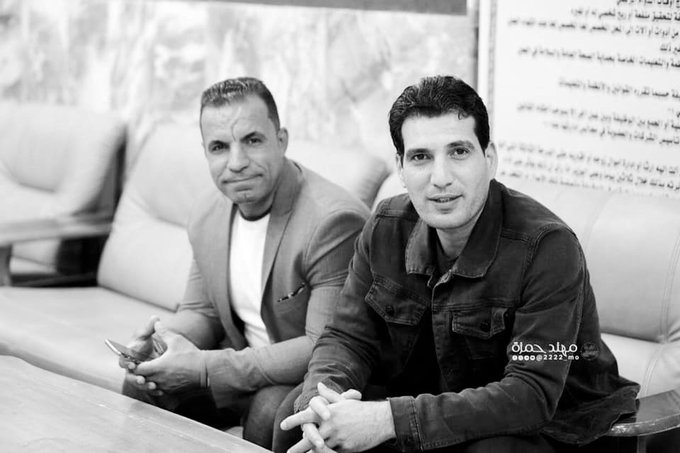
The assassin, Hamza Kadhim Khdheir, confessed that the head of Kata'ib Hezbollah, Ahmed Tuwaissa ordered him to assassinate journalist Ahmed Abdulsamad and photographer Safaa Ghali after a “fatwa” from Khamenei. Y’all still wonder why Iraqis want Iran out?! #فرقة_الموت
Image


Jojo (Siwa) Jabbari Tweets:


Hamza Kadhim Khdheir, who just received the death sentence, confessed in court that Kataib Hezbollah leader Ahmed Tuwaissa ordered him to assassinate journalist Ahmed AbdulSamad based on Khamenei's fatwa. Ahmad's brother recounts the court proceeding here:


Ruba Ali al-Hassani Tweets:


The man charged w/ murdering Ahmed Abdul Samad, Reham Yaqoub, et al confessed during trial to the murders upon decree from Ali Khamenei. The judge recorded the testimony as "a cleric". The hashtag says "Murder decree from beyond the borders." #Iraq #فتوى_القتل_من_خارج_الحدود


Ali al-Mikdam did the following Twitter thread:


Up-pointing red triangleInformation about the assassinations in Basra. Armed militia leaders issued orders to kill protesters, journalists and officers of the security forces and convince their followers that these acts and orders are legitimate fatwas issued directly from the Supreme Leader..1/15
Image

And exploit the work sites of their members within the state institutions for the purpose of completing operations, especially since one of the members of the death squads works in the Judicial Police Department. 2/15


Shocking confessions rocked the Iraqi street after the trial of those accused of the case of assassination of journalist Ahmed Abdul Samad and Safa Ghali. The accused explicitly admitted that the person who directed them directly in the assassinations is Ahmed Tuwaisa. 3/15

Ahmed belongs to Hezbollah Brigades (Kata'ib Hezbollah) in Basra. This group carried out several operations in addition to the assassination of Ahmed Abdul Samad and Safaa Ghali. 4/15

Targeting the governor's house, targeting the house of Hatem Al-Daradji, targeting the governor's brother's house, killing Mujtaba Ahmed Jassim, attempted assassinating Lieutenant Colonel Muthanna Adnan Abdul Karim, assassinating Jenan Madhi,..5/15

throwing Lieutenant Colonel Mustafa's house with an explosive device. These factions were able to convince their members and their collaborators that these operations are the execution of legitimate fatwas issued directly from Supreme Leader of the…6/15

Islamic Revolution in Iran ayatollah Ali Khamenei. Members of these militias, some of whom work in government institutions through which they can delay trials and postpone procedures, taking advantage of their positions. 7/15

The accused who made confessions.   Born in 1983, he works as a commissioner in the Basra Police Directorate-Judicial Police Department. In 2014, he joined the Popular Mobilization Forces,..8/15


He worked as a soldier in PMF for a year and a half, after which he returned to work in the police. During this period, get to know each of: Haidar Shan Shabosa - works as Hezbollah coordinator in the Popular Mobilization Forces. 9/15


Ahmed Tuwaissa - one of Hezbollah members in Basra Abbas Al-Haris - works in the university pool. Akil Abu Fatima - employee of Basra Oil Company (government company) Haidar Abu Janat - Managing Director of Naseem Iraq Company. 10/15


Ahmed Al-Abd (formerly working in Asa'ib Ahl al-Haq AAH) Bashir Abdul Karim. He admitted his work within the assassination squad that carried out assassinations in Basra governorate against protesters and security forces officers. 11/15

Ahmed Tuwaissa told them that these operations are carried out by a fatwa from the Wilayat al-Faqih(Guardianship of the Islamic Jurist) on the assassination of the above people as they are against the state. (Ahmed Tuwaisa) was directed to assassinate Ahmed Abdel Samad.. 12/15

For publishing video clips criticizing the name of Khomeini Street in Basra as well as criticizing loyalists of Iran. The assassination of Ahmed Abdel-Samad was carried out by a pickup:- The assassination took place after pursuing the wheel that Ahmed Abdel Samad And… 13/15

Safaa Ghaly were riding (a white Kia Sportage), where Ahmed Abdel Samad was in the front right seat and wearing a blue suit, with Safaa Ghaly driving the wheel on a road behind the Charter Flour Mill. The operation was carried out near the Al-Shamsona area Specifically.. 14/15


near the Oxford English Language Center. The car of the victims was shot, and the culprit who carried out the assassination got out of the car and shot again at Ahmed Abdel Samad and the photographer Safaa Ghaly, who was driving the vehicle.  15/15


This is a major story and would be one just for the conviction of Hamza Kadhim al-Aidani.  It's an even bigger story because the court refused to publicly identify the convicted and because the court edited the transcript to remove the person the convicted identified as ultimately responsible -- remove that name from the official transcript.

Layal Shakir (RUDAW) notes:


Press right groups and international organizations have described Iraq as one of the “most dangerous” countries for journalists.

Prominent activist Ihab al-Wazni was killed in Karbala in May of this year. The murder sparked outrage among activists, with many blaming Iran-backed militias for his death.

Activist and journalist Ali al-Mikdam was kidnapped and tortured in July. He was later freed.

Iran-backed militias, including factions of the Popular Mobilization forces (PMF or Hashd al-Shaabi in Arabic), are widely blamed for the assassination attacks.


Last week on NPR's ALL THINGS CONSIDERED, Ari Shapiro spoke with Ruth Sherlock about Iraq:


SHAPIRO: So the election was earlier this month, and now the parties are in negotiations to see who will control various ministries and how the coalitions will take shape. As somebody who's covered Iraq and the region for years, what are you thinking watching this process unfold, about the country's future, about the U.S. role there, particularly given what we just saw in Afghanistan?

SHERLOCK: One stark takeaway for me has been the real gap between what the U.S. and other international powers want and what most Iraqis we spoke to want. The U.S. seems to prioritize trying to maintain basic stability and countering Iran, like we just said. Meanwhile, Iraqis want better public services and an end to corruption and actual representation by their government. And the thing is, many Iraqis, especially young people, nowadays see that changing the sectarian structure of government, the underlying foundations, and weakening the main political parties as kind of the only way to achieve this, even if it means risking some stability.

At a recent anti-government protest, I spoke with Ali Hadid. You heard from him a little earlier. He was campaigning to boycott the election.

HADID: There's no democracy in Iraq.

SHERLOCK: Yeah.

HADID: There is no democracy.

SHERLOCK: So this political system...

HADID: It's a Mafia. We are ruled by a Mafia (ph). That's all.

SHERLOCK: Do you think this is, basically, what the Americans brought to Iraq?

HADID: Yeah. It's not just America; it's also the Iranian and also the international. All of them, they participate in this problem.

SHERLOCK: And, you know, what's also striking is speaking to people who were born around the time of the U.S. invasion and seeing how their whole lives have been shaped by that decision. For example, I spoke with one young man, and his first memory is hiding in the shower of his home with his family as U.S. troops fight a militia, and the house gets destroyed around them. Now the poor economy and state corruption means that even as a university graduate, he can't find a job, and he's had friends killed by militias. Look; of course, you can't blame all of Iraq's problems on the U.S. involvement there. It's much more complicated than that. But certainly, the decision to invade Iraq set off a kind of chain reaction of events that continue to shape the broken Iraq you have today.


Iraq held elections October 10th.  There is still not an official final tally.  In fact, Layal Shakir (RUDAW) reports:


Iraq’s electoral commission on Tuesday announced that it has begun accepting evidence again in support of alleged election result errors or violations, state media reported as most of the submitted appeals of the October 10 results have been found to be groundless.

“Whoever has new evidence about the submitted appeals can file them within three days,” the commission’s director of media and public communications Hassan Salman said.

The Independent High Electoral Commission (IHEC) started the manual recount of votes from certain polling stations where complaints were filed last week. 


Meanwhile, Firas Adnan (ALMADA) writes that the expectation currently is that a new government in Iraq will be formed in . . . nine months.  Firas notes that dialogues continue and that the prime minister post will be dependent upon an agreement on who will get control over which ministries.   The Arab Center Tweets:


State of Law, the party led by former Prime Minister Nouri al-Maliki, made a resounding comeback, winning 35 seats.


At The Middle East Institute, Omar al-Nidawi offersL


Despite Sadr’s party winning 74 seats in the 329-seat legislature, twice as many as the next party, Baghdad is likely heading toward another government formation process dictated by the usual rules of power-sharing: that all parties powerful enough to cause trouble may win a seat at the table and a share of government positions commensurate with its weight in parliament. Despite headlines to the contrary, there are no kingmakers in Iraqi politics.

For example, Sadr’s gain vis-à-vis Fatah is somewhat offset by the gains achieved by Fatah’s ally, Nouri al-Maliki. The former prime minister’s State of Law bloc has seen its seats increase from 25 to 37 and is working to build a coalition to compete with Sadr for the designation of “largest bloc.” As negotiations proceed, the extreme options that are the rivals’ first choices for prime minister will likely be excluded in favor of less contentious “compromise candidates.” Some will be rejected for being too Sadrist, others for being too friendly to Washington, too close to Iran, or for being Nouri al-Maliki, with all the baggage that entails.

The immediate post-election shock and euphoria for Fatah and Sadr, respectively, created a fog that may soon begin to lift. Triumphant remarks about a purely Sadrist prime minister, and counter threats by the militia rivals will give way to compromises. After all, from Ibrahim al-Jafari’s 2005 premiership to that of Adil Abdul-Mahdi in 2018, Sadr steadily accumulated power from being part of the government while still able to attack it when it suits his purposes. Sadr may begrudgingly recognize that a Sadrist prime minister may not be a good thing. Against the backdrop of Iraq’s ongoing economic crisis, failing to deliver better services and living conditions when the prime minister is a Sadrist would be much harder to defend or spin than if the premier was from another party, or a weak compromise candidate. As for Fatah’s factions, going to war promises no economic returns and jeopardizes the interests of their allies in Tehran. Ultimately, the Fatah factions will have to accept a slightly reduced status in the next government and settle for a share of positions proportionate to their seats, and perhaps guarantees for some of the PMF budget.

In other news, Black Alliance For Peace has issued the following:


For Immediate Release


Media Contact: Tunde Osazua
(404) 771-2844
outreach@blackallianceforpeace.com

Black Alliance for Peace & the U.S. Out of Africa Network Stand with the People of Sudan

October 25, 2021 — We are clear that the training of African police and military by the US and its NATO allies, in counter insurgency measures to confront the mass uprisings against repression, as taking place  right now in Sudan using violent suppression, is right out of the imperialist playbook. For decades the U.S. Africa Command, or AFRICOM, the E.U., and Israel have assisted in the training, financing, and arming of the militias and forces within Sudan. We must call for an end to the training of African defense and security forces by imperialists and neo-colonial entities and for the demilitarization of the African continent.

The Black Alliance for Peace and the U.S. Out of Africa Network express solidarity with over a million Sudanese people who have taken to the streets in cities and towns across Sudan to resist the military coup that took place the morning of October 25, 2021. Trade unions and people’s movements have called for international solidarity, strikes, and mass protests in response to the coup by the Sudanese military. The coup takes place as Sudan was nearing a transition to civilian rule from the joint military and civilian government that was installed following the deposition of Omar al-Bashir.

The U.S. did not directly come out in support of the military government. We believe that this is so they can more easily manipulate the situation like they did with Tigray. In a recent tweet, U.S. Special Envoy for the Horn of Africa Jeffrey Feltman lays the blame for the coup squarely on the shoulders of Sudan. His statement fails to mention the role of the U.S. in fueling conflict in Sudan to control its energy resources, cement access to the Red Sea which links the Mediterranean to Asia and is one of the world’s busiest waterways, and take advantage in the struggle against China and Russia’s geopolitical ascendancy. 

The Black Alliance for Peace and the U.S. Out of Africa Network, calls for return to Sudan’s popular process of transition.

No compromise! No retreat!

The U.S. Out of Africa Network (USOAN) is a network of volunteers committed to strategizing around creative and radical tactics for the complete withdrawal of U.S. forces from Africa, the demilitarization of the African continent, the closure of U.S. military bases throughout the world, pressuring the Congressional Black Caucus (CBC) to unequivocally oppose AFRICOM and conduct hearings on its impact on the African continent. The USOAN is the driving force for the U.S. Out of Africa! Shutdown AFRICOM! campaign of the Black Alliance for Peace.

Sign up to join the U.S. Out of Africa Network.


New content at THIRD:

The following sites updated:


  • Monday, November 01, 2021

    Garrett Morris, the reactionary elderly man

    I'd like to show respect towards my elders but, to do that, I need them to respect the world we live in.

    Garrett Morris is 84 years old and he clearly thinks he's more in step with the times than he is.  


    From his recent interview:


    Talking about stuff like that, did you see Dave Chappelle’s latest show?

    Yes, I did.

    That was brilliant.

    You thought so?

    Oh. You didn’t think so.

    I appreciate him, I respect him. But by the end, it upset me.


    Really? Why?

    Because I felt he was really going after trans people in a way that —

    They were going after him. That was a response to something.

    Well, yeah. I guess I don’t see what people say to him. I’ve only seen what’s in these specials.


    I got from that: Relax, everybody, this is comedy. Everybody can be the butt of a joke. And why should it be that if we joke about you, it’s sacrilege? You sit in the audience and laugh at jokes about everybody else. If we make a joke about trans [people] or gays, suddenly it’s sacrilege. And that’s what I got from that. I don’t see what’s wrong with that, with all due respect. I see it as nothing but a man saying publicly, “This is what I do.” And if you can’t understand that this is comedy coming at you, then don’t live in a society that’s multicultural.

    The reason he cited for walking away from Comedy Central is that he did a blackface sketch, and there was a white guy laughing at it too hard. And it made him uncomfortable. He was like, “People are not understanding what I mean.” Now it seems he’s not understanding what trans people mean.

    Everybody should be able to understand — if you’re a mature human being — everybody can and might be the butt of a joke in a democracy.


    And he was very preoccupied with the plumbing, you know? The genitalia, the this and the that. Does it really matter?

    That’s why Miss [J.K.] Rowling is now in trouble because she said it’s a fact. Gender is a fact. Is it not? I’m asking you. Is it not? Gender is not a fact?


    Yes, Garrett, 'they' were going after Dave.  'They' were using all their NETFLIX specials to go after him.  'They' were using all their microphone time to go after him.


    Grow up, old man, grow up.

    "Iraq snapshot" (THE COMMON ILLS):

    Monday, November 1, 2021.  Election results are still not official, someone is convicted of murdering journalists finally but they can't tell you who or the person's affiliations, The Lincoln Project is a disgrace that the press needs to start ignoring, and much more.


    Starting in the US, Caroline Downey (NATIONAL REVIEW via MSN):


    The anti-Trump organization The Lincoln Project became the subject of intense criticism after it coordinated a hoax show of support by ostensible white nationalists for Republican Virginia gubernatorial frontrunner Glenn Youngkin.

    In the viral incident, a group sporting khaki pants, baseball hats, and tiki torches lined in up in front of a Youngkin campaign bus to declare their endorsement of the candidate in a way that was presumably supposed to mimic the white nationalist “Unite the Right” rally in Charlottesville, Virginia in 2017.

    “We’re all in for Glenn,” the activists proclaimed.

    After rumors circulated that the stunt was launched by Youngkin’s political adversaries, the Lincoln Project claimed responsibility. It was later revealed that the demonstrators were paid by the non-profit to position themselves as white supremacists affiliated with Youngkin as part of a disinformation campaign against him.


    That's it.  In  a functioning world, that's it.  The Lincoln Project was always an unethical organization but after that stunt, that's it.  No journalistic organization should invite them on as guests, should seek them out for quotes.  They're liars who will lie in any way possible.  They are not trusted participants.  This is not the first time that they've been caught but this should be the last time.  In a functioning world of journalism, that's it.  


    They paid people to pretend to support a candidate and to pretend that themselves were KKK-types.  That's it.  They're liars and they're hacks and they don't need to be included in the discourse anymore.  


    That's the end of the line for them unless you also lack scruples -- in which case, MSNBC 'NEWS,' keep bringing them on as guests.  


    And let's be clear on what happens next if the corporate media does not take a hard line stance here: Every political group now has the right to lie and hire people to smear a candidate with lies.  They have the right to fake support in order to smear a candidate.


    Is that how we want the discourse to be now?  Project Lincoln long ago revealed that they had no ethics but this latest stunt is outrageous.  


    Brendan Cole (NEWSWEEK) reports:


    he Lincoln Project has been condemned for a stunt targeting the Republican gubernatorial candidate for Virginia, Glenn Youngkin, in which it sent people mimicking white nationalists to stand outside his campaign bus.
    The action on Friday by the PAC has prompted concerns that it could harm the election prospects of the Democratic candidate, Terry McAuliffe, whom it had intended to help.
    Lis Smith, a former senior advisor to Democratic primary candidate Pete Buttigieg tweeted: "What a massive, massive screw up. The last thing that the McAuliffe campaign needed this weekend. A total disservice to the hundreds of hard-working staffers on the ground."

    [. . .]

       
    Virginia legislator Sally Hudson tweeted: "Charlottesville is not a prop. Our community is still reeling from years of trauma—especially this week. Don't come back, @ProjectLincoln. Your stunts aren't welcome here."


    Terry McAuliffe's campaign has rightly condemned the lie.  Edward Helmore (GUARDIAN) reports:


    McAuliffe disavowed the Lincoln Project’s actions.

    “What happened today in Charlottesville is disgusting and distasteful and the McAuliffe campaign condemns it in the strongest terms,” the Democrat’s campaign manager said in a tweet. “Those involved should immediately apologise.”


    This did not help Terry -- and the conventional wisdom is that Terry needs help -- and the Lincoln Project needs to be shunned and ostracized.  That's not what you do.  That's not how you support a campaign.  And, had they not been caught, they would have remained silent and let people think that racists supported Terry's opponent.  There is no excuse for what they did and their action should end their access to the media and their media appearances. 

    John Weaver's use of the organization to target men and to groom a 14-year-old boy for sex wasn't enough for the media to walk away from the group -- which tells you more than you ever wanted to know about the corporate media.  This latest stunt should be.  They are trash.  They have no ethics and they harm.  It's time's up for the Lincoln Project if the media has any sense of decency. 


    Iraq held an election October 10th.


    Up-pointing red triangle SabereenNews Up-pointing red triangle Protesters block the road to Umm Qasr port in Basra governorate, in protest against election fraud and the commission's ambivalence. The port is Iraq's 2nd largest port in scale of size and goods shipped to the port of Basra,it is strategically important.


    Rend al-Rahim is Iraq's former US Ambassador.  At the Arab Center, she writes:


    Iraq’s fifth parliamentary election since the 2003 US invasion is procedurally over. The polling stations have closed, but the fight over the results has just begun.

    The situation is still in flux. A week after election day, the Independent High Electoral Commission (IHEC) is still checking ballots and receiving complaints. Its preliminary results are vehemently contested and there may be minor changes in the final tally. Turnout was low: at 43 percent, it was among the lowest for any election since 2005, signaling  a deep and worrisome distrust in the political process and state institutions. Nevertheless, and despite some operational glitches, the process appeared to go smoothly, with no violence, less fraud than usual, and minimal irregularities. As the the European Union mission to observe the election put it, “Voting on election day was largely peaceful and orderly.”


    And they continue to check the ballots and count and, honestly, stall.  No one forced the electoral commission, ahead of the election, to promise that they'd have all ballots counted in 24 hours following the election but that is what the commission promised.  Still we wait all these days later.


    NRT has an interesting report.  We'll note it in full:


     Iraq’s Supreme Judicial Council announced on Monday (November 1) that the Basra Criminal Court has handed down a death sentence for a suspect accused of killing two journalists last year.

    Dijlah TV reporter Ahmed Abdul Samad and camera operator Safaa Ghali were shot and killed while they were covering a protest in Basra on January 10, 2020.

    The Council said in a statement that the defendant confessed to all the details of the crime, the aim of which was to destabilize security and stability and spread terror.

    The verdict was issued in accordance with the provisions of Article 4/1 of Counterterrorism Law No. 13 of 2005, it added.

    Samad was formerly a reporter for NRT.


    If true, it's great that the murderer of a journalist is finally being held accountable.


    But what's most interesting to me is the one convicted.  


    Who?


    We've long noted -- and decried -- Iraq's televising of confessions (which most likely are forced).  Why is the convicted not named?


    A court found someone guilty.  Who?  And what are his or her affiliations?  This should all be part of the public record.  Instead, we're being told that some unnamed person has been found guilty of murdering two journalists.  And that's supposed to pass for informing the public?


    In other news, yesterday saw another rocket attack on Baghdad.  Dilan Sirwan (RUDAW) reports, "Three rockets hit near Baghdad’s Green Zone overnight, the first such attack in more than three months. There are no reports of injuries."  Sinan Mahmoud (THE NATIONAL) adds, "All three were Katyusha rockets – a rail-mounted weapon based on a Second World War-era Soviet design. They were fired from the Bayaa district, a Shiite area in south-western Baghdad, a police officer said."  As RES notes, "It came at a time when the recount of votes from the early parliamentary elections of October 10 continues."


    In other news, Human Rights Watch issued the following Friday:


    Dozens of Sunni Arab men who served prison time or were acquitted in Iraq’s Kurdistan Region for Islamic State (ISIS) connections risk rearrest or retaliation if they try to reunite with their families in areas controlled by Baghdad, Human Rights Watch said today. Some of the men were boys as young as 14 when Kurdish security forces arrested them.

    The men are currently stuck in a camp in the Kurdistan region, after being released from prison between 2018 and 2020. Security forces are not allowing them to leave the camp to live elsewhere in the Kurdistan region, and they fear for their lives if they were to return home. This stems from a lack of coordination and recognition between the separate judicial systems of the Kurdistan Regional Government and Iraq’s Baghdad government, as well as the near-total impunity with which armed groups operating in the men’s home communities arbitrarily detain and even kill those suspected of ISIS affiliation. 

    “These men, most of them boys back when ISIS was in control of their areas, have been and continue to be punished, even though many were victims as child soldiers,” said Belkis Wille, senior crisis and conflict researcher at Human Rights Watch. “After years of suffering they are still in limbo with no hope for the future.”

    In August 2021 Human Rights Watch interviewed 10 men whom the Asayish, the Kurdish security forces, had arrested for alleged ISIS affiliations in 2016 and 2017. Six were children at the time of their arrest. They were among about 65 men at a camp in northern Iraq, controlled by the Kurdistan Regional Government, where they resettled after being acquitted or completing a sentence in the region. Though security forces at the camp would let the men leave if they were to return to Baghdad-controlled areas, they do not allow them to leave the camp at all if they want to travel or resettle within the Kurdistan region.

    The men interviewed said that they were among about 100 men transferred to the camp in April 2019. Because of the dire conditions in the camp, and because many of them felt they had no future in the country, those who could afford it managed to leave the camp, paying smugglers to take them to Turkey. All of those interviewed said they would go to Turkey if they had enough money.

    “My only solution is to leave Iraq and go to Turkey,” one man said. “If I were to go home or anywhere else on the Baghdad side, it wouldn’t just be the courts that would come after me, it would be the tribes, and the PMF [Popular Mobilization Forces – militias formerly under the prime minister’s control]. I have no future here.”

    Each of Iraq’s two separate judicial systems have their own counterterrorism laws, which are applied in their courts. As part of their campaign to defeat ISIS, Iraqi and Kurdish security and military forces screened people leaving ISIS-controlled areas and detained those identified as ISIS suspects. They checked the names against “wanted” lists that security forces on both sides had developed since 2014. The security forces compiled the lists from a variety of sources, including public information about ISIS members, names published by ISIS itself, and names provided by informants.

    Many relatives of detained ISIS suspects told Human Rights Watch that since 2016, people would submit names because of tribal, familial, land, or personal disputes, falsely accusing them of links with ISIS. People stopped at checkpoints who are on the lists face detention while officials investigate the alleged ISIS-affiliation, usually through interrogations.

    Numerous judges and lawyers have told Human Rights Watch that the prosecutions in some cases rely solely on defendants’ confessions, often extracted through torture. Human Rights Watch’s experience monitoring trials in both regions confirms this. In at least 428 cases among almost 800 trials that the United Nations Assistance Mission to Iraq observed, in addition to confessions, evidence admitted – and primarily relied upon in terrorism prosecutions – included anonymous witness statements and information based on security or intelligence reports.

    “Someone from my town who had a grudge arrived in the camp and told the Asayish I had been with ISIS.” said one man who had fled the fighting in 2016 and arrived at a camp in the Kurdish region. “The Asayish beat me until I said I had joined ISIS for four days. They sentenced me, and after over a year in prison they finally released me.”

    The men gave Human Rights Watch the names of four individuals, all of whom had been boys when arrested, who had returned home to areas under Baghdad’s control after completing their sentences. The men said that they heard from relatives later that all four were rearrested by Baghdad authorities and were now serving extended second sentences for ISIS affiliation. Sentences for terrorism charges are significantly longer in Baghdad-controlled territories. Human Rights Watch was able to contact relatives of two of the four men and confirm the accounts.

    Iraq’s constitution prohibits putting anyone on trial twice for the same crime. While the two regions have separate counterterrorism laws, the offense is ultimately the same and if a person has been convicted in one of the jurisdictions and completed their sentence, they cannot be tried again for the same offense anywhere in Iraq. Iraq’s Code of Criminal Procedure prohibits further action against a defendant, even if new evidence emerges, two years after an investigative judge has issued a decision on the case.

    As a priority, Baghdad authorities should ensure that all of the men can obtain up-to-date civil documentation including by sending representatives from the nearest Civil Status Directorate to the camp to issue these documents.

    The Kurdish Regional Government should allow the men to reside in any part of the Kurdish region they choose, in line with the general residency requirements the region has in place. It should allow their families to seek residency to join them in the region. It should open the camp and allow freedom of movement to its residents throughout the Kurdistan region, keeping any restrictions on movement strictly necessary, proportionate, and non-discriminatory as compared to those residing in the Kurdistan region. 

    “These men have served their time or been acquitted,” Wille said. “Continuing to restrict their ability to return to a normal life is nothing less than unlawful discrimination.”

    Real Risks to Return

    All of the men said they were afraid of being rearrested or harmed, even killed, if they returned home, even if Baghdad’s High Judicial Council confirmed that they would face no further charges. They also shared that they are not in regular communication with their parents and relatives, fearing that if security forces found out the men were speaking to their family members, they could be arrested, evicted, or otherwise threatened.

    One man said that his father, brother, and uncle are ISIS members, and that a unit of the PMF that controls his hometown told his mother and other relatives that he needed to return and provide them with information on his ISIS relatives’ whereabouts.

    He said the PMF unit had convinced the local police to issue an arrest warrant for him. They abducted his younger brother and sent the man a photo of the warrant in a message after they got his phone number from the brother’s phone. In the message, which he showed researchers, they said they would use the arrest warrant as grounds to evict the man’s mother and younger brother as an ISIS-affiliated family unless he returned home:

    I don’t know what to do. If I go home, I am sure they will try to get information out of me, and then kill me. But if I don’t surrender myself, they will evict my family. They already are watching my mother and don’t let my family move freely.

    Another man, whose wife was living in Erbil while he served his prison sentence there, said that she is now living in the camp with him. He described what happened to her in mid-2021 when she travelled from the camp to their hometown via Mosul to visit her family:

    When she got to the first Baghdad-controlled checkpoint on the way to Mosul, security forces checked her identity card and then held her for two hours, before letting her go. When they let her go, they told her, “Your husband is wanted. If he doesn’t surrender to us, we will not let you through this or any other checkpoint to visit your family again.”

    One man said that in mid-2021 security forces in control of the area where his family lived, forced his mother to open a criminal complaint against him as an ISIS member in order for her to obtain a security clearance to avoid eviction or other forms of collective punishment. This practice is known as tabriya. He said this meant he could never return home. “I am not angry at her for doing this,” he said, “but now that she has, the tribal forces in our area [effectively] have the right to kill me.”

    Another problem the men face is an inability to obtain civil documentation. Only three of the men have valid identity cards, which are vital for anyone trying to move around within the country. Many only had childhood documents which are no longer valid.

    One man said that his mother tried to get him a new identity card back in his hometown, but when the PMF in control found out from the Civil Status Directorate that she applied for the document, they approached her and told her that if she continued to ask for the identity card, they would evict her from her home.

    In addition, most of the former detainees struggled to obtain documents confirming their time in detention, only one of the ten men was given a document upon his release confirming his time served; whereas the rest required legal assistance from nongovernmental organizations to obtain the appropriate documentation after their release.

    Recommendations

    Baghdad’s High Judicial Council should adopt specific policies and procedures to prevent repeated prosecutions for people who have been acquitted, or convicted and served their sentence for ISIS involvement, whether in the KRI or in other Baghdad-controlled governorates. It should take measures to establish the number of detainees in custody who have already been exonerated or served a sentence for the same crime, and should release or pardon them as appropriate.

    Judicial authorities in Baghdad-controlled territories and the KRI should start automatically sharing with each other the judicial paperwork in each case, including release certificates. They should ensure that all former detainees are given release certificates, including those released without charge, with enough specificity to be considered valid, and order their names be removed from “wanted” lists.

    All detaining authorities should redouble efforts to bring defendants before a judge within the legally mandated 24 hours, so that if they have served a previous sentence, they will be able to communicate this to a judge promptly and be released. Iraq should ratify the Optional Protocol to the Convention Against Torture and set up its own independent system to inspect detention centers.

    Iraqi authorities should consider alternatives to detention and criminal prosecution for child detainees, and develop rehabilitation and reintegration programs to aid their return to society.


    Back in the US, a 40-year-old Iraq War veteran, Tyson Manker, gets some justice.  Stephanie Zimmerman (CHICAGO SUN-TIMES) reports:


    But now the Illinois man has won his latest and potentially most broad-reaching battle — this one fought in court. And it should help him and thousands of other U.S. military vets suffering from post-traumatic stress disorder.

    A preliminary settlement of his class-action lawsuit against the Navy, once finalized, will help veterans given “other-than-honorable” and “general” military discharges due to PTSD — and who, as a result, were locked out of health care, injury compensation, college money and other benefits usually available to vets.

    Like Manker, many went untreated and were flagged for behavioral problems.

    “Think about how wrong this situation is,” Manker says. “We’re going to send you home with no benefits and with injuries and with this scarlet letter, and ‘Good luck.’ ”


    The following sites updated: