Thursday, September 10, 2009

Todd Chretien, sit your ass down

I'm sorry, something funny happened. A meteor hit the earth and all Black people were rendered silent. As a result, we had to count on White Todd Chretien to speak for us. And --

What's that?

We still have our voices?

Yes, we do so someone tell Todd Chretien to sit his White ass down.

Dumb ass Cretin is writing at the US Socialist Worker (what a rag and what a joke it's become in two years) that Van Jones leaving the administration is a sign of racism.

Shut your White ass, Todd Chretien. You don't know a damn thing.

I am so damn sick of White people playing the race card and trying to speak for me.

Shut your damn mouth, Todd Chretien.

Van Jones' departure had nothing to do with his race.

For proof of the 'racism,' White Todd finds that some posting comments at Glenn Beck's website use the term thug.

Let me rephrase and earlier statement, Todd Chretien, shut your RACIST mouth.

"Thug" existed long before the ghetto-killing us culture invaded my community. Foreign Policy in Focus recently featured an article that called Nouri al-Maliki a "thug."

Are you telling me Foreign Policy in Focus is racist, Todd?

Didn't think so, you lazy minded idiot.

People can call Barack a "thug." It has nothing to do with Barack being bi-racial.

I called George W. Bush a "thug" constantly. If I wasn't calling him that, I was calling him "Bully Boy." Didn't have a damn thing to do with his race.

Had a lot to do with his doing two illegal wars. Last time I checked, Barry O was doing the same damn thing.

If Barack's called a "thug," Idiot Todd, live with it.

Stop assuming it's racism, stop assuming every criticism of Barack is racism.

You're so stupid and you degrade the national dialogue with your idiotic commentary.

You have nothing to offer and nothing to say so you play the race card.

Why don't you sit your White ass down and shut your mouth. Okay, White boy?

I'm so sick of it. I would love to see many other of my peers rise up and say "Shut up!" to all these White people who won't stop playing the race card.

Do we play the race card? Absolutely. And sometimes we're right and sometimes we're wrong. And if I think a Black person's wrong, I'm not going to hit the ceiling (unless they're lying) because it's about our lives.

But some White person trying to act like they're Black or like they understand it or are Black by proxy?

I'm not in the damn mood. Shut your mouth and sit your White ass down.

Stop using my race as your political football.

Is that clear enough for you Toad Chretien?

Stan's tackling this as well tonight. We're both sick of it. We planned to write about other things but Van Jones left the administration for many reasons. Race wasn't one.

Stan's grabbing how Toad gloms on race while being silent about other things. Read Stan.


"Iraq snapshot" (The Common Ills):
Thursday, September 10, 2009. Chaos and violence continue, US Ambassador to Iraq Chris Hill appears before Congress, election fears sprout in Iraq, Iraq's LGBT community continues to be targeted, and more.
US Ambassador Chris Hill appeared before Congress today. He last appeared before the Senate Foreign Affairs Committee on March 25th, back when Committee Chair John Kerry was explaining that, if confirmed as ambassador, he would depart for Iraq "within a day of his Senate confirmation. Tuesday April 21st, Hill was confirmed by the Senate. Three days later he showed up in Baghdad. Baby Hill's first broken promise since becoming ambassador.
This morning, Chris Hill appeared before the House Foreign Affairs Committee and there wasn't a great deal to that hearing. Hill insisted that there was joy and wonder in Iraq because Sunnis and Shia had no "risen to the bait" of sectarian warfare. He avoided the issue of mounting tensions between Kurds and Arabs -- surprising when you grasp that outside observers and the top US commander in Iraq, Gen Ray Odierno, have identified that mounting tension as among the most pressing problems facing Iraq today. In fact, "Analysts say tensions between Arabs and Kurds in northern Iraq is the major threat to the country's stability and security as the U.S. troops, which have mediated between the two sides, are prepare to withdraw from Iraq by 2012." That's Xinhua, we'll come back to that after discussing the hearing.
He acknowledged that "there is a risk of escalation in tensions between Arabs and Kurds around the disputed areas in nothern Iraq." A risk? It's taking place. Hill came off like an uninformed fool in March when attempting to speak on the issue of Kirkuk. He was no more convincing today discussing "the thorny dispute in Kirkuk." What is he doing on that issue? Apparently nothing but, he insisted, "The UN has an important role here." Then why are you appearing before Congress?
"There has been some good news," insisted Hill. "Iraq statged two rounds of successful elecitons this year -- the provincial council elections in 14 of Iraq's 18 provinces in January, and elections for the Kurdistan Regional Government in July." Yes, he is that stupid. The KRG elections allowed for 3 more provinces to vote. And? What of Kirkuk? The oil-rich Kirkuk has not had its referendum -- promised in Iraq's Constitution ratified in 2005. There has been no promised census. There is no progress.
And that needs to be stated clearly. In 2007, a series of benchmarks were created by the Bush White House to measure 'progress' in Iraq. These were not 'longterm' benchmarks. These were benchmarks Iraq was supposed to meet within a year. And never did. And even now, as 2009 winds down, the benchmarks haven't been met.
Hill should not be allowed to cite 'progress' without defining it. He found time to slam the Iraqis comfort level with a Socialist economy, to preach the marekt economy as the only way for Iraq to find stability, to prep for a coming war with Iran (including climbing the drama cross about an Iranian rocket landing "in the front yard of my house") and more. James Morrison (Washington Times) reported this morning that Hillmight face questions today regarding why he more or less ignored ("downplayed") a letter from over "500 members of the British Parliament" warning that Camp Ashraf residents were in danger (the residents were assaulted July 28th). The issue was raised by the House Committee and Hill embarrassed himself and the country of the United States. The assulat resulted in 11 dead, many injured and at least 36 kidnapped/imprisoned. (Camp Ashraf residents call the 36 hostages.) Hill declared that Nouri has assured him the 36 won't be sent to Iran. The MEK are Iranian dissidents who have been in Iraq for decades now. Saddam Hussein welcomed them into the country. Following the US invasion in 2003, the US protected the MEK. Hill stated that they won't be sent back to Iran and seemed pleased with his statement. That's an ambassador? When Joe Wilson was Ambassador to Iraq, he stood up to the ruler. Hill's couldn't have been more ineffectual if he'd added, "Nouri and I text and i.m. all the time. And Hoshie Zebari is so dreamy!" He insisted that Nouri knew the US was interested in "the preservation of their human rights" but that appears only to apply to "Don't send them back to Iran!" Imprison them? Hey, fine and dandy with Chris Hill.
Due to the differences in time limits, we'll focus on the Senate committee. Individuals members of the committee have more time to ask questions on the Senate Committee. Equally true, Hill appeared fully awake for the afternoon session. His hair was in disarray and he had a food stain on his shirt (he is the Pig-Pen Ambassador), but he was awake.
We'll note a lengthy section of John Kerry's opening statement:
If the Iraqi public rejects the agreement, then I believe we have no choice but to withdraw all of our forces as quickly as we can. This would complicate our redeployment and severely curtail our ability to assist the Iraqi security forces and government. But at this point, I'm not sure how we justify asking our soldiers to stay one day longer than necessary after being formally disinvited by the Iraqi people.
In a sense, the security agreement that the Bush Administration negotiated with Prime Minister Maliki made moot the old "should we stay or should we go" policy debate. But even so, Iraq remains a Rorschach test for pundits and policymakers:
On the one hand, a person can look at the security gains since 2006 -- when sectarian violence threatened to tear Iraqi society apart -- and conclude that Iraqis have stepped back from the brink. And it's true that, since the worst days of 2006 and 2007, violence has dropped by 85 percent, even with the recent mass-casualty attacks. American fatalities are at their lowest rate of the war. Al-Qaeda in Iraq, while still deadly, is only a shadow of its former self.
There has been political progress, as well. In the January elections, unlike in 2005, sectarian and ethnic identification is unlikely to be the sole organizing principle of Iraqi politics. The leader of the Anbar Awakening, a group that evolved out of the Sunni Arab insurgency, has been talking openly about a political alliance with the Shiite Prime Minister Nouri al-Maliki. Such an announcement would have been unthinkable just eighteen months ago. Other Sunni factions are exploring a coalition with the Kurds. Electricity production, which had long been stalled, quietly increased by forty percent in the last year.
That is the optimistic view. But one can look at the same set of facts on the ground and come to a more pessimistic conclusion: namely, that removing an American presence that has been the lynchpin of the security improvements of the last few years would lead Iraq back into a downward spiral of communal violence.
It's too soon to know whether the rise in violence since American forces withdrew from Iraqi cities in June is an uptick or an upswing. Whether it is a blip or a trend, recent violence has been troubling. August was the deadliest month for Iraqis in more than a year. And the devastating "Black Wednesday" bombings against the Iraqi Foreign and Finance Ministries last month were a stark reminder that forces opposed to reconciliation remain capable of devastating attacks that could alter the country's direction. The attacks were also a blow to the Iraqi people's confidence in their security forces. And of course, Iraq's problems don't end there: Arab -- Kurdish tensions remain unresolved, corruption is rampant; millions of Iraqi refugees and internally displaced persons remain far from home, waiting to be resettled; and Iraq's relations with its neighbors are volatile. These are a few of the many challenges Iraq will face in the coming years.
So which is it? Is Iraq beginning to unravel again, or are these just the inevitable bumps on the road toward returning responsibility for Iraq to Iraqis? What will happen after we leave? We don't have definitive answers to these questions.
Ranking Member Richard Luger stated they didn't need Hill to use a crystal ball and tell them about what would take place in 2011, that instead they need "your best sense of how things are progressing towards that date." And then the floor went to Chris Hill.
In the midst of reading his prepared statement -- the same prepared statement Senator John Kerry asked him to summarize and not read in full so that there could be more time for questions -- Hill looked around (so many rumors of meds, so many rumors) and asked,
"Is that my phone or someone else's? Good, it's not mine." Good. And did anyone else hear the ringing? Hill returned to reading his statement. Repeating, John Kerry told him the statement would be put into the record "as if you read it in full" and instructed him to summarize it so there would be more time for a discussion. Hill just doesn't grasp events around him. Maybe all those ringing cell phones he hears distracts him? Over three minutes into his word-for-word reading of the prepared statment, Hill was greeted by a loud throat clearing on the part of Senator Kerry. No, he didn't take a hint. Four minutes in, Kerry was visibly irritated. No, Hill didn't notice but went on about "we need to work closely with Iraq" . . . Some might think Hill was so dependent upon his prepared remarks because he stammers and stumbles when speaking without prepared text. Possibly. But he manages to screw up even his word-for-word reading. And, it needs to be noted, the prepared remarks he gave in the afternoon were pretty much the same ones he gave in the morning to the House committee. Kirkuk was "the thorny dispute" in both because they were the same damn statement. Four minutes later, Senator Kerry was again loudly clearing his throat and Hill was continuing to speak about "a very important day, more important than many . . ." Over ten minutes after he was asked to summarize and not read his statement, Hill finished reading it.
Senator Kerry noted Hill "mentioned in your testimony a strengthend civilian effort. What do you mean by that? We have one of the largest embassies in the world." Hill agreed that was true and then stated that the embassy "will need to get smaller." If you're confused, the committee appeared to be so as well as Hill began speaking of having to rent apartments in Baghdad for some staff members and putting in a partition/dry wall in one when the two people were not married. "But I want to assure mr chairman I want to see that embassy smaller," he declared firmly to the puzzled stares of the committee. Is Hill planning to rent out the embassy conference room for small parties? Sign lease agreements with some of the Subway sandwich shops losing spots on bases. [Marc Santora reported on bases yesterday, it was an article of interest but there was no room for it in the snapshot. Click here to read his article.]
Senator Russ Feingold asked whether the US military should provide security for embassies in war zone considering recent contractor scandals? "Incidents do happen," stated Hill, "everywhere." Thanks for that explanation, Chris. But, "I would rather not task the military with another mission." The US marines are the ones who are supposed to be protecting US embassies staff in foreign countries. If Hill's aware of that, he gave no indication. In replying to Senator Feingold, Hill fell back repeatedly on some variation of, "Maybe I can take the question and get back to you." Even for something as basic as his own role as supervisor as US troops draw-down. It was rather sad.
And what of 'progress'? Senator Kerry observed, "We've been sitting on this committee listening to this talk -- I can remember Senator Rice [. . .] testifying to us three or four years ago, saying the oil law is almost done." And it wasn't and it isn't.
"I went out there with the expectations that we would move on it," Hill declared of the oil law while painting himself as Hill of Arabia. But now? The issue's so much more complicated than he knew. (Over his head?) The law has many parts: "revenue sharing, institution building". And no luck on it. "We have tried to break it down," Hill shrugged. " I think that getting the economy there operating [. . .] is eseentital to the future of that country and frankly we cannot be funding things that should be funded by the Iraqis and would be funded" if the oil law was in place. Senator Corker wanted to know "how long as a country that we are supporting Iraq financially?" Hill agreed, "They should be able to pay their own bills. There's no question that they should pay their own bills." But?
They need financial support, Hill said, and pinned it on pre-Saddam era, going back to the British occupation (which he named and fingered) and Iraqis 'fear' of turning over assets "to foreigners to development. So they've got to get over that." Oh do they? They have to get over that. Hill said that Iraqis have to get over that? And he's the ambassador to Iraq?
The oil draft law (aka Theft Of Iraqi Oil)? "I think realistically speaking," Hill said indicating he had offered something other than realistic speaking to the committee previously, "it will probably not get done before the January elections. So our concern is that we cannot have Iraq's future held up or held hostage by this one particular issue."
The Ambassador to Iraq made statements blaming Syria and that may have been the most interesting of all. "They have rightly called for their return" declared Hill of former Ba'athists now living in Syria. Wow. What a difference from mere days ago. September 1st he appeared on WBUR's On Point with Tom Ashbrook (see Sept. 2nd snapshot for transcript of his remarks). From that broadcast:
Jacki Lyden: We are going to take a few calls here in just a moment but Ambassador, I would like to ask you, based on your intelligence, who do you think is responsible for the August 19th bombings which was the worst in a very long time?
Chris Hill: Well I you know the investigations are very much continuing I'm not sure I want to sort of give you a running tab of an ongoing investigation but there are certain usual suspects here that we are obviously looking at very closely and one of course is this al Qaeda in Iraq -- so-called AQI. Now the government has some theories that it's more complex that you have possible ex-Ba'athist elements You know these are also Sunni who feel disenfranchised from the system but they're not sort of these extreme Wahhabists Sunnis that al Qaeda draws its ranks from. Yet there is you know talk in the analytical community whether they're Ba'athist in al Qaeda or AQI -- I want to stress this is al Qaeda in Iraq, a sort of franchised operation. And there's a lot of you know talk that perhaps they have some know -- tactical putting, you know, putting this thing together. It's really hard to say. What is clear though is that for many people in this country when those terrible bombings took place out came the fingers and pointing at each other. And to be sure there's a time for finger pointing, there's certainly a time to investigate and see what failures there were in the system. But there's also a times, as the United States, as we know very well in the wake of 9-11. There is a time to come together and one hope that that call will be better heard in Iraq. Because, uh, it's a very rough political climate here.
Again, his tune changed and he sang it repeatedly, always off-key, today. But he found it "rather ironic" that the day before the August 19th bombings, Nouri al-Maliki was in Syria and they had "signed a number of agreements". That's "ironic"? Does Chris Hill know the definition of "irony"? Hill places tremendous faith in Nouri's assessment of Syria and Syrian involvement because, Hill explained, Nouri spent "18 years of his life in Syria."
The issue of the Status Of Forces Agreement was raised -- Kerry raised it first in his opening remarks -- and what would happen if it was changed in some manner or a new agreement was done? Hill felt he wasn't qualified to answer and stated he would defer to the State Dept attorneys but he was of the non-legal opinion that "we would not engage in changing the security agreement without official consulation" with Congress.
We may return to the hearing tomorrow. If so, we'll address the nonsense Hill offered on refugees. It was as irritating as Hill's mincing efforts to be cute such as replying to John Kerry's question about a power grab on Nouri's part with a rambling answer that began "In the privacy of this hearing room".
In terms of immediate concerns, it was pointed out that the elections are scheduled for January and that Barack Obama has stated his delay (broken campaign promise) in terms of drawing down troops is to keep troops on the ground for that. Hill declared, "I worry about developing the political rules of the game and what I don't want to see is an election that resutls in six months of government formation during which there is a loss of some of the progress made." He fears that following the election it will take some time time to set up a new government. That's not the only election fear being expressed currently. Catholic News Agency reports that Father Shlemon Warduni, Auxiliary Bishop of Baghdad, is stating the 2010 elections in Iraq have Iraqi Christians fearful of even more violence and noted of Zakho and Amadhiya, "The lack of work is noticeable and is made worse by the fact that many lands have been occupied by people who have come from other areas in search of refuge. The streets are not secure and neither are they in good condition, thus making it difficult for the people who need to find work or to transport the infirm to move about."
He could have grounded that fear in facts but, being Chris Hill, knew none. In the spring of 2006, when the US nixed the Iraqi's first choice for prime minister and Nouri was proposed as the accepted candidate instead, Nouri promised to quickly assemble his cabinet. He didn't do that. He was boasting that he would do so before the official deadline and gave himself a new deadline, an earlier one. He missed both. Hill was offering some nonsense during the hearing (re: power grab) about how Nouri's cabinet is people forced on him and blah, blah, blah. Nouri assembled his cabinet. Chris Hill seems as unaware of that as he is of every other Iraq-related fact.
During the Senate hearing, there were eight Camp Ashraf supporters (wearing yellow shirts) on the row behind him -- to the left of him (his left) -- with two on the right side of him. Kat, Ava and Wally have a piece on the Camp Ashraf supporters which will run in tomorrow morning's gina & krista round-robin.
In Iraq today, a village outside of Mosul was targeted. Gina Chon (Wall St. Journal) reports the attack was a suicide truck bombing that took place "after midnight" in Wardek village. Hannah Allam (McClatchy Newspapers) adds, "The bombing Thursday flattened 15 houses and damaged 40 others, trapping families under the rubble, police said. By late afternoon, authorities said they'd rescued all those pinned down by debris." 25 dead and forty-three wounded says Marc Santora (New York Times) who explains, "Wardak is a tiny village, with only about 300 houses, made mostly of mud with wood ceilings. Three sides of the village are protected by sand berms, with a shallow river providing a fourth barrier. Nevertheless, two sucide bombers drove through the river under the cover of night, arriving shortly after midnight, local officials said." The second suicide bomber was shot dead by the Kurdish peshmerga. AFP notes, "Police Captain Mohammed Jalal said a second blast was foiled when Iraqi security forces killed a truck driver before he could detonate explosives." Omar Hayali and Ned Parker (Los Angeles Times) quote wounded Hama Kaki stating, "This is the first time this has happened in our village and we do not know why, because we are far from areas of violence but I think that the political tensions in Mosul are the reason. It is the settling of accounts among the political entities, but at our expense." BBC observes of Mosul, "The city is also characterized by communal strife between Kurds and Arabs and violence targeting religious minorities. In late 2008, the UN refugee agency reported that 13,000 Christians had been driven out of the city by violence and intimidation." Jamal Hashim (Xinhua) offers, "The bomb seems to be well-designed to foment up already existing tensions between Kurds and Arabs, who are vying for land and resources. Nineveh province remains one of Iraq's most volatile area despite the dramatic drop of violence in Iraq over the past two years. Analysts say tensions between Arabs and Kurds in northern Iraq is the major threat to the country's stability and security as the U.S. troops, which have mediated between the two sides, are prepare to withdraw from Iraq by 2012."
In other reported violence . . .
Bombings?
Sahar Issa (McClatchy Newspapers) reports 2 Baghdad roadside bombings which claimed 4 lives and left twenty-nine wounded, another Baghdad roadside bombing which targeted a police patrol and left two of them injured (and also injured six civilians) and a Baghdad roadside bombing aimed at a US forces convoy (no reports of any deaths or wounded).
Kidnappings?
Sahar Issa (McClatchy Newspapers) reports Wafa Natiqu was kidnapped on her Baquba college campus today and that she's the "daughter of the press liaison in the local government of Baquba".
Shooting?
Dropping back to yesterday, Reuters reports 2 Mosul shootings (one claimed the life of 1 civilian, the other left an Iraqi police officer injured and the police responded shooting dead two of the assailants).
Staying with violence, yesterday's snapshot included this: "Reuters notes 1 man shot dead in Mosul, the US and Iraqi military killed 2 males in a Baghdad 'pre-dawn raid' while 2 people were also killed by the US and Iraqi military in another Baghdad 'operation'." Today Ned Parker and Usama Redha (Los Angeles Times) attempt to make sense of the shooting deaths of Iraqis by US and Iraqi forces yeterday during a Baghdad raid and explain, "Relatives and neighors said troops set off explosives that knocked down the gates and doors to a home, where they detained an Iraqi military intelligence officer and killed two civilians. Their bodies were discovered with dog bites and gunshot wounds on a kitchen floor, which was streaked with blood, the witness said." Simply shooting someone dead doesn't generally result in a floor streaked with blood.
Noticeably absent from Hill's testimony today was any acknowledgement of the targeting of Iraq's LGBT community. At Foreign Policy, Human Rights Watch's Rasha Moumneh covers the issue Hill couldn't or wouldn't:
When my colleague and I sat down last April with Hamid, an Iraqi man from Baghdad, his trauma-induced stutter said as much as the words he spoke. Huddled inconspicuously in a dingy restaurant, Hamid recounted how militia members killed his partner along with three other men, two kidnapped from their Baghdad homes, two slaughtered in the streets. The next day, Hamid said, "they came for me. They came into my house and they saw my mother, and one of them said, 'Where's your fa**ot son?' My mother called me after they left, in tears. ... I can't go home."
As the world hails Iraq's supposed return to normality, the country's militias -- the same ones that spent years waging a sectarian civil war -- have found a new, less apparent target: men suspected of being gay. The systematic killings, which began earlier this year, reveal the cracks behind Iraq's fragile calm. Iraq's leaders may talk of security and democracy from behind barbed wire in the Green Zone, but the surge of murders against gay men is a stark sign of how far Iraqi society still has to go.
During a 10-day Human Rights Watch research trip to Iraq in April, we heard harrowing stories of torture, abductions, kidnappings, extortion, and murder. We listened to dozens of men who had faced violence at the hands of armed militias, attacked by youths with guns for violating the unwritten codes of Iraqi masculinity. A number of signs might implicate one as being not "manly" enough, from neighborhood gossip that a man is gay to looking somehow effeminate or foreign in the wrong people's eyes: wearing one's hair too long or one's jeans too tight, for example. There is no count available for the number of deaths since the killings began earlier this year, but one U.N. worker told us that the victims could number in the hundreds.
As noted in the hearings today, Iraq and Syria have been in conflict as Nouri al-Maliki's made one charge after another following August 19th's Baghdad bombings and demanding that Syria turn over two people to Iraq (Syria says there is no credible evidence of the two's involvement in the bombings). Yesterday at the Arab League meeting, the issue led to charges and counter-charges. But Xinhua reports:

Syrian Foreign Minister Walid al-Moallem said on Wednesday that he reached an agreement with his Iraqi counterpart Hoshyar Zebari to stop media campaigns between Syria and Iraq, speed up returning ambassadors and form security committees.
Al-Moallem told a joint press conference with Arab League (AL) Secretary General Amr Moussa in Arab League headquarters that he reached this agreement during a quadrilateral meeting included Iraqi Foreign Minister Hoshyar Zebari, Turkish Foreign Minister Ahmet Davutoglu and Moussa.

The Press Trust of India adds Arab League Secretary-General Amr Moussa mediated the media and that he stated, "The league will maintain its good offices in coordination with all parties concerned, mainly the Turkish mediation, in order to contain this crisis." Bashar al Assa, president of Syria, will meet with Recep Tayyip Erdogan, Turkey's prime minister, next week and the issue is expected to be addressed then. There are also rumors that Jalal Talabani, president of Iraq, will travel to Ankara for the meeting as well.
We'll close with this from the Berkeley Daily Planet, World Can't Wait's Kenneth J. Theisen calling out counter-insurgency (attacks on a native people):
One reason that Obama is likely to approve an additional troop request is that the "successful" implementation of COIN strategy requires the introduction of many more U.S. troops into Afghanistan. COIN strategy is troop intensive as is indicated by the Army's new COIN manual, written in large part by General David Petraeus. To quote the manual: "No predetermined, fixed ratio of friendly troops to enemy combatants ensures success in COIN. The conditions of the operational environment and the approaches insurgents use vary too widely. A better force requirement gauge is troop density, the ratio of security forces (including the host nation's military and police forces as well as foreign counterinsurgents) to inhabitants. Most density recommendations fall within a range of 20 to 25 counterinsurgents for every 1000 residents in an AO. Twenty counterinsurgents per 1000 residents is often considered the minimum troop density required for effective COIN operations; however as with any fixed ratio, such calculations remain very dependent upon the situation."

In 2003 the U.N estimated the Afghan population at nearly 24 million. At 20 troops per 1000 Afghan residents that would require 480,000 allied troops to meet the minimum density recommendation of the COIN manual. At 25 troops it would take 600,000 troops. Obviously to reach these numbers would require a massive troop escalation.

Just like in Vietnam the rhetoric may claim the U.S. is "winning hearts and minds, but the reality is that the U.S. war of terror is killing and terrorizing people from Iraq, to Afghanistan, to Pakistan. In Vietnam 2-3 million Vietnamese died. Already there have been a million Iraqi deaths as a result of the 2003 U.S. invasion. Thousands more have died in Afghanistan since the October 2001 invasion. When do we say enough? What will you do to stop the U.S. wars? To see what you can do, please go to
worldcantwait.org.

Wednesday, September 09, 2009

As usual, Michelle looked dreadful

"What To Watch For Tonight" (Hillary is 44):
So what is a sensible person supposed to watch for at tonight’s insensible publicity stunt?
One of the first things to watch for will be Michelle Obama. Will the White House wranglers be able to get her to wear a sensible dress, or costume, most Americans with common sense would wear? Will Michelle Obama again show up in a gin-soaked cocktail dress or one of her silly “I wanna-be a fashion icon” messes? Will Michelle Obama show up in a sober outfit with sleeves that have not been yanked off?
If Michelle Obama shows up in a sober outfit, sleeves still in place, it means that the White House is focusing on bamboozlement of ordinary Americans not the Hopium addled. A sober outfit will demonstrate that the White House understands the level of trouble they are in - bad enough to force Michelle to wear something sensible that will not frighten the visually unimpaired.
A crazy quilt cocktail dress without sleeves will tell us the target audience is still the Hopium addled.
A sober outfit but without sleeves will clue us in that the Obama’s are still playing both sides of the fence.
Michelle Obama’s frock will clue us in as to what audience Barack Obama has been told to target. If real Americans are the target audience, you’ll have to change the channel for a few minutes to see what the target audience is watching.


Lady nO wore a frightful outfit that appeared to have come out of Joan Collins' closet -- Joan Collins' 1986 outfit.

Michelle is not a model, she is not a fashion plate and she doesn't have the body to pretend to be. Barbara Bush. I can remember her when she was First Lady. And? I thought, "Geez, why doesn't she try to pretty herself up?" In retrospect, I have respect for Babsie Bush for accepting who she was. In the end she came up with her own style as a result. It's not one that I would copy. But it was her own.

Michelle, like Barbara Bush, can't wear clothes for s**t.

She looks like a drag queen, like Wesley Snipes in To Wong Foo, actually. She's so bulky and thick. And that's only more obvious when someone tries to dress middle-aged Michelle Obama like a teen princess.

The speech? More garbage from Chicago.

Barack Obama is the worst president ever. I had no expectations for him (I voted for Ralph) but he's even managed to disappoint me.


"Iraq snapshot" (The Common Ills):
Wednesday, September 9, 2009. Chaos and violence continue, another death by shower in Iraq, Robert Gates declares 'no change,' Cindy Sheehan continues calling for an end to the wars, at the Arab League meeting in Cairo tensions continue between Iraq and Syria, did the US government sign a written agreement with residents of Camp Ashraf in 2003, and more.

In an interview with
Al Jazeera's Abderrahim Foukara (click here for DoD transcript), US Secretary of Defense Robert Gates made one of those jaw dropping statements that leaves a nation stunned . . . if they hear it. (Al Jazeera started airing the interview this week.) Speaking of what he hopes the US will accomplish in Afghanistan, Gates declared, "So in a way it's somewhat comparable to the situation in Iraq, where we have -- where our role has become less and less prominent, where the Iraqis have taken a more and more prominent role in protecting their own security. And I think that's how we will measure -- be able to measure -- one way we will be able to measure success in Afghanistan is as we see the Afghan security forces taking a more and more pominent and leading role in protecting their own security." For those who missed it, the new 'secure' Iraq was a myth and even the press had to face that fact as violence began it's slow climb back up starting in February to the point that August saw more deaths than any month in the last 13. Yesterday NPR's Peter Kenyon (Morning Edition -- link has text and audio, transcript below is from audio) examined one section of Baghdad, a region that had seen tremendous 'success' and 'progress.'

Peter Kenyon: This is Antar Square, a well-known spot in Adahmiya. During Saddam Hussein's time, Sunnis lived here and Shiites were actively discouraged from moving there. After 3002, Adhamiya was, like many Baghdad neighborhoods, wracked by sectarian violence. In 2007, miles of concrete blast walls encircled the neighborhood. Sunni "Awakening" forces, armed men recruited and paid by the U.S. military, shouldered their guns and manned checkpoints. The Iraqi army and police improved their capabilities, and slowly the situation improved. By the spring of this year, investors held their breath and plunged into the neighborhood. [, , , notes progress in shopping back in May via Sheik Abdel-Qader a-] Dulami said he was seeing close to 1,000 people a day visit the mall showing that Iraqis were starved for signs of normal life. [. . .] A scant three months later, Sheik Dulaimi's 'Flower of Baghdad' is once again the scene of deadly explosions and a terrorized population. The Iraqi army has resumed raiding house, provoking cries of abuse from families who complain of heavy-handed tactics. That in turn, prompted the army to close the neighborhood down even tighter. A return visit to the Adhamiya Mall this month found it almost completely deserted.

Robert Gates blathers, "So in a way it's somewhat comparable to the situation in Iraq, where we have -- where our role has become less and less prominent, where the Iraqis have taken a more and more prominent role in protecting their own security." And does so at a time when Iraq is rocked by violence. Robert Gates defines that as the measurement for the other illegal war (Afghanistan) and the response across the US should be stunned disbelief. But they'd have to hear about that statement to be appalled. They'd have to know about it.

If the news media ever feels like exploring it, they might also want to explain that this 'strategy' is George W. Bush's. It's the same thing he 'preached' year after year, finally turning it into a soundbye: "As they stand up, we'll stand down." Didn't the United States hold a presidential election in 2008? Don't seem to remember George W. Bush's name on the ballot. So the White House changed but the policies didn't. Hmm.

Gates on to repeat the official line (you really don't think the press comes up with them on their own, do you? No, they interview the military which is assigned the buzz words and the press thinks they discovered something) of: It's still a success because we haven't seen a return of the sectarian war. That would be the civil war and it would be a bit hard for it to 'return' when one of the results of it was futher segregation of Baghdad neighborhoods. But noting that requires critical thinking and apparently stenography saps you of that ability.

Interestingly, the top US commander in Iraq, General Ray Odierno, doesn't appear to be on the exact same page as Gates. While Gates does cart wheels over the lack of a sectarian war, Odierno told Joint Forces Quarterly (PDF format warning,
click here). , "Iraqis are still dealing with lingering ethnosectarian histories, Arab-Kurd tensions, and violent extremist groups such as al Qaeda and other external actors who seek to exploit any fissures. The Iraqis are still deterrmining the nature of their federal state and the balance of powers between the central and provincial govenrments. [. . .] I see Arab-Kurd tensions as the greatest single driver of instability in Iraq -- and it does complicate the security situation in the north to an extent. While our combined operations have degraded al Qaeda, there is still a presence in the north, and those cells work to exploit tensions between the ISF and the Kurdish peshmerga and police forces." That's not Sunni and Shia. And that's an area Robert Gates didn't cover. Back to the interview:


Abderrahim Foukara: And after you leave, my understanding is that President Obama pledged that the United States will not build any permanent military bases in Iraq. Is that pledge -- does that pledge still stand?

Robert Gates: Absolutely.

Abderrahim Foukara: Now how do you define permanent? Because bases in Germany, they've been there for about 60 years now, in Korea for a similar period of time. How do you define permanent? How do you define temporary?

Robert Gates: Temporary is based on the fact that anothe rpart of this agreement is that all US forces will be out of Iraq by the end of 2011. That is the agreement that we have with the Iraqi government. All US forces. No bases. No forces. That's the --

Abderrahim Foukara: Unless the Iraqis ask you to stay longer.

Robert Gates: Unless there is some new agreement or some new negotiation, which would clearly be on Iraqi terms. But we will not have any permanent bases in Iraq. We have no interest in permanet bases in Iraq. And we are now planning on withdrawing all American military forces by the end of 2011.

Yes, the war could be extended. It's a shame US news consumers need Al Jazeera to know that. Continue. It's not over. A few weeks ago,
Jari (The Stupidest Man on Earth) highlighted the International Committee of the Red Cross' statment:

Despite the common perception that the armed conflict in Iraq is largely over, widespread violence and a lack of respect for human life continue to affect the Iraqi people. Civilians are the primary victims.

Let's go back to Gates for a moment, At the end of last month,
August Cole (Wall St. Journal) reported on Gates doing an 'in-store' appearance at Lockheed Martin Corp's "production line in Fort Worth, Texas" where he "made an usually strong endorsement Monday for an approximately $300 billion program to buy thousands of new fighters being developed by Lockheed Martin Corp." War is Big Money. Otherwise a Secretary of Defense wouldn't tour a factory. Monday Thom Shanker (New York Times) reported that the Congressional Research Service's "Conventional Arms Transfers to Developing Nations" found the US the biggest supplier of weapons in the world and, in contrast to the domestic and global recession, the US has actually increased its selling of death toys and destruction instruments in 2008 ($37.8 billion in revenues versuse 2007's $25.4 billion). The next closet competitor is Italy which raked in approximately one-tenth of the monies the US did ($3.7 billion). It's Big Business and it's booming. War is big business. Ask KBR and Halliburton. Even deaths don't hurt their profit motive. Kimberly Hefling (AP) reports that State Dept contractor (Triple Canopy) Adam Hermanson is dead at the age of 25 from "showering in Baghdad". Janine Hermanson states her husband died September 1st and that she was told it was from electrocution. Jermey Scahill (writing at The Nation) reports:

On Tuesday morning, the military medical examiner who performed Hermanson's autopsy met with Hermanson's wife, Janine. "He said that everything was still pending and that he can't make a final [statement] because the toxicology and all that stuff has not come back yet. But he said that [the cause of death] was a low-voltage electrocution," she told The Nation. "When I got the call I was told that he was found in a shower, and now I am getting told that there was even still electrical current on the shower floor when they found him."
When Patricia got the news, she thought there must have been a mistake. "Adam didn't want me to worry and had told me he was in Kuwait. I just found out he was in Iraq the day he died. He said, 'Mom, I'm gonna go to Kuwait, it's gonna be a piece of cake--they even have a water park there.' All along he was telling me a lie because he didn't want me to worry."
Hermanson's family suspects that Adam may have died as a result of faulty electrical wiring. And they have good reason to think that--at least
sixteen US soldiers and two contractors have died from electrocution. The Pentagon's largest contractor in Iraq, KBR (a former Halliburton subsidiary), has for months been at the center of a Congressional investigation into the electrocution deaths because the company has the massive LOGCAP contract and is responsible for almost all of the electrical wiring in US-run facilities in Iraq. The eighteen soldiers and contractors died as a result of KBR's "shoddy work," according to Senator Frank Lautenberg.

On electrocution deaths,
US Senator Bob Casey Jr.'s office released the following July 26th:

After the Department of Defense Inspector General released its report on the electrocution death of Staff Sergeant Ryan Maseth and 17 other electrocution deaths in Iraq, U.S. Senator Bob Casey (D-PA) released the following statement:
"I am heartened that, after an exhaustive investigation, the Department of Defense Inspector General has finally published its findings and recommendations. The responsibility for the death of Ryan Maseth can be attributed to many quarters. However, the Inspector General has concluded that the water pump which shorted and caused his electrocution was first installed by a KBR subcontractor less than two years prior to Ryan's death. That water pump, located on the roof of Ryan's building, was not grounded during installation. This deficiency was not discovered during a subsequent inspection administered by KBR.
"We cannot stop with the publication of this report alone. Those who failed to carry out their contractual obligations in a way that contributed to the death of a U.S. soldier should be held fully accountable for their negligence. I also eagerly await the findings of the Army CID report."

In a carefully worded press release at the start of last month, the
Defense Department stated that their own investigation "concluded that there is insufficient evidence to establish criminal culpability of any person or entity in the death of Staff Sgt. Maseth." Despite Halliburton pointing to this as proof of innocence, it is no such thing. Ryan Maseth did die by electrocution and KBR did do the wiring. But DoD decided there wasn't enough evidence to prove "criminal culpability." No real surprise when you consider how much business Halliburton does with the Pentagon. The outrageous thing is that the US Congress didn't launch their own investigation immediately after the DoD's press release.

Staying with deaths and injuries . . .

Bombings?

Mohammed al Dulaimy (McClatchy Newspapers) reports a Baghdad roadside bombing targeting a police checkpoint which wounded a police officer and two people, a second Baghdad roadside bombing which injured two people, a Baghdad sticky bombing which left two people injured, a Kirkuk suicide car bombing targeting a Sahwa leader in which 3 people died and fifteen were wounded and a Mosul sticky bombing on the car of Col Jassim Mahmoud Jassim that claimed his life and left two people injured. Reuters drops back to Tuesday to note a Baghdad car bombing which injured three people, a Mosul roadside bombing which injured three Iraqi soldiers and a Baghdad motorcycle bombing which claimed 1 life and left seven people injured. Jormana Karadsheh (CNN) reports a Kirkuk home bombing which claimed the life of a Sahwa leader ("Awakening" and "Sons Of Iraq") as well as "seven other family members, including women and children. A wounded two-year-old child was the only survivor." Press TV notes speculation -- Reuters and CNN say Sahwa, AFP states that the people in the home were making the bomb and had recently arrived from Diyala Province.

Shootings?

Reuters notes 1 man shot dead in Mosul, the US and Iraqi military killed 2 males in a Baghdad "pre-dawn raid" while 2 people were also killed by the US and Iraqi military in another Baghdad 'operation'.

Corpses?

Mohammed al Dulaimy (McClatchy Newspapers) reports 2 corpses discovered in Baghdad.

Staying with violence, Black Wednesday, Bloody Wednesday.
August 19th. When bombings rocked Baghdad with two of the buildings being targeted being the Ministry of Finance and the Ministry of Foreign Affairs. The latter ministry faced the most damage and suffered the largest death toll. Nouri al-Maliki had ordered the Bremer/blast walls removed and that's been a source of criticism since the bombings. (Immediately following Black Wednesday, the removal of walls was stopped. It was not immediately announced publicly, but it happened immediately. Since then, walls have been put back up.) The death toll for the day's violence in Baghdad was at least 101 with approximately 600 injured. Immediately Nouri's spokespeople ran out to say that no one should "play the blame game." A rather strange statement when you consider that Nouri and his troupe immediately began blaming Syria. In the process, Nouri has created an ugly scene, an ugly international scene. Baghdad and Damascus have each removed their ambassadors. Nouri demands that Syria turn over two Iraqis. Syria demands proof before doing any extraditions. "Syria and Iraq's diplomatic storm" (Guardian), Ranj Alaadin observes: The spat has now led to a potentially dangerous frenzy of military activity along the Syrian border, where Maliki has sent reinforcements to prevent militants from infiltrating. The speed with which an exchange of goodwill and cooperation between Syria and Iraq turned into a diplomatic storm suggests that Maliki's reaction is electoral posturing more than anything else. His political credentials have taken a battering because of the attacks, given that his main, if not only, credential is security. It had been his decision to get rid of security barriers and checkpoints that could have reduced the magnitude of the attacks, if not prevent them altogether. Right now, Maliki is left with only nationalism and the withdrawal of US troops to campaign on as he heads closer towards the national elections in January; he does not have enough time to improve things such as public services and employment. Syria was a convenient scapegoat that Maliki could use to deflect attention away from his own shortcomings. After all, there was no similar posturing during the early years of Maliki's tenure when cross-border jihadist attacks were at their height. Russia's RIA Novosti reported that the conflict would be addressed today in the Arab League meeting in Cairo. Xinhua quotes Walid al-Moallem, Syria's Foreign Minister, stating, "We are ready to solve the crisis with Iraq" which he describes as "something regrettable that does not serve the interests of both Syria and Iraq." Lebanon's Daily Star explains that Amr Moussa, the Arab League Secretary General, and Ahmet Davutoglu, Turkey's Foreign Minister, met with al-Moallem and Iraq's Foreign Minister Hoshyar Zebari for a discussion of the issue. Maamoun Youssef (AP) adds that the Syrian and Iraqi foreign ministers had angry words in which they exchanged accusations and that today's effort was "a failed attempt to resolve a deepening split" The allegations included that Iraq's blame Syria in order to distract from their own failures and that Syria is a supporter of terrorism in Iraq. Meanwhile Reuters reports, "An investigative council has charged 29 Iraqi security officials with negligence relating to two truck bombs outside government ministries in Baghdad last month that killed 95 people, Baghdad security spokesman Qassim al-Moussawi said." Sami Moubayed (Asia Times) observes: This week, Iraq seemed far from giving anything close to an apology. Maliki's al-Da'wa Party staged demonstrations chanting anti-Syrian slogans, raising tension to unprecedented levels between Damascus and Baghdad. The demonstrations, which took place in al-Hilla, south of Baghdad, brought 200 people to the streets, including officials in the Maliki regime. Many of the al-Da'wa members now spreading anti-Syrian rhetoric were one-time allies of Syria, who for years were protected by Syria against the dragnet of Saddam. Reportedly, more demonstrations are scheduled for September 24, ahead of a United Nations Security Council meeting at which Iraq's request for an international tribunal will be discussed. Certain Iraqi officials, however, are trying to downplay the crisis with Syria.

Nouri's other international problems would include the Iranian dissidents who have lived for years in Iraq. (In fact, they lived there while Nouri was trembling in fear and living outside the country -- that yellow streak down Nouri's back isn't a racing stripe.)
July 28th, Nouri launched an assault on Camp Ashraf, where the dissidents live. (Classified as a terrorist organization by the US, the MEK is no longer considered that by the European Union or by England. The US protected Camp Ashraf following the US invasion of Iraq. They also declared the residents protected persons under Geneva. The Status Of Forces Agreement masquerading as a treaty that Bush rammed through and Barack -- despite previous objections -- accepted turned Camp Ashraf over to Nouri following a verbal assurance/promise from him that he would not harm the residents.) Earlier this month, Italian Radio's Aldo Forbice interviewed Ahmad Foruqi who is among the residents in Camp Ashraf and Foruqi stated, "We have been surrounded by the Iraqi forces and they do not allow any reporters or human rights organizations to enter the camp."

More troubling for the US is Ahmad Forqui's assertion that Camp Ashraf residents had a written agreement with the US guaranteeing their protection -- an agreement the US State Dept has never acknowledged, nor has the White House. "Every one of us in the camp," states Ahmad Foruqi, "had signed an agreement with the American forces in 2003. According to this agreement, they were responsible for our safety and security. However, they did not do anything when we were attacked."

Mark Tran (Guardian) reports on supporters in London "consuming only water and tea for the past 44 days" and stating they will continue their hunger strike (Zohreh Moalemi: "I will carry on until the end."), "The protesters are demanding both US forces protection and UN monitoring for the camp, and the release of 36 refugees still being held by Iraqi forces. One hunger striker in London has suffered a heart attack and others are suffering from internal bleeding and loss of vision." Rebecca Lowe (Barnet Times) adds, "Nineteen-year-old Soudabeh Heidari, from Engel Park, Mill Hill, is on the verge of a coma and can no longer sit or walk. Yaqub Doughforosh Banan, 54, from Hendon, is so weak he cannot open his eyes, and Mahmoud Fassihpor, 57, from Finchley, has lost nearly 18 kilos in weight. All 12 are shwogin signs of muscle wasting and suffering severe abdominal pains. Farzaneh Dadkhah, 41, from Wales, had a heart attack last Wednesday and was admitted to hospital. After recovering, she demanded to rejoin the strikers and continue the protest." Laila Jazayeri (UK's Religious Intelligence News) reports, "The International Human Rights Committee of the Law Society of England and Wales on Wednesday accused the US of having some responsibility for the massacre of Iranian refugees in Camp Ashraf six weeks ago by Iraqi forces and it urged the Obama administration to protect people in the camp." If the statements regarding a written agreement between the US government and Camp Ashraf residents are true, expect even more of an international outcry.

Peace Mom Cindy Sheehan never stops decrying war and advocating for peace.
David R. Henderson (Antiwar.com) reports on a speech Cindy gave in northern California:

Which brings me to my big surprise of the evening: Sheehan's wit. I've read a fair amount about Cindy Sheehan over the years, but one thing that I hadn't known until I saw her speak was what a subtle, smart sense of humor she has. I found myself breaking into loud laughs when she nailed the issues with her great one-liners. Take her discussion of how Nancy Pelosi lines up votes, telling various Democratic congressmen that they can vote against war spending because they need to shore up their antiwar support, while telling others that they need to vote for war spending. Sheehan commented, "That's when the vote is going to be close. She doesn't do that when the vote is going to be 400 to only a handful for the 'Resolution to support Israel in everything they ever want to do.'" I think that besides her courage and persistence, her wit is part of her ability to reach audiences.

Meanwhile
Cindy's quoted by Sean Rose (Courier-Journal) stating, "If we're anti-war, if we hated those polices under the Bush administration, we have to hate those policies under the Obama adminsitration. We can't say we're going to stop being activists because we have a new administration." Today Cindy Sheehan appeared on WFPL's State of Affairs and discussed the wars and her own life including her decision to step away in 2007 as a result of Democrats -- then controlling both houses of Congress -- refusing to make good on their promise to end the Iraq War -- the promise that gave them control of both houses in the 2006 mid-term elections. Some of her activies this week include:

9/10 Thu 11:00 AM-12:00 PM Bellarmine Univ. Speaking event & book signing
(OPEN TO THE PUBLIC)
12:00 - 1:00 PM Brown Bag lunch at Bellarmine by invitation only
1:00 - 2:50 PM OPEN
2:50 - 4:05 PM Speak at Sharon Wallace's Sociology class, JCC, downtown
6:30 PM Potluck Party at Ray's Monkey House, Bardstown Rd.
(OPEN TO THE PUBLIC)
9/11 Fri 10:00-11:00 AM 9/11 event: Fire Fighters' Memorial, Jefferson Square Park
(OPEN TO THE PUBLIC)
Interview with Jim Pence of HillbillyReport.com
11:00 - 4:00 PM OPEN
4:00-9:00 PM Farewell Fund-raiser party at Harold & Carol Trainers' home
(OPEN TO THE PUBLIC)
9/12 Sat - Cindy departs for Lexington day trip
9/13 Sun - Cindy departs Louisville


We'll try to note Cindy's radio interview in tomorrow's snapshot (if not, we'll note it Friday -- tomorrow's snapshot should include a Congressional hearing). We'll close with this from
Debra Sweet of World Can't Wait:

Within the next several weeks, President Obama will announce that up to 20,000 more troops will deploy to Afghanistan - in addition to replacing up to 14,000 support troops with "trigger-pullers." This will only mean increasing the death and destruction brought to the Afghan people. And U.S. involvement in Iraq is not only not over, but is becoming a permanent occupation. We are beginning to see more people openly object to the US occupation of Afghanistan. And
your help and money are needed! From October 3-17 the anti-war movement will be gathering, marching, and doing direct action against the wars in Afghanistan and Iraq. World Can't Wait will be in front of the White House with the National Campaign for Nonviolent Resistance on Monday, October 5 with the "Museum of Torture" displaying for the nation the details of what the torture memos directed CIA operatives to do to detainees. On Tuesday, October 6, the day George Bush began the 2001 invasion of Afghanistan, we're calling on high school students, and their supporters to protest military recruiting, inside the schools and after school. The We Are Not Your Soldiers Tour is gearing up now, as school starts, to bring Iraq & Afghanistan vets into classrooms with the truth about what joining the military means now. World Can't Wait projects War Criminals Watch and Fire John Yoo are intensifying efforts to make the demand for prosecution of war criminals heard from college students where the criminals are teaching; in front of court houses where they preside, and across society. We agree with the Center for Constitutional Rights attorneys that Eric Holder's appointment of a prosecutor to look into whether there should be any investigations of low level torturers, only, is a "sham and a diversion."

iraqnprmorning editionpeter kenyonal jazeera
the wall street journal
the new york timesthom shanker
kimberly hefling
jeremy scahill
cnnjomana karadsheh
the guardianmark tran
cindy sheehan
debra sweet

Tuesday, September 08, 2009

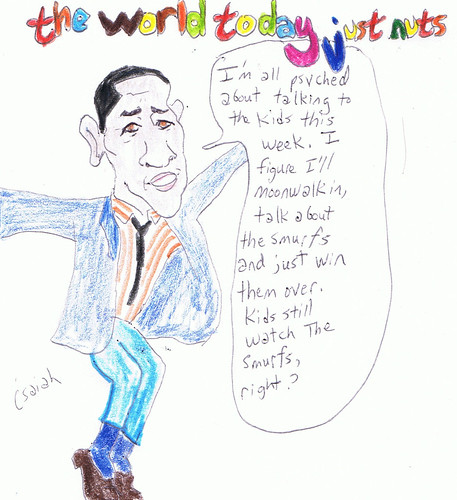
Somerby, Hillary is 44, Isaiah and more

Barack Prepares To Talk To The Kids


Stan and I are highlighting this tonight from Bob Somerby's Saturday column:

Dear Joan: You missed Bill Clinton. And you missed Al Gore, who was savaged for two years by the Hardball host whose ass you have incessantly kissed ever since he did it. We liberals badly undermine our own brief when we pretend that those years simply didn’t exist—the years of the Clinton murder lists and the endless non-lie lies by Gore.
We have no idea why Joan keeps saying things like this. Her history there is simply amazing—amazing for its omissions. (Question: Does lying about Democrats only count if it can be hammered into racial/gender/ethnic frameworks? So it sometimes seems.) That statement represents howling ignorance. It undermines the strength of the fully accurate claims liberals can, and should, be making against people like Jeffrey.


Every now and then, Bob Somerby does a Saturday column. And this one's a really strong one that we want to be sure everyone's aware of. We also agree with him about the racial/gender/ethnic frameworks but, let me add as a Black woman paying attention to this issue, gender matters very little. Gender is a nod, but race and ethnicity is a fiery speech. I've seen it over and over. Hillary is 44 has a strong piece today:


Where is the “uniter”? Like George W. Bush, Obama promised “unity” but brings division. Now all those PINOs who denounced Hillary Clinton as too “polarizing” make excuses for divisive Obama.
Hillary Clinton had “scars” from fights with political opponents who smeared her at every turn, but her scars came from fighting for what she believes in. Obama’s wounds are all from running through the brambles running away from the fight.
Bill Clinton too has scars from fighting. Bill Clinton too had difficulties in his early months. But Bill Clinton fought wisely and did not authorize massive slush funds in “stimulus” that the congress was hungry for in order to grease reelection. Obama spent like a drunken sailor on shore leave, gambling with other peoples’ money.
Obama made elected officials happy with spend, spend, spend policies. The money came from taxpayers.


We could have had a fighter. We wanted a gauzy dream.

"Van Jones: Too much drama for Obama" (San Francisco Chronicle):
The Obama White House was right to distance itself from "green jobs" adviser Van Jones after his radical history came under intense scrutiny. And Jones was right to tender his resignation this weekend. This administration has far too many pressing issues on its plate to spend its energy defending Jones' past statements on race and politics, his support of cop killer Mumia Abu-Jamal or his association with the conspiracy theorists trying to link the Bush White House to 9/11.
Read more:
http://www.sfgate.com/cgi-bin/article.cgi?f=/c/a/2009/09/07/EDPG19JROC.DTL#ixzz0QYty5iP0


He is too much drama. And, sorry Mumia, but the defenders of Van Jones do not bode well for your own case. I've always supported Mumia and am not withdrawing my support now but I do wonder how much reality I got on Mumia now as I watch people spin lies about Van Jones and how 'awful' it was that he stepped down.

He was a distraction. He was drama. He never should have been selected.


"Iraq snapshot" (The Common Ills):
Tuesday, September 8, 2009. Chaos and violence continue, the US military announces multiple deaths, the new trend in violence in Iraq is attacking checkpoints, Nouri continues war of words on Syria but there's a pushback in Iraq, Thomas E. Ricks soils himself in public and much, much more.

Today the
US military announced: "A Multi-National Corps – Iraq servicemember was killed today when an improvised explosive device targeting the patrol detonated in southern Baghdad at approximately 10: 30 a.m. The name of the deceased is being withheld pending notification of next of kin and release by the Department of Defense. The names of servicemembers are announced through the U.S. Department of Defense official website at http://www.defenselink.mil/releases/ The announcements are made on the Web site no earlier than 24 hours after notification of the servicemember's primary next of kin. The incident is under investigation." And they announced: "Three Multi-National Corps -- Iraq Soldiers were killed today when an improvised explosive device targeting their patrol detonated in northern Iraq at approximately 11:40 a.m. The names of the deceased are being withheld pending notification of next of kin and release by the Department of Defense. [. . .] The incident is under investigation." ICCC has been down since Wednesday. It is still down. Sunday the number of US service members killed in Iraq since the start of the illegal war should have been 4338. It should now be 4342 unless we've missed a death. We haven't missed any announcements by MNF; however, they don't always remember to announce. If DoD has covered a death that MNF never announced, then our estimate is off. AFP also estimates that ICCC's number should be 4342. Ali Windawi and Ned Parker (Los Angeles Times) observe today "was the deadliest day for the Americans since June 29, when four soldiers were killed in Baghdad."

Windawi and Parker note, "It was also a bloody day for Iraqi security forces around the oil-rich Kirkuk region of northern Iraq, the territory at the center of a land dispuate among Kurds, Arabs and Turkmen" with 2 police officers dead and four injured in a bombing outside of Kirkuk. Meanwhile BBC News reports an Amirli roadside bombing claimed the life of 1 police chief and four police officers today while one in Baghdad claimed the life of 1 "health ministry employee" with four others left injured. The police chief was Maj Zaid Hussein, Windawi and Parker explain. Sahar Issa (McClatchy Newspapers) reports a roadside bombing in Kirkuk today targeted the home "of a judge . . . without causing casualties." Reuters notes a Mosul roadside bombing which claimed the life of 1 man, a Mosul bombing claimed the life of 1 person and injured another (both are labeled "insurgents" by the police), a Daquq roadside bombing claimed the lives of 2 police officers and injured three, a Tikrit roadside bombing claimed the lives of 2 of Salahuddin Province Deputy Governor Ahmeda Abdul-Jebbar's bodyguards, a Tuz Khurmato roadside bombing claimed the lives of 4 police officers and left three more injured, a second Tuz Khurmato roadside bombing claimed 1 life, a Baquba sticky bombing injured one civilian and one police officer, a Baghdad roadside bombing claimed the life of 1 Ministry of Health employee with twelve people injured (four MoH employees), another Baghdad roadside bombing which left eigh people injured (four are police officers) and a third Baghdad roadside bombing left two police officers injured. In addition, Reuters notes 1 Iraqi soldier was shot dead in Mosul.

Many of the wounded and dead Iraqi security forces were killed in attacks on police and military checkpoints. This has been a recent pattern of violence.
Sunday's violence trend in Iraq was attacks on checkpoints with 3 attacks in Mosul on army and police checkpoints. Monday saw an attack on a military checkpoint and on a police checkpoint. Marc Santora (New York Times) noted, "For those seeking to undermine the Iraqi government, attacking checkpoints is a natural way to undermine public confidence. However, the attacks at checkpoints could also indicate a frustration at being able to penetrate attack more populated areas, Iraqi officials say."


Meanwhile Nouri al-Maliki attempts to create an international crisis as he goes after Syria with accusations that they harbor the two masterminds behind Black Wednesday's bombings.
Ned Parker and Caesar Ahmed (Los Angeles Times) report Nouri continues to air 'confessions': "Two confessions have been shown on state television and a third was aired at a news conference." Today Sherko Raouf, Waleed Ibrahim, Missy Ryan and Samia Nakhoul (Reuters) report "rifts" emerging in Nouri's assault incluidng the country's Presidency Council (made up of Iraq's President and two vice presidents) releasing a statement "calling for dialogue and speaking of the need 'to ease tension with Syria'." President Jalal Talabani is quoted saying the escalation is "unacceptable. This is not in the interest of Syria, Iraq or (other) Arab nations. Such a stand from the Iraqi government, without consultation with the presidency council, is illegal." They also note that Iraqi's Sunni vice president, Tareq al-Hashemi, released a statement which "called for an internal fact-finding committee to collect more evidence about the Aug. 19 attacks." [Adil Abd Al-Mahdi is Iraq's Shi'ite vice president.] In addition, Hannah Allam (McClatchy Newspapers) reports that Nouri is being accused "of lunching a purge of senior security officials in order to weaken political rivals ahead of winter elections. Maliki ordered the dismissals of at least three senior officials from the Interior Ministry over the weekend, Iraqi newspapers reported Tuesday: Maj. Gen. Abdul Karim Khalaf, the ministry's commander of operations; Gen. Ahmed Abu Rikheef, the head of internal affairs; and the director of the explosives division, who wasn't identified in the reports."

Friday,
Jasim Azzawi (Al Jazeera's Inside Iraq, video link) observed, "A so-called Bloody Wednesday has put the brakes on Prime Minister Maliki's claim of winning the war on violence. The question is will he use Syria as the whipping boy to engender sympathy to avoid the backlash of angry voters in January's next election?" Samir Altaqi and Saad al-Muttalibi were the guests.

Jasim Azzawi: To discuss the rising tension between Iraq and Syria, I'm delighted to welcome from Baghdad Saad al-Muttalibi a political adviser to the Ministry of National Dialogue in Iraq and from Damascus Samir Altaqi, Director of the Orient Center for International Studies. Gentlemen welcome to Inside Iraq. Saad Muttalibi, let us go the heart of the matter, rhetoric aside, where is the evidence that Syria is implicated in Bloody Wednesday.

Saad al-Muttalibi: Well next time maybe we should ask the terrorists to bring an authorization when they come and commit a crime I mean this is -- this question should not be asked this way. There are evidence, there are confessions, there are roots, there are cameras, there are maps, there are -- there are millions of things that indicate that 90% of terrorists come through Syria into Iraq. We are not implicating the Syrian government, I must be very clear on this. We implicating Iraqi citizens living in Syria, taking advantadge of the hosp -- of the Syrian hospitality, using Syria as a launch pad to organize crimes against state of Iraq and the people of Iraq.

Jasim Azzawi: Samir Altaqi, Syria has a history of not handing over political refugees requested by their mother country. al-Maliki himself, when he resided in Syria, was asked by Iraq to hand him over during Saddam Hussein and Syria refused. Is this a principle position or is Syria keeping those two suspects for a rainy day.

Samir Altaqui: Not all. Practically the Syrian position for a long time was that it won't be handling those opposition people since not only Mr. Maliki even Mr. [Masoud] Barazani at a certain moment and [Iraqi President Jalal] Talabani were guests in Syria and Syria did not deliver them. Unless there is real evidence that would implicate them directly, that Syria would be convinced that this is not coming because of conflictual positions within the Iraqi political arena.

Jasim Azzawi: Saad Muttalibi, I will come to the maps and the other evidence you alluded to but for the time being regarding Bloody Wednesday, the trucks, the explosives, the suicide bombers, they were all in Baghdad. And some people, they say al-Maliki is shifting the blame against himself because he was the one who ordered those concrete blast walls around the Ministry of Foreign Affairs to be removed.

Saad al-Muttalibi: No, that's not ver -- that's not very honest statement. Not from you, but from the people who says that. The environment in Baghdad became better. Security became much better. A drop -- over 90% drop in violence in Baghdad. The walls beca -- constituted a hurdle in the way of Ira -- in the way of Iraqi citizens. So they were not -- they were not needed anymore. That's the general feeling of people had so the government acted on the general will of the people. That was not a deliberate act of removing these walls to allow bombing -- that's ridiculous. The -- the-the-the bombs were in Baghdad but the political will to start and use these bombs came from overseas or abroad. We say from Syria. We have evidence. We have proof. From Syria. [Turkey's] Foriegn Minister [Ahmed] Oglu was completely convinced of all the evidence otherwise he wouldn't have presented them to the Syrians. He was completely convinced that if this evidence were about Turkey, Turkey would have acted. So there is no question about the validity Syrian political will to hand over those criminals.That's basically it.

Jasim Azzawi: Samir Altaqi, the evidence against you is air tight, he says

Samir Altaqi: Not at all, I think. If we are speaking on behalf of Mr. Ahmed Oglu, he -- as a mediator -- he has to present the Iraqi position but practically he didn't consider them as tight -- water proof. I think practically what is needed is a direct dialogue between the two sides -- not across the media centers today or the press -- but through specialist channels, through diplomatic channels to present those evidences and to discuss them in a decent way.

Jasim Azzawi: The fact that 1.2 million Iraqis live in Syria, can they do exactly what they like regarding Iraq without the knowledge and consent of the Syrian government and Syrian intelligence as Saad al-Muttalibi alludes.

Samir Altaqi: I -- I think we have to take in account the fact that you have one-million-two-hundred-thousand refugees in Syria, they are not from one faction, they are not from one confession. They are Shia, they are Kurds, they are Sunnis and everyone of them is still having his political view about what is going on. And the more the political process in Iraq would be inclusive, the more this will withdraw any support, any domestic support and refugee support to those who are still thinking about regulating their positions in Iraq through violence.

Saad al-Muttalibi: I must comment here. Really. For you to dictate to us that we should include this part -- faction or that faction, that is --

Samir Altaqi: No, no, no, no --

Saad al-Muttalibi: -- interference in Iraqi affairs --

Samir Altaqi: I'm not, I'm not --

Saad al-Muttalibi: You are not, we do not interfere in your affairs --

Samir Altaqi: You are expression to me one million --

Saad al-Muttalibi: No, no, no, I'm not accusing anybody.

Samir Altaqi: -- one million refugees --

Saad al-Muttalibi: No, no --

Samir Altaqi: -- refugees. I'm telling you, it's --

Saad al-Muttalibi: With a welcome mat! First of all -- first of all ---

Samir Altaqi: I'll try to make the situation --

Saad al-Muttalibi: -- first of all -- first of all --

Samir Altaqi: Please -- please. Exactly, they don't consider themselves safe and they don't consider justice available nor justice even fairness would be --

Saad al-Muttalibi: Okay, okay.

Samir Altaqi: -- available for them in Iraq. That's why

Saad al-Mmuttalibi: Okay, okay, let me correct some information. Let me correct some information for you, my dear friend. First of all, the United Nations says there are 160,000 Iraqis in Syria, not 1.2 million. That's one. Second, as from this moment, I am saying we are ready to have all of this 160,000 back --

Samir Altaqi: They are not ready

Saad al-Mmuttalibi: -- We'll pay them.

Samir Altaqi: They are not ready.

Saad al-Muttalibi: -- if they want to come back. They are Iraqis. Well that is their problem, that's not my problem.

First off, al-Muttalibi is incorrect as usual. 160,000 have been registered. state they have registered that many. Yet again, Saad al-Muttalibi has gone on Al Jazeera and lied. The United Nations Refugee Agency (one of the few UN agencies Nouri hasn't been able to successfully bully) carries the estimate of 1,105,698 Iraqis in Syria.
Click on this page, on the right side of the page is "Statistical Snapshot" the number follows "Refugees" and you get the information when you run your mouse across the blue "i".

Second of all, Saad al-Muttalibi's 'that's their problem' attitude to refugees who don't feel it is safe to return (and many of whom do not wish to ever return) when you consider that Saad turned tail and ran to England in 1977 and stayed there until 2003. In other words, by his 'logic,' it was HIS PROBLEM he was a refugee back then. It needs to be especially pointed out that for someone who went to college in the United Kingdom and lived there for nearly 30 years, Saad never managed to master the English language. He can't even get his subjects and verbs to agree. Apparently his planning to pull the US into an illegal war was more important than anything else. At the end of last week, The Economist offered an editorial entitled "
Iraq's freedoms under threat: Could a police state return" in which they noted:

Old habits from Saddam Hussein's era are becoming familiar again. Torture is routine in government detention centres. "Things are bad and getting worse, even by regional standards," says Samer Muscati, who works for Human Rights Watch, a New York-based lobby. His outfit reports that, with American oversight gone (albeit that the Americans committed their own shameful abuses in such places as Abu Ghraib prison), Iraqi police and security people are again pulling out fingernails and beating detainees, even those who have already made confessions. A limping former prison inmate tells how he realised, after a bout of torture in a government ministry that lasted for five days, that he had been relatively lucky. When he was reunited with fellow prisoners, he said he saw that many had lost limbs and organs. The domestic-security apparatus is at its busiest since Saddam was overthrown six years ago, especially in the capital. In July the Baghdad police reimposed a nightly curfew, making it easier for the police, taking orders from politicians, to arrest people disliked by the Shia-led government. In particular, they have been targeting leaders of the Awakening Councils, groups of Sunnis, many of them former insurgents and sympathisers, who have helped the government to drive out or capture Sunni rebels who refused to come onside. Instead of being drawn into the new power set-up, many of them in the past few months have been hauled off to prison. In the most delicate cases, the arrests are being made by an elite unit called the Baghdad Brigade, also known as "the dirty squad", which is said to report to the office of the prime minister, Nuri al-Maliki.


Turning to England, there's news regarding the kidnapped British citizens. To recap, May 29, 2007, Alec Maclachlan, Jason Crewswell, Alan McMenemy, Peter Moore and Jason Swindelhurst were kidnapped in Baghdad. Both Jasons are confirmed dead. At the end of July, the British government stated they believed Alec Maclachlan and Alan McMenemy were dead. The families remained hopeful. Last
Wednesday a third British corpse was turned over and Thursday it was announced it was Alec's. That leaves Alan McMenemy and Peter Moore unaccounted for. (The three corpses were turned over by the League of Righteous after the US military released the group's leader and the leader's brother -- a deal was made. Not a very good deal obviously.)Tom Pettifor (Daily Mirror) reports Peter Moore's mother Avril Sweeney feels the kidnapping was an inside job (press reports in England have maintained the same for over a month now) and explains her son "was working on a computer system which could have tracked billions in stolen aid and oil money." She points out the League of Righteous (Asaib al-Haq) sent firty people dressed in police uniforms and driving 19 Land Cruisers to kidnap all five. She states:The cat's out of the bag. All evidence shows the men who took my son had help from the Iraqi Government. I will leave no stone unturned. I'm a normal working woman but I can't sit quietly waiting any more. I gave Peter life and I'll fight to the end to save that life.On the subject of Iraqi government involvement, press reports have linked the League of Righteous to both Nouri al-Malik and Ahmed Chalabi. Last week, Hannah Allem's "Chalabi aide: I went from White House to secret U.S. prisoner" (McClatchy Newspapers) backed up Eli Lake's earlier "EXCLUSIVE: Iraqi official's top aide linked to Shi'ite terrorists" (Washington Times) which reported that Ahmed Chalabi's secretary Ali Feisal al Lami had ties to the League of Rightous. While briefly imprisoned, Lami brags in Allem's article, he encountered his old friend, leader of the League of Righteous, "I asked him, 'So, Sheikh Qais, which is better: your military way or my political way?' He said, 'It's all the same. We're both in prison.' He was right and I was wrong." Lami states that the leader of the League of Righteous "was right" to use violence. Grasp that.BBC News reports that Alec Maclachlan's body arrived in the United King yesterday.
David Zeiger, Director of
Sir! No Sir! and Bestor Cram, Director of Unfinished Symphony note:Episode Five: This is Not Human Nature available now. Click here This Is Where We Take Our Stand discussed in a New York Times piece on the antiwar movement and Afghanistan. Click here Episode Five of the ground breaking web series, This is Where We Take Our Stand, is now live at http://www. thisiswherewetakeourstand.com. "This is Not Human Nature" tells the story of the Iraq Veterans Against the War members' struggle to bring hundreds of veterans to Washington, DC, to tell their stories and reveal the true nature of these occupations. If you've watched the first four episodes, you won't want to miss this one. And if you haven't, WATCH THEM. This is Where We Take Our Stand is a series that can and should help push the debate about these wars back on to the table. Experience the series, send this email to everyone you know, and spread the word! This is Not Human Nature: For the first time in history, women have combat and other front-line roles in the U.S. military, yet the military today is rife with sexual harassment, as Wendy Barranco reveals. Is this progress? Is it inevitable? Human nature? Or perhaps it's the sign of a deeper malignancy. For Wendy, her treatment was "the last thing I would have imagined from my own peers and comrades." This is Where We Take Our Stand, the series that tells the riveting and timely story of the hundreds of Iraq and Afghanistan veterans who testified at last year's Winter Soldier investigation, continues today. Watch episode five, tell friends, forward this email, spread the word and fan the debate. These stories must be heard. Stay tuned for the final episode: Episode Six: No Longer a Monster will launch September 20, 2009.Spread the link and mark your calendar!

Over the weekend, the Kurdish region of Iraq received some attention.
Tim Cocks, Shamal Aqrawi and Michael Christie (Reuters) reported tensions in Nineveh Province as Mayor Barzan Said Kaka (who is Kurdish) declared "independence from the largely Arab-run council" in the province while offering a list of allegations against the council including violent crimes and claims that they aren't concerned at all with Kurds. The reporters note that the province's governor, Atheel al-Nujaifi, has made repeated statements against the Kurds and that he "has so upset mayors in 16 Kurdish areas that they're threatening to secede."Staying with the Kurdish focus, Azad Aslan (Kurdish Globe) reported that Barham Salih, who recently resigned as deputy prime minister of the central government (under Nouri al-Maliki) is expected to "start negotiations to form the next Kurdistan Regional Government (KRG)." Saturday the Kurdish Globe reported on the KRG's reaction to Nouri's announcement that the long-promised census will not, in fact, take place this year:"The KRG is concerned that the decree has been issued. The census process is a national right for all Iraq, including Kurdistan Region. By holding the census, all of us would have benefited from the great information that would have been gained," said Osman Shwani, KRG Minister of Planning. Shwani explained that the delay had political backgrounds. The decree came during a meeting of the Iraqi Council of Ministers, according to a statement published by government spokesman Ali al-Dabagh on Thursday. Al-Dabagh stated that the Council of the Ministers agreed to postpone the census until October 2010 as reply to "social changes" in provinces of dispute.Ako Muhammed (Kurdish Globe) reports that Kamal Kirkuki (Speaker of KRG Parliament) is calling out the United Nations' inept and unfocused 'help' offered in the last years. It's noted that Staffan de Mistura did very little as the UN rep in Iraq. The article notes:UN involvement came as Baghdad halted fulfilling constitutional Article 140, which calls for returning displaced families home in the disputed areas, deporting brought-in people from those areas, and allowing the original people of those places to decide in a referendum whether to be governed by the Kurdistan Regional Government or directly by the federal government. "We insist on the resolution of this issue in accordance with the implementation of Article 140 of the Constitution, because we do not want to see our people go through hardships and tragedies again." [KRG President Massoud] Barzani also assured of their readiness to cooperate with the UN, "but this issue concerns a whole nation and we will not make any concessions on this issue in any way whatsoever.

TV notes. NOW on PBS asks: "
Is Obama tossing out the Constitution with his new anti-terror plan?" -- the program began airing on many PBS stations Friday:

This week NOW, as part of a collaboration with the nonprofit investigative unit
ProPublica, explores the controversial tactic of "preventative detention," a government plan that may detain suspects indefinitely without trial or even formal charges. Implementing such a plan may have far-reaching consequences on not just our fight against terrorism, but the integrity of the U.S. Constitution and the cause of human rights.

They round that out with an online exclusive: "In an eye-opening web-exclusive video, a government prosecutor talks candidly about his appointment to convinct an alleged 9/11 conspirator, and the surprising decision he made after gaining access to what he considers evidence of torture."

Related, Sunday I noted of
Ned Parker and Caesar Ahmed's decision to reprint the transcript of a 'confession,' "I don't question their right to do so. However, we're not quoting from it. The current 'government' of Iraq has already notched up a bulky history of torturing people for 'confessions' and I will not knowingly allow the possible work-product of torture to go up here." I didn't condemn them, I didn't question their ethics or motives. And I won't. It is news. They have every right to print it in full. I have the right to decide I'm not going to include it here but I would look like a fool if I stomped my feet and started screaming at two reporters for practicing journalism. America, meet Thomas E. Ricks whose brains have apparently slipped down to his man boobs. (Click here for Isaiah's comic on that back in May.)

The Associated Press had a photo of a dying Marine and ran it. First of all, AP owns NO papers and owns NO TV stations. (Radio would not appear to apply here but they also don't own any radio stations.) Point, if the photo ran in a newspaper, it ran due to a decision made by newspaper staff not the AP. But Saturday, Thomas E. Ricks soiled his Depends as he screamed and yelled at the AP for putting the photo out on their wire services (from which TV or newspapers can grab it). Ricks lies: "I'm a 1st Amendment fundamentalist." No, Ricks, you're not. You can't scream that AP covering the news is "morally indefensible" and claim to support the First Amendment. You've spent too long with your head up the ass of counter-insurgency. That's reality. You're becoming a huge embarrassment and, every day, less and less of a reporter. Saturday was such a big disgrace that you really need to issue an apology or accept the fact that you're now a journalist in the same way that Robert Novak was.

Well into his rant, Tommy Ricks lets slip, "I confess that I haven't looked at the photo, and don't want to." It's his right not to want to look at it. It's not his right to scream and yell and question the journalism ethics of AP while boasting he hasn't even seen the photo. Ricks then further disgraces himself suggesting that the phto could have run if AP had held it "a few weeks or months". No, you dumb idiot, news is a daily cycle and when you were still a reporter, before you became a WAR ADDICT, you damn well grasped that. The photo was news. Anyone can choose to look away but no one has a right to censor it. An AP photographer snapped the news photo. They made the decision to put it out on the wires. That is perfectly in keeping with the ethics of journalism.

Apparently Tommy Ricks was too bored to find one of those cheesy nude or half nude pics of young women to post at his blog -- which really qualifies as sexual harassment at Foreign Policy -- it's not Sports Illustrated and every time that s**t goes up, Tommy runs off women. So, bored, he decided to attack journalism. "Today I am embarrassed for American journalism," he whines. Guess what, American journalism is embarrassed for you and many more little stunts like your assualt on AP and you can forget about ever going back to journalism. Robert Novak is your other future. You're at a fork in the road, make a damn decision.

I'll note
Kat's "Kat's Korner: Cass Elliot's buried classic surfaces" went up yesterday and Isaiah's The World Today Just Nuts "Barack Prepares To Talk To The Kids" went up Sunday. Mike posted yesterday at his site with "Labor Day post."

iraqthe los angeles timesned parker
caesar ahmedmcclatchy newspapers
hannah allem
the new york timesthom shankerdavid zeigerbester cram
the daily mirrortom pettiforiraq veterans against the warmarc santora
the washington timeseli lake
bbc newsreuters
sahar issa
the economist
pbsnow on pbs
thomas e. ricks
kats kornerthe world today just nutsmikey likes it