Wednesday, April 13, 2011

Barry and Dick

"Please Pretend You Care - Obama Gives Another Publicity Stunt Speech" (Hillary Is 44):

We’re going to spare you the garbage posted after that “Here’s the law:” bit because it is plain old rubbish. A lie. It is simply not true. How do we know? We know because Time Magazine was forced to update the article and admits their legal “facts” are wrong. WRONG.

The Time Magazine article (published Monday, April 11, 2011 at 12:50 pm) mocks “birthers” and Donald Trump. The author of the article writes lighthearted silliness suggesting that Dick Cheney, as a distant relative of Obama, might be able to help. Here’s that silly section:

“I’ll get to the authorized persons in a second, but first, let’s review. Section (a) of Hawaii’s law on vital records explicitly says it is unlawful to copy a vital statistics record. Section (b) authorizes specific individuals to inspect the document and the state can issue them a certified copy. But it provides no option for photocopying by anyone.

Obama has made public an authorized copy of the document issued by the state and complete with a raised seal. That didn’t get him very far. Neither have the multiple statements by people who have inspected the original document.

So if you can’t issue a photocopy of the original and birthers don’t believe the state-issued certified copy or the officials who have inspected the original, there is only one option: find someone authorized to inspect the original whom birthers will believe. Which brings us to Dick Cheney. [snip]

As you no doubt remember, Dick Cheney and Barack Obama are 8th cousins. Lynne Cheney, who discovered the fact researching a book a few years ago, said (at 8:15) to Nora O’Donnell in 2008, “If you go back eight generations they have a common ancestor.”

So instead of hiring Magnum PI to look into it, why doesn’t Donald Trump just ask Dick Cheney to make a trip to Hawaii and inspect the document and testify to its validity?”

Hardie, hardie, har, har. Isn’t that every so funny and precious? Oh those Big Media wits are so very very clever.

But, but, but, but, but, but….. shocker… heart attack warning….. OMG! — Time Magazine then say’s “never mind, we’re wrong!” Here’s the Time Magazine update:

Updated 5:40 p.m. [snip]

I mistakenly said above that photocopies of original birth certificates are disallowed by law in Hawaii. In fact, the law as I cited it says that the state’s department of health can create rules regarding the copying of vital statistics records. And if you click through to the Hawaii DoH webpage of FAQs regarding Obama’s birth certificate, at item 5 (pdf) you can download those rules. At chapter 8B, paragraph 2.4(B)(1a), you will find this:

Standard copies of vital records may be prepared by photographic, dry copy reproduction process or by typing.

At paragraph 2.5 (A)(1) the rules say that a standard copy (including either a photographic copy or a dry copy) may be issued to:

The registrant, his descendants, his authorized agent or upon order of a court of competent jurisdiction.”

The “registrant” is Barack Obama. Barack Obama can and is legally easily able to get a photocopy of his birth certificate. So, why doesn’t he? Isn’t that what Donald Trump is asking?


Barry O is such a fake. I swear he refuses to release his birth certificate just to keep people from focusing on other issues.

If you want to see a good movie, rent or stream "I Love You, Phillip Morris" with Jim Carrey and Ewan McGregor. It's a really great film. Carrey's a con artist, so he'll probably remind you of Barack.


Social Security reform and boosting government revenues are among the provisions that could be included in a deficit-reduction package being negotiated by a bipartisan group of senators.

The so-called “Gang of Six” is expected to unveil its proposals after the congressional Easter break, Sen. Dick Durbin (D-Ill.), the Senate’s No. 2 Democrat, told reporters at a breakfast meeting hosted by Bloomberg News.


Which only serves to remind me of how much I loathe Senator Dick Durbin. I was not fond of him before Barack Obama became a senator. Back then, Mr. Durbin was fond of crying in the Senate publicly. Weak-willed and no spine. He will gladly destroy Social Security to dance for his Chicago owners. He is no different than Mr. Obama.
They will privatize the right to breathe before the two of them are done.


"Iraq snapshot" (The Common Ills):

Wednesday, April 13, 2011. Chaos and violence continue, the US government declares no region of Iraq safe, Barack Obama wants to cut costs but not wars, a study on Iraqi refugees is presented at a conference in Honolulu, US Senator Bill Nelson fights for the rights of spouses and children of service members who've passed away, and more.
US President Barack Obama was speechifying (rhymes with lying) this afternoon. David Swanson (War Is A Crime) offers this analysis:
Obama's speech on the deficit on Wednesday was a flop. He proposed to end no wars, make no serious cuts to the military, REDUCE corporate taxes, tax no estates or investments, raise no taxes on any billionaires, and give an unelected commission the power to slash Medicare.
Obama began by blaming tax cuts, wars, and healthcare:
"[A]fter Democrats and Republicans committed to fiscal discipline during the 1990s, we lost our way in the decade that followed. We increased spending dramatically for two wars and an expensive prescription drug program -- but we didn't pay for any of this new spending. Instead, we made the problem worse with trillions of dollars in unpaid-for tax cuts -- tax cuts that went to every millionaire and billionaire in the country; tax cuts that will force us to borrow an average of $500 billion every year over the next decade. To give you an idea of how much damage this caused to our national checkbook, consider this: in the last decade, if we had simply found a way to pay for the tax cuts and the prescription drug benefit, our deficit would currently be at low historical levels in the coming years."
Notice that the possibility of ending wars got dropped from that last sentence.
"Look to Iraq," declared Barack Obama in his January 2011 State of the Union address, "where nearly 100,000 of our brave men and women have left with their heads held high. American combat patrols have ended, violence is down and a new government has been formed."
Actually, Barack, let's look to the US State Dept which issued a warning yesterday that began, "The Department of State warns U.S. citizens of the risks inherent in travel to Iraq and recommends against all but essential travel to the country given the dangerous security situation. Civilian air and road travel within Iraq remains dangerous. This Travel Warning replaces the Travel Warning dated November 5, 2010, to update information and to remind U.S. citizens of ongoing security concerns for U.S. citizens in Iraq, including kidnapping and terrorist violence." And at a time when Europe continues forced returns, note that the alert insists "no region should be considered safe from dangerous conditions"
And the war drags on. Jane Arraf (Christian Science Monitor) speaks with US military brass in Iraq and observes "a growing concern by American officials that the Iraqi governmetn is closing the door on a new aggreement for US troops in Iraq past the end of this year. The comments to a small group of reporters also signaled a concern that a militarily weak Iraq could be another destabilizing factor in what has become a volatile region." Brendan McGarry (Bloomberg News) reports from the Penatgon today and quotes Army Chief of Staff Gen Martin Dempsey stating, "It would certainly be in our interest to see Iraq remain on its current path and becom even more stable. As a member of the national security team, that would be my advice." US Secretary of Defense Robert Gates spent several days in Iraq last week pressing the case for the US military staying on the ground in Iraq past December 31, 2011. In what appears to be an attempt at arm twising by the US White House, Anwar Faruqi (AFP) quotes an unnamed US miliary official stating, "If we left -- and this is the health warning we would give to anybody -- be careful about assuming that we will come running back to put out the fire if we don't have an agreement. Rudaw adds:
Chief of Staff of Kurdistan's president said today that the extension of the presence of American troops in Iraq is directly linked to the federal government of Iraq and the agreement between Baghdad and Washington.

This statement by the President's Chief of Staff Fuad Hussein was in reference to the question of American troops being stationed in the Kurdistan Region after the US withdrawal.

"American troops are here only based on the agreement between Iraq and the United States and this agreement will expire by the end of this year." said Fuad Hussein. "If Iraq wants these troops to stay longer, it will have to sign a new agreement."

Fuad Hussein said that only the Iraqi state can sign international agreements and that the Kurdistan Region can do nothing in this regard.

Jane Arraf explains, "If there is no new status of forces agreement, the United States could still negotiate bilateral pacts for specific training and assistance missions but those, too, would be expected to come under the scrutiny of Iraqi cabinet."
The government of Iraq remains frozen. Nouri al-Maliki still has yet to fill the security ministries. His 100 day clock (to show real reform) is ticking away and the political blocs appear to be unraveling. Dar Addustour reports that Ayad Allawi, Adel Abdul Mahdi and Ahmed Chalabi met yesterday to firm up plans for the shadow government. Ayas Hossam Acommok (Al Mada) adds that a source close to the planning notes this was the first meeting between the three leaders to address the shadow government and how to exercise oversight of the Parliament. The article also notes that Nouri al-Maliki, who had previously made noises about forming a 'majority government' (kicking out the winners) is now publicly stating he's dropped the plan (which, knowing Nouri's record, doesn't mean he actually has dropped it)and that he now insists a wide partnership of all the parties is needed. Al Rafidayn notes that Parliament resumed sessions yesterday (after yet another week long break) and that Hisham Darraji is seen as the favorite among the nominees for Minister of Defense. David Ali (Al Mada) observes that Iraq is still without a Minister of Defense or Minister of Interior and that Nouri is left attempting to assure Iraqis that this isn't a problem and that the matter is being resolved. Ali notes that some political observers are not so sure that Nouri will be able to reassure the Iraqi people and an opinion that popular favorite Hashim Darraji is being penalized (by Nouri) due to his congratulations to Ayad Allawi on Iraqiya's win in the elections. (Nouri was State Of Law which came in second in the national eelections.) Aswat al-Iraq reports that the political process was the topic of a discussion today between KRG President Massoud Barzani and Speaker of Parliament Osama al-Nujiefi. While Nouri's spokesperson released a statement on a Tuesday meet-up, "The meeting, attended by the Chairman of Baghdad's Provincial Council, Kamel al-Zaidy, Baghdad Governor Salah Abdul-Razzaq, the Chariman of the Iraqi Journalists Syndicate, Moaya al-Lamy and a large number of journalists, as weel as the Chairman of the Free Youth Gathering, Jalal al-Shahmany, discussed the demands of Baghdad citizens and means to present necessary services for them." The statement was released shortly before another development took place. AFP reports that Baghdad security forces have announced that protests in the capital from now on will only be allowed in one of three football stadiums. The excuse being offered is complaints from shop keepers about traffic issues but the reality is this is yet another effort to hide the protests away. Academics are among those participating in the protests. They are also among those again targeted. UPI reports that the Iraqi class that returned or that managed to hang on during the so-called "brain drain" is once again finding itself targeted by unknown assailants. This was common from 2004 through 2008 but said to have tapered off with 'improved security'.
As the security posts have gone unfilled, Nouri has handled them by himself as a 'temporary' Minister. Some have seen this as an effort to consolidate the powers of the post into the post of prime minister. Others see it as further proof that Nouri lacks the ability to lead and pull the country together. What most can agree on is that while the three posts have remained vacant, the violence has increased in Iraq.
Press TV reports a southern Iraq US military base was attacked with mortars today and that this was "the third such attack on US forces in Iraq over the past week. On Sunday, three rockets targeted a US camp in Diwaniyah, a city south of the capital Baghdad." One of the keys to the reduction in violence in Iraq -- according to Congressional testimony provided repeatedly by Gen David Petraeus and then-US Ambassador to Iraq Ryan Crocker in April 2008 -- was the Sahwa. These were largely Sunni fighters (but, according to Petraeus, they weren't all Sunni) who were paid by the US government not to attack military equipment or soldiers (that was the order Petraues used repeatedly when testifying before Congress). Dropping back to the April 8, 2008 snapshot when the two appeared before the Senate Armed Services Committee:
In his opening remarks, Petraues explained of the "Awakening" Council (aka "Sons of Iraq," et al) that it was a good thing "there are now over 91,000 Sons of Iraq -- Shia as well as Sunni -- under contract to help Coalition and Iraqi Forces protect their neighborhoods and secure infrastructure and roads. These volunteers have contributed significantly in various areas, and the savings in vehicles not lost because of reduced violence -- not to mention the priceless lives saved -- have far outweighed the cost of their monthly contracts."
In that same hearing, Crocker declared, "What has been achieved is substantial, but it is also reversible." The reverse may have taken place as Sahwa ("Awakening," "Sons Of Iraq") were taken off the US payroll with the expectation that Nouri would pick up the costs. When, a year after the April 2008 hearing, Nouri finally did, he frequently didn't pay the Sahwa. They were also frequently targeted by his forces (on his orders). Many have spoken to the press in the last two years explaining how it's been made clear that Sahwa are not wanted by the government out of Baghdad. Today Aswat al-Iraq reports four Sahwa were arrested and one ("a young man") put a knoose aroun dhis neck and hanged himself. That took place in Kirkuk which was also the site for a car bombing today which claimed 1 life and left sixteen people injured and a Baquba roadside bombing wounded the "Director of the al-Saadiya district and three of his companions." Reuters notes a Kirkuk roadside bombing injured Lt Col Najat Hassan, a Baghdad bombing left three people injured and, dropping back to last night, a Ramadi attack resulted in 1 shop keeper being murdered.
Lara Jakes (AP) reports that at least 17 injured residents of Camp Ashraf were "forcibly removed from their hospital beds" by Iraqi forces and left at Camp Ashraf. Jakes adds, "Three women were among the patients, many of whom were bandaged, according to the doctor and an ambulance driver who spoke on condition of anonymity because that were not authorized to speak to the media." Following the US invasion, the US made these MEK residents of Camp Ashraf -- Iranian refuees who had been in Iraq for decades -- surrender weapons and also put them under US protection. They also extracted a 'promise' from Nouri that he would not move against them. July 28, 2009 the world saw what Nouri's word was actually worth. Since that Nouri-ordered assault in which at least 11 residents died, he's continued to bully the residents. Iran's Fars News Agency reported last week that the Iraqi military denied allegations that it entered the camp and assaulted residents. Specifically, Camp Ashraf residents state, "The forces of Iraq's Fifth Division invaded Camp Ashraf with columns of armored vehicles, occupying areas inside the camp, since midnight on Saturday." Friday saw another attack which the Iraqi government again denied. Yesterday AP's Lara Jakes reported that the Iraqi Parliament voted today to close down the camp. AP reported that last Friday, at a UN Security Council meeting, Iraq's Ambassador to the UN, Hamid al-Bayati, declared that Iraq would "not force" the residents back to Iran "but it will encourage them to go to a third country." Alsumaria TV reported yesterday that Ali al-Dbbagh -- aka Nouri's mouth -- has declared, "The council of ministers has committed to implement an earlier decision about disganding the terrorist group People's Mujahedeen of Iran, by the end of this year at the latest, and the necessity of getting it out of Iraq." Alsumaria reports today that MP Safiya al-Suhail has declared turning the dissients over "to Iran does not go along with Iraq constitution and laws and the respect of human and individual rights regardless the fact that these refugees are in Iraq as a result of a political decision of the former regime." He states that due to "the humanitarian cases inside the camp, Iraq is bound in front of the international community to provide the needed for the members of this organization to get asylum countries."
More refugees. Iraqi refugees account for a large number of the world's refugees. UPI notes that that John Hopkins University's Dr. Farrah Mateen has observed the number of Iraqi refugees is growing as she noted the study she worked on which "presents the first results of a large national pilot project by the United Nations to monitor neurological disease in displaced people." The study of Iraqi refugees was presented today in Honolulu at the 63rd Annual Meeting of the American Academy of Neurology. Dr. Mateen explains the study in this video.
Dr. Farrah Mateen: So the United Nations High Commissioner of Refugees recognizes more than 40 million refugees in the world today and there are currently more than 30 active, armed conflicts and we know very little about neurological disease in humanitarian emergencies and in times of humanitarian crisis. The war in Iraq actually began more than eight years ago now, March 20, 2003. And the UNHCR recognizes more than 3.5 million persons of concern of Iraqi origin and currently there are more than 2 million refugees who live outside of Iraq. The United States as well as western Europe, Australia and Canada are major recipients of Iraqi refugees today and continue to be. Iraqi refugees often have to seek humanitarian assistance in the countries where they flee to. And its been found over recent years that developing country paradigms for understanding neurological disorders in refugee situations have been inadequate. And so we previously knew very little about neurological disease. It was limited to mortality outbreaks involving meninga coli outbreaks and polio outbreaks but very little was known about the more chronic disorders that refugees faced. So the Refugee Assistance Information System, or RAIS, is a pilot program run by the UNHCR which began January 1, 2010 in the kingdom of Jordan because Jordan has just over 6 million people overall and it's estimated there are about 450,000 Iraqi refugees there right now. 36953 are registered with UNHCR and 7,642 are in receipt of humanitarian and health assistance. So the objective of this study was to look specifically amongst those people receiving health and humanitarian assistance, what is their burden of neurological disorders and what specifically are those disorders? So we found that there are 1,295 refugees over the course of one year who had neurological diagnoses and RAIS is a program involving more than 100 centers country wide in Jordan with more than 25 partner organizations. The most common neurological diagnoses in this group were back pain -- which was 378 individuals, headache -- 171, epilepsy -- 164, nerve, root and plexus disorders 126, cervical disc disorders -- 93, dizziness 90, cerebral vascular listed as ICD, other cerebral vascular disorders -- 55, intervertebral disc disease, migraine and cerebral palsy followed that. In the whole data set, there are 70% of individuals from Baghdad, 78% were adults. The age range was less than one. So, at the time of birth, to 103 years old. The total data set had a median age of 37 years and 49% were male. Along people with neurological disorders, the median age was slightly higher, 43 yrs, 46% female and a high number of disabled 10%. Notably the UN in general feels that 10% of the world's population is disabled. [. . . ] Among people with neurological disorders, 4.97% -- approximately 5% -- self-reported a history of torture. This compares to 3.1% among people without neurological diseases. So that's a relative risk of 1.47. Neurologists were involved with a very small fraction of all cases of neurological disease among Iraqi refugees, 177 cases in total, which is about 14%, a very small number. Following neurologists, neurosurgeons, physical therapists and orthopedic surgeons were the next most involved medical specialists. Amongst the people with neurological disorders, 763 required medications which is also a very high number. So some of the conclusons of the study are Iraqi refugees -- I just want to emphasize how high some of the numbers are and how this is a large data set. It's the first of its kind. But neurological disorders are highly present in this population. So they account for -- I think it's 17% of all people seeking humanitarian assistance in this study. This is basically a marker of health care utilization. This is not a prevalent study. It's also not necessarily an assessment of health care needs which we would assume would be much igher. This is health care utilization. The strengths of this study are that it's an active, country wide, national surveillance system. RAIS is expected to expand throughout the Middle East and throughout northern Africa as conflict continues in the regions. So this is an initial goal for this system. But I want to recognize here that there is a potentially higher burden of neurological disorders. This is a country of first-asylum for many people. The existing studies -- they have been from third country resettlements and have had very small numbers and so there is a potentially high need for neurological care for Iraqi refugees, it's a global problem and it's a long term problem as well.
For the study, researchers used a UN database in Jordan. A total of 1,295 refugees were reported to have a brain or nervous system disorder, or four percent of all registered Iraqi refugees. Of those, 10 percent were disabled.
The study found that five percent of refugees with brain or nervous system disorders reported a history of torture compared to 3.1 percent of those without a diagnosed brain or nervous system disorder. The most common diagnoses were epilepsy (30 percent), back pain (27 percent) and headache (nearly 12 percent).
Neurologists were involved in 14 percent, or 179, of these cases and health education was available to about 11 percent of refugees with brain disorders.
"Our study highlights the great need for neurological health services, health education regarding neurological disorders and long-term disease management for refugees from war-torn countries," said Mateen.
The study was supported by the 2010 American Academy of Neurology Foundation Practice Research Training Fellowship grant.
The American Academy of Neurology, an association of more than 22,500 neurologists and neuroscience professionals, is dedicated to promoting the highest quality patient-centered neurologic care. A neurologist is a doctor with specialized training in diagnosing, treating and managing disorders of the brain and nervous system such as Alzheimer's disease, stroke, migraine, multiple sclerosis, brain injury, epilepsy and Parkinson's disease. For more information about the American Academy of Neurology and its upcoming Annual Meeting, visit http://www.aan.com.
If, in watching the US Congress, you're ever frustrated by their inaction, take comfort that you're not frustrated and serving in Congress. February 2nd, US Senator Bill Nelson's office released a statement which included the following:

If at first you don't succeed, try, try, again. That's what eleven lawmakers did today when they re-introduced longstanding legislation in the Senate aimed at giving some 55,000 military widows and widowers an improvement in benefits.
U.S. Sens. Bill Nelson (D-FL), James Inhofe (R-OK), Mark Begich (D-AK), Barbara Boxer (D-CA), Bernie Sanders (I-VT), Olympia Snowe (R-ME), David Vitter (R-LA), Mark Udall (D-CO), Jeff Bingaman (D-NM), Sherrod Brown (D-OH) and John Kerry (D-MA) filed legislation to end the practice of offsetting survivor benefits paid by the Defense Department by the dollar amount of a benefit provided by the VA -- in cases where someone qualifies for both.
More specifically, veterans who die from a service injury or who were disabled before death are entitled to benefits from the Department of Veterans Affairs. Some of these vets had also purchased or qualified for life insurance offered by the Defense Department's Survivor Benefit Plan. But, due to a quirk in federal law, the survivors of vets who chose to buy that insurance have had the insurance benefit greatly reduced -- or, offset by the VA benefit -- by as much as $1,200 a month.
The legislation does a second thing. It allows certain spouses to keep lump sum insurance payments they'd previously received from the military.
In January, the St. Petersburg Times reported the military was forcing a Brooksville, Florida woman, Freda Green, to pay back $41,000 from a defense department life insurance policy she received upon the death of her husband in 2003, simply because she got remarried. The move to recover the money resulted from federal court ruling that said the military hadn't followed a confusing section of federal law when it failed to award the full amount of both VA and defense department survivor benefits to spouses who remarried after age 57. But, instead of restoring full benefits to Ms. Green following the ruling, the military demanded she begin repaying the money they'd sent her years ago.
What the statement didn't note was that Senator Nelson has repeatedly introduced this measure for the last decade. When you have to introduce a measure again, it's because it didn't pass or was altered in the process. This afternoon, Senator Bill Nelson appeared before the US Senate Armed Services' Subcommittee on Personnel, chaired by Senator Jim Webb, to make the case for the legislation again.
Senator Bill Nelson: I want to come and speak about this legislation that you accurately noted that we have filed every year about the inequity in the treatment of military survivors. There's a long standing problem in our military survivor benefits system. And the requirement for a dollar to dollar reduction in the survivor benefit plan annuity by the amount -- and offset, by the amount of the dependency and indemnity compensation received by the Department of Veterans Affairs. It's that inequity that I want to address and that I have addressed each year that I have been here. And over the years we have chipped away at it. But the basic inequity is still there. Obviously we are in a tough fiscal environment. And obviously there are many worthy pieces of legislation to be funded. So I realize that in this environment we are going to have to find an offset. Now what has typically happened, we always pass this in the Senate and it goes to the conference and, because of the cost of this legislation, it's dropped in conference or it is whittled away at in a minor way. Interestingly, the cost is dropping as the survivors increasingly diminish in number. The cost of this, accurarely projected is-is dropping. But nevertheless I am here to say to your Subcomittee, Mr. Chairman, that I am committed to finding an offset. Now I don't want to tell you what the offset ought to be because what I learned from last week's experience is that you can be very creative in finding offsets and new sources of revenue as we found in the negotiations that went on between the President and the Majority Leader [Harry Reid] and the Speaker of the House last week. This benefit plan is an optional program for military retirees offered by the Department of Defense. And the military retirees pay a premium out of their retirement pay to ensure that their survivors will have income upon their death. It's reasonably priced insurance. But from the public marketplace, that's not necessarily available reasonably priced. Usually because there are service connected disabilities and health issues. And so SBP is a way for retirees to provide income insurance for their survivors, their family, and it pays them 55% of their pay. SBP is also paid to survivors when the service member dies on active duty. So it's an insurance program. On the flip side, dependency and indemnity compensation -- DIC -- is a survivor benefit administered by the Veterans Administration. And when military service cause the service member's death -- either due to service connected illness or disability or active duty death -- survivors are entitled to monthly compensation of just over $1100 a month from the VA. Well of the 270,000 survivors receiving Survivors Benefit Plan, about 54,000 of them are subject to the offset. And according to the Defense Accurarey, 31,000 survivors SBP is completely offset by DIC, that the survivor receives no SBP and must live on that $1100 alone. Retirees bought into the Survivors Benefit Plan in good faith, they paid good money. These military families planned for the future and the government offsets it. And there are other complications to the existing offset including a court decision in '09 which really is strange. It requires surviving widows to remarry after age of 57 in order to eliminate the offset. I can't figure that one out. And obviously, this shouldn't be tolerated. So, Mr. Chairman, I had a little bit of experience in insurance before I came to the Senate as the elected Insurance Commissioner of Florida and this offset is troubling. When somebody buys an insurance policy and there's another government program over here called Disability Indemnity and I know of no purchased annuity that would deny payment based on the receipt of a different payment. Now you recall, you are not only a student of history, Mr. Chairman, you are a historian and you are a great writer and you certainly recall those immortal words of President Lincoln in his second inaugural address in which he said, "[. . .] finish the work we are in; to bind up the nation's wounds; to care for him who shall have borne the battle, and for his widow, and his orphan." And that encapsulates what I've been trying to say here and have been trying to say for a decade. To honor these service members, the government should take care of these veterans, their widows and their orphans. And since '05, the Senate has supported this almost every year and then we go in the provision being offset when we go into conference. We made some steps in the right direction and I hope that we can find mandatory spending offsets to pay for this legislation which is always the reason that is given to ax it. CBO informs me that it will cost roughtly $6.6 billion to completely eliminate the offset over ten years. When I started out on this a decade ago the cost was upwards of $12 and 15 billion for a ten year period. I would ask you all in this Subcommittee to consider that as we put the legislation together for the authorization bill. And I would just conclude, Mr. Chairman, by saying that as the president in his second inauagrual address, in the midst of the Civil War, said, 'To take care of him, his orphan and his widow is the cost of war.' One of the costs of war is not only what we buy in the way of equipment and salaries, but a cost of war is taking care of our veterans and their survivors. And I humbly submit this to the Committee for your consideration.
Lastly, Ellen Willis passed away in the fall of 2006. Her survivors included her husband Stanley Aronowitz and their daughter Nona Willis-Aronowitz. Nona is an author and writer herself and she's also compiled a number of her mother's writings online and is the editor of the forthcoming Out of the Vinyl Deeps: Ellen Willis on Rock Music which collects her mothers writing on rock music from The New Yorker, The Village Voice. The book comes out in May and, April 30th, there will be a conference at NYU entitled "Sex, Hope & Rock 'n Roll: The Music Writing of Ellen Willis" which will feature a large number of participants including Bikini Kill and Le Tigre's Kathleen Hanna, music journalist Richard Goldstein, Maxim's Joe Levy (formerly of Rolling Stone), the Los Angeles Times' Ann Powers, Rolling Stone's Rob Sheffield, Georgia and Robert Christgau, Elle's Karen Durbin, Donna Gaines, the New Yorker's Alex Ross, Billboard's Evie Nagy, NYU's Susie Linfield and music journalist Joan Morgan.
"

Tuesday, April 12, 2011

The poor fit

Oh look who's talking! Desiree Rogers is on Nightline last night. POLITICO has a clip here.
It was comical. Both because she went on national television to talk about the incident that got her fired. (She was fired.) And yet she refused to testify to Congress. She refused to testify to Congress.
She was full of lies. She claimed she harbored no ill will but a "less mature person" might.
Whatever Desiree, whatever.
The only thing she would have done differently is "I would have declined interviews more". Why? Maybe because that's what ticked off Michelle Obama. That Desiree was getting too much press and much more favorable press than did Michelle.


"Iraq snapshot" (The Common Ills):

Tuesday, April 12, 2011. Chaos and violence continue, stalemate continues, corruption continues -- why is the US still in Iraq?, Amnesty International releases a report that stands as an indictment against the thuggery that passes for 'democracy' in Iraq, and much, much more.
Yesterday the Defense Department issued the following, "The Department of Defense announced today the death of a soldier who was supporting Operation New Dawn. Sgt. Vorasack T. Xaysana, 30, of Westminster, Colo., died April 10 in Kirkuk, Iraq, of injuries sustained April 9 in a non-combat related incident. He was assigned to the 2nd Battalion, 12th Cavalry Regiment, 4th Brigade Combat Team, Fort Hood, Texas. For more information, the media may contact the Fort Hood public affairs at 254-287-9993 or 254-287-0106." He is the sixth US soldier to die in Iraq this month.
And for what? What is being accomplished? The Iraqi 'govermnet' remains in a state of paralysis. 2007 benchmarks were never, ever reached. Yet Robert Burns (AP) observes, "The U.S. wants to keep perhaps several thousand troops in Iraq, not to engage in combat but to guard against an unraveling of a still-fragile peace. This was made clear during Defense Secretary Robert Gates' visit Thursday and Friday in which he talked up the prospect of an extended U.S. stay." And should the SOFA not be extended? Tim Arango (New York Times) notes, "The State Department has worked up plans to double its size here in preparation for the scheduled military withdrawal. It intends to expand from about 8,000 civilians to more than 16,000 many of them private contractors, but Congress has not yet approved the money to pay for it." Why stay?
What justifies prolonging the illegal war? The wonderful human rights situation in Iraq? That little myth is (yet again) blown out of the water. Today Amnesty International issued the report [PDF format warning] "DAYS OF RAGE: PROTESTS AND REPRESSION IN IRAQ" which opens with the threat made to activist Fatima Ahmed February 25th to stop her from participating in that day's actions, "If you don't stop your political opposition activities we will kidnap you, rape you and videotape the rape." In February many Iraqi cities continued their 2010 protests. February 25th, the protests reached Baghdad. Every Friday since, protests have taken place in Baghdad (and across the country -- and they've been held on days other than Friday as well). The response from Nouri's government was to attack protesters, arrest them, assault journalists, impeded access to protest sites and more.
The report rightly notes that Iraqis were protesting in 2010 and that at least one person died in a June 19, 2010 protest in Basra "when police fired on astone-throwing demonstrators." This led to the resignation of the Minister of Electricity and, from the Minister of the Interior, "new regulations that make it extremely difficult to obtain official authorization to hold protest meetings or demonstrations." Though the report doesn't mention it, the resignation also came with the promise that the electricity issue would be addressed. It wasn't. (The Minister of Oil was also made the Minister of Electricity -- by Nouri. No, the Constitution does not allow Nouri to make such a move unilaterally.) The reports note that protests in 2011 built up to February 25th which was dubbed "The Day of Rage." From the report:
The various forces under the control of the authorities and political parties, including security guards, armed forces and security forces, responded from the start with excessive force, killing and injuring protesters, and with frequent arrests. The first fatalities were on 16 February in the eastern city of Kut in Wasit province, and on 17 February in Sulaimaniya in the Kurdistan region. Activists told Amnesty International that the ferocity of the crackdown following the "Days of Rage" led to a decline in the number of protests in subsequent weeks, although protests have continued.
On several occasions, however, protestors have used violence -- mainly by throwing stones at members of the security forces or public buildings, or on rare occasions by setting fire to public buildings. As a result, members of the security forces have been injured. On most such occasions, it appears that demonstrators only resorted to violence after security forces had used force against them, including sound bombs and live ammunition.
[. . .]
Amnesty International also found disturbing evidence of targeted attacks on political activists, torture and other ill-treatment of people arrested in connection with the protests, and attacks or threats against journalists, media outlets, government critics, academics and students.
Up to now, the Iraqi authorities in both Baghdad and Kurdistan region have sought to crack down on peaceful protestors. This must change. They should be cracking down on the use of excessive force and torture by their own largely unaccountable security forces, not on the right of people to peacefully protest. The Iraqi authorities should be upholding the rights to freedom of expression and peacefully assembly, including the right to protest, not trying to suppress them. It is high time to do so.
The Iraqi authorities have failed to respect their constitutional and international obligations to uphold the rights to freedom of assembly and expression.
By refusing to do so the authorities in Iraq violated the Constitution's Article 38 as well as the International Covenant on Civil and Political Rights' Article 21. The report notes protesters who were killed such as Mu'ataz Muwafaq Waissi and Salim Farooq. It also includes testimony from those who were tortured like activist Oday Alzaidy who was picked up by the army , transferred to another vehicle, "beaten and blindfolded," taken to another location where he was held for five days and tortured:
They came to me every day and they attacked me with beatings and gave me electric shocks. They told me to confess that I was sent by the Ba'ath party [the party led by former President Saddam Hussain, executed in December 2006]. When I denied this, they beat me even harder with batons and they shocked me with electric prods.
In the Kurdistan Region Government, the report explains "at least six people have died as a result of excessive force b the security forces during protests". As elsewhere in Iraq, KRG protesters have decried government services, corruption, the vast unemployment the lack of "respect for human rights and freedoms." The daily sit-ins in Sulaimaniay are noted (ongoing since February 17th). This is where security forces shot Rezhwan Ali in the head and the 15-year-old died. It's where teenager Surkew Zahid and 28-year-old Sherzad Taha died forllowing attacks by security forces.It's where Omed Jalal was shot dead by security forces (Jalal was not a protester, the 25-year-old was merely walking past the protest). Those are only some of the deaths which have taken place in the KRG protests. The capital has been largely free of protests and that's due to the government's clamp down on protests in Erbil by refusing to allow them access to the city's square -- even when denying access has meant the security forces violently responding to protesters. Torture of protesters has also taken place in the KRG. Sharwan Azad Faqi 'Abdallah shares:
At around 2.30pm as I had just finished a phone conversation with a friend, three men confronted me and asked me to give them the mobile. Other men arrived within seconds, including from behind, and then I received several punches on the head and different parts of the body. I fell to the ground, they kicked me for several minutes, but I managed to stand up. They put one handcuff on my right wrist and attached it to someone else's left wrist. But I managed with force to pull my arm away and the handcuff was broken. I ran away towards the Citadel but within seconds another group of security men in civilian clothes blocked my way and they started punching me and hitting me. There were now many security men surrounding me and kicking me. There was blood streaming from my nose and from left eye. My head was very painful.
They put me in a car . . . One security man told me I was one of the troublemakers. I was taken to the Asayish Gishti in Erbil. I was first asked to go to the bathroom to wash my face wash my face which was covered in blood. I was then interrogated in the evening and the person interrogating me kept asking about why I was in the park and kept accusing me of being a troublemaker. I was asked to sign a written testimony. When I said I needed to see what is on the paper he hit me hard. Then I signed the paper without reading it. I stayed there for two nights sharing a room with around 60 people. Then on the third day I was taken to a police station where I stayed for one night before I was released. I was not tortured in the Asayish Prison or in the police station."
That's but one example in the report. There are many more in the KRG who share stories and one of the most disturbing aspects -- something that sets it apart from the arrests/kidnappings of activists elsewhere in Iraq -- is how and when the forces appear. The report doesn't make this point, I am. Forces in the KRG show up as people are on the phone or have just finished a call. It would appear that beyond the physical abuse and intimidation, they're also violating privacy and monitoring phone calls.
Of the KRG, the report argues:
It appears clear that the two main political parties in the Kurdistan region have sought to mobilize their own security agencies and party militants to undermine and weaken the protest movement and are prepared to use extreme means, including excessive force, arbitrary arrests, torture and threats, to achieve their objective.
Throughout Iraq, the press has been under attack. Journalist Hadi al-Mehdi was eating lunch with collegaues (Hussam Sara'i, Ali Abdul Sada and Ali al-Mussawi) "when at least 15 soldiers stormed the [Baghdad] restaurant, beat him and his three friends with rifles and forced them into vehicles. He said that they were taken to a detention centre run by the 11th Army Division, later identified as the former building of the Defence Ministry, and interogated. He said he was frequently beaten during the interrogation, twice given electric shocks to his feet, and threatend with rape." The report also notes the attacks on journalistic institutions. Example:
Journalists covering the demonstrations have been attacked and injured by armed forces or security forces. Several have had their equipment and footage seized or destroyed and some have been detained. On 23 February in the morning, security forces raided the office of the Journalistic Freedoms Observatory in Baghdad confiscating IT equipment and its archive. The organization has been campaigning for media freedom in Iraq for several years, including protesting restrictions on media coverage of recent demonstrations in Iraq.
When you read about Iraqi forces torturing people, grasp that this comes back to their trainers. As World Can't Wait's Debra Sweet observed at the Left Forum last month, on the "Why We Resist" panel, "The way these occupations are maintained and justified is by terrorizing people through this torture, abuse. We know what happened at Abu Ghraib. One of the things we're going to talk about later today in our panel on WikiLeaks is the fact that the US not only knew about but trained the Iraqi military and police in abusing detainees. And that is still going on. So this is one of the effects of the war. So these issues are really important for the occupation." Torture and abuse continue in Iraq and the pattern for them includes the training forces received.
The report concludes calling for the following:
* Guarantee and uphold the right to peaceful protest, and protect protesters from excessive force by police or violence by others.
* Conduct full, thorough and transparent investigations into the killings and attacks on protesters and the assaults and threats made against journalists and others, make the results of the investigation public and bring perpetrators to justice.
* Ensure that security forces and other law enforcement officers act at all times in full conformity with the UN Code of Conduct for Law Enforcement Officials and the UN Basic Principles on the Use of Force and Firearms by Law Enforcement Officials, by giving clear instructions that force may only beused when strictly necessary and only to the extent required for the performance of their duty, and that lethal force may only be used when strictly unavoidable in order to protect their lives or the lives of others.
* Publicly condemn torture and other ill-treatment, and ensure that these abusive stop.
* Conduct full, thorough and transparent investigations into all allegations of torture and other ill-treatment and bring perpetrators to justice.
* Provide victims of human rights violations with financial compensation and other forms of reparation that are appropriate and proportional to the gravity of the violation and the circumstances of the case.
It should be noted that Iraqi officials aren't opposed to all protests. Kelly McEvers (NPR's All Things Considered) reported yesterday on how Ahmed Chalabi is helping protesters . . . in Bahrain. Excerpt:

McEVERS: In his modernist sitting room, Chalabi receives petitioners like a powerful sheik. He says Iraq should serve as an example to the region.

Mr. AHMED CHALABI (Iraqi Politician): Iraq has overthrown one of the most terrible dictatorships and blood-thirsty dictators in the 20th century. Now, Iraq can claim rightfully that it has a democratic government and it has elected parliament and free elections, and there is a dialogue, a political dialogue, going on.

McEVERS: Thing is, it's not quite so simple. In Iraq, Saddam Hussein led an elite made up mostly of Sunnis. Now that he's gone, many of those in power are Shiites. Western analysts say rather than just asserting a new Iraq, Chalabi and others are pushing for a Shiite Iraq to become a major player in the so-called Shiite Crescent, which is led by Iraq's neighbor, Iran. And this, they say, is why Chalabi cares so deeply about Bahrain. The majority of people there are Shiite, but the ruling family is Sunni. Chalabi denies he's stoking sectarian flames by extending a Shiite hand to Bahrain.

Meanwhile the US military improves life for Iraqis how by staying on the ground in Iraq? Andrew Hammon, Frederik Richter and Alison Williams (Reuters) report, "Gulf Arab states have asked the Arab League to cancela summit scheduled to be held in Baghdad in May" -- this is a rescheduling. It was supposed to have taken place in March. Al Mada reports that the Minister of Foreign Affairs, Hoshyar Zebari, has declared holding the Arab Summitt in Baghdad (May 10th through 11th) will cost the country $450 million in US dollars. Imagine what $450 million, allocated to Iraq's infrastructure, could do for the Iraqi people. They put on the dog for the foreigners and allow most Iraqis to live below poverty and without potable water or reliable electricity. Inas Tariq (Al Mada) reports on an Iraqi bride who quickly became an Iraqi widow when her husband was killed in July 2010, leaving her alone and expecting a child. Tariq notes the continued increase in the number of women who are now heads of single-parent households and how rare it is for any of them to receive financial assistance from the government. The Committee on Labor and Social Affairs states that a great deal of corruption is taking place in programs that are supposed to be assisting these women. The Minister of Labor and Social Affairs, Nassar al-Rubaie, estimates that there are over 750,000 Iraqi widows. Tariq's report is troubling for a number of reasons but especially bothersome considering the United Nations silence on the targeting of gay and presumed gay men in Iraq is that the UN is stated to have predicted a list of 'misfortunes' that will plague Iraq in coming years and "homosexuality" is on the list -- a list that includes "mental illness." Is the UN being misunderstood or misquoted by Tariq? Or is that the attitude of the United Nations? Again, their past silence on the targeting makes it seem less like Tariq's mistake. Last week, UN Secretary-General Ban Ki-moon delivered a report on Iraq which was written March 31st. Though rather lengthy and allegedly addressing the many problems facing Iraq as a civil society, the report never noted the targeting of the LGBT community. What sort of leadership is Ban Ki-moon providing?
Homophobia? Sexism? It's the groovy Moqtada al-Sadr. Iraq's fattest thug hides in Iran because he's afraid of his own country and his fellow Iraqis. But he's worshipped (wrongly) by a number in the US who see him as the 'resistance.' There is an Iraqi resistance. It is not represented by Moqtada al-Sadr and never has been. Moqtada's currently threatening to do something (it's the same tired and empty threat he's always made) that if the US doesn't leave, he's going to unleash his mob on US troops. UAE's National Newspaper reports on Moqtada but, note, they do so with a byline credited to "The National staff." Tell too much truth about Moqtada and you better go anonymous. The paper reports that graffiti is popping up around Baghdad announcing the return of Moqtada's mob:
On the buildings that line the streets and alleyways of neighbourhoods in the Shiite strongholds of north-eastern Baghdad, similarly foreboding messages admonish men against shaving their beards and women against forsaking the abaya for western clothing. Iraq's security forces quickly whitewash over the warnings, only for them to reappear elsewhere.
They appear to be a calling card of the Mahdi Army which, at the height of its influence in Baghdad after the US-led invasion of 2003, prohibited Iraqis from watching football on television on the ground that sport was against the teachings of Islam. It also operated death squads and fought US troops and Sunni militants with equal ferocity.

Again, Moqtada al-Sadr does not represent the Iraqi resistance. He is a threat to the Iraqi people, he has always been a threat to the Iraqi people.
Turning to today's violence, Mohammed Tawfeeq (CNN) reports the Ministry of the Interiror's Mustafa Saeid was shot dead in Baghdad, a Falluja sticky bombing claimed the life of 1 police officer and injured two passer-bys, and a second Falluja sticky bombing claimed the life of 1 police officer. AFP notes a Baghdad bombing claimed the lives of 2 police officers, Baghdad grenade attacks claimed 2 lives and left two more people injured, a Baghdad mortar attack injured three poeple, a Baghdad home bombing (dynamite) claimed the lives of 2 Iraqi "civilian contractors for the Iraqi army" -- the two were cousins and three of their family members were left injured, and gun attacks left four people in Baghdad injured. Aswat al-Iraq notes 1 corpse was discovered in Mosul and 1 person was injured "when police opened fire on him accidently". Aswat al-Iraq also reports an Iskandariya bombing claimed the lives of 2 police officers and left two more injured.
Following the US invasion, the US made these MEK residents of Camp Ashraf -- Iranian refuees who had been in Iraq for decades -- surrender weapons and also put them under US protection. They also extracted a 'promise' from Nouri that he would not move against them. July 28, 2009 the world saw what Nouri's word was actually worth. Since that Nouri-ordered assault in which at least 11 residents died, he's continued to bully the residents. Iran's Fars News Agency reported last week that the Iraqi military denied allegations that it entered the camp and assaulted residents. Specifically, Camp Ashraf residents state, "The forces of Iraq's Fifth Division invaded Camp Ashraf with columns of armored vehicles, occupying areas inside the camp, since midnight on Saturday." Friday saw another attack which the Iraqi government again denied. Yesterday AP's Lara Jakes reported that the Iraqi Parliament voted today to close down the camp. AP reported that last Friday, at a UN Security Council meeting, Iraq's Ambassador to the UN, Hamid al-Bayati, declared that Iraq would "not force" the residents back to Iran "but it will encourage them to go to a third country." Alsumaria TV reports today that Ali al-Dbbagh -- aka Nouri's mouth -- has declared, "The council of ministers has committed to implement an earlier decision about disganding the terrorist group People's Mujahedeen of Iran, by the end of this year at the latest, and the necessity of getting it out of Iraq." Reuters notes that the Ministry of Defense states it will investigate the allegations of an attack -- but such a claim/boat might be taken more seriously if the ministry had, for example, a minister. But the security ministries aren't important enough for Nouri to get around to naming them.
The violence hasn't stopped -- in fact, it's been on the rise for some time now. Why are US soldiers on the ground in Iraq. Eight years and counting, what has been accomplished? How much more blood and money will go into this war?
Today The Middle East Media Research Institute released an analysis of Iraq by Dr. Nimrod Raphaeli entitled "Iraqi Government in Crisis -- Sectarianism, Corruption and Dissent." Raphaeli argues:
Nothing more vividly demonstrates the dissent within, and the sectarian nature of, the Iraqi government than the failure of the coalition partners to agree on the nominees for the three of the most significant cabinet posts, namely those of defense, interior, and national security. Almost four months after this government was voted into office on December 21, 2010, these three cabinet posts remain vacant because the prime minister and the leaders of the other blocs -- indeed, even al-Maliki's bloc, the National Alliance, itself -- could not agree on candidates that would get the parliament's vote of confidence. Al-Maliki was reported to have siad that he was prepared to wait a year until he was ready to submit to parliament names of candidates to his liking. As a result, al-Maliki has since been the acting minister for all three ministers.
Today Aswat al-Iraq reports that MP "Safiya al-Suheil [. . .] wondered on Tuesday about possibility of Iraq's commitment towards the Security Agreement signed between Baghdad and Washington in 2008, at a time when Iraq does not have Security Ministers." Pure happenstance, of course, Aswat al-Iraq also reports Nouri "has nominated Ibrahim al-Lamy" for Minister of the Interiror. Nouri's been in no great hurry to put together a complete Cabinet. But US troops are on the ground in Iraq. Ensuring that Nouri is not tossed aside. Why?
Visit one of America's best known corporation's online and their website brags about the work they're doing on recycling, their donation to tsunami relief and more, they'll need more than detangler spray to escape the latest image problem. Joshua Gallu and Alex Nussbaum (Bloomberg News) reported this weekend, "Johnson & Johnson (JNJ), the world's second-biggest seller of medical products, will pay $70 million after admitting that the company bribed doctors in Europe and paid kickbacks in Iraq to win contracts and sell drugs and artificial joints." Halah Touryalai (Forbes' Working Capital) observed, "In typical settlement fashion, Johnson & Johnson did not admit or deny wrongdoing but forked over $70 million between the SEC and the DOJ." From the Securities and Exchange Commission press release on the charges:

"The message in this and the SEC's other FCPA cases is plain -- any competitive advantage gained through corruption is a mirage," said Robert Khuzami, Director of the SEC's Division of Enforcement. "J&J chose profit margins over compliance with the law by acquiring a private company for the purpose of paying bribes, and using sham contracts, off-shore companies, and slush funds to cover its tracks."
Cheryl J. Scarboro, Chief of the SEC Enforcement Division's Foreign Corrupt Practices Act Unit, added, "Bribes to public doctors can have a detrimental effect on the public health care systems that potentially pay more for products procured through greed and corruption."
According to the SEC's complaint filed in federal court in the District of Columbia, public doctors and administrators in Greece, Poland, and Romania who ordered or prescribed J&J products were rewarded in a variety of ways, including with cash and inappropriate travel. J&J subsidiaries, employees and agents used slush funds, sham civil contracts with doctors, and off-shore companies in the Isle of Man to carry out the bribery.


Peter Loftus and Jessica Holzer (Dow Jones Newswire) reminded, "The news is the latest black eye for J&J, which has been grappling with a series of product recalls because of manufacturing-quality lapses, as well as government investigations of its U.S. marketing practices. J&J recently agreed to heightened government oversight of manufacturing in its McNeil Consumer Healthcare unit, the source of recalls of millions of bottles of over-the-counter medicines including Tylenol since 2009."

In other corruption news, the Justice Dept announced Friday that a one-time US Baghdad Embassy employee who stole close to $250,000 had received a prison sentence:

WASHINGTON -- A former employee of the U.S. Embassy in Baghdad, Iraq, was sentenced today in U.S. District Court in Alexandria, Va., to 42 months in prison for stealing nearly $250,000 intended for the payment of shipping and customs services for the embassy, announced Assistant Attorney General Lanny A. Breuer of the Criminal Division and U.S. Attorney Neil H. MacBride for the Eastern District of Virginia.
Osama Esam Saleem Ayesh, 36, was also ordered to pay $243,416 in restitution and a $5,000 fine, as well as to serve three years of supervised release following his prison term. A federal jury convicted Ayesh on two counts of theft of public money and one count of engaging in acts affecting a personal financial interest. Ayesh was arrested at Dulles International Airport on Aug. 16, 2010, and indicted on Oct. 15, 2010, on the charges for which he was convicted.
Ayesh, a resident of Jordan, was hired by the Department of State as a shipping and customs supervisor at the embassy in Baghdad, who oversaw the shipments of personal property of embassy officials and personnel in Iraq. His duties required that he maintain close contact with local Iraqi companies and vendors with expertise in clearing goods through Iraqi customs. As a State Department employee, Ayesh was aware that he would be subject to the conflict of interest laws of the United States that prohibit government employees from using their position for personal profit.
According to court records, Ayesh used his State Department computer to create a phony e-mail account in the name of a real Iraqi contractor and used that e-mail account to impersonate the contractor in communications with embassy procurement officials. He also established a bank account in Jordan under his wife's name to further his criminal scheme and falsified wire transfer instructions that directed U.S. government electronic funds transfers to that account.
Court records and evidence at trial showed that Ayesh was personally involved in establishing and operating blanket purchase agreements for the provision of customs clearance and delivery services to the U.S. Embassy in Baghdad. From November 2008 to June 2010, Ayesh submitted false invoices in the name of an Iraqi contractor -- which Ayesh fabricated on blank stationery he kept in his embassy apartment -- and caused the U.S. Department of State to wire $243,416 to his wife's account in Jordan.
This case was prosecuted by David Laufman of the Criminal Division's Fraud Section, who is on detail to the Department of Justice from the Special Inspector General for Iraq Reconstruction, and Assistant U.S. Attorney Thomas McQuillan of the Eastern District of Virginia. The Criminal Division's Office of International Affairs provided assistance in this matter. The case was investigated by special agents of the State Department's Office of Inspector General and the FBI's Washington Field Office.
Finally, at the Left Forum last month, Debra Sweet, director of World Can't Wait, moderated a panel on "Why We Resist" with the Center for Constitutional Rights' Pardiss Kebriaei, Iraq War resister Matthis Chiroux and journalists Eric Stoner of the War Reisisters League. This was the World Can't Wait panel and WCW posted the video of it on Friday. The plan was to note all three panelists. I've since looked at the week's schedule which includes a number of Congressional hearings. There's a chance we won't get to note all three so I'm jumping to Matthis today (we noted Pardiss Kebriaei yesterday) to make sure he's included. Time and space permitting, we will include Eric Stoner in a snapshot this week.
Matthis Chiroux: [. . .] I can't believe that I went to Afghanistan, just like you [Eric Stoner] went to Afghanistan, except I went as an occupier. Not just as an occupier. An Army journalist sent to try and help justify what was going on, to try and suggest to the world that this chicken s**t that is US imperialism is somehow chicken salad that's capable of filling the bellies of the people of Afghanistan and Iraq. That's why I resist. I would like to think I would resist one way or another but I certainly have taken a very -- uh -- personal stance against all of this. If for no other reason than because I deal with such guilt from the knowledge of what he just described to all of you -- which makes me want to cry. As a 27-year-old man -- the knowledge that I am responsible for that . . . is a huge part of why I resist. . . . I'm sorry. Debra will tell you I don't usually get emotionally effected like this when I'm speaking on panels but, G** damn, nothing has changed. It's been six years and nothing has changed. The people are still suffering so badly. And just because we can't see them doesn't mean that we shouldn't be able to feel them. You know, we're supposed to be listening to Afghanistan today, just trying feeling for one second what these people must be going through. What these children -- and he's right, there are so many children in Afghanistan -- And not these little devils we see running around the streets of America treating their parents like they're their slaves. I'm talking about beautiful children who would do anything to help feed their families, who will try and sell drugs to soldiers carrying guns so that they can take home a loaf of bread to their mother. The most beautiful eyes you've ever seen. And the children of Afghanistan, I can't even describe to you how beautiful these children are even caked in mud and feces and urine, their eyes shine with such life. And to know that Americans are there pointing guns at them -- that I was there pointing guns at these children . . . To me, it is a matter of resist or die. I have felt so suicidal in my life and I have had to make the decision that either I will fight for justice or I will die for the crimes that I have committed and probably by my own hand. And it drives me crazy when I hear Americans complain about not being able to pay their f**king rents while there are millions and millions and millions of people we have made homeless in the name of security in this country. But we know it's not for security. We know what it's for. It's for empire. It's just sick.

Monday, April 11, 2011

His problems trying to lead

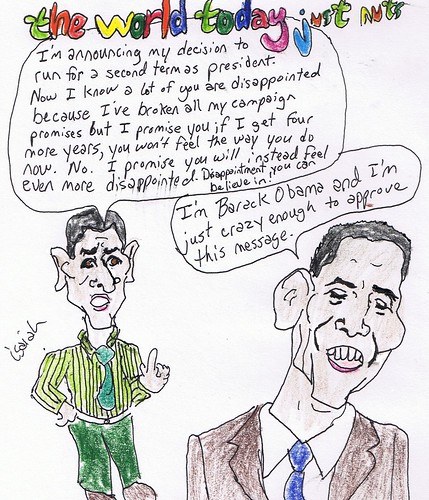
From last night, Isaiah's The World Today Just Nuts "Disappointment you can believe in!"

Disappointment You Can Believe In

Hilarious. I especially love the juxtaposition of cartoon Barack with more portrait Barack.

"The Trump Card" (Hillary Is 44):

By seizing an issue without fear and making it almost 100% his own, Donald Trump is rising in the only public opinion polls that matter at the moment to potential candidates for president. The only public opinion polls that matter at the moment are those that measure Republican voter sentiment. Republican/conservative Big Media outlet, The Washington Times, explains:

“Would-be 2012 Republican nominee Donald Trump is riding doubts about President Obama’s birth certificate to the front of the party’s presidential contender field, the latest sign that the long-standing fringe controversy is going mainstream.

The New York real estate magnate and reality show star, fresh off a Wall Street Journal poll that shows him tied for second among Republican voters as their choice for the presidential nominee, jumped back into the “birther” controversy Sunday.

Why doesn’t he show his birth certificate? The fact is, if he wasn’t born in this country, he shouldn’t be the president of the United States,” the billionaire developer said in a CNN interview that aired Sunday. The Constitution requires that the president be a “natural-born citizen.”

“It’s a very sad thing, because the people – the birthers – they got labeled and they got labeled so negatively and even the word ‘birther’ is a negative word. If you come out and … even question, the press goes wild. They get angry at the question,” he said.

Far from backing away, Mr. Trump seems to be embracing the birther controversy and relishing the confrontations with reporters. He has responded in print to critics and blitzed talk radio, morning shows and news programs to talk about birth certificates. Mr. Trump also has said he had sent private detectives to Hawaii to investigate the president’s birth.

Since Mr. Trump embraced the issue of Mr. Obama’s birth – or alternatively why he hasn’t released the state of Hawaii’s “long-form” birth certificate – he has gone from nowhere to the top tier of possible 2012 Republican candidates.”

That the Birth Certificate issue has been of extraordinary help to Donald Trump and that Donald Trump has been of extraordinary help to the Birth Certificate issue is now beyond doubt. But if Big Media is typically in a frenzy to protect Barack Obama on the Birth Certificate issue the same can be said of many, if not most, Republicans and conservatives.

Many of the Republicans/conservatives who do not like or want the Birth Certificate issue to even be discussed do so out of fear. They fear being labeled “nuts” (as if they won’t be anyway). They fear that this is all some sort of elaborate Barack Obama trap.

For these Republicans/conservatives it’s a mirror image reverse reverence for Barack Obama – the sort that Obama worshipers have – that Obama is some sort of extraordinary “three dimensional chess” player. Somehow, it escapes these political opposites that Obama is a boob and that boobery is demonstrated at every turn (such as the latest Republican victory on the 2011 budget). Only when Big Media is fully dedicated to Obama protection on a particular issue (such as his election) can Obama overcome defeat by boobery.


Damn straight. Donald Trump has gotten these questions into the office work place. And I don't think they're going away. I think they most of all go to how ineffective Barack is. If he had a clue, most people would agree, he would authorize the governor of Hawaii to sell copies of his birth certificate (as the governor wanted to) and that would end the matter.

Instead, Baack refuses to do so and it goes to our image and understanding of him as someone who is forever delaying until it is too late. Even those supporting the Libyan War (I don't) tend to argue that Barack waited too long to do something.

He's not able to think on his feet, he's not able to respond. And, at the heart of it all, that's why he has so much trouble trying to lead.

"Iraq snapshot" (The Common Ills):

Monday, April 11, 2011. Chaos and violence continue, the US military announces another death, at least 23 Iraqis are killed in today's waves of violence, the government of China 'responds' to the US government, Nouri may be under pressure from the military to sign an extension of the SOFA, Nouri may have signed the extension, Nouri may get out of his political party and more.
Conor Friedersdorf (The Atlantic) observes, "After the September 11 terrorist attacks, mainstream newspapers and television programs briefly chose to be more graphic in their coverage, rightly judging that sanitizing the events of that day would do us a disservice. But why is it less important to fully confront the reality of what is happening now in Afghanistan and Iraq? The United States Armed Forces has lost 5,885 people in those two countries. When did you last see a photograph of one of their coffins? Has the story of an innocent Iraqi killed by our forces ever flashed across your TV screen? The figures are mere abstractions." Yesterday, AP noted another American soldier has died in Iraq and this "marks the sixth U.S. soldier to die in Iraq so far this month." If that's new to you, see last week's "5 US soldiers have died this month."
Gareth Porter: I mention that both American officials -- an American official and the Iraqi intelligence source that I got this story from agree that there's no guarantee that the al-Maliki regime is going to survive this summer. But he is under a lot of political pressure there from a protest movement that the Sunnis are mounting and one of the big questions is whether the Sadrists will join that protest movement? And should that happen, then the short term outlook for the al-Maliki regime is very dark indeed. But there's another factor even beyond that. And that is that the Iraqi military is quite upset that -- that al-Maliki is dawdling over and refusing to go ahead with signing this letter -- sending a letter to the White House requesting the stationing of troops. The Iraqi military which is very close to the US military wants that very badly. And I had a hint -- even more than a hint -- that it could be the case that the Iraqi military would try to carry out its own move against the Maliki regime.
Scott Horton: In order so that they can keep the American troops there --
Gareth Porter: Exactly.
Scott Horton: Which means that they're going to have to fight another civil war against Moqtada al-Sadr.
Gareth Porter: Exactly. Yep. And I think that is certainly something to watch for very closely.
Scott Horton: Well now -- so -- It's been a long time and I know the Supreme Islamic Council ain't what it used to be and whatever, but is it fair to say that the Iraqi army right now, I guess it's the leadership roles that are most important, but that's mostly made up of old Badr corps type rather than Madhi Army guys? Because I know there were a lot of Mahdi Army that went to volunteer for the Iraqi army as well, right?
Gareth Porter: That's right. Although there are some -- in key positions -- there are some Ba'athists as well.
Scott Horton: Well look, if-if Maliki's biggest threat is from Sunni protesters then he's going to really need Moqtada al-Sadr -- which means that he's not going to sign Obama's document.
Gareth Porter: Oh, I think that's right. I mean I am absolutely convinced that this is not going to happen. I think it's very, very unlikely, let's put it that way. I would be very surprised if he were to move in that direction at this point. It just seems to me the factors are all lined up in the same direction.
No one knows what will happen and Porter's an informed observer of the scene so his take is worth listening to and considering. That doesn't make it right. Counter-take on Porter. Under pressure from the military, Nouri signs up for the US soldiers to remain on Iraqi soil. Most likely scenario in which Nouri extends the SOFA?
Factoring in the military, Nouri signs up (if he hasn't already) because he's aware Moqtada al-Sadr is (a) weak and (b) all talk. Moqtada is in Iran. He's made a life there for years -- largely due to the outstanding arrest warrant in Iraq that he fears may be enforced. Moqtada was among those wanting a referendum on the SOFA and Nouri promised that in November 2008 -- swore that in July 2009 it would take place. Never did. He kicked it back and kicked it back.
And what did Moqtada do? Not a damn thing.
Does Moqtada have a great deal of power? That hasn't been tested in a very long time. He had a popular resurgance in 2007 when Nouri ordered the attacks on Basra and the Sadr City of Baghdad. Attacking Moqtada did help build his popularity. However, not enough that Moqtada could fight back. As most will recall, Nouri won that battle, Moqtada caved -- just as he would later do on the referendum -- and went along.
"Caved and went along," many could argue (and some in the State Dept do), is Moqtada al-Sadr's m.o. Moqtada can get supporters to attend a speech or rally. What he can't do -- at least thus far -- is get them to risk their own lives while he remains in Iran. That's been demonstrated repeatedly. Moqtada is popular with a certain international set -- Amy Goodman for example (who notes him and credits him a protest -- that wasn't his protest "across Iraq" -- he is a very minor figure in the entire country, his base is a huge sub-set of Iraq). They love to turn the homophobic and sexist and fundamentalist thug into a cuddly bear. That's not reality. Nor has reality ever demonstrated that Moqtada has the power he's supposed to have.
Should Nouri stand firm against him (again) and should Moqtada attempt to issue orders for combat from Iran, Moqtada might grasp just how much sway he's lost by making Iran his home.
Maybe not, but that is a counter-take. And it is also speculation based on the facts that are known.
It's not know if the SOFA has already been extended; however, Saturday New Sabbah reported that a source in Parliament states that Nouri's Council fo Ministers has voted to extend the SOFA and that they signed the extension as well "during the last meeting of the Council of Ministers." Since US Secretary of Defense Robert Gates told US troops Friday that the whole purpose of his visit was to raise the extension of the SOFA, if New Sabbah's source is being truthful, it would appear Gates will be leaving his post later this year feeling "MISSION ACCOMPLISHED." If the extension was signed, did Gates sign on behalf of the US or did US Ambassador James Jeffrey? (Then-US Ambassador to Iraq Ryan Crocker signed the original in 2008.) If the extension was done, this is not a "national security" issue and not only should the US Congress be informed but so should the American people.
Alsumaria TV reports Nouri al-Maliki is stating that Iraqi forces are capable of standing on their own. However, Robert Burns (AP) notes, "The U.S. wants to keep perhaps several thousand troops in Iraq, not to engage in combat but to guard against an unraveling of a still-fragile peace. This was made clear during Defense Secretary Robert Gates' visit Thursday and Friday in which he and the top U.S. commander in Iraq talked up the prospect of an extended U.S. stay." Al Mada reports former US envoy (during the Bush administration) Zalmay Khalilzad is visiting Iraq. You can probably guess why. Note that sending in the big guns does not require utilizing Chris Hill -- his reputation in Iraq helps no one. Ayas Hossam Acommok (Al Mada) notes that the US pressure also includes pressure on Nouri al-Maliki to name the security ministers.

New Sabah reports that Parliamentary Speaker Osama al-Nujafi is stating that the US is pressuring the government to extend the SOFA but al-Nujafi is deckarubg that will not happen. Of course, Parliament declared in 2006 that it would not happen -- but it did (with the UN mandate). And Parliament declared in 2007 that it would not happen -- but it did. In both cases, Nouri ignored their wishes and their will and just extended it all by himself. Mohammad Akef Jamal (Gulf News) feels the problems facing Iraq are rather obvious:


One of the current problems is the insistence of Al Dawa party (and the State of Law coalition) headed by Prime Minister Nouri Al Maliki, to hold the reins of power, despite the fact that the results of the election were not in its favour. The State of Law coalition, through guile, was able to use loopholes in the constitution, and struck complicated and fragile deals, and added foreign pressure, to remain on top. These actions also saw a clear split between the Iraqi masses and the elite. There was criticism from individuals and also mass demonstrations against government policies.
This year, the demonstrations widened and took the form of angry strikes which flared through many Iraqi cities and governorates, turning into protests against unemployment, and lack of basic amenities, such as electricity.
However, the demonstrations, some of which turned bloody, did not cause the government much concern, as it was able to contain them through false promises.


A number of people increasingly consider Nouri to be a problem. For example, Ma'ad Fayad (Aswat al-Iraq) reports: that the Dawa Party, according to "key" party member Salim al-Husni, is on the verge of announcing Nouri al-Maliki has been kicked out of the party for "abuse of the principles and ideas adopted by the Islamic Dawa Party." al-Husni insists that "the ideas and principles of our party are far from power-mongering. Instead, it is a cultural and mass party that is founded on the principle of serving people, rather than serving officials and covering up for them."
Dropping back to Saturday, Dar Addustour reported Sadr supporters, "tens of thousands" of them, rallied despite Iraqi forces shutting down bridges and imposing a vehicle ban. US flags wer burned, a call for national unity was made and, in a statement Moqtada al-Sadr issued (but had someone else read), it was demanded that all US forces leave Iraq. His statement denounced the presence of US forces noting "the occupation is still among us with assassinations, terror and tyranny." Al Rafidayn reported that, in his statement, he threatened to bring back the (armed) Mehdi militia if US forces were in Iraq after January 1, 2012. The paper notes that the Sadr bloc has 40 seats in Parliament (there are 325 total seats in the Parliament which means that they hold approximately 12.3% of the seats in Parliament) and they hold 7 of the 43 Cabinet ministries (which is about 16.28% of the ministries). If US forces do not leave, Sadr's representative, MP Kamel Saadi, declared that armed resistance will return to Iraq. Mohammed Tawfeeq (CNN -- link has text and video) reported:


That prospect of American troops staying in Iraq disturbs many citizens, including the thousands who support al-Sadr, a cleric with grassroots appeal in Iraq's Shiite cities and neighborhoods.
Sheikh Salah al-Obaidi, a cleric who read a statement to demonstrators on behalf of al-Sadr, raised the prospect of American troops staying in Iraq into next year and beyond.
"What if the invading forces decide not to leave our country? What if they decide to stay? What if American troops and others decide to stay in our lands? .... Will you keep silent? " al-Obaidi said, reading al-Sadr's statement to chants of "God is great."
"If they decide to stay in our country, then we have to do two things: first is to escalate armed resistance and lift the freeze on Mehdi Army," al-Obaidi said.

Al Mada noted that the protesters also demanded no US bases. Jane Arraf (Christian Science Monitor) and Laith Hammoudi (McClatchy Newspapers) reported:

Black smoke rose from the square from the burning American flags, and protesters set up a grisly display of Americans in business suits being burned in cages.
"We are time bombs," the protesters chanted between a choreographed wave of young men dressed in the satin colors of Iraq's flag.
The protest was the first major Sadr demonstration since demonstrations began sweeping the Arab world this year. Sadr – who has reinvented himself as s serious political figure after his leadership of the paramilitary Mahdi Army, which fought US forces in 2004 – has called for restraint in protests against the Iraqi government, in which his party members now play a key role. Instead, the young cleric has used the possibility of massive protests as a veiled threat against the government.


The Daily Mail (in an article feature multiple AP photos of the protest) quoted protester Haidar Nuaman stating, "It seems that the government does not know what to do. Muqtada's is an important voice to stand against any intention by the government to extend the presence of forces." RIA Novosti reminded, "Al-Sadr lives in Iran where he is engaged in religious study. During a visit to Iraq in January".

Though Moqtada al-Sadr is a media created hero, there were protests elsewhere in Iraq having nothing to do with him. Dar Addustour reports that hundreds rallied in Salahuddin Province also calling for US forces to leave, for detainees to be released and hundreds gathered in Nineveh Province also calling for US forces to leave while hundreds rallied in Anbar Province calling for US forces to leave Iraq and for George W. Bush to be tried as a War Criminal while.
A key city in Anbar Province is Falluja which was slammed with twin bombings today. DPA reports after the first bomb exploded, police arrived and then the second bomb went off. Fadel al-Badrani, Jim Loney and David Stamp (Reuters) report the bombs went off near a busy market. Tang Danlu (Xinhua)adds that a police source tells the news agency 6 people are dead and twenty injured. Mohammed Tawfeeq (CNN) notes that 2 Khan Bani Saad roadside bombings claimed 10 lives and left two people injured, a Baghdad sticky bombing claimed the life of 1 Iraqi police officer and left "his driver" injured, a Baghdad roadside bombing claimed 3 lives and left eleven injured and a Baghdad bombing left one person injured. Reuters adds that an Iskandariya roadside bombing claimed the lives of 3 police officers.

Staying with violence, over the weekend Mu Xuequan (Xinhua) reported:

U.S.-led wars in Iraq and Afghanistan have been causing huge civilian casualties with 63 percent of some 109,000 people killed in the Iraq war being civilians, according to a report on the U.S. human rights record released on Sunday.

The figures were quoted from a WikiLeaks trove by the Human Rights Record of the United States in 2010, which was released by the Information Office of China's State Council in response to the country reports on Human Rights Practices for 2010 issued by the U.S. Department of State.

The Chinese government's report is said by some to be a retaliation for the US State Dept's release last week of a report critical of the Chinese government, the 2010 Human Report on Human Rights Practices. In their report, the government of China doesn't just zoom in on Iraq, it notes that poverty has increased in the US, it notes the gender discrimination that is widespread and a great deal more. The question shouldn't be whether or not China was angry about the US report, the question should be why aren't Americans angry about the report -- specifically that the Iraqi 'government' continues to receive support (military, financial, diplomatic, etc.)? From the report:
The constitution expressly prohibits torture in all its forms under all circumstances, as well as cruel, inhuman, or degrading treatment. During the year there were documented instances of torture and other abuses by government agents and similar abuses by illegal armed groups. The government's effectiveness in adhering to the rule of law in these circumstances faced obstacles from continuing large-scale violence, corruption, sectarian bias, and lack of civilian oversight and accountability, particularly in the security forces and detention facilities.
Local and international human rights organizations, the MOHR, and the human rights directorates of the MOI and Ministry of Defense (MOD) continued to report allegations of torture and abuse in several MOI and MOD detention facilities, as well as in KRG security forces' detention facilities. A MOHR prisons report for 2009 indicated that there were 326 documented cases of torture and mistreatment at MOI facilities, 152 cases at MOD facilities, 14 cases at Ministry of Labor and Social Affairs (MOLSA) facilities, one case at Ministry of Justice (MOJ) facilities, and 12 in Peshmerga facilities in the Kurdistan region during that year.
As in previous years, reports of abuse at the point of arrest and investigation, particularly by the MOI's Federal Police and MOD battalion-level forces, continued to be common. Allegations of abuse included use of stress positions, beatings, electric shocks, sexual assault, denial of medical treatment, death threats, and death.
On April 19, the local and international media reported the discovery of a secret prison operated by security forces under control of the Prime Minister's Office containing more than 400 Sunni detainees, of which over 100 were reportedly tortured. The detainees were arrested by the ISF during October 2009 security sweeps in Ninewa Province and then transferred to a prison in Baghdad. One prisoner reportedly died in January from the abuse, while others were allegedly beaten, raped, suffocated with plastic bags, and had electricity applied to them. Authorities initially arrested three officers, but they were later released without charge. There were no prosecutions of any officer or judge associated with the event. Subsequently, 75 of the prisoners were released and 200 were transferred to other jails, according to government officials.
In May 2009 three detainees at the MOI's Al Forsan detention facility in Ramadi were allegedly tortured, and in June 2009 prison guards allegedly tortured and raped female detainees at an MOI detention facility in the Adamiya neighborhood of Baghdad. Charges were brought against the officers involved; no further updates were available. In June 2009, in response to three COR members' allegations that 11 detainees had been subjected to abuse and torture by MOI officials, the government established a committee that charged 40 police officers with abuse. According to government reports, one general, two colonels, two majors, and two lieutenants were suspended pending additional investigation into charges of detainee abuse; no further updates were available.
Still on violence, CBS and AP report that US humanitarian aid was finally allowed into Camp Ashraf. AP's Lara Jakes reports that the Iraqi Parliament voted today to close down the camp. Following the US invasion, the US made these MEK residents of Camp Ashraf -- Iranian refuees who had been in Iraq for decades -- surrender weapons and also put them under US protection. They also extracted a 'promise' from Nouri that he would not move against them. July 28, 2009 the world saw what Nouri's word was actually worth. Since that Nouri-ordered assault in which at least 11 residents died, he's continued to bully the residents. Iran's Fars News Agency reported Monday that the Iraqi military denied allegations that it entered the camp and assaulted residents. Specifically, Camp Ashraf residents state, "The forces of Iraq's Fifth Division invaded Camp Ashraf with columns of armored vehicles, occupying areas inside the camp, since midnight on Saturday." Friday saw another attack which the Iraqi government again denied. Iraq4All News explained that the 2500 security forces present at the assault are commanded by Nouri al-Maliki. Stephanie McCrummen (Washington Post) reported that Iraqi forces are saying one thing and Camp Ashraf spokespeople another while "Journalists were prevented from entering the sprawling settlement, known as Camp Ashraf, which is home to about 3,000 people and has polished representatives in Paris and lawyers and congressional allies in Washington." UPI noted, "[US Secretary of Defense Robert] Gates said no U.S. troops stationed near Camp Ashraf were involved in the clash, but may have offered medical assistance."
Saturday, Tim Arango (New York Times) reported that Nouri's forces refused to allow "the delivery of American humanitarian aid" to Camp Ashraf today according to the US military and that "some reporters" were permitted to visit the camp today; however, they were prevented from speaking to the residents. CNN added, "Camp dwellers staged angry protests, hoisting banners and inviting journalists to talk to them. 'Please journalists -- come visit us and check on our people,' one sign read." Tim Arango noted some of Reporters Without Border statement, we'll include their statement in full:

Reporters Without Borders condemns the news blackout imposed by the Iraqi authorities on events at Camp Ashraf, a camp in northern Iraq that houses 3,500 Iranian exiles. An attack by the Iraqi army yesterday reportedly resulted in the deaths of around 30 residents and many wounded.

"This news blackout is unacceptable," Reporters Without Borders said. "The security forces are denying journalists access to the camp to hide abuses committed against civilians. Anyone trying to take photographs of the clashes is being attacked in a systematic and targeted fashion."

According to several news organizations, the camp is surrounded by armoured vehicles and army trucks. Journalists have been forced to remain at the camp gates. No media personnel have been allowed inside.

Located 60 km west of the Iranian border and 120 km north of Baghdad, Camp Ashraf was set up in the 1980s to house members of the People's Mujahideen, a militant Iranian movement opposed to Iran's Islamic regime.

US forces began disarming them after the 2003 invasion. Since then the camp's residents have been protected under the Geneva Conventions. After overseeing the camp for six years, the US military handed over control to the Iraqi authorities in January 2009.

The Iraqi authorities have banned journalists from entering the camp since July 2009, following clashes between Iraqi security forces and the camp's residents (http://en.rsf.org/iraq-journalists-detained-for-trying-to-05-08-2009,34012.html). The residents accuse the Iraqi authorities of trying to please the Iranian government while the Iraqis blame claim the violence on the Mujahideen.

In a rare move for Camp Ashraf issues, the US State Dept issued a comment. Mark C. Toner, Acting Deputy Spokesperson for the State Dept, states, "The U.S. Government is deeply troubled by reports of deaths and injuries resulting from this morning's clash at Camp Ashraf. Although we do not know what exactly transpired early this morning at Ashraf, this crisis and the loss of life was initiated by the Government of Iraq and the Iraqi military. The U.S. Embassy, United States Forces-Iraq, and United Nations Assistance Mission for Iraq are in regular contact with Iraqi officials at the highest levels to repeatedly urge them to avoid violence and show restraint. We reiterate our call for the Iraqi government to live up to its commitments to treat the residents of Ashraf humanely and in accordance with Iraqi law and their international obligations." David Alton is a member of England's House of Lords. Today he contributes a column for The Hill calling on the US to protect Camp Ashraf and noting a similarity between Friday's attack and the July 28, 2009 attack: Secretary of Defense Robert Gates was on the ground in Iraq when both took place. Alton writes, "In fact the attacks both happened only hours after a meeting between Nuri al-Maliki and Secretary Gates. Although Secretary Gates may not have had any knowledge of what was in the making by al-Maliki, this can hardly be a coincidence. There are not so many options: either Nuri al-Maliki has received some kind of green light from the Secretary Gates or he wanted to demonstrate that he carries some sort of pre-arrangement with the US; or he is contemptuous of U.S. opinion." AFP notes that the residents are "protected under the Geneva Convetions" and explains, "A left-wing Islamic movement, the PMOI was founded in 1965 in opposition to the Shah of Iran and has subsequently fought to oust the clerical regime that took power in Tehran after Iran's 1979 Islamic Revolution."
At the Left Forum last month, Debra Sweet, director of World Can't Wait, moderated a panel on "Why We Resist" with the Center for Constitutional Rights' Pardiss Kebriaei, Iraq War resister Matthis Chiroux and journalists Eric Stoner of the War Reisisters League. This was the World Can't Wait panel and WCW posted the video of it on Friday. We're noting an excerpt from Pardiss Kebriaei today and we'll note Matthis and Eric Stoner in two other snapshots this week. Just some background before we get to the excerpt. Habeas corpus refers to producing the body. It's Latin. If you were going to charge someone with murder, you would be required to produce a corpse to prove that a crime took place. When someone files a habeas petition today (write of habeas corpus) they are usually (and in the example below, they are) asking that the imprisonment be justified. Produce your charges thereby demonstrating that someone is not being held in violation of the law or Constitution. That's a general overview. We could get more specific but that handles what's coming up in the excerpt. The only time it has been suspended in the US was during the Civil War by President Abraham Lincoln. Unless they did it be 'secret order' (which really shouldn't cut it when you consider what the writ addresses), neither George W. Bush nor Barack Obama suspended it.
Pardiss Kebriaei: I was going to talk about two aspects of what I work on at CCR which is Guantanamo and the issue of targeted killing. And I guess it makes sense maybe to start with what the Bush administration and the Obama administration are continuing to do domestically. And then we can move on to some of the impacts abroad from my fellow panelists. So starting with Guantanamo which I think is -- and the power of the administration it claims it has to detain people it deems enemies of the state. You know, we're talking about a small group of people who are left but I think the power that's being claimed and the principle still holds and could apply to anyone really who the administration deems to be al Qaeda or associated forces or enemies. And I just wanted to start with a story about a man I represented who was released in July. This is an example of one of the lucky people who was released and then to contrast that with the people who remain and what they face. The person who I represented who was recently released, this was in last July, his name is Abdul Nasser. He's a man from Syria. About 50 but looks about 20 years older than he is because of the toll of his eight years of detention and abuse at Guantanamo. He was transferred to the prison with his son Muhammed in early 2002. And they were both detained there without ever being charged of a crime. We filed cases for them in court. The first chance they had after their arrivial at Guantanamo in 2002, the first chance they had to actually challenge their detention was in 2005. We filed habeas petitions for them in court. Those cases were never actually reviewed -- even though there was the right to do so -- because of obstacles put up by the government and delays. So they're both out now but never actually had the legality of their detention determined by a court. Because they're from Syria and because of the stigma of their detention at Guantanamo, they feared being returned to Syria, to their family and to their home there and so they needed resettlement and needed third countries to take them in. So Muhammed was the first to go. Portugal offered him resettlement. But him alone, not with his father. So he had to make the tortuous decision between his freedom or staying back with his father and waiting for a country to take both of them. And I was with him when he was making this decision. I saw him when he was with his father saying goodbye. It was one of the hardest things I've ever had to see. But he-he decided to go in the end because he thought one person in Guantanamo -- or one person out was better than two people in. And he thought he could do more for his father on the outside than he could do than he could on the inside. So he left. A year later, Cape Verde -- a former colony of Portugal -- offered Abdul Nasser, his father, resettlement. And again, it might seem like it wouldn't take much thought to decide, for someone detained, whether to leave Guantanamo. But it was a very difficult decision for Abdul Nasser. He wanted to be with his son in Portugal. He had just spent years in detention in a remote island in Guantanamo and knew nothing about Cape Verde other than it was another remote island off the coast of Africa. He, at least in Guantanamo, was with men he had known for years who he could eat with and pray with and speak Arabic with. There's no community of -- Muslim or Arabic speaking community to speak of in Cape Verde. It's a very poor country with few resources to deal with victims of torture, with refugees. So he knew that he would be very isolated and that the transition would be hard. So we spent a lot of time talking about his decision and ultimately he did decide to go. And he's there now, he's been there now for three-fourths of a year. And I think, he's alone, he has no one to speak with. He can talk occassionally with his family but he has no real community or support or structure to his day. But I think that every day -- or more days than not -- he's thankful to be out. And I know that I feel that way despite the difficulty of watching his transistion. And I know his son feels that way. And I feel that way in particular because of what I've been watching with respect to the men who remain. There are 170-plus people who are still in Guantanamo, this is facing their tenth year of detention there.