Tuesday, July 19, 2011

Leave Maxine alone

John Bresnahan (POLITICO) reports:

Rep. Maxine Waters (D-Calif.) is threatening to take the House Ethics Committee to federal court if the secretive panel charges her with any violations of House rules.

Waters’ attorney, Stan Brand, made the threat in a Tuesday letter to Reps. Jo Bonner (R-Ala.) and Linda Sanchez (D-Calif.), the chairman and ranking member of the Ethics Committee, just as the committee was scheduled to hold a meeting on what to do with the long-running Waters case.

I did not and do not believe that Maxine Waters has done anything wrong. However, I don't think that even matters at this point. They've allowed this matter to drag on and on and they should just move on already. They have kept a cloud of suspicion hanging over her and refused to wrap up their investigation.

So they should drop the investigation at this point.

Again, I have maintained Maxine is innocent and I stand by that but there's also the very basic fact that the Ethics Committee is not supposed to let an investigation linger -- or malinger -- they're supposed to wrap it up quickly and present any findings. They've refused to do that and it's time they left Maxine alone.


"Iraq snapshot"(The Common Ills):

Tuesday, July 19, 2011. Chaos and violence continue, Amnesty International calls for executions in Iraq to be put on hold, Nouri al-Maliki is wanted before a Spanish court, Iran boast of their invasion of Iraq, Senator Patty Murray takes to the Senate floor to note the needs of veterans and argue that the country has a debt to pay which cannot be forgotten, and more.
Signature wounds of the current wars are TBI and PTSD. When the US military brass testifies before Congress they like to emphasize TBI and bury PTSD. That may be changing, not because the military brass really wants to address PTSD but because TBI may have even more risks than have been previously known. Albertina Torsoli (Bloomberg News) reported yesterday that a new study on TBI, presented in Paris at the Alzheimer's Association International Conference, found TBI "may more than double the risk of dementia in military veterans." AP added, "The veterans study was led by Dr. Kristine Yaffe, a University of California professor and director of the Memory Disorders Clinic at the San Francisco VA Medical Center. The Department of Defense and the National Institutes of Health paid for the work." Today in the Senate, TBI was addressed. Senator Patty Murray's office notes:
VETERANS: Senator Murray Reminds Senate of Critical Need to Pass Veterans and Military Construction Spending Bill
The bill includes life-saving investments in Traumatic Brain Injury, PTSD research as well as mental health care for those struggling with 'invisible wounds of war'
Watch the speech HERE (Senator Murray begins speaking at 44:50).
(Washington, D.C.) – Today, U.S. Senator Patty Murray, senior member of the Military Construction Appropriations Subcommittee, gave a speech on the Senate Floor urging her colleagues to pass the critical health care and benefits investments included in the Military Construction and Veterans Affairs spending bill the Senate is considering this week. Among many other things, the bill includes life-saving investments in Traumatic Brain Injury and Post Traumatic Stress Disorder research as well as mental health care for those struggling with the invisible wounds of war. The bill also makes a significant investment in preparing the VA for the influx of new Iraq and Afghanistan veterans while supporting housing opportunities and care for older veterans.
"No matter what fiscal crisis we face, no matter how divided we may be over approaches to cutting our debt and deficit, no matter how heated the rhetoric here
in Washington, D.C. gets, we have to keep our commitments to our veterans and service members," said Senator Murray. "We have to move this bill forward and we have to provide those who wore -- are are wearing -- the uniform with the peace of mind that we are keeping up our promise to them."
For details on the critical veterans and military construction priorities included in the bill click HERE. The bill also includes over $500 million in investments for Washington state military bases.

Funding broken down by base appears below:

  • Naval Station Bremerton – $13,341,000
  • Naval Station Kitsap – $121,844,000
  • Fairchild Air Force Base – $27,600,000
  • Joint Base Lewis McChord – $331,300,000
  • Naval Air Station Whidbey Island – $25,000,000

Read the full text of the speech below:

"Madame President, there is no question that we need to make smart decisions to
tighten our belts and reduce our nation's debt and deficit.
"American families have done it around their kitchen table, and we owe it to them
to get our fiscal house in order.
"But there is also one group of Americans that we owe an even greater promise to.
"A group who we can never allow to become pawns, fall through the cracks, or be
forgotten altogether in these budget debates.
"And that is our men and women in uniform -- and the veterans who have protected our nation for decades.
"And that is why I'm here today -- in the midst of the whirlwind of debt and deficit
rhetoric -- to remind us all of the critical nature of the bill we have on the floor this
week.
"To remind us that no matter what fiscal crisis we face, no matter how divided we
may be over approaches to cutting our debt and deficit, no matter how heated the
rhetoric here in Washington D.C. gets, we have to keep our commitments to our
veterans and service members.
"We have to move this bill forward.
"And we have to provide those who wore -- or are wearing -- the uniform with the peace of mind that we are keeping up our promise to them.
"Now Madam President, a couple of years ago we took a proactive step to ensure
that the non-stop wrangling over appropriations bills here in Congress didn't interfere with the health care that our veterans have earned.
"Thanks to the work of Senator [Daniel] Akaka -- and many others -- VA spending for health care is now appropriated a year in advance.
"Protecting it from an imperfect budget process that is so often affected by politics.
But I remember that when we passed advanced appropriations we were very clear.
"Our foresight was not going to be an excuse to sit on our hands when VA funding
was up for consideration.
"We were not going to allow a precautionary measure to get in the way of passing
timely increases in veterans health care.
"And so this bill is the test.
"Can we put politics aside for the good of our nation's veterans and service
members?
"Can we show them that -- despite our differences -- we will work as diligently
toward getting them the benefits and care they've earned as they have worked
for our nation?
"I hope we can.
"And I say that because the investments in this bill are a lot more than numbers
on a page.
"They are life changing programs for veterans with Post Traumatic Stress Disorder
and Traumatic Brain Injury.
"It's support for suicide hotlines that are seeing more callers than ever before.
"It's providing roofs over the heads of our service members and their families.
"It's timely investments -- in the the very biggest priorities of our nation's heroes.
"And so today I want to talk about just a few of the investments included in this bill
and how they translate into the lives of our service members, veterans, and their
families.
"Madam President, there is an influx of young veterans coming into the VA system
right now like we have not seen in a very long time.
"In fact the VA estimates that the number of Iraq and Afghanistan veterans in its
health care system will reach well over half-a-million at some point next year -- that's an over 100% increase since 2008.
"This is a big challenge -- and one that we have no choice but to step up to meet
if we are going to avoid many of the same mistakes we saw with the Vietnam
generation.
"That is why this bill includes nearly $3 billion to meet the health care needs of veterans who have served in Iraq and Afghanistan -- a nearly $600 million increase over last year.
"But it's more than just the sheer number of new veterans that will be coming home to the VA in the near future -- it's the extent of their wounds -- both visible and invisible -- that will require untold resources from our nation.
"Through the wonders of modern medicine, service members who would have been lost in previous conflicts are coming home to live productive and fulfilling lives.
"But they will need a lifetime of care from the VA.
"And that's part of why this bill includes significant investments for research in a
number of areas including: Traumatic Brain Injury, spinal cord injury, polytrauma
injuries, and sensory loss.
"It includes funding that will go to maintaining world-class prosthetics like the one
worn by Sergeant Leroy Petry who I saw at the White House last week shake the
hand of a grateful President Obama as he was awarded the Medal of Honor.
"It's also funding that comes at a critical time as amputations have sharply increased among soldiers in Afghanistan -- many of whom are getting out of protected MRAP and Humvees to engage Afghan citizens and at the same time putting themselves at far greater risk of severe IED injuries.
"According to a recent Washington Post article 'twice as many U.S. soldiers wounded in battle last year required limb amputations than in either of the two previous years.'
"This funding also comes as mental health concerns continue to rise and suicides
among active duty troops and veterans from these wars have risen to a level now on par with combat deaths.
"In April, the VA's suicide hotline [1-800-273-TALK] took 14,000 suicide calls -- more
than they had taken in any month the previous four years.
"This bill ensures that we are putting someone on the other end of that call.
"This bill funds efforts to give veterans access to mental health professionals.
"This bill ensure we are not leaving our veterans to go it alone.
"But Madam President, this will do much more than help our newest generation of
veterans.
"For generations we have faced the problem of homelessness among our nation's
veterans without making real headway.
"But recently, through the success of programs like HUD-VASH and the Grant and
Per Diem program, we are seeing real progress toward putting homeless veterans into safe and secure housing and the bold goals laid out by the Obama Administration to end veterans homelessness once and for all.
"This bill includes nearly $1 billion in direct assistance to homeless veterans."
"This bill also helps those who have taken on the monumental but deeply personal task of providing care to an injured veteran in their family.
"Those people who have left behind careers, personal lives, and even their own health care and benefits to care for those who can't care for themselves.
"It includes major investments to meet the unique needs of one of the fastest growing groups of veterans: women veterans
"Who through health care and construction upgrades that improve privacy will benefit from VA facilities that are more conducive to their needs.
This bill also includes major investments to fund military construction projects world-wide, including readiness centers, barracks, hospitals, clinics, and schools.
"It also supports family housing construction projects that ensure military families
have a satisfactory roof over their heads.
"And will create thousands of good-paying construction jobs.
"As we all know well, the strength of our military is rooted in the strength of the
families that support them.
"Investments like these are what allows service members to go abroad knowing
their loved ones are being looked after by the nation they are protecting.
"Madam President, after nearly a decade at war, the consequences of sending our
service members into combat and the sacred obligation we have to care for those
injured in service have become clear.
"But so have the shortcomings and the challenges we have to meet.
"Last week, I chaired a hearing on the gaps in mental health care that still exist at
the VA [to stream that hearing, click here] and the stories we heard were deeply
frustration.
"I heard the stories of two separate veterans who attempted suicide but were still
left to wait for weeks and months for appointments at the VA.
"We have to fix the VA in a way that makes it flexible and responsive to the needs
of these veterans.
"And we have to do it in a cost effective way by ensuring that we are getting the
most value out of every dollar that a bill like this one provides.
"Next week I will be examing the long term costs of the wars in Iraq and Afghanistan to our newest generation of veterans because I believe we need to address this problem openly and honestly.
"Madam President, like generations of service members and veterans before them, today's heroes have done everything that has been asked of them.
"They have been separated from their families through repeat deployments.
"They have sacrificed life and limb in combat.
"And they have done all of this selflessly and with honor to our country.
"We can't allow our commitment to them to lapse or to get caught up in politics.
"We need to pass this bill.
"And we must also come to a budget agreement that avoids default and the
consequences it would have on our veterans.
"We have to keep our promise. No matter what.
"Thank you."
Senator Patty Murray is also the Chair of the Senate Veterans Affairs Committee. For community coverage of the hearing she referred to, see "Iraq snapshot," "Scott Brown asks if it is a staffing issue (Ava)," "Burr: I'd heard it before, I just hadn't heard it from you," and "The Senate Veterans Affairs Committee hearing."
Turning to active duty military personnel, yesterday on Adam vs the Man (RT, airs at 7:00 pm EST), Iraq War veteran Adam Kokesh reviewed active duty military personnel donations to the contenders for the GOP presidential nomination in the last financial quarter.
Herman Cain $6223
Mitt Romney $5000
Michele Bachmann $2550
Newt Gingrich $1025
Tim Pawlenty $250
Rick Santorum $250
Gary Johnson $0
The above donations total $15398.
Who go the most? With $36,739, Ron Paul. He got double what all the other candidates took in. He also got more donations from active duty personnel in the last quarter than President Barack Obama ($28,833).
Last Friday, Ned Parker had an important story that we did note in the morning but I forgot to include in the snapshot. For the Los Angeles Times, Parker reported:
Elite units controlled by Prime Minister Nouri Maliki's military office are ignoring members of parliament and the government's own directive by operating a clandestine jail in Baghdad's Green Zone where prisoners routinely face torture to extract confessions, Iraqi officials say.
Iraqi legislators and security officials have been joined by the International Committee of the Red Cross in expressing concern about the facility, called Camp Honor. In a confidential letter to the prime minister, the Red Cross requested immediate access to the jail and added that there could be three more connected to it where detainees also are being mistreated.
Iraq's Justice Ministry ordered Camp Honor shut down in March after parliament's human rights committee toured the center and said it had uncovered evidence of torture. The Human Rights Ministry denied Wednesday that it was still in operation. But several Iraqi officials familiar with the site said that anywhere from 60 to 120 people have been held there since it was ordered closed.
This is a topic Ned Parker has long reported on and it's a topic that helped spark the protests in Iraq this year. As January wound down, Ned Parker. reported on the secret prisons for the Los Angeles Times and Human Rights Watch issued their report on it. Parker's January report on the secret prisons and how they were run by Nouri's security forces, the Baghdad Brigade followed up on his earlier report on how the Brigade was behind the prison that he and the paper exposed in April 2010. But despite the January 2011 prison revelations, Nouri kept insisting there were no secret prisons in Iraq. Such as February 6th when Mohammed Tawfeeq (CNN) reported, "The Iraqi government on Sunday denied a human rights organization's allegation that it has a secret detention center in Baghdad, run by Prime Minister Nur al-Maliki's security forces." The report then quoted Nouri's spokesperson Ali al-Moussawi stating, "We don't know how such a respectable organization like Human Rights Watch is able to report such lies." Camp Honor is a prison that's under Nouri's control, staffed by people working for him. Amnesty International would also call the use of secret prisons out while Nouri continued to deny them. In the middle of March, the world was supposed to forget all the denials and rejoice that (yet again) Nouri had been caught operating a secret prison and that he was saying (yet again) he would close one and saying that (yet again) secret prisons did not belong in the 'new' Iraq and would not be part of it. The lie would continue until March 15th. From that day's snapshot:
Today Raheem Salman and Salar Jaffe (Los Angeles Times) note, "The jail in Baghdad's high-security Green Zone, called Camp Honor, fell under the nominal supervision of the Justice Ministry. But it was actually controlled by two elite security branches affiliated with Prime Minister Nouri Maliki's military office, the Baghdad Brigade and Counter-Terrorism Bureau. [. . .] After a scandal last spring over a secret prison at another military base, Maliki ordered that Camp Honor should be opened to detainees' families and lawyers. Instead, the jail remained closed to visitors and allegations of abuse emerged in late January in reports by the Times and Human Rights Watch." AP reports that the Minister of Justice's spokesperson is stating that "Camp Honor" will be shut down. New Sabbah quotes the spokesperson stating that the prison runs "contrary to international human rights standards."
Despite insisting that they were closing the prison in March, it has not been closed. In part, Nouri's been able to keep it open by refusing to appoint a Minister of Defense and a Minister of Interior. The power grab has prevented any accountability. Many of the prisoners (estimated to be as many as 120) are said to be political prisoners.
Last week, Jane Arraf (Al Jazeera, Christian Science Monitor) Tweeted:
jane arraf
janearraf jane arraf
And she's correct, this has been Ned Parker's story for years (plural) now.
Yes, it is the same secret prison. In part, Nouri's been able to keep it open because he's assumed the post of Minister of the Defense. Had someone from Iraqiya been appointed to the post, as was agreed to in the Erbil Agreement, Nouri wouldn't have had control
While Nouri's made nice in China, he's wanted in Spain. New Sabah reports on the decision by the Spanish court to call Nouri al-Maliki, prime minister and chief thug of Iraq, before them along with members of Iraq's Defense Ministry and representatives of the United Nations in an attempt to make sense of the massacre on Camp Ashraf in April in which 35 people were killed. Nouri's official spokesperson (and president of his fan club) Ali al-Dabbagh insists that no other state can do what Spain thinks it can and that it encroaches "on national sovereignty" and, apparently, on Nouri's inalienable right to slaughter freely.

Camp Ashraf is where a group of Iranian dissidents leave. Marxists, they took part in the early stages of the Iranian revolution of the late 70s. They ended up in Iraq where Saddam Hussein granted asylum. Throughout their long stay in Iraq, they are not known to have created any internal problems. But Iran doesn't want them in Iraq. Not an issue when Hussein was in power; however, a big deal to the current installed government. Following the US invasion, the US disarmed the group. The residents of Camp Ashraf turned over their arms with the promise from the US that they would be protected. That has not been the case. Since 2009, Nouri has repeatedly sent the Iraqi military into the camp to terrorize the people and he, Hoshyar Zebari, Jalal Talabani and others have been making public statements in Iran and elsewhere promising to evict the residents of Camp Ashraf by the end of this year. They have also repeatedly lied including recently insisting that the International Red Cross was helping them with forcing the residents out of Iraq. The Red Cross immediately issued a statement explaining that they were doing no such thing.

The Spanish court is calling for Nouri to appear before it in October. Ali al-Dabbagh insists that Nouri is under obligation to do so. So are they about to curtail Nouri's traveling? They do realize that should he try to avoid a subpoena, certain countries have agreements that would compel them to take Nouri into custody and turn him over to Spanish authorities. This isn't a civil case. BBC News notes, "Under Spain's universal justice doctrine, grave crimes committed in other countries can be prosecuted." The BBC's article omits Nouri's name (maybe everyone's still recovering from Friday's strike?) but AP notes that Nouri is being asked to testify and they note that Judge Fernando Andreu plans to explore the April 8th massacre as well as the July 2009 one in which 11 Camp Ashraf Residents were killed. We'll remind that the same judge had earlier offered to kill the probe of 2009 (this offer was made at the start of the year) if the Iraqi government would launch their own probe. They refused to do so.

While Nouri bends over backwards to appease Iran, the Iranian military boasts of their control over Iraq. Press TV reports:

A senior Iranian military commander says the Islamic Republic will continue efforts to completely weed out the Party for Free Life of Kurdistan (PJAK) terrorist cell.
Iran's Islamic Revolution Guards Corps (IRGC) clashed with PJAK terrorists and inflicted heavy casualties on them during recent days with the purpose of establishing sustainable security and fighting against insecurity and instability in northwestern areas of the country, commander of Iran's Islamic Revolution Guards Corps (IRGC) Ground Forces Brigadier General Mohammad Pakpour said on Monday.
A top Iranian military commander, Delavar Ranjbarzadeh, said on Monday that the IRGC has taken full control of three bases of the PJAK terrorist cell near the Iraqi border.

Alsumaria TV offers
the weakly worded: "Iranian Revolutionary Guards Chief in Sardasht, northwestern Iran, announced that Iranian Forces took over three rebel camps of the Kurdish Party for free life in Iraq." Wait. Wasn't Ali al-Dabbagh whining about "national sovereignty"? Iran invades Iraq and he's got nothing to say about sovereignty? Al Sabaah notes that Iran's military has "penetrated deep into Iraqi territory" and that at least 30 Iraqi families have been displaced as a result. They also note the Iraqi woman injured yesterday by the shelling from the Iranian military. AFP reports that Kurdistan officials are stating that "Iran must respect its borders with Iraq" and quotes KRG spokesperson Qawa Mahmud stating, "We demand Iran respect the sovereignty of the Kurdistan region as part of the sovereignty of Iraq. There was Iranian infiltration along the Iraqi border. If there is any border problem, the best way to resolve it is through negotations and peace, not by bombing civilians." Meanwhile MP and Deputy Chairman of Parliament Iskandar Witwitt thinks he's solved the issue. Aswat al-Iraq reports he's declared the blame for the attacks goes to . . . the United States! He states, the US dismantled Iraq's military when it invaded in 2003 and, as a result, Iraq cannot defend borders today.


Iran's also boasting that they won the 80s Iran-Iraq War. If the US government ever had the brains to leave Iraq, it would appear that happy neighbors Iran and Iraq might be at each other throats in a matter of minutes. Especially once they weren't able to bond over their mutual hatred of the US presence on the ground in Iraq.
Yesterday we noted historian and journalist Gareth Porter's article "What Is Sadr's Game on Future US Troop Presence" (IPS via Dissident Voice) and his conversation with Scott Horton (Antiwar Radio). The interview is now posted at Antiwar Radio. Excerpt:
Scott Horton: Now, Gareth, I think you say in this article and you were alluding to this a moment ago that therre are indications that July's different from June, that maybe if Sadr was orchestrating attacks against American forces last month that something's happened to change his mind in the meantime -- or there are indications that he had ordered a new strategy.
Gareth Porter: Right. And I think the important -- the first thing that I haven't mentioned which needs to be added to this storyline is that according to this ILO arm of the Iraqi military intelligence which handles intelligence with Sadr for al-Maliki basically there was a major, not a physical meeting, but an exchange of views between Sadr and Maliki last weekend and what happened in that exchange of views. Basically Maliki wanted to know point-blank what Sadr's intentions were? Was he going to use a request for US troops to stay in Iraq against the government and try to bring it to down or was he ready to support the government or to continue to support the government and not try to use that issue politically? And in the background of course was Sadr's previous threat to de- -- to reactivate not to deactivate the Mahdi Army which in fact has been deactivated since 2008 -- since 2009, excuse me. And so basically Sadr responded to that by assuring Maliki that he would not try to bring the government down, that he would not obstruct or stand in the way of a request for US troops. And so this was a major move by Sadr and he then issued a public statement on his website which very -- in a sort of low key way, tipped by saying that he would not reactive the Mahdi Army and explained that corruption and malfeasance in the Mahdi Army that they were not ready to be re-activated so he was not going to do that as he had threatened to do in April if US troops in Iraq past the December 2011 deadline. And he also essentially said that the Promise Day Brigade would be the only force that would have the authorization to resist US troops and they would do so only if US troops remained past the deadline. So, in other words, he was saying that between now and the end of the deadline that Promise Day Brigade would stand down which of course could be viewed and I think should be viewed as another signal by Sadr as to his intentions. So there are a number of things which are going on here which point in that direction but it still remains true that Sadr cannot afford to stop military resistance to any continued US presence because he'll lose his following. He simply cannot be in a position of accepting the US military position publicly. And so my source is telling me that if the US military presence does remain, of course, Sadr will have to continue making attacks on US bases and convoys. But he would do so in a way that would be aimed at not causing large numbers of dead or wounded. So it's a very, very subtle approach that Sadr is apparently taking on this, trying to have it both ways.
Roy Gutman (McClatchy Newspapers) covers Kirkuk's desire for US troops to stay (and we'll note that article in more detail tomorrow but there's just not room today).

Reuters notes that in Kirkuk today, two roadside bombing left a father and son injured (the father is a police officer), a Baghdad roadside bombing injured two people (one was a police officer) and, dropping back to last night, a Baghdad roadside bombing injured one person.
In other news, Alsumaria TV notes that Parliament went along with Nouri's call to reduce the number of ministries from 46 to 29 but "in principle." Next week, Parliament expects Nouri to appear before them and they will do another vote. Now, Al Mada reports, Nouri's State of Law political slate is pushing to do away with the independent electoral commission.

Amnesty International released the following yesterday on planned executions in Iraq:


81 death sentences reportedly approved by President

The Iraqi authorities should halt the imminent execution of five senior officials under former president Saddam Hussain, Amnesty International said today.

The five, who were transferred from US to Iraqi custody last week, have been convicted of crimes against humanity by the Supreme Iraqi Criminal Tribunal (SICT) and could be executed within a month if the Iraqi Presidency approves their sentences. A Ministry of Justice official told Iraqi media that he expected the ratification of the death sentences within days.
Amnesty has questioned the fairness of trials before the SICT, which was established to try Saddam Hussain and others accused of responsibility for war crimes and crimes against humanity committed during his rule. The court has been subject to repeated political interference undermining its independence.
Watban Ibrahim Hassan al-Tikriti, former Minister of Interior, and Sab'awi Ibrahim Hassan al-Tikriti, former Head of Intelligence -- both half brothers of ex-President Saddam Hussain -- were sentenced to death in 2009 after being convicted of crimes against humanity.
Senior army and security officials Sultan Hashem Ahmad and Hussain Rashid al-Tikriti were sentenced to death in 2007 after being convicted of participation in the so-called Anfal campaign against Iraq's Kurdish minority in 1988 in which some 180,000 Iraqi Kurds died. The fifth man, 'Aziz Saleh Nu'man, a senior Ba'ath party official, was sentenced to death last month for his role in the brutal suppression of the 1991 uprising against Saddam Hussain by the Shi'a community in southern Iraq.
The five were among a group of 206 "high value" detainees and prisoners handed over to the Iraqi authorities by the US military on 14 July.
Amnesty International Middle East and North Africa Director Malcolm Smart said:
"While the Iraqi authorities have a responsibility to bring to justice those
responsible for the gross human rights crime committed under Saddam Hussein,
they must not use the death penalty under any circumstances.
"It is a violation of the right to life and the ultimate form of cruel, inhuman and degrading punishment.
"These men must not be executed. The Iraqi authorities should commute these and all other death sentences and declare an immediate moratorium on executions."
In a letter to the Iraqi Minister for Justice last month, Amnesty raised concern at Iraqi news reports that the Iraqi Presidency had approved 81 out of a total of 516 death sentences submitted for ratification since 2009. According to other news reports, a further 20 sentences were referred for ratification on 14 June alone.
The death penalty was suspended for a time after the US-led invasion of Iraq but restored in August 2004. Since then, hundreds of people have been sentenced to death and many have been executed.
Jane Arraf (Christian Science Monitor) and Sahar Issa and Laith Hammoudi (McClatchy Newspapers) report a deal may be forming to stop the executions, "The move would be a significant shift from an announcement by the Justice Ministry last week that execution orders could be signed in days and the men put to death this month." And quotes Ministry of Justice spokesperson Haider al-Saade stating, "There are effots made by some political blocs to bring about a way to avoid execution for some of those who have been sentenced to death -- the efforts are ongoing." The reporters state that the strongest opposition is to the execution of Sultan Hashim, especially in Mosul.
And the Mandaeans have begun a religious ceremony. Al Sabaah reports that the community entered into a five day ritual starting today which includes fasting (for two days). The community is estimated to have 500 families. Each morning will begin with the ritual of bapsitam for the chidlren of the Sabean Mandaeans. It is estimated that 53,000 Mandaeans have left Iraq (or been killed) from their record high in the 1990s. Most have left since the start of the Iraq War and left as a result of the chaos and violence as well as being targeted by other Iraqi groups. They are a gnostic religion.

Monday, July 18, 2011

The ones who chose the path of ill repute

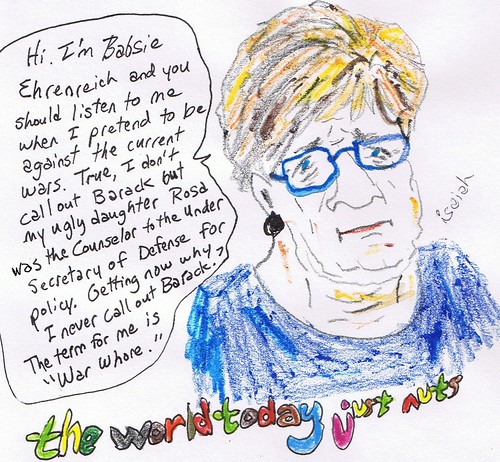
Isaiah's The World Today Just Nuts "War Whore"

war whore


I really think that Barack Obama is the gift the left never expected.

How so?

Barack is a piece of trash who's destroyed the country.

But he was a gift in that he allowed us to find out who were the liars and who were the truth tellers. Most of the so-called independent media has been exposed as fakes and frauds. Whores who will sell out beliefs in order to whore for Barack Obama.

It's a long list which includes many, many familiar names: Naomi Wolf, John Nichols, Naomi Klein, Barbara Ehrenreich, Danny Schechter, Bill Fletcher, Richard Kim, Spencer Ackerman, Amy Goodman, Lila Garrett, Margret Prescod, Aimee Allison, Mitch Jesserich, Tom Hayden, Leslie Cagan, Alice Walker, and so, so many more.

It was the most illuminating moment for the left. We got to see so-called 'leaders' presented with the dilemma of choosing things we believe in or whoring for a political candidate and they repeatedly chose to whore.

Those of us who chose not to whore will not forget.


"Iraq snapshot" (The Common Ills):

Monday, July 18, 2011. Chaos and violence continue, the US military announces another death, the little noted Stalemate II continues in Iraq, Iran invades Iraq, Sibel Edmonds offers some strong media criticism, and more.
On Antiwar Radio, Scott Horton interviewed Jason Ditz about the ongoing wars including the Iraq War.
Jason Ditz: Of course people may remember that in the last few months of the Bush administration there was a Status Of Forces Agreement signed with the Iraqi government saying that the US would keep troops there through the end of 2011 and that all the troops would be out by then. And at the time, of course, President Obama and the other candidates on the Democratic side were saying that 'oh this is way too long' and suggesting that they were going to get the troops out sooner. They never actually gave concrete dates, but they certainly hinted that they would have the troops out much sooner than that. And now President Obama is pretty clear on keeping the troops there well beyond this deadline and the talks are already ongoing for exactly how long and in what fashion they're going to do so.
[. . .]
Scott Horton: I wonder whether he thinks he really needs the Americans. Really the question is does he need us or Moqtada al-Sadr more?
Jason Ditz: Well it definitely does seem to be the case. In fact, it seems to be that he can only have one or the other, not both.
Scott Horton: Well now Americans have been killed in some violence over there recently. Are the headlines right that these attacks basically are attributable to the Sadrists and then further that must mean the Iranians are behind it?
Jason Ditz: Well I think they're going -- they're jumping to a lot of conclusions. Most of these attacks are happening in Shi'ite controlled areas, they're happening probably by militias that are Shi'ite in nature. Whether you can jump from that to concluding that Sadr is directly behind it isn't clear. And the conclusion beyond that -- that this is the Iranian government -- seems completely far fetched because despite Adm [Mike] Mullen's claim that they have proof, the only evidence they've presented is that some of these weapons these militias are using contain some parts that you could buy in Iran. Now that may well be the case but Iran's a big country and those are some pretty big borders between those two countries. I think drawing the conclusion that this is direct Iranian government intervention in this war as opposed to just commerce across borders seems a little bit -- a little bit far fetched.
Scott Horton:Right. I mean even if it did have a "MADE IN IRAN" stamp on it, it still means it could have come from the black market in 600 directions.
Jason Ditz: Absolutely. Iran is not this big giant monolith that is all one agency operating as a single entity. There are a lot of militant factions in Iran that don't like the Iranian government that might get involved in this as well.
Scott Horton: There are plenty of business men too -- in and outside of government and their ties and circles.
Jason Ditz: Right.
Scott Horton and Jason Ditz were noting the deaths of US soldiers in the Iraq War and the Associated Press reported this morning that the US military announced the death of another US soldier in Iraq. This brings the death toll for this month to 5 and the death toll for June and July combined to 20. ABC News Radio quotes from the statement: "A U.S. service member died Sunday in a non-hostile incident in central Iraq."

Two of the five this month were Nathan Beyers and Nicholas Newby. KPVI reports (link is text and features a slide show) the Pocatello, Idaho National Guard Armory last night was the scene of a rememberance for the two fallen as approximately 50 people paid their respects in a candle light ceremony. Lucas Elliott was killed Friday while serving in Iraq. WTVD notes, "On Monday, Lucas Elliott would have celebrated his 22nd birthday." Lucas Elliott's death was known because his family came forward on Saturday. WRAL first reported the fallen was Lucas Elliott. Patti Elliott, his mother, told them, "On 9/11, we were sitting there watching everything unfold and Lucas turned to us and said, 'I'm going to be a soldier'." Ed Elliott, his father, stated, "All I can say is I'm going to miss my hunting and fishing buddy." And Trisha Elliott, his wife, talked about how they met in a college class and said, "I'm not sure how he did it, but he convinced me to marry him and I don't regret it." Today the Defense Dept issued the following:

The Department of Defense announced today the death of a soldier who was supporting Operation New Dawn.
Spc. Daniel L. Elliott, 21, of Youngsville, N.C., died July 15 in Basra, Iraq, when enemy forces attacked his unit with an improvised explosive device. He was assigned to the 290th Military Police Brigade, 200th Military Police Command, Cary, N.C.
For more information, the media may contact the 200th Military Police Command public affairs office at 301-677-1079.

A few words on Antiwar Radio which airs on KPFK most Fridays. We note Antiwar Radio and we note Antiwar.com. Most of the voices featured are libertarian because that's who runs the sites. But they are not the only voices featured. All the voices featured -- left or right or center or apathetic to election politics -- are serious about ending the wars. That's why we include them (and Antiwar Radio is probably the only radio program that has not forgotten the Iraq War.) However, please, stop wasting your time and mine sending me Lila Garrett garbage. (You know who you are.) Connect The Dots could be an important show; however, Lila choses to trash her own show repeatedly. I have no use for her. If the wars are going to end, it's going to take everyone calling for an end to it and Lila's non-stop hate speech towards Republicans isn't doing anyone any good. She needs to be told to cut it out. It's taken her forever to find the strength to criticize Barack (the threat to her Social Security check appears to have finally pushed her firmly) and any meek criticism has required -- as it did today -- that Lila move into trashing Republicans as racists and more. Lila Garrett hasn't spoken to Republicans in years. She has no idea what most Republicans in this country -- we're talking about voters, not office holders -- believe in. I find her destructive and damaging Her stereotypes are offensive and off-putting and do nothing to allow for a left-right bridge to end the Iraq War or even for the left to understand what the right is after. Stop sending me Lila's garbage, I'm not interested. Again, on most Fridays, KPFK features Antiwar Radio. Last Friday, historian and journalist Gareth Porter was on to discuss his new article "What Is Sadr's Game on Future US Troop Presence" (IPS via Dissident Voice):


The big question looming over U.S.-Iraqi negotiations on a U.S. military presence after 2011 is what game Shi'a leader Moqtada al-Sadr is playing on the issue.
U.S. officials regard Sadr as still resisting the U.S. military presence illegally and are demanding that Sadr call off his Promised Day Brigades completely.
But Prime Minister Nouri al-Maliki's main point of contact with Sadr says Sadr is playing a double game and does not intend to obstruct the negotiations on a deal for the stationing of 10,000 or more U.S. troops from 2012 onward.
Sadr made a crucial move over the weekend toward accepting such an agreement between the Barack Obama administration and the Maliki government, according to a senior Iraqi intelligence official in the International Liaison Office (ILO). The ILO is an arm of Iraqi military intelligence that is run by a former East German intelligence official who was Sadr's political adviser during the height of the U.S. war against the Sadrists in 2007-08.
Sadr agreed in an unpublicised direct exchange of views with Maliki that he would not exploit a request by Maliki to President Obama to station U.S. troops in Iraq beyond this year by attacking Maliki politically or threatening his government, the senior Iraqi intelligence official told IPS.


Friday, Scott Horton discussed the article with Gareth Porter (click here for KPFK archives, not yet up at Antiwar Radio). Excerpt:
Scott Horton: Here's the thing, you sit there for a couple of moments, I'm going to make a couple of assertions and then I'm going to turn it over to you.
Gareth Porter: Okay.
Scott Horton: So it used to be that the Ba'ath Party ruled Iraq. It was a predominately Sunni party especially at the heighest levels. And the Arabs are the majority in Iraq as opposed to the Kurds but the Sunnis are the minority among the Arabs in Iraq.
Gareth Porter: Right.
Scott Horton: So then America invaded and overthrew the Ba'athists and fought a giant civil war on behalf of the Badr Brigade of the Supreme Islamic Council and the Mahdi Army of Moqtada al-Sadr and safely completed the ensconcing of them in power in Baghdad in say oh I don't know 2007, '08 they pretty much finished up winning that civil war. And so now the only problem is there's this religious leader on the Shi'ite majority side. that we've fought this war to install in power who wants us to go. Or not. Tell us about Moqtada al-Sadr.
Gareth Porter: Well first of all, just one point that I would make which is a bit different from the presentation that you just made which is otherwise perfectly correct and that is that Sadr although he did not resist the initial US invasion of Iraq, it's quite true, within one year -- or year and a half -- he had begun a military resistance to the US and has maintained that degree of resistance to US presence -- in varying degrees, I guess I should say, resistance to US presence ever since. And of course it's important to understand that the real -- within the Shi'ite community or the Shia community, the real big conflict here has been the Badr Brigade people who represent the middle and upper class of the Shia community and Sadr whose constituency clearly is the poor and dispossed of the Shia community. So that's part of the background of this story. So now what is Sadr's game here? He has --
Scott Horton: Wait a minute. Hold on Sadr's game. Because as long as you're going to clarify that, we should also clarify that Abdul Aziz al-Hakim, the leader of the Badr faction, the Supreme Islamic Council, has died. His son didn't have the wherewithal to hold it together and Moqtada al-Sadr is now the dominant force inside the Iraqi Supreme Islamic Council* as well as the Iraqi National Alliance -- the majority party that rules the Parliament and supports Nouri al-Maliki to be prime minister. So he resisted and our guys fought battles with him from time to time over the years but still the war was to make him the Ayatollah basically -- whether that's what they were trying to do or not.
Gareth Porter: Well I think that that is in fact the larger and longer term effect of the US war. But neverthelss in the wake of the Shi'ite -- basically their victory over the Sunnis in the civil war in 2007 -- 2006, 2007 -- the fact is that the United States and Sadr are still very much at odds. And so Sadr is a very complex figure politically at this point and really this is the main point of my article -- is that he wants to play an apparently ambiguous two-sided double-game if you will with regards to the US presence there. Despite the fact that he continues publicly to rail against the US military presence and indeed has continued to carry out attacks on US military targets. Nevertheless, the evidence now is that he's trying to maneuver so that the Nouri al-Maliki government can allow or reach an agreement that he will allow between the government and the United States to station troops. And this is coming from the office of Iraqi military intelligence which is responsible for relations between the al-Maliki government and Sadr.
We'll note it when it goes up at Antiwar Radio. "*" On Scott Horton's statement that Moqtada al-Sadr dominates the Islamic Supreme Council of Iraq, that's his take and we'll offer a counter-one. I don't know what he means by "dominates." If he means "dwarfs," that's true in terms of press attention. He may mean it in another way. If he means in terms of power I don't see it. (Popularly, he's Howard Dean after the "scream" takes Dean out of the running.) Ammar al-Hakim is not in a position of weakness when it comes to Moqtada al-Sadr. In the 2005 elections, ISCI was the leader. Voters grew disenchanted. In 2009, Iraq held provincial elections (we're leaving the KRG out of this because they held provincial elections months after the rest of Iraq), the disappointment could be clearly seen in those elecitons when the previously dominant part accounted for approximately 1/8 of the seats in the 14 provinces. (Again, the KRG held their provincial elections months later and are not included in that count.) At the time of those elections Ammar al-Hakim was not in charge of the party, his father was. His father would die in August of 2009 and the party would vote for Ammar al-Hakim to take over months before the parliamentary elections (March 7, 2010). Ammar al-Hakim would oversee the building of the coalition (National Alliance) which included Moqtada al-Sadr's bloc. That National Alliance came in third. Approximately seven months in power, I don't know that he can be judged to be responsible for the election results; however, predictions for further erosion did not take place. The recent death of Abdul Aziz al-Hakim might have been a rallying point or it might have been hopes for the new leader (his son Ammar). But at this point, I don't see how you say that Ammar al-Hakim is less powerful than Moqtada al-Sadr when al-Hakim is as popular within Iraq and is more popular than al-Sadr with Iraq's neighbors and that includes Iran. If you asked the neighboring countries to pick a prime minister for Iraq, Ammar al-Hakim would be the choice. That may change as he gets more of a record of leadership but that is currently where he stands. Within the Islamic Supreme Council itself, Ammar remains leader and Moqtada al-Sadr could never challenge him in that post. The issue of family is huge in Iraq (as are tribes) and Moqtada really doesn't have that to offer in the way Ammar does. In fact, had Moqtada not called in favors from his late father's friends in Iran and gotten to be recognized (by them) as something of a holy man, he'd still be the petty thug he was seen as in Iraq for most of 2003. My call on al-Hakim's
position in the Iraq hiearchy is based on the usual sources and I could be wrong. (They were correct about Moqtada.) Scott Horton may very well be right. But we rarely cover al-Hakim and with all that's been said, I'll offer the counter-opinion. (Scott Horton may very well be right. I could be wrong and often am.) He appears to argue al-Sadr's power because al-Sadr "represents the poor." Traditionally, in any society, the poor are the disenfranchised. That's true in the US, that's true in most countries. The idea that there was a scramble on in Iraq where anyone could achieve power existed in the early days of the US-invasion (and was false even then). Again, we'll note it when the Gareth Porter interview goes up at Antiwar Radio.
Let's stay with the 'withdrawal' issue. Al Mada reported Saturday that MP Sabah al-Saadi called on Nouri al-Maliki to reveal his on stance regarding US military troops staying beyond 2011 and he called for Nouri to release an evaluation of Iraq's security system currently. Noting the "lack of readiness on the part of the security forces to maintain the country," al-Saadi wonders "what did the government do for the last three years?" It is implied that any faliures would fall at Nouri's footsteps because he was prime minister when the SOFA was signed and it would appear -- either through "negligence" or a desire to keep US forces -- Nouri has not been up for the job. Today Suadad al-Salhy (Reuters) embarrasses himself and the outlet (do I detect Serena's hand?) with a bunch of garbage about how "trainers" not "troops" will stay. That's a false term. al-Salhy's in Iraq and unaware of what the US Congress has heard in repeated hearings this year. I've been at everyone of those public hearings and we've covered them in the snapshots here. Whether it was military brass or the US Ambassador to Iraq or US State Dept employees, over and over Congress has been told that the US military will be acting as "trainers." And, in fact, that's the claim currently about the US military on the ground in Iraq right now. So why Suadad al-Salhy thinks his nonsense today was needed, I have no idea. He writes, "The difference between troops and trainers, usually former soldiers and police contracted to the U.S. government, may be critical for Prime Minister Nuri al-Maliki [. . .]" Grow the hell up. I'm not interested in your pathetic, juvenile delusions (or have you gone to work for the CIA? In which case you're serving up propaganda). Here's reality on the 'untrained' forces still needing training. They were getting training. They were getting police training and plenty more. Remember? 2006? And what happened? The US military made the decision to stop those programs in Jordan and elsewhere. Had those programs continued, don't you think the Iraqi forces would be up to speed by now? Or do we need to see the 'training' video on YouTube again? Where the US military comes in, screams at the Iraqi police trainees, using derogatory, sexist, homophobic and other 'good' language and has a hissy fit while playing "Dumb Idiot Iraqis!" You really think a 'teacher' like that was ever going to impart a damn thing? Really? The report that Reuters missed -- through cowardice or ignorance -- is that Nouri's trying to sell the extension of the US military presence by claiming that they aren't "troops," they are "trainers."
Over the weekend, Al Mada also reported that KRG President Massoud Barzani is attempting to return everyone to the Erbil Agreement (which ended the nine month plus political stalemate) and, most importantly, introduce a proposal calling for the security ministries being pulled from Nouri. On the topic of the Erbil Agreement, Aswat al-Iraq reported, "President Jalal Talabani and the head of al-Iraqiya Bloc Iyad Allawi have discussed the implementation of the Arbil agreement, a presidential statement noted." Alsumaria TV added, "In a statement to Alsumarianews, Al Iraqiya spokeswoman Maysoun Al Damlouji accused Prime Minister Nuri Al Maliki of aiming to take over the defense, interior and national security ministries and of refusing to engage Al Iraqiya in the ministries. Maliki's statements over the strategic policy council are a proof of his denial to national partnership and his aim to establish a dictatorship, Al Damlouji argued." But for all the talk, nothing happens. It's Stalemate II, if anyone wants to notice. November 11th, hopes were high. After nine months and counting, the political stalemate was finally going to end, Parliament would meet, they would name a prime minister, a president, vice presidents would be declared, the prime minister would nominate a cabinet -- and do so within 30 days of being made prime minister-designate -- because the political blocs had met in Erbil and all signed off on the Erbil Agreement.
By the end of December, it was obvious that wasn't happening and that Iraq was again in a political stalemate. Just as he did during Stalemate I, Nouri continues to hold everyone hostage. In order to remain prime minister, he made many promises and over-promised on positions which is how the Cabinet was left with way too many ministers and deputy ministers. Having gotten what he wanted -- continuing as prime minister -- Nouri's now ready to break promises and has announced that he will cut the number of ministries from 43 to 29. Aswat al-Iraq reports that the Parliament is expected to go along with his plan.
Al Mada reports on a poll of Iraqi conducted by Greenberg Quinlan Rosner Research in partnership (supervision?) of the National Democratic Institute. 42% of Iraqis said the country was headed in the wrong direction which is down 3% from July 2010. Southern Iraq appears to be more likely to see the country on the wrong track. The younger you were and the harder your economic condition, the more likely that you were to rank the country as headed in the wrong direction. The elderly had the most positive view of Iraq. Asked what situation was improving, top choices were education and security and power (electricity) and corruption were seen as the least improved. (The figures Al Mada gives add up to double 100% so we're not including the actual numbers on this item). The most important task the respondents felt the government needed to address? Jobs. Iraqis registered a positive attitude towards democracy in the abstract. Asked about their own government and whether or not it was democratic, 39% responded "no" and 42% responded "yes." Adam Youssef and Suha Sheikhly (Al Mada) report that Iraq is said to need 4 million tons of wheat and barley to feed Iraq's population and 2 million tons is what's estimated Iraq will produce this year. Among the problems farmers cite in the article is the heavy price of commercial fertilizer and what they are calling seeds from "testing laboratories" which sounds like genetically modified seeds. It would be very interesting to see if genetically modified crops are being forced off on Iraq.

The other big problem farmers list is the rising saline factor in the water. This has previously been blamed on Iran which has admitted to being responsible. On the topic of conflicts between Iraq and Iran, Eli Lake (Washington Times) reports, "Fighting erupted Sunday between Iranian Kurdish insurgents and the Islamic republic's military forces near Iran's border with Kurdish Iraq. At least two Iranian Kurdish rebels and one member of the Iranian Revolutionary Guard Corps were killed during clashes along the border with Iraq, according to reports from Iraqi Kurdistan, citing officials on both sides." Kurdish rebels targeting Turkey are the PKK. Those involved in conflict with Iran are the PJAK. Kurds are said to be one of the largest ethnic groups in the world without an official and autonomous homeland. The KRG -- Kurdistan Regional Government -- in Iraq is the closest to such a land. CNN notes, "The Kurdish region is a contiguous area that spreads across Iraq, Iran, Syria and Turkey and the Kurdish rebels in those regions are fighting for an independent Kurdish state." Turkey fears that should the KRG become anymore independent, it will fuel the desires of the PKK for their own homeland within Turkey. On the clash this weekend, Al Jazeera reports:

Jabbar Yawar, the highest official in the Iraqi Kurdish ministry responsible for the region's security forces, earlier confirmed Iranian shelling of PJAK bases, but said he received no reports of clashes and had no death toll.
The shelling came despite a warning on July 3 by the president of Iraqi Kurdistan, Massoud Barzani, over the cross-border operations.
Earlier this month, a senior Iranian military official accused Barzani of "giving 300,000 hectares of land to the PJAK terrorist group without the knowledge of the central government in Baghdad", Iran's semi-official Fars news agency said.


AGI quotes Iranian Col Delavar Ranjbarzadeh stating, "All 3 camps on Iraqi land that supported the terrorist organization are now under our control." Today's Zaman reports, "PJAK says Iranian forces entered Iraq's semi-autonomous Kurdish region to fight them. They claim that PJAK has killed 53 Iranian soldiers and wounded 43 while only two PJAK members were killed and seven wounded in the fighting." Yes, it was just last month that Jalal Talabani, Kurd and president of Iraq, showed up in Tehran for a safety meeting and gave a speech decrying the residents of Camp Ashraf as terrorists and promising Iraq was addressing the issue. In his speech, he never said one word about the PKK which occupies northern Iraq and launches attacks on Turkey or the PJAK which are Kurds who launch attacks on Iran. Reza (Kurdish Aspect) weighs in:

Despite repetitive cautions by both Kurdish Regional Government and Baghdad, Iran has not only not dissuaded from resuming its illegitimate aerial strikes, but also dispatched ten thousands members of its Armed Revolutionary Guards deep into Kurdish territory in North of Iraq, according to a report aired by the Iraqi al-Rafedain Television.
Iranian terrorist regime recently hurled baseless allegations against Kurdish Government President Massood Barzani, stating that his administration has granted 300,000 hectares of land to the members of PJAK (Party of Free Life of Kurdistan), a Kurdish political party struggling for Kurdish Human Rights, Freedom and Democracy in Iran, without the knowledge of the central government in Baghdad.
Having been authorized to operate in Kurdistan for years, by now Iranian consulate agents must have collected sufficient intelligence realizing that for any purchase, sale or resale of real state, proper verified Iraqi documentations must be presented to the court to register such properties. Therefore, such groundless accusations are mere pretexts to distort the facts. The fact is Iranian military is conducting recon and maneuvering operations in Iraqi Kurdistan, something that can destabilize Iraq and imperil the lives of US troops.
In other news, Al Rafidayn notes that a doctor was released Saturday after three weeks of being held hostage and after a half a million dollars was paid as ransom. Turning to some of today's reported violence, Reuters notes a Kirkuk roadside bombing which claimed the life of 1 Sahwa, a Mosul armed clash in which 3 people were killed and two police officers injured, an attack on a Mosul checkpoint in which 1 person was killed and two suspects were arrested by police, a Sulaimaniya shelling (from Iran) which injured one Iraqi woman, a Mahaweel roadside bombing which injured three police officers and, dropping back to last night, a woman was stabbed to death in Jurf al-Sakhar.

Turning to the US, on Boiling Frogs whistle blower Sibel Edmonds and Peter B. Collins spoke with journalist James Bamford about the administration's war on whistle blowers and more. Excerpt:
Sibel Edmonds: We have all these secret wars, all these covert wars and all these overt wars, and all these attacks on transparency and whistle blowers, Jim, and yet we have even less media coverage of these important issues today, now, than we had during the Bush administration. And this also applies to the so-called alternative media . You either have Obama apologists who are actually defending this president's actions on all these different issues we just discussed or they simply don't write about it or analyze. I mean, for example, The New Yorker. I remember New Yorker's Seymour Hersh during the first three years of the Bush administration had fourteen, fifteen articles -- investigative pieces on these covert operations, whether the assassinations or the covert wars. And he's been absent. The New Yorker has been absent. As far as the other alternative media channels have been silent. The fundings for anti-war movement has dried up. We had all these foundations and think tanks that supplied these organizations and coalitions -- anti-war coalitions with money -- you know, get out there and raise objections and raise your voice, and now they don't have the money because they are not opposing these wars because they have this Democratic president and they're still backing him despite all of this record. So, I mean, what is happening with both mainstream media and the alternative when it comes to these issues that we just discussed, Jim?
James Bamford: Well I would have loved to have had just half the amount of coverage that [former US House] Representative [Anthony] Weiner had on the issue of his uh his Twitter pictures. Just half that amount of press focused on Anwar al-Awlaki and the fact that we're targeting American citizens for murder without any judicial allowance just killing them. To me, it's absurd that we haven't had enough, nearly enough, coverage of issues like that. And it's sort of a minor issue that attracts [press] attention and you just sort of wonder: Why, if they're going to pay that much attention to an issue like that, why can't they pay an equal amount or at least half as much to something as important as the US military and the CIA going after American citizens not convicted of any crime and not under any judicial kind of sentence or anything.