Thursday, February 16, 2012

Animation

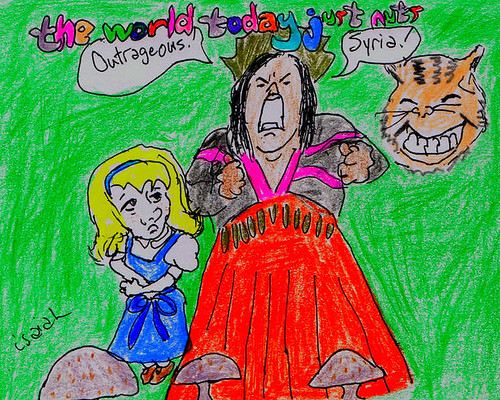
Isaiah's The World Today Just Nuts "Alice In Barackland" went up this morning.

Alice in Barackland

I know Isaiah was struggling with the visual look for the comic he wanted to do on Syria.  I really didn't understand what was going on, honestly.  I knew he felt it needed to have a distinctive look color wise.  Seeing it now, I get what he was going for and why he was so frustrated with earlier attempts.


As I have shared before, if I could have any talent, it would be to draw.  I don't mean, "Dig me, I'm in a museum!"  I mean animation.  I would love to be able to draw in entertaining ways.  To draw like Isaiah above or like "The Simpsons."

And if I could, I would draw my own cartoon series.

That's not a dream I had all my life.  It's one that probably popped up around 2008 or 2009.

And that's a talent I really wish I had.

Which doesn't mean that my life ends because it's not happening, it just means that we all need something to dream about.  I'll probably have some dream life when I'm 82.

For years and years, I wanted to be a dee jay on the radio.

That, to me, was an incredible job.

Then I got older and found out that they really didn't play what they wanted and that Clear Channel or whomever dictated what was played for every minute of the day and that was that.

In high school, for a little bit, I had fantasies of the WNBA.  I was good in middle school but in high school I really was on fire for a bit with basketball.

And I thought it would be really cool to be in the WNBA.  Figured I'd hang with Reggie and Cheryl Miller (famous basketball stars -- they're brother and sister).

Around the time I realized I wasn't growing anymore (both Cheryl and Reggie are well over six foot), that fantasy went flying away.

When I had my first child (my oldest son), for about a year I had this dream where he was going to be a doctor and I would be so happy because my son grew up to be a doctor.  And I even tried to do things like dress him up as a doctor for his first Halloween.  I got him some toys that I thought were medical. All he wanted to do was use them to bang out rhythm on the rails of his playpen or crib.

And he's turned out to be very musical.  Which is great.  But there was something one day when I was like, "No, not that, you want to eat . . ."  Whatever it was that at that moment I thought 'grew' doctors.  And I just heard myself in that moment and was so disgusted with myself.

He was a little baby and there I was trying to manipulate his whole life.

So I wisely trashed that dream.

But I think we all need fantasies.  Some days we really need them just to get through the work day.


"Iraq snapshot" (The Common Ills):
Wednesday, February 15, 2012.  Chaos and violence continue, UN Secretary-General Ban Ki-moon talks Camp Ashraf, another prep meet-up for a national conference takes place, Iraq continues to struggle to pass a 2012 budget, the US House Veterans Affairs Committee hears from the VA about their budget requests and more.
 
 
President Barack Obama, don't threaten veterans.  That was the message of House Veterans Affairs Committee Chair Jeff Miller this morning.  What was he talking about?  He was noting that other departments know whether or not sequestration would effect them but VA doesn't.  In 1985, the Congress passed the Gramm-Rudman-Hollings Budget Act.  If the budget triggers sequestration, then automatic cuts would take place.  Chair Miller explained that they had repeatedly attempted to get a clear answer from the White House on this issue but that they still had no answer.  "If the president won't lead on this issue," Chair Miller declared, "then we will."
 
It was a lively hearing.  So much so that all overshadowed Miller's opening remarks.
The hearing was about the 2013 budget and two panels appeared before the Committee.  The first panel was Secretary of Veterans Affairs Eric Shinseki (with the VA's Robert Petzel, Allison Hickey, Steve Muro, Roger Baker and Todd Grams).  Paralyzed Veterans of America's Carl Blake, VFW's Ramond Kelley, Disabled American Veterans' Joseph Violante, AMVETS Diane Zumatto and the American Legion's Timothy Tetz.  We'll note the second panel in tomorrow's snapshot and focus on the first panel today.  The White House has put out their trial budget.  The House Veterans Affairs Committee was focusing on the budget in terms of veterans issues.
 
Chair Jeff Miller: In the -- in the current budget submission, it has a billion dollars for Veterans Job Corps. We all are keenly aware of the high number of unemployed veterans in our country today. And not a single member of this Committee nor this Congress should be in any way satisifed with that number. And we have tried to do things in this Commitee to help bring those numbers down.  My concern is there's no detail in the budget submission. Where did the number one billion dollars come from?  You know, it was chosen to be provided in your entitlement accounts to be dispensed over a five year period.  And so I think we all benefit from a conversation, Mr. Secretary, as to who's going to be focused on, what area of the veteran population, how's it going to work and what will happen to these jobs once the funds run out?
 
 
Secretary Eric Shinseki:  Mr. Chairman, the proposal for the Veterans Job Corps, the $1 billion piece of that, is a program that we're seeking Congressional authorization on and we are putting together the details of that which we would provide to you and you would have a chance to review. I would say that the intent here is to put up to 20,000 veterans back to work over the next five years on projects that will protect and restore our public lands. Projects would be in national parks, forests, rivers and trails, wild life refuge, national monuments, other public lands. Veterans could work on park maintenance projects, patrolling public lands, rehabilitating natural and recreational areas and in administrative, technical, law enforcement-related activities. The Veterans Job Corps program is a project that's going to be coordinated with other departments and we are a -- sort of a oversight of the distribution of funds but there are others who will be participating.  I'm told that uh -- and I'm confident that uh VA resources won't be diverted to fund this $1 billion that it will come from elsewhere.  And I don't know exactly where at the moment.  But, Mr. Chairman, I'll share that with you as soon as I have clarity.
 
And we'll note, from his written statement about the Veterans Job Corps, "The program will serve all Veterans, but will have a particular focus on post-9/11 Veterans."  So the 20,000 jobs are not guaranteed to veterans of today's wars.  I'm not saying they should be but I am saying 20,000 wasn't, to me, an impressive number, and became less so when it was going to address not only the largest unemployed veterans population (young veterans of today's wars) but all veterans.  US House Rep Corrine Brown would bring up the issue of contracts and outsourcing and asking why every contract the VA outsourced didn't have a clause in it about hiring veterans?  Not really an answer. "You're not answering the question," Ranking Member Bob Filner pointed out to the VA's Allison Hickey as she went on about how one contract has seen a company hire 15% veterans and how they have conversations with contractors.  Filner pointed out that Brown's question was why didn't they mandate this in the contract, why have conversations when you should be writing it into the contract?  Hickey attempted to reply but Shinseki took over.
 
Secretary Eric Shinseki:  Mr. Filner, we'll take a look at this.
 
Ranking Member Bob Filner: Oh, come on, you can give me some kind of answer.  Are you saying we can't do it legally?
 
Secretary Eric Shinseki:  I don't know. I don't know the answer to that question.
 
Ranking Member Bob Filner: She must know the answer [gesturing to Hickey].  I mean, come on. This is not rocket science here.  You issue contracts 100 times a day.  Why can't we have contracts that do this?
 
Secretary Eric Shinseki:  You can. And I don't know the circumstances of this contract. And I would --
 
Ranking Member Bob Filner: But she apparently does. Why didn't we do it here?
 
Allison Hickey: So, Congressman, I will go back to our physician folks to ask --
 
Ranking Member Bob Filner: Oh, come on.  You guys know the answer to this.  Why are you so afraid to just tell us?
 
Secretary Eric Shinseki: I'm not sure it wasn't in the contract, Mr. Filner. That's why -- 
 
Ranking Member Bob Filner:  Well she's sure --
 
Allison Hickey: Congressman --
 
Ranking Member Bob Filner: You started off your testimony, "I know the contract." So did it specify or not?
 
Allison Hickey: I will find out and get back to you for the record --
 
Ranking Member Bob Filner: I don't understand this.  You know this better than you're saying here.
 
 
US House Rep Corrine Brown then noted that one of the biggest complaints she gets is that VA does billions of dollars of work and they're not doing it with veterans, they're not hiring them and this at a time when so many veterans are unemployed. Brown noted employment elsewhere in the hearing as well.  US House Rep and Dr. Roe raised the issue of the large number of suicides and shared that one thing he's hearing from veterans is that they're doing well in one-on-one sessions and then they're moved on to groups and that's not working.  "These needs aren't being met in large group settings," he explained. The short answer is that the VA is currently evaluating with plans to increase in the numbers hired where needed.
 
US House Rep Corrine Brown: Sir, I have a follow up on that, you said can we hire -- are we not -- are we trying to hire all those people or are we working with other agencies as far as subcontracting out? Because we're not going to be able to hire enough people.  He talked about the group setting, some people can benefit from the group setting, everbody don't need that one-on-one but some people do. So based on the resources, how can we better utilize the dollars to meet the needs?
 
Dr. Robert Petzel: Thank you, Congressman Brown.  We do contract in the community.  We do provide on a fee basis mental health care. And as the Secretary was just pointing out to me a new modality that's becoming increasingly important is tele-mental health where we provide both evaluation and therapy in a tele-health setting -- where the patient may be remotely, a hundred miles away. They're on a television screen with an appropriate supervisor and the psychiatrist or psychologist is back at a larger medical center.  It has been very successful in treating PTSD and other mental health disorders.  And I think that this is going to become a more common practice as we move forward.
 
FYI, Petzel called every female House Rep, throughout the hearing, "Congressman." Maybe here we'll call him "Mrs. Dr. Petzel" in the future?
 
Last week, Senator Patty Murray, Chair of the Senate Veterans Affairs Committee, participated in a Virtual Town Hall, an online Town Hall which allowed her and veterans all over the country to interact. The Virtual Town Hall was sponsored by Disabled American Veterans and a full transcript of the exchange can be found here.  Various veterans participating in the Virtual Town Hall noted the delays and backlog with regards to claims -- not surprising, over 500,000 claims are currently backlogged according to the VA's Allison Hickey testimony in today's hearing.  Senator Murray observed, "I receive so many complaints from veterans and their families about long waits for claims. I visited the Seattle Regional Office a few months ago and was astounded at the mountain of paper work and had the opportunity to really see what we are facing.  I am working hard to try and help the VA get a handle on this.  We do have to recognize that the claims are increasingly complex and there are more of them with the number of service members coming home today.  We want them to be done efficiently but correctly.  This will remain a top priority for me."  And in today's hearing, Ranking Member Bob Filner touched on the issues of backlog and Agent Orange.
 
 
Ranking Member Bob Filner: And I just want to ask a couple -- focus on a couple areas that I've been involved with over the years. One is the claims backlog.  In your budget presentation ou title it "Eliminate The Claims Backlog." But I don't see any real estimate or projection or anything of when you think you're going to do that but I still think that -- in the short run, at least -- to get this turned around your notion of -- I think you used the word "brute force" a few years ago, if I recall that.
 
Secretary Eric Shinseki: It was probably a poor choice of words.
 
Ranking Member Bob Filner: No, it's okay. It was good. Gives me something to shoot at, you know? I don't think it's going to work.  I just think all this stuff you have is good stuff but it's too big and, as you point out, there's all kind of factors making it bigger.  I still think you have to take some, I'll say, radical step in the short run -- whether it's to grant all the Agent Orange claims that have been submitted or have been there for X number of years or, as I've suggested at other times, all claims that have the medical information in it and have been submitted with the help of a Veterans Service Officer you accept subject to audit. That is, unless you take some real radical step to eliminate a million of them or 500,000 of them, you're never going to get there. It's going to always be there.  You don't want that as your legacy -- I don't think.  So -- Nor do we.  I think you're going to have to take some really strong steps in terms of accepting stuff that's been in the pipeline a long time, again, that has adequate -- by whatever definition -- documentation and help from professional support. Plus this incredible situation of Agent Orange where, as you know, not only have those claims increaded but we're talking about -- as you well know -- your comrades for thirty or more years that have been wrestling with this.  Let's give the Vietnam vets some peace. Let's give them a real welcome home. Let's grant those Agent Orange claims.  Let's get those -- whatever it is, 100,000 or 200,000  of our backlog -- just get them off the books.  I don't know if you want to comment on that but I still think you're never going to get there with -- All this is good stuff.  We've talked about it on many occasions.  But it's not going to fundamentally -- or at least in the short run change it around so you can get to a base  level of zero or whatever you want to be and move forward from there.
 
Secretary Eric Shinseki:  Mr. Filner, I'll call on Secretary Hickey for the final details but we've pretty much worked through the Agent Orange -- the increase in Agent Orange claims. I think we're well down on the numbers. I'll rely on her statistic here.
 
Many other issues were touched on.  We'll note the exchanges on women veterans.
 
Ranking Member Bob Filner: The House passed a bill that I had put forward a year or two ago called a Women's Veterans Bill of Rights.  It got through the House, it got stuck in the Senate.  [He's referring to HR 809 which he introduced in the 111th Congress and which the Senate didn't pass.  He reintroduced HR 809 in the new Congress in February of 2010.]  I would just ask that you look at that.  You can do stuff administratively. You could post something in each of our centers and clinics. We have a long way to go on this but women veterans need to feel that this institution is evolving to meet their needs.  And a statement at the front door of their rights, I think, would be very helpful. So I would just ask you to look at that.  We didn't do it legislatively but I think you could do some stuff administratively. 
 
Shinseki replied that women veterans' issues in the proposed budget increased by 17%. Dropping back to his written statement, he gives 8% as the number women make up in VA's total population, women are "nearly 15 percent of today's active duty military forces and 18 percent of National Guard and Reserves."  337,000 women access care through VA and, "The 2013 budget includes $403 million for the gender-specific healthcare needs of women Veterans, an increase of 17.5 percent over the 2012 level."  Later in the hearing, US House Rep Linda Sanchez would raise the issue of women veterans and we'll jump to her exchange.
 
US House Rep Linda Sanchez: Secretary Shinseki, I recently had the opportunity to visit the Patient Alligned Care Center at the Long Beach VA facility and I want to applaud the efforts there to provide an integrated system of care. But one of the things that's been brought to my attention is the levels of staffing for the new models that will be put in place. I heard from doctors, nurses and other pracitioners to discuss how thinly they feel they are being stretched in this new system. And it's a system that they want to see succeed. They're employed there because they believe in the mission, they want to provide the service.  But I'm wondering if you could maybe go into a little bit of detail  as to how the $433 million that is proposed for patient-centered care -- how that will go towards staffing to make sure that we have the staff availble to meet the needs of those veterans.
 
Secretary Eric Shinseki:  I'm going to call on Dr. Petzel for the details.
 
US House Rep Linda Sanchez: Sure.
 
Dr. Robert Petzel: Thank you, Mr. Secretary.  Congressman Sanchez, when we implemented the PAC [Patient Aligned Care] program, several years ago, the first thing that we did was a survey of what we call PAC readiness.  One of which was to determine how many support people there were in place for each one of the providers in a PAC clinic.  The desirable ratio agreed to in the entire health care community is 3 people per provider. We found that there were places that were reaching that goal and then others that weren't.  One of the major things that has been involved in the PAC model financing has been to provide the medical centers with -- and the clinics with -- the number of people that they need to support the provider.  I will look specifically at Long Beach and I can, in fact, get back to you. But our goal -- and we're very close to it as I understand -- is to have 3 support people per provider in each one of our clinics.
 
 
US House Rep Linda Sanchez: Okay because I hear stories about staffing being stretched and no new hires or people leave and are not replaced. And so the concern is to have the appropriate amount of people available to provide the services that are needed.  And I would appreciate you following up with me about that.  To the Secretary, I know that you and I have previously discussed some of my concerns -- specifically with respect to the VA employing female specialists to assist specifically female veterans with VA services.  And I know that the administration's budget contains $403 million to address the needs of women veterans.  I'm wondering if you can tease that out a little bit and provide more specifics on how that money will be used to address the growing needs of the female veteran population?
 
Secretary Eric Shinseki: Uh, thank you, Congresswoman. I'm going to call on Dr. Petzel for the details but this is confirmed that you and I have had discussions about this.
 
US House Rep Linda Sanchez: Yes.
 
Dr. Robert Petzel: I thank you, Mr. Secretary.  Uh, the -- our goal is to ensure that every female veteran has a choice of providers and that, if they wish to, they will be able to be seen by a female provider.  About 75% of women choose to have a female provider.  And we are able to meet that need in virtually every setting except perhaps some remote community-based outpatient clinics where we just don't have those sort of uh facilities.  I can, for the record, give you the details about how much staffing -- what kind of staffing is to be associated with the $403 million increase we're seeing in women's health programs. I don't have that number at the tip of my fingers but it is important to us as I'm sure it is to you that women have a choice, that if they wish to see a female provider, they are afforded that opportunity.
 
US House Rep Linda Sanchez:  Yeah, one of the things on my tour of the Long Beach facility is that they do have a sort of separate women's clinic area where women can choose that to be their point of entry to the system.
 
Dr. Robert Petzel: About sixty of our largest medical centers have specific women's centers, women's health centers where all of the services are provided in that same environment. The rest of them are sort of associated with women specific primary care clinics when they're not as large. And then, in community based outpatient clinics we have trained the primary care providers in the necessities of women's health.
 
 
Homelessness was touched on by US House Reps Corrine Brown and Dr. Phil Roe.  We're ignoring that for two reasons.  1) Roe brought up that once a case worker has X number of clients, the VA isn't issuing vouchers so even though there is space a veterans left sleeping on the street or somewhere else (he or she receives no voucher).  Shinseki noted that homeless veterans were decreasing.  Are they?  Or is this program -- which tracks beds used in shelters -- not factoring in that veterans aren't receiving vouchers if their caseworker is maxed out?  That's not addressed and until it is, I'm not interested in going into the figures.  2) What we do know is that one group of homeless veterans is increasing and it's not the stereotype of the homeless veteran.  Earlier this week, Peggy McCarthy (The Day) reports on homeless veterans. Andy and Miriam Miranda live with their young son in a New Haven shelter. Andy's a veteran, they both have degrees and were teachers and their home was foreclosed during these economic hard times. McCarthy reports an emerging trend for homeless veterans is that it's no longer a single veteran but families. Connecticut saw 15 veterans family appealing for help via the homeless programs in 2008 but last year saw 135 families which mirrors what's happening on a national level (2010 saw "an 86 percent increase over 2009").  This increasing group -- homeless veterans with their femilies -- was not addressed in the hearing.  The VA budget calls for "$1.352 billion for programs that will prevent and treat Veteran homelessness" (Shinseki's written statement) and I'm fine with noting that figure but, repeating, if VA is saying that the number of homeless veterans is decreasing and US House Rep Roe is telling us -- without any dispute from Shinseki or anyone from the VA on the panel -- that homeless people are being turned away when beds are available, that they're not being given vouchers, then I think the VA needs to clarify how they're collecting their numbers.  I'll also note that Shinseki's defined as "VA's goal" for 2013 "to serve 32,000 homeless veterans."  Also on the issue of homeless veterans, Senator Patty Murray's office released the following this afternoon:
 
 
FOR IMMEDIATE RELEASE
Contact: Murray Press Office
(202) 224-2834
Wednesday, February 15, 2012

Tester Press Office (202) 228-0371
Snowe Press Office (202) 224-8667


VETERANS: Chairman Murray and Senators Tester and Snowe Call on VA and HUD to Provide Answers about Homeless Women Veterans

After GAO report emphasizes data collection partnership opportunities between VA and HUD, Murray, Tester, and Snowe ask Secretaries for answers ahead of the March 14 Senate Veterans' Affairs Committee hearing on veteran homelessness
READ FULL GAO REPORT HERE

(Washington, D.C.) -- Today, Senate Veterans' Affairs Committee Chairman Patty Murray, Committee Member Jon Tester, and Senator Olympia J. Snowe sent a joint letter to Department of Veterans Affairs Secretary Eric Shinkseki and Department of Housing and Urban Development Secretary Shaun Donovan asking for explicit answers to questions in light of a GAO report highlighting missed opportunities for the two departments to improve services for homeless women veterans. The report also highlighted limitations in available housing options for women veterans with children and an inability to ensure the privacy, safety, and security of women veterans in mixed-gender housing facilities.

"It is critical that we continue doing absolutely everything we can on behalf of the brave men and women who have already made tremendous sacrifices for our nation," the Senators wrote. "Until every single veteran is off the street, we must not relent in our efforts to provide the services and assistance they need to find adequate and long-term housing for them and their families. In doing so, we must make every effort to ensure we are addressing the needs of our entire veteran population, particularly our women veterans, to ensure their needs are being met and they are not falling through the cracks."

The Senators have requested a response in advance of the March 14 Senate Veterans' Affairs Committee hearing scheduled on veteran homelessness.

The full text of the Senators' letter follows:

The Honorable Eric K. Shinseki
Secretary of Veterans Affairs
810 Vermont Avenue, NW
Washington, DC 20420

Honorable Shaun L.S. Donovan
Secretary
United States Department of
Housing & Urband Development
451 7th Street, SW
Washington, DC 20410


Dear Secretary Shinseki and Secretary Donovan,

We appreciate your ongoing efforts to reduce homelessness among our nation's veterans, and applaud your request for an increase of $333 million for programs to end veteran homelessness in the fiscal year 2013 budget. Recent reports of a 12 percent reduction in the homeless veteran population over the last year are certainly a testament to your hard work and leadership. Despite these gains, we have concerns that the particular needs of homeless women veterans are frequently being overlooked. As we see more and more women veterans returning from Iraq and Afghanistan, it is increasingly critical that we do more to help them transition home.

As you know, a recent Government Accountability Office report, "Homeless Women Veterans: Actions Needed to Ensure Safe and Appropriate Housing," highlighted an opportunity to increase collaboration between your two agencies when it comes to gathering data about homeless women veterans. As you would undoubtedly agree, without that data, it is impossible for us to have a clear understanding of the demographics of this population or to develop a strategy that can effectively address their particular needs.

The report also highlighted limitations in available housing options for women veterans with children. Although VA has a referral policy in place for temporary housing, it is not being implemented uniformly nationwide. As a result, homeless women veterans in some parts of the country are forced to return to the streets until they are admitted into the Grant and Per Diem or HUD-VASH programs. Additionally, infrastructure needs such as private and secure rooms and showering facilities are often lacking -- placing women veterans in uncomfortable and potentially unsafe situations. We can and should do better.

In light of this report, we request responses to the following questions:

* What steps are your agencies taking to better capture information on our homeless women veteran population?

* How do you track both the demographics and particular needs of this population?

* What strategies are being employed to effectively address their unique needs?

* What improvements will be made to VA's implementation of its referral policy?

* What type of gender-specific safety and security standards will be implemented for VA's Grant and Per Diem program?

* What additional steps need to be taken to reduce the rate of homelessness among female veterans?


Recent data from the Bureau of Labor Statistics points out that, although the overall number of unemployed veterans has decreased significantly over the past year, the unemployment rate amongst women veterans is now more than double the national average. As unemployment rates often directly correlate with rates of homelessness, how closely are your Agencies working with the Department of Labor to reduce the homeless women veteran population by addressing one of the underlying symptoms of their unemployment or underemployment?

It is critical that we continue doing absolutely everything we can on behalf of the brave men and women who have already made tremendous sacrifices for our nation. Until every single veteran is off the street, we must not relent in our efforts to provide the services and assistance they need to find adequate and long-term housing for them and their families. In doing so, we must make every effort to ensure we are addressing the needs of our entire veteran population, particularly our women veterans, to ensure their needs are being met and they are not falling through the cracks.

We appreciate your attention to this matter, and request a response to inform our views in advance of the March 14 hearing before the Senate Committee on Veterans Affairs on veteran homelessness. We look forward to working closely with both of you to address this critical issue.

Sincerely,

Chairman Patty Murray

Senator Jon Tester

Senator Olympia J. Snowe

###
Meghan Roh
Deputy Press Secretary
Office of U.S. Senator Patty Murray
202-224-2834


Violence continued in Iraq today.  Reuters notes a police officer's Jurf al-Sakhar home was attacked with gunfire and grenades leaving his wife and their two daughters dead and him injured and a Baquba roadside bombing left two people injured.  Aswat al-Iraq adds that a Mosul bombing left 1 person dead and one police officer injured.
 
From the never-ending violence to confusion.  Confusion over AFP and Reuters' reporting and confusion over United Nations Secretary-General Ban Ki-Moon. Let's set the stage by noting what we were noting this morning.  We're talking about the residents of Camp Ashraf, approximately 3,500 Iranian dissidents who were welcomed into Iraq decades ago, following the Iranian revolution. Nouri al-Maliki does not care for the residents and has, since Barack Obama was sworn in as US President, twice ordered their assault. They are protected persons under international law and Nouri gave his word that he would ensure their protection. Nouri's word is worthless. They are being relocated to Camp Liberty. The British Parliamentary Committee for Iran Freedom's Muriel Turner offers this in a guest column for UPI:


The 3,400 residents will be housed it what can only be described as veal crates, in an area not much more than half-a-kilometer-square. Martin Kobler, the U.N. special representative to Iraq, has admitted to Ashraf residents that they will still be denied medical facilities. There will be no way to care for the disabled and nowhere to tend to the injured.
There isn't even any drinking water!
Their instructions mandate that, residents can only take "individual belongings" with them -- basically as much as they can carry. Vehicles and other property that they have worked hard for over the 30 years in Ashraf will have to be abandoned.
The Iraqi government has designated Camp Liberty to be a "temporary transfer location." That's because it does not meet the standards required of a refugee camp.
Once inside Camp Liberty, the 13-foot-high walls will close in on them and they will no doubt be forgotten. They will have no way of contacting U.N. observers other than by telephone, which the Iraqis will disconnect as they please. They are to be fingerprinted upon arrival, as if they were prisoners of war. One report said Iraqi guards, perhaps even the same guards who killed their friends and relatives, will be based inside the camp.

United Nations Secretary-General Ban Ki-moon's Special Envoy to Iraq is Martin Kobler. He penned a column on Camp Ashraf for the International Herald Tribune which includes:

As a first step, it calls for the camp residents to voluntarily relocate to a transit site at the Baghdad airport. In contrast to Camp Ashraf, this site would be monitored around the clock by observers from the United Nations. There, the residents would be interviewed by the U.N. refugee agency, the UNHCR, to determine their eligibility for refugee status, paving the way for their resettlement outside of Iraq. Most have filed refugee claims. A small number have returned to Iran in recent years, but many others will want to go elsewhere.
Under the same agreement, the government of Iraq has made two key commitments that it must uphold. First, it has accepted full responsibility for the safety and security of the residents, from the relocation process throughout their stay at the new facility. Secondly, it has promised that nobody would be forced to go to Iran or elsewhere against their wishes.
The new site is a former U.S. Marine base that can hold more than 5,000 people. It has been equipped at considerable expense to receive the residents of Camp Ashraf. It has cooking and medical facilities, space for recreational activities and provisions for women and religious observance. UNHCR has carried out a careful technical assessment and determined that the new camp meets the humanitarian standards it applies for refugee situations around the world.
Yes, the two are at odds over the conditions of Camp Liberty. First, Reuters, Kobler's column was not "an article in Wednesday's New York Times."  It was a column run by the International Herald Tribune.  The New York Times is now the sole owner of that paper and it elected to repost the column to the New York Times website today.  It did not run it in the paper.  This should have been clear with the note the Times' website attached to the column at the end: "A version of this op-ed appeared in print on February 16, 2012, in The International Herald Tribune."  Repeating, the column did not run "in Wednesday's New York Times."  That is an error you should correct.  It's also a minor point except to note that the wires obviously don't read the daily New York Times -- either in print or digital form.  And that's not necessarily a bad thing, just something worth noting.
 
Confusion.  For some reason, Ban Ki-moon weighed in today.  No indicationthat this would be happening from Kobler's column.  More confusing are his remarks.  The UN News Centre notes:
 
Secretary-General Ban Ki-moon today called for the start of the relocation of residents of the settlement in Iraq formerly known as Camp Ashraf, urging the Government and the camp dwellers to continue to cooperate so that the process can be carried out in a peaceful manner.
"The Secretary-General reiterates that the Government of Iraq bears the primary responsibility for the security and the welfare of the residents of Camp Ashraf," said a statement issued by his spokesperson.
"At the same time, the residents of Camp Ashraf also bear a responsibility to abide by the laws of Iraq. Any provocation or violence must be avoided and would be unacceptable."
 
I'm confused why he made that last statement?  Are Camp Ashraf residents threating to riot or attack?  There's been no reports indicating that.  They aren't supposed to have any weapons, the US disarmed them.  It's a very interesting remark.  Did he say it? Let's go to the UN's post of UN Secretary-General Ban Ki-Moon's remarks:
 
The Secretary-General continues to closely follow the situation in Camp Ashraf. Over the past few months, the United Nations Assistance Mission for Iraq (UNAMI), under the leadership of his Special Representative, Martin Kobler, and in close cooperation with UNHCR, the European Union, the United States and other interested Member States, has been tirelessly working as an impartial facilitator to promote a peaceful resolution of this issue, within the framework of UNAMI's humanitarian mandate.
At the request of the Secretary-General, the Government of Iraq extended its deadline to close Camp Ashraf from 31 December 2011 to 30 April 2012. The Memorandum of Understanding (MoU) signed on 25 December 2011 between the United Nations and the Government of Iraq has laid the foundation for a peaceful and durable solution, respecting both the sovereignty of Iraq and meeting Iraq's international humanitarian and human rights obligations.
The Secretary-General acknowledges the efforts of the Government of Iraq to prepare the temporary transit location to host the residents and allow UNHCR to undertake refugee status determination. On 31 January 2012, UNHCR confirmed that the infrastructure and facilities at the temporary transit location are in accordance with the international humanitarian standards stipulated in the MoU.
The Secretary-General believes that the time has come to start the relocation process without further delay. He urges the Iraqi authorities and the residents of Camp Ashraf to continue to cooperate and complete the process in a peaceful manner. The Secretary-General reiterates that the Government of Iraq bears the primary responsibility for the security and the welfare of the residents of Camp Ashraf. At the same time, the residents of Camp Ashraf also bear a responsibility to abide by the laws of Iraq. Any provocation or violence must be avoided and would be unacceptable.
The Secretary-General reiterates his call to Member States to contribute to a durable solution by demonstrating their readiness to accept eligible residents of Camp Ashraf who wish to resettle in third countries.
The Secretary-General stresses that the United Nations remains strongly committed to continue to do its utmost to facilitate a peaceful and durable solution.
 
Yes, the remarks the UN intended to be attributed to him carry it.  So where is that in the Retuers report?  Or the AFP report?  Not present in either. That's the part that confuses me regarding the two news outlets.  In terms of Ban Ki-Moon, the remarks admonishing Camp Ashraf residents not to resort to violence and the timing of the 'you must move now'  statements are confusing.
 
Turning to the political scene, Al Mada notes that the Parliament discussed the 2012 federal budget yesterday, they also did a reading (the first reading) of it. The article mainly addresses MP Jaafar al-Moussawi. He is a part of the National Alliance and a member of the Sadr bloc. He is also an opponent/rival of Nouri's for many years now. He has repeatedly, over the years, called for the Constitution to be followed and castigated Nouri when Nouri refused to do so. November 28th, a bomb went off outside Parliament. Dropping back to that day's snapshot:


In the one that will probably have the most impact the Baghdad-based government, Parliament was attacked. Confusion remains as to what it was attacked with. Mohammed Tawfeeq (CNN) puts it this way, "Also Monday, a mortar round landed inside the heavily fortified Green Zone, killing at least two people, police said. The round landed on the outdoor car park that belongs to the Iraqi Parliament compound and hit a car. " Citing the news channel Al-Arabiya, Adnkronos Security maintains it was a rocket. KUNA states mortars and that it "hit a parking lot near the parliament" leaving at least four injured. Aswat al-Iraq notes Parliament's Mohammed al-Khalidi states it was a car and a suicide bombing, "the car exploded outside the parliament building, where the driver was trying enter, but blocked by a military hummer, which obliged him to commit suicide." AFP emphasizes the confusion over details, "The explosion in the parking lot of the Iraqi parliament was caused by a mortar round, said Baghdad security spokesman Qassem al-Moussawi and several other sources. However, at least two sources at parliament said it was a car bomb." Parliament's spokesperson Aidan Helmi declares the attack was an attempted assassination of Speaker of Parliament Osama al-Nujaifi and states the car involved was similar to the cars used in Nujaifi's security detail and that when asked to display a security badge, the car slammed into anothe car, the driver got out and detonated a bomb on his person. Jack Healy, Yasir Ghazi, Andrew E. Kramer and Zaid Thaker (New York Times) observe, "An attempted bombing steps outside Parliament would represent a serious security breach inside one of the capital's most heavily guarded sectors, raising questions about the competence -- or complicity -- of security forces. Parliament sits inside the Green Zone, the locked-down expanse along the Tigris River that houses many Iraqi governmetn buildings and the American Embassy."

Immediately came the lies. In order to try to elevate Nouri to martyr status, he and his lackeys began declaring that it was an attack on him. He was no where near the Parliament nor scheduled to be. But his vanity is so great that everything must be about him.

The attacks were blamed -- by the press -- on the usual catch-all: al-Qaeda in Mesopotamia.
More recently, Nouri's asked that the Supreme Court lift Jaafar al-Moussawi's immunity and accused him of being responsible for the bombing. al-Moussawi held his press conference yesterday at the Parliament building and denied any involvement in the bombing or guilt of the charges. He decried unnamed politicians who were attempting to use the media to smear his name. He stated that a DNA test on the body of a corpse thought to be the suicide bomber demonstrates that the man, two hours prior to the bombing, killed someone working for al-Moussawi (a bodyguard). al-Moussawi states he has other information and will be sharing it. Dar Addustour has him declaring that it was not him or people supporting him that did the bombing but people wanting to harm him for Saddam Hussein's execution. Alsumaria TV reports this morning that Spain's Ambassador to Iraq, Jose Turbine, is stating that the national conference is going to resolve the al-Hashemi issue.


Today Aswat al-Iraq reports, "The preparatory committee for the National Conference held its third meeting today with the attendance of all parties, according to a Parliament statement issued today."  Since December, President Jalal Talabani and Speaker of Parliament Osama al-Nujaifi have been calling for a national conference to address the political crisis. All this time later, all that's taken place is meetings to prepare for it. Al Mada reports that al-Nujaifi attempted to meet with State of Law for a discussion but they rebuffed him. al-Nujaifi is a member of the Iraqiya political slate headed by Ayad Allawi. They came in first in the March 2010 elections. Nouri al-Maliki's State of Law slate came in second. Iraqiya's Haider Mullah is calling for the issues of Deputy Prime Minister Saleh al-Mutlaq and Vice President Tareq al-Hashemi to be addressed prior to the national conference. Nouri is demanding that al-Mutlaq (a Sunni and member of Iraqiya) be stripped of his title (and immunity -- so Nouri can sue him for "libel" for his comparison of Nouri to Saddam Hussein) and he issued an arrest warrant for al-Hashemi (a Sunni and member of Iraqiya) on charges of 'terrorism.' This is what finally prompted press attention in the political crisis that's gone on since December 2010.


Tuesday, February 14, 2012

Vultures

Whitney Houston died Saturday.  The singer was only 48 years old.

In terms of community coverage, "Whitney (Ava and C.I.)"  kicked things off Sunday and Ava and C.I. did the illustration below (with Isaiah) for that feature.

wh

Last night, Marica, Kat and Stan weighed in.


  • And that pretty much says everything except for one thing.

    I hate the vultures.

    You may think I mean the media and they are certainly picking her bones.

    But I'm referring to people like a woman in the building that I've never more than nodded to who immediately rushed to me Monday mumbling how awful the news (of the death) is but do I have some Whitney CDs?  Any on me?  Any she could copy?

    She died.

    You made it through your whole life without buying her music, why are you chasing the hearse now?

    It makes no sense to me.

    It's not like she just emerged.  She's been in the public eye since 1985.

    So clearly you made the decision that her music wasn't your can of cola.

    Fine.

    But now that she's dead you suddenly need to have a copy of her music?

    This same woman did the same thing when Amy Winehouse died.  Only she didn't ask me.  She went up to this guy I'm friends with and -- he's British, maybe that's why she went to him -- talked about how awful Amy's death was and all and, oh, by the way, did he have any of her music?

    She never cares about anyone until they die.  She's the most ghoulish person in the building.  She was going on about Heath Ledger.  Oh, he was so wonderful and so great and she never saw him until the Dark Knight but she didn't know about him, she told me Monday, until he died.

    People like her are vultures.

    "Iraq snapshot" (The Common Ills):
    Tuesday, February 14, 2012.  Chaos and violence continue, Nouri's accusations are noted by those he accused, Iraqiya calls for those imprisoned who have not been convicted to be released, US Senator Patty Murray talks with veterans in a new format, and more.


    Wally: Who determines what diseae's or ailment's is agent orange. I have several health issues and when i get a agent orange exam they tell me it is not on the list, yet I know there are other vets witht he same problems. I know the doctor I see at the exam does not record the symtoms. Why can't we see someone who monitors the health issue to verify it might be agent orange related.  I was told the way health issues make the list is when the population of all viet nam vets have a higher number of health issues than the regular population. I know I was sprayed with agent orange why should my health issues be diluted with vets that were not exposed?
     
    Senator Patty Murray: We worked hard last year to defeat an amendment in the Senate that would have changed the VA standard for determining presumptions for Agent Orange because some wanted to just "save money" I knew that was wrong and we beat that amendment.  We will have to remain vigilant this year as well.  Research is going on as we speak and hopefully we will be able to better help you and many more in the future.
     
    That was Senator Patty Murray conversing with veterans last week and we'll come back to that in just a moment.  First, if you need to know how ugly the Agent Orange issue got on the Senate Veterans Affairs Committee, you can refer to the September 23, 2010 snapshot reporting on that day's hearing when Senator Jim Webb had his little hissy, when Senator Roland Burris insisted that "budget shortfalls" do not mean you cut needed health benefits for veterans and, as Senator Burris said that, Senator Jon Testor, with an angry look on his face, rose and stormed out of the hearing.  Earlier Testor had been backing up Webb who was furious that VA Secretary Eric Shinseki was attempting to see to it that the victims of Agent Orange got the help they needed.
     
    And we're going to drop back to the June 15, 2010 snapshot:
     
     WAVY reports (link has text and video) that victims of Agent Orange (specifically Vietnam era veterans) could recieve addition beneifts for B-Cell Leukemia, Parkinson's disease and coronary heart disease.  Could?  A US Senator is objecting to the proposed changes by VA.  Jim Webb has written VA Secretary Eric Shinseki that ". . . this single executive decision is estimated to cost a minimum of $42.2 billion over the next ten years. A regulatory action of this magnitude requires proper Congressional review and oversight."  Besides, Webb wrote, "Heart disease is a common phenomenon regardless of potential exposure to Agent Orange." That is really embarrasing and especially embarrassing for the Democratic Party (Webb is a Democrat today, having converted from a Reagan Republican).  It also goes a long way towards explaining Webb's refusal to get on board with Senator Evan Bayh's bill to create a national registry that would allow those Iraq and Afghanistan War veterans to be able to receive treatment for their exposures without having to jump through hoops repeatedly.
     
    Veteran Jim Webb did everything he could to prevent victims of Agent Orange and Burn Pits from receiving the medical treatment they needed.  That's why he can't run for re-election.  Veterans in Virginia pulled their support in 2010 over the Agent Orange issue.  His decision not to seek re-election has to do with the fact that he doesn't have the votes to win.  And he shouldn't after what he did.  There's an important lesson there: A veteran isn't necessarily the one to elect to Congress if you're concerned about veterans issues.
     
    Back to Senator Patty Murray's remarks.  She made them last Thursday at a Town Hall.  It was the first of its kind for veterans, being able to speak with the Chair of the Senate Veterans Affairs Committee and from their home or work or library.  It was a Virtual Town Hall which Disabled American Veterans sponsored. A full transcript of the exchange can be found here.  Face to face contact is always best, yes.  And that's why Murray takes part in Town Halls frequently.  But the Virtual Town Hall allowed her and veterans from around the country to meet up online and that was especially helpful to veterans who may have issues with mobility.  Many issues were raised, from VA charging for services that they are supposed to provide for free, the need for better transitioning of Wounded Warriors, the long wait time for medical appointments for mental treatment.  One question dealt with an issue on many veterans minds.
     
     
    Jeremy K.: We have about 2 million combat veterans who are going to be coming back, or are already back, from Iraq and Afghanistan.  Too many of them are sick and injured and will need VA.  Given the government's debt, is VA going to have the money and people to meet those needs while continuing to serve 5-6 million older veterans?
     
     
    Senator Patty Murray: There is no doubt that we as a nation must address the issue of our national debt.  However we send our men and women into combat and should never allow our budgets to be an excuse for not providing them with the care that has been promised.  We will be getting the Presidents budget next week, and I will be looking at it very carefully to make sure we are meeting the needs of our nation's veterans.
     
     
    Veterans exposed to burn pits in Iraq and Afghanistan have health needs. Martin C. Evans (Newsday) is apparently the only reporter at a major daily newspaper to cover yesterday's Burn Pits Symposium at Stony Brook College. Evans reports that the Army sent Veronique Hauschild from their "Public Health Command" to speak and she insisted that the military needs to do its own studies and added, "I don't want to say there's not a problem because I believe there is." But that "I" is herself and not the official position of the Army.  Her presence is encouraging, however. It attests to the reality that the Pentagon can no longer outright dismiss the very real damage of burn pits. If the government study (a bunch of subsidized scientists refusing to disclose their government funding as they posed as independent) from last fall had been a success, the Pentagon would not have felt the need to send someone to the conference. But the pushback on that non-scientific nonsense and the increased public awareness of the damage from burn pits was so great that the paper is pretty much dead and rebuked.
    Evans notes a study Dr. Anthony Szema did "published in the September issue of the Journal of Occupational and Environmental Medicine, area soldiers who served combat tours in Iraq and Afghanistan were found to be about seven times more likely to display signs of damaged lungs than enlistees who never served there."  Last week,  Kelley B. Vlahos (Antiwar.com) explained:

    We've been following the issue of toxic environmental exposure of U.S. servicemen and women here at Antiwar.com since 2009. Mounting evidence strongly suggests that the unregulated open-air burn pits used to incinerate everything from medical waste to batteries and rubber tires, has contributed to the fine particulate matter found carried in the dust, including metals and bacteria, and has something to do with the dramatically changed health of returning veterans.
    "What makes healthy individuals who have never had asthma end up in wheelchairs on oxygen, or a 34-year-old non-smoker who has near-normal [physical fitness tests] but is short of breath and has lungs that are totally destroyed? These are the problems we are trying to solve," exclaimed Dr. Anthony Szema, Stony Brook University Medical Center Assist Professor of Surgery, in a recent interview for the Army Times.
    Szema recently wrote about a soldier serving both in Iraq and Kuwait who has lung tissue riddled with fine particles of titanium, iron and copper. He published his findings recently in the Journal of Occupational and Environmental Medicine. It is part of his ongoing study of soldiers suffering from unexplained illnesses.
    This particular soldier, according to the report, is suffering from nonspecific interstitial pneumonitis, a rare and dangerous type of pneumonia that afflicts people for no known reason, cannot be treated and is 60 percent fatal within the first six months of diagnosis, according to Wikipedia. What we know about the soldier is where he was stationed, and that he came into contact with "the laundry facility, improvised explosive device blasts, sandstorms, burn pits and the occasional cigar."


    In Iraq violence continues,  AP notes a Baghdad bombing has claimed 1 life and left six other people injured. In addition, Reuters notes 1 Asaish was shot dead in Kirkuk and, dropping back to Monday, the corpse of 1 woman was discovered in Baquba (strangled),  2 corpses were discovered elsewhere in Baquba (the two are thought to have been killed in 2006).  Mohammed Tawfeeq (CNN) reports military General Aziz Hamzah was shot dead in Baghdad, a second Baghdad bombing left two peple injured and a Mosul bombing claimed 3 lives and left nineteen people injured.
    Violence includes the targeting of various groups in Iraq with threats of violence or with actual violence.  The Secretary of the South Asia Council for Minorities Navaid Hamid (Two Circles) notes the targeting of Iraqi Chrisitans:
     
    After a month of the withdrawal of the Allied forces from Iraq and its becoming a sovereign state, one of the serving US Military Archbishop Timothy P. Broglio admitted in an interview to CNA in Rome, "Yes, you can say in a certain sense that the invasion of Iraq did provoke this tremendous diminution of the Christian population in that country. And what the future holds, that still remains to be seen," Archbishop Timothy believes that the collapse of Iraq's Christian population is among the legacies of America's invasion in 2003 and he is perfectly correct.
    [. . .]
    While announcing the withdrawal of American forces from Iraq, President Obama had confidently thundered on 15th December 2011, "they were leaving behind a "sovereign, stable and self-reliant," country and just 10 days after his pronouncement the Christian community in Iraq was under such tremendous pressure that fear of an attack forced Christians during Chrism to cancel the Chaldean Catholics' midnight Christmas celebrations. Services were moved to the daytime, and Christians were warned by community leaders not to display decorations outside their homes.
    I wonders whom to blame for the decimation of the patriotic Iraqi Christians from Iraq, invading Allied forces under US command or Al Qaida?
     
    Last week, Aswat al-Iraq noted "that Italy granted Iraq a loan of half a billion Euros (approximately $660,000 in US dollars) to support Iraqi infrastructures and human development" with the provision that 10% of the loan "be allocated to support the Iraqi Chrisitans."  Also last week, the Vactian Ambassador to Baghdad, Archbishop Giorgio Lingua, met with Yousif al-Shukri, the Minister of Planning in Iraq, to discuss the Iraqi Christians "and the difficulties theya re facing" and to note that, in 1977, Christians made up 5% of the population in Iraq; however, that number has fallen to "less than 1 percent." While al-Shukri noted that all segments of Iraq are under attack, the Archbiship noted that Iraqi Christians are fleeing due to violence.
     
    We'll note three reports on Iraqi Christians who left Iraq and relocated.  Farid Farid (The Conversion) observes that Iraqi Christians make up over "40% of forced migrants and refugees" and he notes the Iraqi Christians who have migrated to Australie:

    It is important to understand that the pain, indiginity and humiliation of war still resides deep within Iraqi hearts, minds and bodies.
    As Aghnar Niazi, an award winning visual artist residing in Sydney, has said, "if you look at my paintings you will see the internal expressions what we as Iraqi have been going through -- sadness, joy and exhuastion . . . we are an open book  for the world to see." 
    Her words and her paintings are a testament to a new chapter in Iraq's future which hopefully will be less bloody.
     
    Nicole E. Smith (Rock Hill Herald) reports on Mazen Asaqa whose father expressed that he "couldn't have asked for a better son" the day before the father was kidnapped in Mosul for being a Christian.  The father's corpse turned up within the week. In 2009, Mazen Asaqa was able to join "his mother, Awitif, and sisters Maha, 28, and Rand, 27" in Detroit.  With the Presbyterian Peacemaking progam, he has been speaking in South Carolina about his and other Iraqis experiences including the phone call his father got in 2006, ordering him to pay $20,000 and shut down the church, "He told me, 'I've been therre 40 years, and I'm not closing it now. I could not go to sleep thinking how the money went to weapons, explosives and killing more innocent people'."  Steve Schmidt (San Diego Union-Tribune) reports on a group of Iraqi Christians who have resettled in El Cajon, California and are hoping to continue their card games throughout they year in spite of a new ordinance banning them.  The vice president of the Chaldean American Association, Noori Bakra states, "People drink tea and they play and they play. It has nothing to do with gambling. For you, a card is for gambling. For us, a card is for fun. I wouldn't put myself in a gambling place."  El Cajon is home to at least 30,000 Chaldeans.
     
    Some believe that when things calm down, Iraqi Christians will return to Iraq.  That might happen if the violence were reduced.  It might not.  In Detroit or El Cajon, for example, where large populations have established homes and lives, asking them ten years down the road to uproot themselves and return to Iraq might be expecting too much.  They will have made lives here.  They will have met friends here.  That will include Chaldeans who, back in Iraq, might live several towns over.  They will raise children here.  All these issues complicate the simplistic view that some day the Iraqi Christians who were threatened and forced to flee their homes go skipping back into Iraq.
     
     
    Though it's still not safe, Iraq did open an oil sea port, you may remember.  It was the site for a big photo op on Sunday.  See yesterday's snapshot, this was going to be Nouri's prestige lifter.  It's not lifting all that well currently.  Al Forat News reports that "dozens" of residents took to the streets of Basra to protest againt Royal Dutch Shell.  They are calling for the oil corporation to provide jobs in the area.
     
    Turning to the political crisis caused by Nouri's refusal to honor the Erbil Agreement that allowed him to (circumvent the Constitution and) remain prime minister.  Things remain tense and  Al Mada reports there is still disagreements over exactly what's being proposed for the national conference with State of Law insisting that the issues around Deputy Prime Minister Saleh al-Mutlaq and Vice President Tareq al-Hashemi would not be addressed and the Kurdistan Alliance insisting that Iraqiya is not asking for those issues to be addressed. Alsumaria TV notes that al-Hashemi declared Friday, "Human Rights status is deteriorating to sad levels in Iraq which requires the International Community's interference on a large scale. We totally understand fears behind Human Rights Watch's report and conclusions it reached aout Iraqi tribunals that accept testimonies, evidence and confressions acquired by force."
     
    Al Mada reports  that Iraqiya spokesperson Maysoun al-Damlouji referenced Nouri's remarks Saturday on the anniversary of the Dawa Party and how his remarks were "provocative" (they were insulting and threatening). She states that they escalate the situation in Iraq, not help it.
     
    The remarks by Nouri were made Saturday.  The same Nouri who insists that no one must accuse him of anything and laments that various political actors air problems in the press.  That Nouri al-Maliki insisted Saturday that his political rivals in Iraqiya were following orders from "other countries.  Al Mada reported that he made this charge -- one that he'd sue over if it were aimed at him -- while 'celebrating' Dawa in his hometown of Touirij.  (Dawa is Nouri's political party, State of Law is his political slate.  Iraqiya bested State of Law in the March 2010 elections.)
     
    As Sheikh (Dar Addustour) observes that "the differences are over the details." Alsumaria TV notes that the Turkmen will provide their written proposals today and are calling for the studying of political blocs among other things.  Alsumaria TV speaks with former MP Mithal al-Alusi who declares the political  process to be a failure and who insists Iraq will emerge from Nouri al-Maliki's control.  He also states that US President Barack Obama sold out Iraq to Iran.
                                                                

    Fiscal year 2012 started October 1, 2011. And Iraq still has no 2012 budget. Muhammad Abdul-Jabbar (Al Sabaah) writes that this terrifies him and he is not pleased by the words of Parliament's Financial Committee about there not being a specific target date to pass one still. He states that the citizens are kept in the dark. Repeating, Fiscal Year 2012 started October 1, 2011. It's now February 14, 2012. Iraq still hasn't passed their 2012 budget.

    In other budgetary news, remember last year, the February 25th protest in Baghdad's Tahrir Square and how it had Nouri promising that (a) he would reduce his (unknown) salary in half (didn't happen), (b) address corruption in 100 days (didn't happen), (c) eliminate positions in his cabinet (he didn't unless you consider his refusal to name a Minister of National Security, Minister of Interior and a Minister of Defense as eliminating). But now Al Mada reports an unnamed source "close to" Nouri declares that he will be announcing the expansion of support staff for members of his Cabinet. Let's remember this sort of thing is why Vice President Adel Abdul-Mahdi resigned last summer, in protest of this sort of nonsense. He considered the government a failure and also felt the government needed to save money (his salary was supposed to be at least US $100,000 annually.)


    Al Mada notes the judiciary's insistence that it is independent. Al Sabaah notes MPs in Parliament state that and independent judiciary is one of the strongest indicators of a democratic state. Alsumaria TV notes Kurdish Alliance MP Mahmoud Othman states that the Parliament is forming a committee to study the disturbing requests by the judiciary to lift immunity on certain MPs and deputies. Iraqiya has called these requests politically motivated. Alsumaria also speaks with Iraqiya's spokesperson Haider Mulla that this is an attempt to "muzzle" discussion and opponents, an attempt to gag the Parliament and prevent them from conducting their oversight role.  In related news, Al Forat News reports that Iraqiya is calling for an end to "random arrest" and for the many prisoners arrested on policital grounds.  Iraqiya notes all the blather of a coup and how that was used to arrest political rivals. Aswat al-Iraq notes that this is taking in place in Basra as well where "a number of MPs from Basra's al-Iraqiya Bloc today demanded the release of detained Basra citizens who had not been convicted."
     
     
    Jane Arraf covers Iraq for Al Jazeera and the Christan Science Monitor.  She Tweets:
     
    janearraf #Iraq getting serious re curbs on Western security contractors - checking badges at green zone checkpoint to look for several banned firms.
     
    This crackdown follows verbal statements which anticipated it.  The US Embassy in Baghdad notes the State Dept's Deputy Secretary of State for Management and Resources Thomas Nides declaring that "we'll continue to look at how we can hire like we do in many countries around the world, that we hire Iraqis to help us with the programs that we're executing [. . .] my hope is, is that . . . we can consolidate some of the locations and space, and that will allow us to rely more upon local Iraqi contractors."
     
    Yesterday Nides and USAID Administrator Rajiv Shah (link has text and video) gave a joint-press briefing on their agencies' proposed budgets for 2013.  Iraq was breifly noted.  We'll note that section in full.
     
     
    Deputy Secretary Thomas Nides: Twenty-three percent of the budget is spent on the frontline states -- Iraq, Afghanistan, and Pakistan. Twenty-eight percent of our budget goes to preventing conflicts, supporting our allies and partners through direct assistance and multilateral contributions, among other things. Another 28 percent is also spent on human and economic security. And the remaining 20 percent -- or 21 percent supports our people, embassies, and global presence.
    Now, the specific numbers. First, the 23 percent or one -- or $11.9 billion of requests goes in defending our now security interests in the frontline states of Iraq, Afghanistan, and Pakistan. Our Civilian Overseas Contingency Operations budget, better known for OCO, funds the temporary extraordinary cost associated with these missions. Using the same methodology from the last year's request, we've asked for $8.2 billion in OCO, and $3.7 billion in our base budget for a total of $11.9 billion for the frontline states. And let me now just break it down to you specifically.
    In Iraq, we're requesting $4.8 billion for next year, which is about 10 percent less than last year. The transition is already saving American taxpayers a great deal of money. With now -- with State in the lead, and with the troops no longer on the ground, the government is spending $40 billion less this year than last. And as discussed during last week's press briefing, we're continuing to be thoughtful about the rightsizing of our presence in Iraq, hiring more local staff, procuring more goods locally, which should further reduce our spending.
    In Afghanistan, we're requesting $4.6 billion. Civilians are vital to our efforts and they are securing our gains against the Taliban. They're helping us take Afghans lead responsibility for their own security and they're laying the groundwork for what comes next: sustainable economic growth, national reconciliation, and the long-term civilian partnership, all of which helps us ensure that Afghanistan never again becomes the safe haven for terrorists.


    Consul Thomas Yazdgerdi presided over a ceremony at the Kirkuk Library on Februay 6, 2012, where he presented the library with 41 books sent by American school children from Hilo, Hawaii. 
    In 2009, the Kaumana Elementary School in Hilo, Hawaii, a K-6 elementary school of 250 students read The Librarian of Basra by Jeannette Winters as a Book of the Month. [David Kay adapts it for Brooklyn Blowback TV in this YouTube video.]  This non-fiction picture book tells the tale of the librarian who attempted to save Basra Library's entire collection in anticipation of the bombing of Basra.  The students learned how deeply literacy is valued in the Middle East and were inspired to run a "penny drive" to collect money to buy books for that library.  When the school contacted the American Library Association about the project, they were told about the newly renovated library in Kirkuk and decided to send the books to Kirkuk.
    The children raised about $740.00, and with guidance from former PRT Kirkuk members, they selected a few dozen children's picture books, and adult picture and reference books about Hawaii from a local bookseller.  When the Kirkuk PRT mission ended, the Consulate Public Affairs Officer corresponded with the schoo, arranged shipment, and organized the presentation ceremony. 
    The Kirkuk Library just underwent a $450 million renovation funded by the U.S. military.  The book donation reaffirmed U.S. commitment to the Strategic Framework Agreement in the area of Cultural Cooperation.  During the ceremony, Consul Yazdgerdi stated, "connections as we have here today between Americans and Kirkukis will continue to forge strong, long lasting bonds of friendship and mutal respect."


    antiwar.com
    kelley b. vlahos

    Monday, February 13, 2012

    Desperate Housewives

    I may write about Whitney Houston's sad passing tomorrow.  Tonight I'm going to cover "Desperate Housewives" which finally aired a new episode last night on ABC.

    Susan.  She finally gets a storyline.  As the show winds down.  Her daughter returned for a visit.  Her daughter's working on her PhD and Susan's so excited and happy that she made time for a visit.  She wants Mike to pull the trampoline out of the garage because her daughter loves the trampoline and she's bought every cereal in the grocery store (every kind of cereal) because they used to do cereal dinners.

    But the daughter's pregnant which Susan can handle.  The father is out of the picture.  Susan can handle that.  What she can't handle is adoption.

    I really thought that they dusted off an abortion storyline that they chickened out on and went through the script replacing "abortion" with "adoption."

    I am pro-choice and I'm also pro-adoption.

    I'm also pro-woman.

    If a woman thinks she can't handle a baby on her own, I respect that.  If she wants to have an abortion or give birth and use adoption, I respect that.

    Susan can't accept (and the writers can't either) that the daughter with a part-time job and no support from the father-to-be doesn't want to be a single mother and short change her child.

    Susan worked overtime to destroy the adoption -- lying to would-be adoptive parents that her daughter had mental illness, tattoos from her various times in jail, etc.

    Because it was Teri Hatcher, it was amusing.  She can do that. She's really talented.  I just wish that they had given Susan one good storyline in the 2 years that I've watched the show.

    Renee?

    One scene.

    She comforted Lynette.  Let me skip to something else and come back to that.

    Lynette has a bad date.  It's good until she invites him home for dessert and he finds out she really means something from the fridge (as opposed to sex).  She feels awful.

    At this point, Bree walks out with her latest one-night stand.  She walks him to her truck and the women (Lynette, Susan and Gabby) are basically making fun of her, basically calling her a slut.

    I found that very offensive.  If Bree, a grown woman who's raised two children and works for a living, wants to have sex with a different guy, that's her business.

    Lynette goes out with the guy again.  She takes him to the bedroom and she cries and cries.  She tells Renee she thinks she's ruined it.

    I'm thinking, "Do you ever go to work, Lynette? Didn't Gabby hire you and Renee to redo her house?  And wasn't that supposed to be done before Carlos got home?  He's just got 14 more days in rehab."

    But Lynette brings up Bree and Renee notes she's glad Bree's loosened up and that she took Bree drinking --

    You what!

    Lynette calls a pow-wow.

    But apparently Cracker Mama Lynette felt it was important to leave out the only Black woman in the neighborhood.  She also insults Renee saying she's self-involved and misses things.

    Excuse me, but I believe it was Renee who stopped Bree from killing herself and I believe it was Renee who moved in with Bree to make sure she didn't try again.

    But they do an 'intervention' and do it without Renee.

    Bree tells them to go to hell.  Good for Bree.

    She tells them if they're such good friends, why didn't they know that she checked into a hotel room with a bottle and a gun, determined to take her own life.

    If they're such good friends, when Bree came to Lynette for help why did Lynette send her away.

    Bree points out that they knew she was a leader and able to handle things and they used that when Carlos killed Gabby's step-father and then, when things got rough, they turned on her for holding it together.

    Bree goes back to the bar.  A man tries to pick her up. She tells him she's not interested.  He tries to assault her in the parking lot and Orson shows up and tasers him.

    Renee (Vanessa Williams) had that one scene.  Nothing else.

    Lynette is a lousy friend, a lousy wife and a lousy person.  And for someone being judgmental about Bree's sex life, it was pretty weird that she chose to brag to her potential boyfriend that "I was a whore in college."


    "Iraq snapshot" (The Common Ills):
    Monday, February 13, 2011.  Chaos and violence continue, more prep meetings for a national conference, Iraqi women stage a demonstration, Barack needs more billions for the Iraq War (that hasn't ended), an MIT professor embarrasses on the public stage (calm down, it's not Noam Chomsky), and more.
     
    They grow 'em dumb at MIT.  John Tirman thinks he has something to say at the Huffington Post but he's just huffing and puffing.  He wants you to know that the Conflict Zone photo exhibit at New York City Fire Museum, ignores Iraqi suffering.  Does it?  I don't know.  I haven't toured the exhibit.  So I won't offer an opinion on it.  John Tirman hasn't toured it either but he saw a few photos online and that made an 'expert.'  MIT grows 'em dumb because it encourages stupidity, fearless stupidity.  In Friday's snapshot we noted four of five participants in the New York Times' Thursday "Room for Debate" feature.   Tirman notes it as well . . . in order to defend Barack Obama.
     
    Like most worthless whores of the last few years, he trashes the Clinton administration because he thinks that makes him look like less of a whore and independent.  ("Look, I trashed a Demorat!")  No, it doesn't.  It's the second oldest trick in the whore's book.  (I believe the first oldest is stealing money out of john's wallet while the john sleeps.)  The most blessed thing about a second Barack administration would be the absence of Hillary Clinton and the inability of all these little pricks to continue to blame her for everything he does.  That's not me wishing for a second term for Barack, that's me saying, if it happens, there's one positive aspect of it right there.
     
    Tirman's just another cheap whore for Barack, unable and unwilling to address reality.  Pretending to give a damn about the dead in Iraq . . . as long as he can pretend the dying stopped after Bully Boy Bush left the White House. 
     
    Tirman writes as if things are wonderful in Iraq.  Kenan Engin (Eurasia Review) offers this summary of events:
     
    Since the US-withdrawal from Iraq approximately 500 Iraqis have been killed across the country. This is the highest death and casualty toll in the past five years. The recent attacks have mostly occurred in Shiite neighborhoods and intensified a sectarian tension between Sunnis and Shiites. This tension flamed up with the recent conflict between Sunni Arab Vice President Al-Hashimi and Shiite PM Al-Maliki and has turned into a political crisis. Al-Maliki has accused Al-Hashimi of assisting a terrorist car bombing supposedly aimed to assassinate Al-Maliki. For that reason an arrest warrant has been issued against Al-Hashimi after which he fled to Kurdistan. This has agitated Al-Hashimi and Sunni Arab members of parliament who blame Al-Maliki's political tendency to dominate power centers, rule extra-constitutionally, and deny the rights of Sunni federated regions as in the case of Kurdistan.
     
     
    Tirman ignores all that.  That someone at MIT could be as dishonest as Tirman is very telling about the decay in US academia.  Like a good little whore for Barack, he wants to distract because if he can't go to "the war is illegal!" and bash Bush for starting it, he might have to note that continuing an illegal war is just as wrong -- something Barack did.  So he ignores the arguments that were put forward in the forum.  He can't handle the arguments, his mind isn't equipped for it.  And in the process, the idiot allows the right wing to win.  That's not how we engaged on the left, by throwing up a lot a smoke and trying to distract from the points being made.  Tirman is not just dishonest, he's embarrassing.
     
    Nouri al-Maliki?  He huffs, "They are not only upset about the hasty retreat, but the residual support for Prime Minister Nouri al-Maliki, whom they find distasteful."  It takes extreme stupidity or whoredom to be responsible for that sentence.  Human Rights Watch, Amnesty International and many others are calling out Nouri al-Maliki.  But because some right-wingers and some centrists also do, Tirman must reflexively take the opposing side?  That's academically and intellectually dishonest. 
     
    The dishonesty abounds.  We'll take one paragraph as an example and break it up into bits.
     
    "Putting aside for a moment the fact that the timetable for withdrawal was set by President Bush,"
     
    He's referring to the SOFA (Status Of Forces Agreement) which extended the US military occupation of Iraq from 2008 to 2011.
     
    "the impossibility of extending that timeline foiled by the Haditha massacre (the result of which is Iraq's refusal to sustain U.S. criminal immunity),"
     
     
    First, "the impossibility of extending that timeline foiled by . . ."  What the hell is he trying to say?  Extending the timeline of the SOFA was an impossibility that Haditha foiled?  If it foiled the impossibility -- pay attention, MIT -- that would mean the extension wasn't an impossibility.
     
    Regardless of what he's trying to say, the Barack administration did attempt to extend the SOFA, did attempt to enter into a new agreement and, according to Michele Flournoy, is now back in negotiations with Iraq for a US military presence.  From the January 30th snapshot:
     
    Robert Burns (AP) reports this morning Michele Flournoy, outgoing Under Secretary of Defense for Policy, explained to reporters that talks will be kicking off shortly between the US and Iraq -- part of the reason the White House strong-armed Ayad Allawi on Friday and over the weekend -- and "to start thinking about how they [Iraqis] want to work with" US troops.  Which is completely expected despite the failure of press outlets to pay attention in November.  See the November 15th "Iraq snapshot," November 16th "Iraq snapshot," November 17th "Iraq snapshot,"  Ava's "Scott Brown questions Panetta and Dempsey (Ava)," Wally's "The costs (Wally)," Kat's "Who wanted what?" and Third's "Enduring bases, staging platforms, continued war" and "Gen Dempsey talks "10 enduring" US bases in Iraq." 
     
     
    Like many dabblers, he goes to Haditha for outrage when Haditha was only one of the outrage and not even the most outrageous to Iraq.  There's an Iraqi on trial in the US.  For a crime that is less than what was done to 14-year-old Abeer and her family (in the US, the accused is accused of rape only -- not gang-rape and multiple murders).  That case is followed in the Iraqi media.  The anger over no one being put to death for the murder of a family of a four, for the gang-rape of a 14-year-old girl, has not gone away.  There's Abu Ghraib, there's so much.  But dabblers go with Haditha.  It's a reference they can sprinkle into their pre-written sermons.
     
     
    "that Maliki's power was consolidated under Bush,"
     
    In March 2010, Iraq held elections.  This was followed by an eight-month political stalemate because Nouri refused to surrender the post of prime minister.  He never would have been able to bring Iraq to a standstill for eight months without the backing of the White House and that's President Barack Obama's White House.  Yes, Bully Boy Bush and company installed a thug they thought would be an easy puppet and push through the oil & gas law they wanted.  No question of that.  But Nouri al-Maliki was not the choice of the Iraqi people in 2010.  And Nouri could have been ousted if the process -- outlined in the Constitution -- had been followed.  Instead, he was able to hang onto a post because he had the White House backing.  The Erbil Agreement reached by the political blocs?  The US government drafted whole portions of that. 
     
    "and that a major promise of Obama's 2008 election was withdrawal from Iraq."
     
    Was it a major promise in March of 2008 when Samantha Power revealed that it wasn't a promise?  Let's drop back to the March 7, 2008 snapshot:
     
     
    Stephen Sackur: You said that he'll revisit it [the decision to pull troops] when he goes to the White House.  So what the American public thinks is a commitment to get combat forces out within sixteen months, isn't a commitment is it?
     
     
    Samantha Power: You can't make a commitment in whatever month we're in now, in March of 2008 about what circumstances are going to be like in January 2009.  We can'te ven tell what Bush is up to in terms of troops pauses and so forth.  He will of course not rely upon some plan that he's crafted as a presidential candidate or as a US Senator.
     
     
    Noted here when it happened, ignored by the Cult of St Barack until July 4, 2008 when it was briefly noted in our 'brave' 'alternative' media (see  "Editorial: The Whores of Indymedia" first and then "Letters to An Old Sell Out: Iraq" if you're late to the party).
     
     
    The US still hasn't withdrawn from Iraq.  Special Ops, the CIA, the FBI, 700 US service members as trainers (according to Tirman's beloved Nouri al-Maliki), drones and the 17,000 brigade known as the 'diplomatic corps' of the State Dept is not withdrawal.  Barack did lie on the campaign trail in 2008, he swore one brigade a month and it would start when he was sworn in, the first thing he would do.  And yet, that would have meant everyone out of Iraq in 2010.  Barack didn't meet that promise. 
     
    "What is more troubling about the right-wing moaning is that they fail to mention that eight-year war that just ravaged the country. "
     
    What is most troubling about whores for Barack is that they want to pretend that Iraq can now be ignored because they've got an election to whore for.  Violence is up in Iraq.  There's a political crisis in Iraq.  You think they're outraged by Haditha?  Did you miss their outrage over the US drones being flown in their country?  (The State Dept says they're controlling the drones but many believe it's the CIA.)
     
    Whores don't care about people, they just care about a person and they'll lie for him or her and that's all they'll do, that's all they ever do.  They offer nothing to an honest debate because they hocked honesty at a pawn shop years ago.  If you doubt it, note how many times Tirman tells you what the photo exhibit means -- the one he's never been to.  The one he's seen just a few photos of online.  You try attending a class as a student and giving a critical evaluation on, for example, Hesse's Steppenwolf after you admit you haven't read the book and see how that goes over.
     
     
    Thought the Iraq war was over? The Obama administration certainly wants you to think so, the better for its re-election campaign. Inconvenient fact, though: The Pentagon is asking for nearly $3 billion for a war it isn't actually fighting.
    To be specific, the Pentagon's brand-new budget request asks for $2.9 billion for what it calls "Post-Operation NEW DAWN (OND)/Iraq Activities." That's almost as much money as the Pentagon spends on Darpa, its mad-science arm. And there are practically no U.S. troops in Iraq.
     
    RT adds, "After 'ending' the war last year, the US government handed Iraqi operations over to the State Department. Three billion dollars -- the amount that the DoD wants for a war they aren't waging -- makes up around one-ninth of the State Department's entire annual budget. In 2012, the Pentagon had asked for $11 billion to fight the War in Iraq -- which was, at the time, an actual war."  The Defense Dept isn't the only one sticking their greedy hands out for US taxpayer dollars.  Nicole Gauette (Bloomberg News) reports, "President Barack Obama's budget seeks $8.2 billion in 'extraordinary and temporary' funding for State Department responsibilities in Iraq, Afghanistan and Pakistan. The request comes on top of the $43.4 billion proposed for the 'core' budget for the State Department and the U.S. Agency for International Development, which manages foreign aid. As the military has pulled out of Iraq and drawn down in Afghanistan, the administration has turned to the State Department to oversee spending on political, security and economic projects, such as the $1.8 billion for Iraq police training and military assistance."
     
    Aren't you glad Barack 'ended' the Iraq War and all those billions of US taxpayer dollars stopped being spent on it?  Oh, that's right, neither of those things actually happened.
     
    On other elements of the budget, specifically veterans issues, the office of Senator Patty Murray, Chair of the Senate Veterans Affairs Committee, issues the following.
     
    FOR IMMEDIATE RELEASE
    Monday, February 13, 2012
    Contact: Murray Press Office
    (202) 224-2834
     
    Senator Murray's Statement on President Obama's VA Budget
     
    (Washington, D.C.) -- Today, U.S. Senator Patty Murray, Chairman of the Senate Veterans' Affairs Committee and the second-ranking Democrat on the Senate Budget Committee, issued the following statement on the President's Fiscal Year 2013 budget request for the Department of Veterans Affairs.
    "This is a budget that provides reassurance for our veterans in an extremely difficult budget climate. It represents a 15% increase over the VA budget enacted last year and provides critical help in the areas of mental health care and getting our veterans back to work. As a major influx of Iraq and Afghanistan veterans return home seeking care at the VA, there is no question that the investments this budget makes are sorely needed.
    "I will continue to work with the VA on the few concern areas I have in this budget including in VA construction and maintenance.  We must work to ensure the VA has the facilities to provide the state-of-the-art care our veterans deserve."
    ###
    Matt McAlvanah
    Communications Director
    U.S. Senator Patty Murray
    202-224-2834 - press office
    202--224-0228 - direct
     
     
    Staying on the topic of dollars, CNNMoney reports, "Exxon Mobil is being shut out of bidding on the next round of oil and gas exploration contracts in Iraq because of its decision to sign an exploration deal with Kurdistan's regional government in the northern part of that country."  Apparently, they finally got tired of waiting for a reply to their strongly worded letters -- all these months later.  Back in October, ExxonMobil signed a deal with the Kurdistan Regional Government. The central government out of Baghdad has been whining ever since. Whinnd barking but doing nothing.  November 27th,  Ahmed Rasheed (Reuters) reported that the central government took 'action,' that the Minister of Oil announced they'd sent ExxonMobil a letter -- and it wasn't their first letter to the company.  Minister Abdul-Kareem Luaibi was quoted stating, "So far we have sent Exxon three letters and tomorrow we will send them another confirmation letter seeking their response." They sent three letters over approximately six weeks and ExxonMobil never responded to them so the new plan was to send them a letter asking them why they weren't responding to the previous three letters.   He added, "We have not decided anything yet. We are waiting for their response." During that time, public threats were made about canceling the contract, forbidding ExxonMobil from doing business in Iraq and more.  This morning, Hassan Hafidh (Wall St. Journal) reported  Hussein al-Shahristani, Deputy Prime Minster for Energy, was declaring that ExxonMobil might be barred from the round of bidding scheduled to take place in May. They've whined for months and at least they finally did something.  Not anything important, but something.  Exxon Mobil is now barred from an auction that Big Oil already saw as a flea market and were intent on avoiding.  As noted at Third yesterday:
     
    Business and investment wise, money and business keeps going to the north. ExxonMobil is already going with the Kurdistan region and Reuters noted, "Total's chief executive said on Friday he was considering possible investments in Kurdistan, something which previously prompted the central Iraq government to bar companies from investing in the south of the country, and added he did not plan to chase contracts in Baghdad's next licensing round." Tara Patel (Bloomberg News) notes the company is "Europe's third-largest oil company" and that the three provinces which make up the Kurdistan Regional Government are "home to about 40% of the country's 115 billion barrels of reserves". Carin Hall (Energy Digital) explains, "Iraq opened up its vast reserves of oil to foreign investment after the Gulf War, but many find Baghdad's terms too stringent."
    Dow Jones speaks today with KBC Energy Economics analyst Samuel Ciszuk who explains that the May auction will be for fixed-fee service contracts as opposed to "industry-standard production sharing contracts, where the oil company owns a portion of the oil in the ground and can profit from its sale" -- which may be another reason Big Oil's not excited about the May auction.  Again falling back to Third yesterday:
     
    Friday, Peg Mackey (Reuters) reported that Iraq is attempting to increase sourthern Iraq oil output by 100,000 barrels per day next month. This would result from a new floating port, one that Aswat al-Iraq reports is supposed to be "one of four similar projects," according to the Ministry of Oil's Asim Jihad. Nouri al-Maliki needs something and something to spin because he's not representing Iraq very well in any manner.

    And Nouri tried to spin the new port.  Ben Lando and Ali Abu Iraq (Iraq Oil Report) note that Nouri tried to stage a photo-op yesterday at the port with assistants handing out flowers and flags right before the cameras started clicking.  But, also on Sunday, 
    Aswat al-Iraq reported MP Suzan al-Saad stated that there are problems and demands regarding Basra that must be addressed: "Some of the demands are for the services sector, as well as the start in building the Greater Fao Port."
     
    Nouri's hoping to increase his prestige but the reality is there's no political gridlock in the KRG, they aren't trying to imprison rival politicians, they sit on an estimated 40% of Iraq's oil and they make efforts at public transparency.  By contrast, the paranoid and unstable Nouri al-Maliki is forever screaming "Ba'athist" when ordering mass arrests, runs secret prisons, refuses to appoint a Minister of Defense, a Minister of Interior and a Minister of National Security though they should have been named (per the Constitution) no later than December 2010, pays thugs to harass Iraqi citizens who demonstrate in Tahrir Square, is unable to pass an oil and gas law despite having been installed as prime minister in 2006 to do just that, and worse.

     
    And at some point, Iraq's going to need to develop other revenues.  Dropping back to the November 21st snapshot:

    Sounding alarms over the focus/reliance on oil is Iraq's Sunni vice president. KUNA reports, "Iraqi Vice-President Tareq Al-Hashimi warned on Sunday his country might witness a major financial crisis if oil prices fall in 2012 to an expected USD 85 per barrel. The annual budget for Iraq depends entirely on oil sales and imports, Al-Hashimi said during his participation in the 5th political forum of the Renewal Movement, adding that next year's budget has been estimated at USD 112 billion." The Voice of Russia adds, "Speaking on Sunday, the minister argued for speedy economic reconstruction and diversification away from oil and natural gas."
    Any prestige that Nouri might be hoping for would plummet were oil prices to drop.   
     
    Violence hasn't dropped.  Reuters notes a Kirkuk sticky bombing injured a teacher and two other people, a second Kirkuk sticky bombing injured a police officer and a Muqdadiya sticky bombing injured a Sahwa ("Awakening," "Sons Of Iraq").  In addition, Aswat al-Iraq reports Sahwa leader Saad al-Shamarri and two of his bodyguards were shot dead in Anbar Province (two more guards were injured) when unknown gunmen attacked their car.  Aswat al-Iraq notes that this was the tenth known attempt on Saad al-Shamarri's life.

    political crisis? The Jordan Times explains:

    Today, the country is deeply divided along sectarian lines. The government of Prime Minister Nouri Maliki remains hostage to its own ambition to reign unchallenged. Maliki, a Shiite, has centralised decisive power in himself and is now pursuing a campaign to stamp out all Sunni challenges to his reign.
    His orders that saw hundreds of Sunnis belonging to the now defunct Baathist Party being detained and his push to have the vice president, Tareg Al Hashim, tried on "terrorism" charges and Saleh Al Mutlaq, the deputy prime minister, expelled from the Cabinet for criticising him are all part of that campaign.
    An arrest warrant has been issued for Hashimi, and 16 of his bodyguards have been arrested.

    Over the weekend, another meet-up for the much anticipated national conference took place. Since December, President Jalal Talabani and Speaker of Parliament Osama al-Nujaifi have been calling for a national conference to address the political crisis. All that has taken place thus far is a handful of planning sessions. Omar Abdel-Latif (Al Sabaah) reports that Talabani and al-Nujaifi meet with Nouri and representatives for the National Alliance, Iraqiya and the Kurdish Alliance. The meeting is supposed to address various proposals put forward in written format by various political blocs. This prep meeting will be followed by . . . another prep meeting currently scheduled for Wednesday. Ayad al-Tamimi (Al Mada) reports that al-Nujaifi declared of yesterday's meeting that the proposals from Iraqiya and the Kurdish Alliance were discussed. In Iraqiya's written proposals, they address the issues of Tareq al-Hashemi and Saleh al-Mutlaq -- issues Nouri's State of Law has insisted will not be addressed at the national conference. Dar Addustour notes that the issues are pretty much tabled with agreement from the majority that al-Hashemi and al-Mutlaq will not be addressed at the national conference.  Aswat al-Iraq reports that the Sadrist bloc is stating that Iraqiya has agreed to withdraw discussions of al-Hashemi and al-Mutlaq from the national conference.   Nevzat Hmedin (Al Mada) focuses on the leader of the Islamic Supreme Council of Iraq's Ammar al-Hakim who is stating that the paper his bloc (part of the National Alliance and, along with Nouri and Moqtada al-Sadr, one of the major players in the National Alliance slate) presented addresses the issues of provincial powers and rights, specifically that it calls for increased powers for the provincial councils and for the provinces to receive a larger slice of the national budget. al-Hakim also states that Ninveh Province council members should end their ongoing boycott of local government.
     
    From the political crisis to the human condition,  Naomi Wolf (Al Jazeera) notes Iraqi film maker Oday Rasheed and his latest film Qarantina which played at the Museum of Modern Art last month:

    Now Rasheed reflects on his country's turn toward religious extremism: he describes a pre-invasion Iraq in which women were professionals and fairly emancipated, whereas now women wear headscarves under pressure, "for a peaceful life". His friend, a young Iraqi actress named Zahra Zubaidi, had to flee the Middle East after having played a rape victim in Brian de Palma's film Redacted; she has since emigrated to New York.
    Constant intimidation by religious extremists and political factions is the intellectual's fate in Iraq today. And yet Rasheed refuses to be discreet: "Everything I believe, I believe in it," he says. "I cannot lie or not answer the questions."


    Iraqi women led a protest for their rights and that was significant. You know it was significant because the New York Times never said a word about it.
     
     
    Saturday, Al Mada reported a group of women demonstrated in Iraq on Baghdad's Mutanabi Street -- a large number of women from the picture -- to salute Iraq women and the pioneering Iraqi women of the 20th century feminist movement. The women noted the widespread discrimination against women (illegal under the country's Constitution). Dr. Buthaina Sharif made remarks about how the rights of women are a cause for all men and women to share. Dr. Sharif saluted Paulina Hassoun who, in 1923, edited Iraq's first feminist magazine Layla ("On the way to the revival of the Iraqi woman"). She spoke to Iraq's long history of social progress in the 20th century and decried the violence aimed at so many women today. (The UN estimates that one out of five Iraqi women is a victim of domestic violence.) Those demonstrating had passed a list of recommendations.

    1) The Constitution must be followed.
    2) The government needs to establish a fund for women -- women who are widows and women whose husbands have left them.
    3) Publis assistance for the education of girls to prevent them from being forced to drop out.
    4) Subsidies for young families which would encourage marriage and building families.
    5) Better housing for women and priority on housing lists.
    6) Training sessions should be opened to women and job creation should keep their qualifications in mind.
    7) Double the amount guaranteed by the ration card.
    8) Efforts to discredit women by sullying their names with false rumors should result in prosecution in court.
    9) Freedom and unity is for all and that includes women.
    10) Restore normal life by providing potable water (safe to drink) and electricity.
    11) create a Higher National Committee of women and men from different backgrounds and ages

    Nora Khaled Mahmoud and Mahmoud Raouf filed a follow up piece for Al Mada
    on the demonstration noting that it included intellectuals and activists and could said to have been prompted by the Minster for Women's recent remarks that men and women were not equal and her insistance upon dictating how women dress. The note Iraqi women spoke of women's history being a continuum of two experiences: Injustice and triumph. Women face injustice and they triumph over it. They declared that democracy is traveling around the world and that Iraq must be a good model for it. They noted that, throughout the women's movement in Iraq, women and men have taken part in the struggle for equality and that, as early as the 20s and 30s, Iraqi clerics joined in the demands for equality for all. Women, they insisted, must not lose their freedom and that this is even more clear when they hear the Minister for Women publicly declaring she does not believe in equality. While that's her opinion, the women state, that's not the opinion of alll women and it's not the opinion of the Constitution. Journalist and feminist Nermin Mufti declared that civil liberties and personal freedoms are declining in Iraq and that the Minister for Women should represent the interests of Iraqi women and seek to claim the rights guaranteed to women, not rob them of their rights little by little.

    That protest may kick off this month's protests in Baghdad. Dar Addustour reports that Iraqi intellectuals are calling for a protest on the first anniversary of protests led by Iraqi youths in Baghdad's Tahrir Square. This kicked off Friday protests which do continue. A very small number currently because Nouri al-Maliki's hired thugs swarm Tahrir Square and shout down Iraqi citizens.