Monday, July 23, 2012

Sally Ride

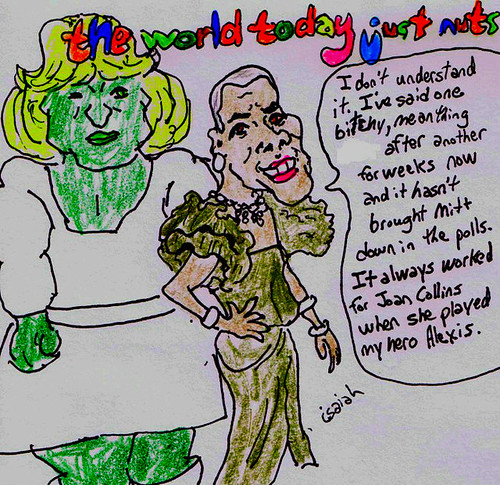
Isaiah's The World Today Just Nuts "He Trynasty"
he triesnasty


In "Spirit In the Dark," Aretha Franklin sings, "Ride, Sally, ride."  That was a 1970 hit.

13 years later, a Sally Ride would make history.  She was the first American woman to go into outerspace.  In school, she liked science and tennis.  In 1978, she made it into NASA.  June 18, 1983 she entered space on the Space Shuttle Challenger.  She'd go back into space in 1984 on the Challenger. 

This was big stuff when I was in school and I did three different reports on Sally Ride.  (They were all assigned before someone thinks I was just dusting off last year's report each year.)  And we were impressed with her.  But back then, we cared about NASA.  I don't feel like this administration has done a thing to support NASA or space exploration. 

We really did think, back then, that we'd be flying to the moon -- us, every day people -- by the time we were in our 30s.  Now I'm in my 30s and that's not happened and probably won't as a result of the lack of commitment from the White House.

I write about Sally Ride because she died today.  CNN says she died today, at 61, from pancreatic cancer.

NASA issued the following today:

S84-37256: Sally RideRide's official astronaut portrait. She joined the astronaut corps in 1978. Credit: NASARide floats alongside Challenger's middeck airlock hatch.Ride floats on the shuttle Challenger's mid-deck during her historic STS-7 flight in 1983. Credit: NASA 
›View Photo Gallery

In a space agency filled with trailblazers, Sally K. Ride was a pioneer of a different sort. The soft-spoken California physicist broke the gender barrier 29 years ago when she rode to orbit aboard space shuttle Challenger to become America’s first woman in space.

"Sally Ride broke barriers with grace and professionalism – and literally changed the face of America’s space program," said NASA Administrator Charles Bolden. "The nation has lost one of its finest leaders, teachers and explorers. Our thoughts and prayers are with Sally's family and the many she inspired. She will be missed, but her star will always shine brightly."

“Sally was a personal and professional role model to me and thousands of women around the world,” said NASA Deputy Administrator Lori Garver. “Her spirit and determination will continue to be an inspiration for women everywhere.” 

Ride’s contribution to America’s space program continued right up until her death at age 61 this week. After two trips to orbit aboard the shuttle, she went on an award-winning academic career at the University of California, San Diego, where her expertise and wisdom were widely sought on matters related to space. She holds the distinction of being the only person to serve as a member of both investigation boards following NASA’s two space shuttle accidents. She also served as a member of the Review of U.S. Human Spaceflight Plans Committee, also known as the Augustine Committee, in 2009, which informed many of the decisions about NASA’s current human spaceflight programs.

"The selection of the 1978 Astronaut Class that included Sally and several other women, had a huge impact on my dream to become an astronaut. The success of those woman, with Sally paving the way, made my dream seem one step closer to becoming a reality," said Peggy Whitson, Chief of the NASA Astronaut Office.

However, Ride’s place in history was assured on June 18, 1983, when she rocketed into space on Challenger’s STS-7 mission with four male crewmates. 

“The fact that I was going to be the first American woman to go into space carried huge expectations along with it,” Ride recalled in an interview for the 25th anniversary of her flight in 2008. “That was made pretty clear the day that I was told I was selected as a crew. I was taken up to Chris Kraft’s office. He wanted to have a chat with me and make sure I knew what I was getting into before I went on the crew. I was so dazzled to be on the crew and go into space I remembered very little of what he said.”

“On launch day, there was so much excitement and so much happening around us in crew quarters, even on the way to the launch pad,” Ride said. “I didn’t really think about it that much at the time . . . but I came to appreciate what an honor it was to be selected to be the first to get a chance to go into space.” 

Ride joined NASA as part of the 1978 astronaut class, the first to include women. She and five other women, along with 29 men, were selected out of 8,000 applicants. The class became known as the “Thirty-Five New Guys” and reported to the Johnson Space Center the next summer to begin training. Ride trained for five years before she and three of her classmates were assigned to STS-7. The six-day mission deployed two communications satellites and performed a number of science experiments.

Watch Ride Talk About Looking At Earth During Her Two Shuttle Missions:

Following that historic flight, Ride returned to space on another shuttle mission, STS-41G in 1984. The 8-day mission deployed the Earth Radiation Budget Satellite, conducted scientific observations of Earth, and demonstrated potential satellite refueling techniques. She was assigned to a third flight, but transitioned to a role on the Rogers Commission that investigated the Challenger accident after that shuttle was lost in January 1986. When the investigation was completed, she accepted a job as a special assistant to the NASA administrator for long range and strategic planning.

Ride left NASA in August 1987 to join the faculty at the University of California, San Diego, as a professor of physics and director of the University of California’s California Space Institute. In 2001, she founded her own company, Sally Ride Science, to pursue her long-time passion of motivating girls and young women to pursue careers in science, math and technology.

A native of Los Angeles, Ride graduated from high school there in 1968 and enrolled at Stanford University. At Stanford, she earned four degrees, including a doctorate in physics in 1978. She also was an accomplished athlete who played varsity tennis at Stanford after being nationally ranked as a youth.

Ride received numerous honors and awards during the course of her career. Most notably, she was inducted into the National Women's Hall of Fame and the Astronaut Hall of Fame, and received the Jefferson Award for Public Service, the von Braun Award, the Lindbergh Eagle, and the NCAA’s Theodore Roosevelt Award.

I made the mistake of going to NOW, thinking they'd have noted the death.  Wrong.  They're too busy trying to scare you about Mitt Romney.  ('He's Paul Ryan!' -- what a surprise that must be to Paul Ryan's mother.)
It's at times like these that the 'leaders' and their decision to be handmaidens of power to men really suck.

And for the record, I was first assigned to write about Sally Ride in fifth grade.  And even then, I knew she was an American hero.  In fifth grade, I was smarter than NOW.


"Iraq snapshot" (The Common Ills):

Monday, July 23, 2012.  Chaos and violence continue as Iraq sees the largest death toll of the year thus far, Victoria Nuland spins at the White House (and fails to bring up a threat to the US -- way to serve the public, Vicki), Moqtada al-Sadr rejects Nouri's Reform Commission, reports emerge of a British military training camp in Iraq, we look at MST and more.
 
As noted this morning, US President Barack Obama decided to grandstand on the Iraq War.  His re-election campaign released a ridiculous video featuring Tom Appelbaum (and his wife) talking about the St. Louis veterans parade earlier this year.  Appelbaum and Craig Schneider were the organizers of that event -- one which was billed as non-political and non-partisan, one that was fundraised on with the promise that this was about the veterans and not some political stunt.  Today Appelbaum turned it into just that whoring for Barack's campaign and the use of footage of that parade in Barack's commercial is offensive.  To be clear, they had to fundraise because the Barack Obama administration refused to stage a parade or fund a parade.  That's why private citizens had to donate in St. Louis and across the country where such events have been held.  Barack was too busy to attend the St. Louis welcome home or any other across the country.  But Tom Appelbaum wants to play cheap whore for Barack and take an event that Barack did not attend or contribute to and pretend like Barack Obama was part of it.  That lousy whore ad shouldn't pass a fact check but watch the enablers of Barack, as usual, look the other way.  In the media, Kevin Lipstak (CNN) was the first to note the ad.  He was not the last.
 
Charlie Spiering (Washington Examiner) notes the use of parade footage in the ad and points out that "President Obama's own Defense Department advised against Iraq victory parades, warning that they were inappropriate as troops were still in Afghanistan."  Spiering quotes NYC Mayor Michael Bloomberg from last January stating, "The chairman of the Joint Chiefs of Staff, General Dempsey, and Army Secretary McHugh and Army Chief of Staff General Odierno made it clear -- we talked about it -- they do not think a parade is appropriate now."
 
At the conservative National Review, Mario Loyola argues, "It was President Bush who ended the war in Iraq -- by winning it.  For Obama to claim that he ended the war in Iraq by bringing the troops home is as ridiculous as if he claimed credit for ending World War II by bringing troops home from Germany and Japan."  While we disagree that Bully Boy Bush won the Iraq War -- the war continues as news out of Iraq makes clear today -- it can be argued that Bush did end the Iraq War.  Barack Obama campaigned on all troops out in 16 months and then, to Tom Hayden's joy, 10 months.  As soon as he was sworn in, he stated, it was the first thing he would do.  Instead, the thing that got most US troops out of Iraq last December was the Status of Forces Agreement that the Bush administration negotiated. 
 
So people voted for a liar named Barack who spent the primaries tearing apart Hillary Clinton and other opponents, waxing on about his 'fabeled judgment' and pretending to be against the Iraq War (he was only against it before it started) while insisting that "change" was needed, that the US needed a new path.  And then he's sworn in and he offers America the same withdrawal Bush had negotiated.  Where in all of that did Barack do a damn thing?
 
Julie Pace and Thomas Beaumont (AP) report Barack told the VFW today of Iraq, "When you're commander in chief, you owe the troops a plan."   Well then we should all be glad George W. Bush came up with one before he left office since Barack was unable to.  (And, no, "we should all be glad George W. Bush came up with one" does not flow easily from my mouth.)  The only thing more outrageous than his ridiculous claims is how far so many in the press are willing to go along with him.  Thankfully not all.
 
Jake Tapper (ABC News) probably captures the unfettered ego out of the Oval Office best with "President Obama Praises Self for Ending War in Iraq on Bloodiest Day of the Year in That Country." At the conservative News Busters, Scott Whitlock notes Iraq's bloodshed received two sentences on NBC's Today ("Today marks the single bloodiest day in Iraq so far this year, as nationwide attacks have killed at least 89 people. The wave of violence comes just days after al Qaeda issued a warning that it is regrouping.")  as did ABC's Good Morning America, while CBS' This Morning ignored the Iraq attacks completely.   Whitlock writes:
 
A 2005 study by the Media Research Center found that (under a Republican president) the networks were eager to report bad news relating to Iraq:
Network coverage has been overwhelmingly pessimistic. More than half of all stories (848, or 61%) focused on negative topics or presented a pessimistic analysis of the situation, four times as many as featured U.S. or Iraqi achievements or offered an optimistic assessment (just 211 stories, or 15%).


Bombings slammed Iraq today.  No doubt, Barack took credit for that as well.   Alsumaria notes the dead includes police officers and Sahwa members ("Awakenings" and "Sons/Daughters of Iraq") and that Baghdad, Nineveh Province, Diwaniyah Province, Kirkuk, Wasit Province, Diyala Province and Salahuddin Province were all targeted with bombs.  Rami Ruhayem (BBC News -- link is video and text) reports, "Well the attacks took place all over the country in different cities. They seem to have targeted primarily security forces -- army as well as police -- checkpoints, convoys and even some police officers were targeted inside their homes. There have also been a number of incidents targeting civilians and marketplaces -- especially in Sadr City in Baghdad." In a sidebar on the right-hand side, the BBC notes the most violent attacks of 2012 and today replaces June 13th when 84 were killed and "nearly 300" wounded.   Ala A. Nabhan and Sam Dagher (Wall St. Journal) add, "Several parked car bombs were detonated in markets packed with Ramadan shoppers in predominantly Shiite areas such as Baghdad's congested Sadr City district, the town of Taji northwest of the capital and the city of Diwaniya to the south, killing and wounding dozens, according to a Ministry of Interior official." Mark Leon Goldberg (UN Dispatch) notes over 100 dead.
 
 
 Kareem Raheem (Reuters) puts the death toll at 107.   Today's attacks come two days after the official start of Ramadan in Iraq and follow increased violence which includes the assassination Saturday of a bodyguard for one of Iraq's two vice presidents and Sunday's violence of which Interfax and AFP note, "On Sunday at least 39 people were killed and 118 more wounded in a series of terrorist attacks in the suburbs of the Iraqi capital Baghdad, according to reports from local emergency services personnel and the police." 
 
In addition, Sunday , Xinhua reported on an audio recording released by the Islamic State of Iraq (ISI -- linked to al Qaeda in Iraq) which states, "We are setting of a new stage of our struggle, with the launch of a plan named 'breaking the walls.'  The tape says the effort will release "Muslim prisoners" from jail and kill "judges and investigators and their guards." The recording warns the United States that "you will see them (Qaida militants) at the heart of your country with God's willing, since our war against you has just started." Maamoun Youssef (AP) notes the recording and that it is supposed to be Abuk Bakr al-Baghdadi speaking (he "became head of the Islamic State of Iraq in 2010").   
 
 
Greg Jaffe (Washington Post) states, "The question facing U.S. officials is whether the mass killings, which have accelerated throughout the summer, represent a return to sectarian war or a resurgence of al-Qaeda."  Yasir Ghazi and Rod Nordland (New York Times) argue today's violence ("40 separate attacks") were "a coordinated display [by the Islamic State of Iraq]  intended to show that they remain a viable force."
 

More and more these attacks are greeted with international silence. The Voice of Russia notes, "The Russian Foreign Ministry has expressed its condolences to victim's relatives and support for Iraqi government's measures to 'stabilize the situation and boost security' in the country." In Iraq, UNAMI's Gyorgy Busztin declared today, "I strongly condemn the heinous attacks and the senseless violence and bloodshed across the country.  The scale and brutality of the attacks are appalling -- especially now, when Iraqis are not only celebrating the holy month of Ramadan with its messages of peace and reconciliation, but are also welcoming thousands of returnees who have fled the ongoing violence in Syria."  Because the Russian government and UNAMI issued  statements and because she was asked about the topic in today's State Dept press briefing, Victoria Nuland offered a brief condemnation of the attacks and then basically spun (and spun badly): 


QUESTION: It's kind of Syria-related.
 
MS. NULAND: Syria-related? (Laughter.) Okay.
 
QUESTION: Because of the pressure on its borders --
 
MS. NULAND: Yeah.
 
QUESTION: -- on Iraq's borders from Syria, we saw some incidents last week when apparently the opposition took some border posts. How concerned are you about the situation in Iraq right now and whether or not the security forces are up to the task? They're – they've got all these attacks within the country and now the border with Syria, which is so porous anyway.
 
 
MS. NULAND: Well, first on Iraq and Syria, you'll also note that Iraq made a call for its own citizens who had taken refuge in Syria during the troubles, the worst of times in Iraq, to now begin to come home. So I think that speaks to Iraq's sense that it can manage the return of its own citizens, that it can provide for them better in Iraq than the situation that they confront in Syria now. We work very closely with the Iraqis on Syrian issues, as you know. In part of outreach to the transition, we've been working not only with the groups that are strong in the western parts of Syria but also with some of these tribes in the east, as has the Iraqi Government, to get to know them better, to support the opposition as best it can. With regard to the security inside Iraq itself and some of the violence that we've seen as Ramadan has started, we strongly condemn these attacks which took place today, took place over the weekend, in Iraq. The targeting of innocents is always cowardly. It's particularly reprehensible during this holy month of Ramadan. I would like to see it's unusual. Unfortunately, it is not unusual, that we have seen terrorists exploit the holy month, exploit the peaceful efforts by Iraqis to worship, to commit acts of terror. But we continue to believe that Iraqi security forces are up to the task, that net-net the security situation over the last couple of years has improved in Iraq, as has the capability of Iraqi forces.  Please.
 
QUESTION: Victoria --
 
MS. NULAND: Still on Iraq?
 
QUESTION: Yeah. Still on Iraq, this wave of attacks was the most violent day since the withdrawal of U.S. forces. Is the United States doing anything specifically to help the Iraqi Government in its response to this morning's violence?
 
MS. NULAND: Well, as you know, we continue to provide appropriate security support to the Iraqis based on their requests in terms of equipping and training and that kind of thing, and we will continue to do that. But in general, the position of the Iraqi Government is that they want to be responsible for their own security, that they are up to the task of dealing with these kinds of things.  The issue here is the horrific tactics of al-Qaida in Iraq, who, during this month of Ramadan, are making desperate efforts to call on Sunnis to turn against their government, to assassinate judges and investigators, and to, in general, turn against all of these democratic institutions. They're going to fail. The Iraqis know they're going to fail. But regrettably, this is a bloody pattern that we've seen in years past, that Ramadan has been exploited for the agendas of terrorists and those who don't have the best interest of Iraq at heart.
 
QUESTION: Can I just follow it up really quickly, just to be absolutely clear? So does the violence change the U.S. posture towards Iraq? Does this morning's violence shift what we are doing at all?
 
MS. NULAND: Again, we are concerned, and we stand ready to give the Iraqis any support that they might request. At the moment, their preference is to do what they can to manage their security themselves. They fought long and hard to get to this stage where they are taking responsibility for their own security. But as necessary, we provide support.
 
QUESTION: If they requested, say, a contingency of U.S. troops to go back in --
 
MS. NULAND: Now you're, Guy, into all kinds of hypotheticals that I'm not going to get into. But again, it has been their desire – all the way through we've been guided by what they have wanted. We made clear a year ago that we were open to a number of options. They picked the option that we are in, which is that they maintain security with advice and support as necessary. But if that posture changes, obviously we will consult with them on it.
 
QUESTION: Has there been any communication today between the U.S. and the Iraqi Government as they try to manage these series of events in Iraq?
 
MS. NULAND: Our Embassy is in constant contact there.
 
 
So much in there that's wrong.  The bulk of Iraqis returning from Syria have largely gone to the KRG and that's not a large number of returnees to begin with.  Victoria Nuland hopes you're stupid enough to believe that all the Iraqis who went to Syria beginning in 2006 have stayed there -- despite the fact that they're not allowed to legally work in Syria.  She's hoping you're real stupid and don't know that the United Nations has been assisting them in relocation.  She also prays the press never raise relocation of refugees since the current administration has falied repeatedly to meet the slots set aside for Iraqi refugees.  She avoided the issue of Syrian refugees.  That's because of this:
 
 
The UN system in Iraq is putting in place contingency plans for possible humanitarian emergency.  In this connection, I recently visited a refugee camp in the Kurdistan Region for those displaced by the conflict in Syria.  So far, with 7,000 refugees, their number are manageable. 
 
The camp is in the KRG and that's UN Special Enovy to Iraq Martin Kobler testifying to the UN Security Council last week.  In addition, over the weekend, the Times of Malta reports, "Iraq's government said yesterday it was unable to provide help for Syrian refugees looking to escape their country's ongoing strife because of its own poor security situation."
 
Yeah, that doesn't really help her argument so she avoids and probably says a prayer of thanks the press didn't bring it up.  On another day we could examine all the lies she offered and take her to task for failing to address the threat made to the United States but we have other things to cover.


In other news, Kitabat notes thousands are crossing from Syria into the KRG in search of asylum -- these include Kurds and Syrians. Who else is in Iraq?   Kitabat notes a report in the UK Sunday Express which stated British forces were training Syrian fighters -- training over 300 of them from a base inside Iraq. What is Kitabat talking about?  This article by Marco Giannangeli:

A British Army source revealed last night that former SAS soldiers are training Syrian rebels in Iraq in military tactics, weapons handling and communications systems.
More than 300 have passed through a base just inside the Iraq border, while a command course is run in Saudi Arabia.
Groups of 50 rebels at a time are being trained by two private security firms employing former Special Forces personnel. "Our role is purely instructional teaching tactics, techniques and procedures," said a former SAS member.
"Some of these guys are shopkeepers and schoolteachers who have lost everything.
"If we can teach them how to take cover, to shoot and avoid being spotted by snipers it will hopefully help."


There is entering Iraq and there is also leaving Iraq.  Dar Addustour reports rumors that high level government officials and politicians are smuggling rare birds and animals out of Iraq -- already there has been at least one arrest with the official said to have had 102 birds and animals.

On the topic of officials and politicians, the political stalemate continues in Iraq.  Dar Addustour notes politicians are saying Nouri's Reform Commission will not replace the call for a no-confidence vote in Parliament to oust Nouri.  Today Moqtada al-Sadr's website reports -- quoting Secretary-General of Moqtada's bloc, Zia al-Asadi -- that Moqtada's bloc will not be part of the Reform Commission.  The commission itself is deemed a contradiction in terms.  Nouri caused the stalemate by refusing to honor the US-brokered Erbil Agreement.  Moqtada al-Sadr has repeatedly noted that Nouri could end the stalemate by returning to the Erbil Agreement.   The failure to do so may be why al-Sadr sees the Reform Commission as something less than genuine.  Saturday, Iraqiya head Ayad Allawi also rejected the Reform Commission.
 
 
Last Wednesday and Thursday we covered the  Wednesday morning House Oversight Subcommittee on National Security, Homeland Defense and Foreign Operations into how the VA was managing (or not) claims.  Thursday and Friday we covered the Thursday Iraq briefing to the United Security Council by Martin Kobler, the Special Envoy to the United Nations Secretary-General Ban Ki-moon.  There was a Wednesday afternoon hearing that was put on hold here so we could finish up the Subcommittee and grab the UN briefing.  We'll drop back to that hearing now  (and tomorrow we'll note US House Rep Chellie Pingree from the hearing).
 
 
"As a nation, we call on our armed service members to sacrifice bravely on our behalf," declared House Veterans Subcommittee on Disability Assistance and Memorial Affairs Chair Jon Runyan as he brought the hearing to order.  "They courageously put their lives at risk and face deadly enemies on the battlefield.  When we think of these enemies, we think of those who oppose our freedom and our American way of life.  We certainly do not think of soldiers needing to defend themselves from their fellow service members.  However, many of our service members are required to do just that.  Women are the fast growing population among veterans, making up 8% of the Armed Forces; however, the Department of Defense estimates that 1 in 4 women who join the armed services will be raped or assaulted. But only -- but that only about 10% of such instances are ever reported.  Even more alarming, is that of those few who did report the incidents of Military Sexual Trauma.  Over 75% stated that they would not have made the same decision about reporting the instances again due to the consequences it had on their military career.  Despite the fact that these instances often go unreported, VA currently estimates that over half of a million veterans have experienced Military Sexual Trauma.  This includes 17% of veterans from recent conflicts in Iraq and Afghanistan."
 
So MST is clearly a problem while serving but after service?  Veterans with MST are repeatedly struggling with the system in order to have the VA recognize their MST.
 
 
Ruth Moore: In 1987, I was a bright, vivacious eighteen-year-old, serving in the United States Navy.  After my training school, my first assignment was to an overseas duty station in Europe.  Two-and-a-half months after I arrived, I was raped by my supervisor outside of the local club.  Not once, but twice.  I sought help from the chaplain but did not receive any.  I tried to move beyond this nightmare but had contracted a STD.  At this point, my life spiraled downward and I attempted suicide.  Shortly thereafter, I was medivaced to Bethesda Naval Hospital and ultimately discharged from the Navy.  No prosecution was ever made against the perpetrator.  In hindsight, it was easier for the military to get rid of me, than admit to a rape.  My problems began at the point of separation as the psychiatrist diagnosed me with a Borderline Personality Disorder. I did not have a personality disorder, this was the standard diagnosis that was given to all victims of MST at that time, to separate them from active duty and protect the military from any and all liability.  This travesty continued when I was counseled by outprocessing to waive all claims to the VA, as I "would get helathcare" through my former spouse who was on active duty.  From 1987 to 1993, I struggled with interpersonal relationships, could not trust male supervisors and could not maintain employment. I filed my first VA claim in Jacksonville which was denied despite having serveral markers for PTSD and gynecological problems.  My life continued to spiral downward and I was not able to maintain my marriage.  In 1997, I fled from my house and lived out of my van for two weeks before I was able to start rebuilding my life with my present spouse.  Things were very difficult and I developed additional markers of PTSD including night terrors, panic attacks, severe migraine headaches and insomnia.  In 2003, I refiled for disability and was denied again; howeaver, I enlisted the aid of the Disabled American Veterans.  With their help, I was awarded 30% compensation for depression.  I was denied PTSD and was told that I did not submit enough evidence to prove that I was raped despite having submitted a letter from my former spouse who remembered the rape and when I was treated for Chalmydia.  Given the eyewitness testimony, the VA still denied this as credible proof.  There was no record of my medical treatement for STD from that duty station as my medical records had been partially expunged.  Additionaly, I wasa coded by the Togus VA as having Traumatic Brain Injury or Brain Syndrome.  In 2009, I entered into my first comprehensive treatment at the VA hospital in White River Junction, Vermont.  I met a MST Coordinator who truly listened to me. She began a systemic review of all my records and determined that they had been expunged by noting the glaring incosistencies between my lab work, treatment notes and service record.  My psychiatrist and counselor determined that I did not have Borderlin Personality Disorder and the later diagnosis of Traumatic Brain Syndrome was inaccurate. My MST coordinator and I refiled for an increase in disability and my clinicians wrote supportive records for the VBA to make an accurate determination.  They readjudicated my claim to 70% but denied my status as individually unemployable, citing that I did not complete the necessary paperwork.  At this point, I was very frustrated and suicidal with the stresses of the VBA system and claims process.  In my final effort, I called the Honorable Bernie Sanders and his staff agreed to investigate why the VA was taking so long and denying part of my claim.  I took Mr. Sanders copies of all the paperwork I had filed, including the VBA time and date stamped "missing information" to prove that they had originally received it.  Within two weeks, my claim was finally adjudicated to 70% with IU and it was a total and permanent decision.  My rating should have been 100% by the VBA criteria, but I was so grateful for a favorable determination that I have not pursued it further. Ladies and Gentleman, this process took me 23 years to resolve, and I am one of the fortunate  ones. It should not be this way.  If I had been treated promptly and received benefits in a timely manner, back at the time of my discharge, my life would have been much different.  I do not believe that I would have been totally and permanently disabled in my 40's. I would not have had to endure homelessness and increased symptomology to the point where I was suicidal, I would not have miscarried 9 children, and I firmly believe that I would have been able to develop better coping and social skills.  Instead, my quality of life has been degraded to the point where I am considering the possibility of getting a service animal to relieve the stress that my husband endures, as my unpaid caretaker.
 
 
Another example from the hearing.
 
 
Margaret Middleton:  I recently interviewed a female veteran who was raped by two sergeants in her barracks thirty years ago.  They ordered everybody else out and they kept her behind.  Decades later, similar to what the doctor just said [Dr. Barbara Van Dahlen] just said, I was the first person that she had ever told.  She didn't tell anyone at the time because it would have meant the end of her career.  And if you think her career wasn't important to her, she served in Iraq, she achieved the rank of Master Sergeant and she was retired honorably after 28 years serving in the military. This incredibly strong soldier held back tears when she told me this story and it was only one of the several episodes of MST that she described to me.  This veteran's claim faces an almost impossible evidentiary burden because of this particular provision [38 CFR 3.3.04 (f) (5)].  She did not tell anyone what happened, so there are no medical records, no letters home, no actions taken against her assailants.  In order to succeed in the army, this veteran felt forced to stay silent and now she will be punished for her silence because the VA will refuse to credit her story on her testimony alone.
 
 
The hearing was divided into four panels.  The first panel was Service Women's Action Network's Anu Bhagwati, Disabled American Veterans' Joy Ilem, the American Legion's Lori Perkio.   The second panel was Give An Hour's Dr. Barbara Van Dahlen, Connecticut Veterans Legal Center's Margaret Middleton.  The third panel was Ruth Moore (joined by her husband Butch Moore).  The fourth panel was DoD's Col Alan Metzler (joined by DoD's Dr. Nate Galbreath) and VA's Thomas Murphy (joined by VA's Edna MacDonald).  From the first panel, we'll note this exchange.
 
 
Chair Jon Runyan:  I think this Committee recognizes that many veterans are having difficulty receiving benefits related to MST and despite the [VA's] relaxed evidentiary standard, many veterans still have difficulty providing the evidence required for the award of the service connection disability.  In each of your opinions, can you kind of touch -- and in your personal opinion -- why that is happening?
 
Anu Bhagwati:  Well I think the first thing I would say is I wouldn't refer to them as relaxed evidentiary standards.  I would refer to them as actually harder evidentiary standards.  There's -- there's a two-tier system right now.  One for PTSD generally and one for MST-PTSD.  And those veterans -- again, 87% of these assaults are never reported for very good reason -- for fear of retialiation in the military and a variety of other factors related to rape and assault and the trauma that results. And so we have to think more strategically about -- about what counts as a fair evidentiary standard.  But the regulation itself gives you that suggestion.  And it's clear in all other cases of PTSD that the veterans testimony, the lay testimony, is sufficient as long as that veteran has a diagnosis of Post Traumatic Stress Disorder from a qualified medical provider as well as proof of time and service.  And there's language in that legislation for every other veteran suffering from PTSD with the exception of rape, assault and harassment.   And it's completely unfair.
 
Chair Jon Runyan: Okay.  Ms.
 
Joy Ilem: I think probably we would like to see the data.  For years, we've asked for data.  Specific to MST-related cases versus non-personal assaults. The first information we'd really seen was the FOI-ed information and certainly we believe VA does have the capability to extract that information and perhaps has, just briefly looking at their testimony, appeared to evaluate some of the raters' decisions. And I think we would definitely want to look at where was their compliance with the rules and regulations and the policies that have been set so far.  That's where probably, I think, the biggest, you know, problem may lie because there are often times signficant number of other opportunities to support those claims but it appears perhaps they're not being consistent throughout the country because we continue to hear these complaints repeatedly of people saying 'I've submitted a number of things -- everything they've asked me and my claim is still denied.'
 
Chair Jon Runyan: Ms. Perkio, in [laughing] one second, can you surmise? No.  Please do respond.
 
Lori Perkio: Thank you.  I've been a service officer for 16 years and I've been working VA claims and that include Military Sexual Trauma claims.  In my experience as a service officer is that the evidence was not given the weight that it should have.  When a service member -- I worked with one man.  He had been -- He had been raped.  And the next morning, he was walking around, feeling very dejected and trying to figure out what he was going to do with the rest of his life, he chose to commit suicide by throwing himself under a truck.  Not only did he have to live with the results of the medical injuries from that, the treatment that he received did not get used in support of his claim because he didn't report that he had actually been sexually assaulted. The medical records and nobody in the VA would take into account the reasons why he may have tried to commit suicide  when it's plain there was definitely a change in his attitude, his personality and in his will to live.  Those are the types of things that we would like to see the VA take more into account in supporting claims for Military Sexual Trauma.  In their own adjudication manual, it states behavioral changes will be considered.  These are things -- while the regulation is already there -- the adjudication manual is there -- more information needs to be provided to the raters on how to look at that information and apply it.
 
Chair Jon Runyan: Thank you.  And with that, I'll recognize the Ranking Member, Mr. McNerney.
 
Ranking Member Jerry McNerney: Thank you.  Ms. Bhagwati, I believe that one of the problems you mentioned that claimants have is that records have been purged after a certain number of years.  Do you know if that's a policy or is that just local custom or what regulates when records are purged and how can we change that so that there's more evidence that would be persistent?
 
Anu Bhagwati: Well there are some records that are still purged and some records that are no longer purged thanks to the last National Defense Authorization Act and perhaps Congresswoman [Chellie] Pingree can add to that.  Sexual assault -- I believe it's unrestricted reports are kept for 50 years -- or maybe restricted reports.  What's still destroyed however is EO or sexual harassment investigations so if you were sexually harassed and reported it.  This happened to me, I could tell you my first-hand experience. Those EO reports are destroyed in two-to-five years and it's done branch to branch by service and the Marines, so the Department of the Navy is not tracking those, we're not keeping those records forever.
 
Ranking Member Jerry McNerney: So there's no policy with regards to keeping those?
 
Anu Bhagwati: Not for sexual harassment investigations.
 
Ranking Member Jerry McNerney: Well you concluded in your testimony that when we look at the VA's policies on paper, it's no surprise that veterans who suffer from MST related PTSD have only a one-in-three chance of having their claims approved.  Could you please elaborate on that conclusion and how the VA regulations could be changed to change the outcomes of that?
 
Anu Bhagwati:  Sure. It's an absolutely murderous process.  We heard the example of one veteran who killed himself because of this process but I went through it myself, it took four years and VA -- frankly VBA is inept at the regional office level.  I mean, you can -- you can give them all the evidence you have.  I had plenty of eye witness statements -- anything they asked for, all the secondary evidence that's in the regulation but it was flat out ignored.  What happenes when those claims get rejected is a lot of veterans fall into this downward spiral of worsening trauma -- suicidal ideation, maybe attempted suicide, maybe completed suicide.  And so, I mean, we're looking at really a life and death situation here with this claims process.
 
 
We'll continue coverage of the hearing in tomorrow's snapshot.


Friday, July 20, 2012

Putting the "B" and "C" in MSNBC

Bob Mackie has always said Cher has great armpits.  And if you've seen her in various outfits, you know what he means.  Who has the worst armpits?

Click here and look at the photo of Lie Face Melissa Harris Lacewell-Perry.  I'm counting four folds in her armpit.  Is she not the ugliest thing you've ever seen?

Ava and C.I. first introduced the online world to the whorish lying Lie Face Melissa Harris Lacewell-Perry in "Democracy Sometimes?" where they explained what a liar the "b" was.

She's nothing but a trashy liar.  And now NPR's reporting on her and treating her like a trusted voice.  She's the c-word and the b-word, kids.  That's all she'll ever be.  She's a dirty, lying whore and she hates that this community exists.  She has gone from begging for deletions to attacks on us.  Because we're the ones who can chart her lies.

And it's cute to listen to her blather away about the hours that she spends flying to NYC each week to do her Saturday and Sunday show.  It's just too important, she insists.

You can whore if you want, I really don't care.  Except if you're trying to raise a child -- or pretending too.

So the bitch spent the bulk of 2007 and all of 2008 traipsing around the country to whore for Barack.  And where was her daughter?  You know, the prop she pretends to care about?

Now Lie Face wants sympathy for having to be on an airplane.

The question remains: Where is her daughter?

Lie Face is a cheap whore and has always been one.

She lied to America that she was Black -- and hit the roof when this community exposed her White mommy -- and she lies about everything.  The little things, the big things.  She can't stop lying.

That's what whores do.

I think it's fitting that she's now putting the "B" and the "C" into MSNBC.  That channel's going down, if you haven't heard.  It's causing too many problems for NBC News.

Here's Bob Somerby on some of Lie Face's lying:

On the other hand, it’s hard to know why the professor wastes our time with some of those data—for example, with the fact that Clinton’s vote among women rose by seven points. But please note: Amid that swirl of gorilla dust, there are no data concerning Clinton’s vote total among white liberals. Nor does she offer any data about Obama’s support from white liberals.

As far as we know, such data don’t exist. But there are certainly no such data in Harris-Perry’s column.

Indeed, Harris-Perry offers no data about white liberals at all. Nor does she seem to know that vote totalsapproval ratings. Are we supposed to compare Clinton’s rise in the white vote to Obama’s drop in white approvals?

Are we supposed to make that comparison? If so, why?

These professors today! Harris-Perry drops several bombs as she proceeds with her critique. And the bombs she drops are potent weapons; the R-bomb is plainly the most important bomb in the American arsenal. That said, we’ll close today with one of the questions with which we closed yesterday’s post:

How careful should a person be when she is dropping such powerful bombs? To that, we’ll add another question:

Did the professor understand that she had no relevant data? That she had no data which were actually relevant to her apparent claim?
are a whole different critter from

Lie Face is mixed and she can't even tell the truth about that.  If she really were Black, she'd know the film "Imitation of Life," rather infamous in the Black community, when the young woman who has passed as White learns her mother died (the one she denied) she rushes to the funeral.  "I'm Living In Shame" Diana Ross & the Supremes sang exploring similar terrain.  Lie Face is a failure as a daughter, as a mother, a political commentator and (give this latest marriage a few more weeks) as a wife.


"Iraq snapshot" (The Common Ills):

Friday, July 20, 2012 (and, yes, today is the 20th, not yesterday).  Chaos and violence continue, a document -- a secret document -- Nouri wrote in 2009 just emerged, Ramadan starts Saturday Grand Ayatollah Ali al-Sistani declares, Iraqis struggle with obtaining basic food stuffs, we continue covering the UN Secretary-General's Special Envoy Martin Kobler's report on Iraq, we wonder when he'll stop being so squirmy when it comes to LGBT issues, US Green Party presidential candidate Jill Stein's running a questionable and ineffective campiagn, and much more.
 
 
This morning there were many interesting articles about Martin Kobler's presentation on Iraq to the United Nation's Security Council yesterday.  Kobler is the UN Secretary-General's Special Envoy to Iraq.  And the few articles this morning about the presentation were nothing like what Kobler delivered yesterday.  (This afternoon, UPI produced a report that demonstrated their correspondent saw the actual presentation.)  But the reports this morning were a lot like the press conference Kobler held after -- about an hour after -- the Security Council presentation.  You have to wonder how editorial boards ever pretend to have an ethical stature to call others out from when their reporters lie?  A press briefing is not the report Kobler presented to the UN Security Council. 
 
Kobler's report was interesting for what it said.  It was even more interesting for what it didn't say but you probably needed to hear the report to know that and you probably needed to have heard the April report to be able to offer context in July. 
 
April 10th was when he made his previous presentation and we covered that in the April 10th snapshot and the April 11th snapshot.  His Thursday report we covered yesterday and we'll continue that coverage now.  When we left off yesterday, he was talking about 12 acts of violence a day and over 1,300
 
 
UN Special Envoy Martin Kobler:  Each victim is one victim too many.  The Iraqi authorities must continue to make every effort to identify the perpetrators of these acts of violence and bring them to justice.  These attacks are intended to ignite further violence.  Despite the sufferings, Iraqis from all walks of life and religious backgrounds must turn their backs on past divisions and unite for a peaceful future.  Mr. President, human rights are a cornerstone of Iraq's democratic future and are at the core of United Nations mandate  in Iraq. To this end, UNAMI [United Nations Assistance Mission for Iraq] continues to support activities of the Ministry of Human Rights in ensuring that Iraq meets its international humanitarian rights obligations.  As I informed the Council members last April, the Council of Representatives endorsed the appointment of the Commissioners of Iraq's first Independent High Commission for Human Rights.  And I am pleased to further report the commissioners have now met and started their work.  UNAMI and UNDP [United Nations Development Programme]  are supporting the Commission in this process.  The findings of the 2011 United Nations report on the Human Rights Situation in Iraq published in May underlined the fragility of human rights situation in Iraq.  The report's conclusions largely coincided with the  Ministry of Human Rights own findings.  While it is recognized that the government of Iraq has made progress in implementing measures to protect and promote human rights, the impact on the overall human rights situation remains limited.  The UN is assisting the Iraqi authorities in strengthening the rule of law and boosting protections for human rights in Iraq to bring an end to abuses like arbitrary arrests and detentions.  The economic, culture and social rights of Iraqis are also a matter of real concern.  Poverty, high unemployment, economic stagnation, environmental degradation and a lack of basic services continue to effect large sections of the population.  It is vital that Iraqis -- in particular, vulnerable groups -- be provided with better access to basic services, social welfare and community development programs and opportunities for education.  Nothing less is required in order to provide for the success of future generations.  The rights of all Iraqis -- including minorities -- must be protected as stipulated in the Iraqi Contrib -- Iraqi Constitution.  Mr. President, Iraq retains the death penalty for a large number of crimes.  I therefore reiterate the call by the Secretary-General [Ban Ki-moon] and the High Commissioner of Human Rights for the government of Iraq to establish a moratorium on all executions with a view to their abolition.  I welcome that the authorities of the Kurdistan Region continue to implement a moratorium on carrying out executions which has been in place since 2007. 
 
 
That's not the end of his report.  We'll continue noting from there in order but we're breaking parts up.  It was interesting how in both the written report (July 11th) and the oral report Kobler gave yesterday, the Russian bikers were ignored.  5 men threatened with the death penalty, 5 men arrested and beaten.  An international incident and not a word on it.  But Kobler wasn't very interested in words.  There was time to whine about his budget taking a 20% cut next year but not time to note, as the written report did:
 
Journalists and media professionals in Iraq continue to face arbitrary arrest and detention and to suffer from intimidation and attacks as a result of their profession.  During the reporting period, UNESCO and UNOPS [United Nations Office for Project Services] trained 240 media professionals in Basra, Erbil and Baghdad on security, self-protection, risk management and trauma first aid to enable them to cope with existing professional threats and risks.
 
 
The issue so bothered Secretary-General Ban Ki-moon that he raised it twice in the written report (the first time is quoted above).  When Kobler states he's repeating the Secretary-General's point about stopping death penalty, he's referring to the written report (it's the 72nd paragraph in the written report). 
 
Iraq being discussed before the UN.  That means what topic gets touched on that the US media usually ignores?  Chapter VII.  Iraq was placed in that status by the UN as a result of Iraq's war on Kuwait. 
 
Speical Envoy Martin Kobler:  Let me now turn to some of the regional and international developments pertaining to Iraq.  As you know, Prime Minister Maliki's visit to Kuwait in March was followed by the historic visit of the Emir of Kuwait [Sabah al-Ahmad al-Jaber al-Sabah] to Baghdad to attend the Arab League Summit.  These two visits have markedly improved bi-later relations between Kuwait and Iraq and facilitated the resumption of the meetings of the Joint Ministerial Committee. Iraq has also taken decisive steps to finalize the Iraqi-Kuwait border maintenance project in accordance with Resolution 833.  At the request of both parties, the United Nations is preparing now for maintenance work to start by 31st of October provided that key prerequisites -- like the removal of obstacles on the borders -- are met bringing all Chapter VII obligations pertaining to Kuwait to a satisfactory close will boost prospects for bilateral trade, investment, promote regional cooperation and lead to the restoration of Iraq's rightful standing within the international community.  In this regard, I would also like to take the opportunity to welcome the adoption of on 28th of June by the Council of Representatives of a law ratifying the additional protocol to the Comprehensive Safeguards Agreement of the IAEA [International Atomic Energy Agency] and encourage the government of Iraq to take the remaining steps to ensure its entry into force as soon as possible.   Mr. President, the intensity and frequency of sand and dust storms mainly generated from inside Iraq has increased in recent years.  They have significant impact on public health in Iraq and in the wider region --  especially for the most vulnerable --  and they effect transport and trade. During my visit to Kuwait in June and following an offer by the Emir of Kuwait to invest a portion of Iraq's outstanding war compensation funds back into Iraq, I proposed an environmental fund to combat sand and dust storms.  If Iraq and Kuwait agree, the fund could be used to undertake activities to reduce this health hazard which is impeding daily life in the region.  Such activities might include improving water resource management, anti desertification, re-forestification and agricultural projects.  Mr. President, needless to say that the ongoing violence in Syria is a source of deep concern given the potential for the spread of instability and violence, humanitarian fall out and political repercussions.  The UN system in Iraq is putting in place contingency plans for possible humanitarian emergency.  In this connection, I recently visited a refugee camp in the Kurdistan Region for those displaced by the conflict in Syria.  So far, with 7,000 refugees, their number are manageable.  On 10th of July, the United Nations and League of Arab States Joint-Special Envoy for Syria, Mr. Kofi Anan, visited Iraq and met with Prime Minister Nouri al-Maliki.  The government of Iraq was very clear on the policy of a political transition that is Syrian-led and Syrian-owned and ensures that the legitimate and democratic aspirations of the Syrian people are fully realized.
 
 
So there's a refugee camp in the KRG.  And the KRG has a moratorium on the death penalty.  Wonder how much bleaker the state of Iraq would be reported to the Security Council as being if the Special Envoy didn't keep including the semi-autonomous KRG region?
 
As he continues, he'll note some basic numbers.
 
Special Envoy Martin Kobler:  Mr. President, the United Nations in Iraq also continues to support the development of effective, accountable and transparent state institutions.  My new deputy and resident humanitarian coordinator for Iraq, Ms. Jacqueline Babcock, took up her duties on 13th of May.  She has already shown her determination and leadership in coordinating the UN country team to deliver as one.  I have asked her to ensure that the country team  strengthens its presence and activities across the country.  This is taking shape in Basra. There, the UN funds and programs can assist in bringing the quality of life in this oil rich province to those levels found in other oil rich countries in the region.  Mr. President, let me briefly highlight two of the priority areas with important political, security and development implications where the UN system in Iraq is working together.  Iraq is one of the most youthful countries  in the world with 50% of the population under the age of 18.  At the same time, the unemployment rate for youth is more than double the domestic average with 23%.  The UN system is supporting programs aimed at increasing youth participation in social, political and economic spheres.  Building on the International Year of Youth 2011, the UN is supporting civil-society groups to strengthen their role in ensuring democratic spaces and freedom.  The third UNDP National Development Report focuses on youth and will be published later this year.  As with youth, women are important actors in Iraq's development. Yet the illiteracy rate among Iraqi women is more than double that of Iraqi men.  In my meetings with the Iraqi governmental interloculators, as well as women's civil-society organizations, I advocate for the adoption and implementation of the proposed National Strategy on the Advancement of Women.  The UN family is working to support women take up their role also in political and economic life.  The UN is also continuing to implement Security Council Resolution 1322 and to encourage the government to fulfill its committment in this regard. 
 
 
Now we're getting to Camp Ashraf.  Camp Ashraf were approximately 3,500 residents who were Iranian dissidents.  They came to Iraq in the 80s and had protection up to the Iraq War.  When the US-launched war toppled the government of Iraqi President Saddam Hussein, the US government -- largely via US military officers -- began a dialogue with the residents which resulted in their surrendering their arms and becoming protected persons under the Geneva Agreement and international law.  Though never legally revoked, that protection would be ignored once Barack Obama was sworn in as US president.  Nouri would twice attack the camp resulting in multiple deaths and a large number of wounded.  Humanitarian organizations -- Amnesty, for example -- would decry the attacks but the US government would remain silent.  When you read over Kobler's remarks in a second, focus on what's really harming Camp Ashraf right now.
 
 
UN Special Envoy Martin Kobler:  Finally, Mr. President, I still remain very concerned by the lack of progress in resolving the issue of Camp Ashraf. 2,000 residents of Camp Ashraf have relocated to Camp Hurriyah [Liberty] in the last months.  Approximately 1,200 remain in Camp Ashraf.  The several deadlines set by the government of Iraq have been extended. I thank the government of Iraq for their flexibility in this regard and I appeal to the Iraqi authorities to continue the process to resolve the relocation peacefully. Our committment is strictly humanitarian, to facilitate a voluntary, temporary relocation of residents to Camp Hurriyah as the first step of resettlement to countries outside of Iraq; however, the success of a facilitator depends at least on good will. Their can be no facilitation without constructive and practical dialogue.  We are faced with three main challenges.  First, recent weeks have witnessed difficulties in maintaining dialogue between UNAMI and the residents and between the residents and the government of Iraq reinforcing a perception that the residents lack genuine will to participate in the process faciliated by UNAMI.  Second, responsiblity also falls on the many international supporters.  It is of great importance that they contribute to positively influence the residents' position.  And third, to  date almost no memeber-state has stepped forward to offer resettlement to eligible, former Ashraf residents.  There must be a way out of Hurriyah in the foreseeable future.  Without prospect for resettlement, the ongoing process runs the risk of collapsing.  The tempoary transit location at Camp Hurriyah has the capacity to accomodate the remaining 1,200 residents and meets acceptable humanitarian standards.  Both UNAMI and UNHCR [United Nations High Commissioner for Refugees] have devoted substantial energy and resources to resolving this issue.  More than 100 staff are dedicated to the project in the meantime.  I appeal to the government of Iraq to be generous -- particularly in terms of humanitarian needs like water and electricity and to avoid violence under any circumstances.  I also appeal to camp residents to abide by Iraqi laws and avoid provocation and violence.  Time is running out to find a sustainable solution.  The government's patience is wearing thin. I would therefore like to echo the Secretary-General and urge Camp Ashraf residents to cooperate with the Iraqi authorities and to relocate from Camp Ashraf to Camp Hurriyah.  It is also imperative that third countries step forward to accept eligible residents for resettlement as soon as possible without which there can be no durable solution. 
 
The residents have stopped moving to Camp Liberty.  They want to take items such as generators.  Why? 
 
Nouri doesn't want them to take items such as generators.  Why?
 
Because both sides don't believe that the Camp Ashraf residents will soon leave Camp Liberty.  Why don't they believe it?
 
Because no one's left so far and that's because other countries aren't willing to take them in.  In Nouri al-Maliki's view, Camp Liberty is just a place to store Camp Ashraf residents for another lengthy period.  In his view, he's being conned and then in a year or two, he'll be told they'll be moved somewhere else in Iraq.  It's a view Camp Ashraf residents can share.  Because both they and Nouri have seen 1200 moved and not resettled anywhere.  They're just remaining in Camp Liberty, the same way they remained in Camp Ashraf.   If Nouri (or the government in Tehran) is to believe that the residents are being resettled, they're going to have to see some resettled.  It's not that complicated.
 
Why are so many nations so reluctant to take them?  Because the US government refuses to do their job.  Camp Ashraf residents are part of the MEK.  The MEK is considered a terrorist group by the US government -- the Clinton administration put them on that list in the late 90s in an effort to make an overture to the government of Iran.  Though ordered by a federal court to resolve the MEK status quickly, the State Dept refused and now has until October to do so or the court will impose a punishment.  (Whether Barack Obama is re-elected president or not, Secretary of State Hillary Clinton has already stated she will not serve a second term in her post.  An October deadline from the court is a joke because the administration will treat it as such -- either because they will quickly become a lameduck one or because they will be looking for a new Secretary of State.)   Barack Obama and Hillary Clinton and those under them have repeatedly and falsely equated MEK and Camp Ashraf residents as one grouping.
 
The US government does not recognize the MEK as protected persons.  The US government does recognize Camp Ashraf residents as protected persons.  This issue should have been resolved a long time ago, the US government made promises and needs to keep them.  The easiest way is to create an excpetion for the Camp Ashraf residents.  That's 3,200 people currently.  They are all in Iraq.  Those in Iraq transferring out would not be considered "terrorists."  This is due to where they were located, due to the stationary aspect of their location and due to the fact that the US government already gave them protected persons status.  That status expires only when they are out of Iraq so it is in the US government's best interests to get them out of Iraq quickly.  The State Dept could easily create a subgrouping of those residents in Iraq to allow other countries to take them in.
 
The refusal to do so means the Barack Obama administration will likely have blood on their hands because one side will likely explode in a very short time.  This has been going on too long and neither Nouri nor the residents are seeing any progress.  If the US government can not seriously assist the Camp Ashraf residents by creating a subgrouping/classification for them and violence takes place, those deaths -- Iraqis or Ashraf residents -- will be the responsibility of the US White House.
 
There was a lot mentioned in the report.  A lot overlooked as well.  As he winds down, Kobler makes the decision that UNAMI itself -- and its budget -- is more important than any Iraqi topic that he could include in the final moments.
 
 
Special Envoy Martin Kolber:  Mr. President, in my introduction, I posed the question of whether the people of Iraq still need UNAMI?  I am convinced that UNAMI is needed more than ever to help Iraq complete its transition to a stable and prosperous democracy.  UNAMI has the legitimacy and the standing to represent the international community in Iraq.  Iraqis from all communities look to UNAMI to protect their aspirations and to ensure their needs are met.  With Security Council support, UNAMI will continue its efforts to address the many outstanding issues crucial to securing Iraq's future.  The substantial cut of 20% of UNAMI's budget in 2013  requires that we do more with less.  In this context, the mission may need to reconsider some areas of operation.  Mr. President, I should like to sincerely thank the members of the council for their continued support, the government of Iraq and the wider membership of the United Nations as well as the staff of UNAMI for their unrelenting commitment and dedication to implement our mandate.  Thank you very much.
 
 
And that was it.  Last April, in his presentation to the UN Security-Council, he refused to note the targeting of Iraq's LGBT community.  In the written report (written in March), there was a passing reference ("perception of their sexual orientation") with the promise that the UN was in the process of corroborating the reported deaths and would address it when they had.  It's months later, presumably the UN has been able to corroborate those reports in some fashion by now.  So why can't Martin Kobler talk about it?  It's not even in the written report (which was published July 11th).  There is no mention made of it.  If Martin Kobler wishes to represent Iraqis, he needs to represent all Iraqis.  He needs to find it in his comfort zone to use the terms "gay" and "lesbian."  If that's too much work for him, if it's too much of a stretch, he needs to find a new position.  The United Nations was silent as young Iraqis were targeted -- males and females -- because they were believed to be gay or to be Emo or both.  Rolling Stone and NME covered it.  But the United Nations stayed silent.  The US State Dept covered it in their own human rights report.  But the United Nations stayed silent.  That's unacceptable.
 
It's especially unacceptable considering the United Nations' supposed position on this issue.  As we noted when Kobler gave his last report to the Security Council:
 
Last month, Igor Volsky (Think Progress) noted (March 7, 2012), "Earlier today, the UN Human Rights Council held the first hearing 'to discuss discrimination and violence against LGBT people."  UN Secretary General Ban-Ki Moon issued a special message to the council, decrying violence against the LGBT community as a 'monumental tragedy' that is a 'stain on our collective conscience' and a 'violation of international law' [. . .]" and he quotes UN Secretary-General Ban Ki-Moon stating, "To those who are gay, lesbian, bisexual or transgender, let me say -- you are not along. Your struggle for an end to violence and discrimination is a shared struggle.  Any attack on you is an attack on the universal values the United Nations and I have sworn to uphold."
Is Kobler not part of the UN?  Has he sworn to do the same.
We got a little talk about women in this presenation.  That is new.  Previous presentations to the Security Council by the Special Envoy to Iraq frequently left women out.  But apparently, something more "gross" and "disgusting" than women has been found by the office of Special Envoy: Iraq's LGBTs.
It was really disgusting to hear Kobler prattle on about violence and minorities and never once note the attacks on Iraq's LGBT community.  It was disgusting.
 
You may remember that Kobler silence on LGBT was an issue that continued past the two snapshots on the April report.  You may remember my noting UN friends swore he'd include it when the figures were verified.  The figures were verified -- I've 'verified' that with UN friends this morning.  And still Kobler said nothing.  There was time for budget and shout-outs, but no time for Martin Kobler to find his comfort level with gays and lesbians.
 
Martin Kobler better start representing all of Iraq or become the leading face of homophobia in the United Nations.  On that last possibility, he's already well on his way.
 
As the Washington Post notes, the holy day of Ramadan is arriving. Alsumaria reports that Grand Ayatollah Ali al-Sistani has declared Saturday to be the first day of Ramadan.   Al Mada carries a Ramadan greeting congratulating all Iraqis and asking for their blessing in the coming year with God Almighty strengthening their path to justice, freedom and security.   Kitabat notes that there are calls for the government to grant leave for employees on days when the temperature reaches 50 degrees Celsius (122 degrees Fahrenheit).  While the sun is up, those observing the Muslim holiday are supposed to fast.  Before sunrise and after sunset, those observing the holiday can eat.  However, food prices are rising in Iraq.  Alsumaria is the latest this week to report on the sharp increase in prices for basic items such as lentils.  The Ministry of Commerce is insisting that they got materials to the stores in time so any increase in prices is not their fault.  The article also notes that the high prices might make Ramadan slowly disappear as a part of Iraqi life -- as other habits have been forgotten in Iraq.  It seems unlikely that Ramadan could disappear from Iraq but then come reports about how hard it is for some to observe it.  
Al Mada notes that unemployment is also a huge issue during the holy month and only more so when the food prices increase.  They speak with Hani Rseg who is a construction worker and tells the paper that he didn't get any wages for four months because contractors rarely get paid on time and when money did come in, there was electricity, gasoline, water and other things to pay for and only now is he able to shop for Ramadan.  Police officer Ahmed Radhi al-Hleaj states that he's paying a car loan and wouldn't be able to afford Ramadan except that he's taken on a second job working as a taxi driver.

Rahim Ruhayem (BBC News -- link is video) reports on Iraq's ration systems.
 
Rahim Ruhayem:  In distribution centers, few complain about waste or abundance.  Dawood is a construction worker in central Baghdad and he's come to collect his monthly share.  He told me the distribution system is gradually fading away. 
 
Dawood: It's getting less and less, year by year, month by month.  And there is no variety.  We get cooking oil.  Sometimes rice, flour.  No tea, no washing powder, no salt.  Many things have been scrapped.  And they will probably cancel the rest too.  The whole thing will be finished soon.  We better get used to it. 
 
Rahim Ruhayem:  The government insists it has no plans to end the system, it only talks of reform over the coming years. At a cost of about five billion dollars a year, the Iraqi state hands out food to its people. But some of these people need it a lot more than others.  23% of Iraqis live below the poverty line.  If the government wants to reform the system, it has a delicate balance to strike between encouraging productivity and less reliance on the state on one hand while making sure on the other not to jeopardize the food security of those most in need.  Rahim Ruhayem, BBC News, Baghdad.
 
 
Census numbers might change the ration-card numbers but, as Al Mada points out, Iraq has not had a census since 1997 and both the 2007 and 2009 censuses were postponed (by Nouri).  Today, Al Mada reports, a member of Parliament's Finance Committee told the paper that the government does not know the actual population in Iraq and depends upon a random and inaccurate figure based on indicators and that their is a wide difference between the Ministry of FInance's figure and the ration card number and between the Ministry of Plannin's figure and the ration car number. 
 
 
Earlier this week, as continued unemployment was met with soaring food prices,  Al Mada reported that there are accusations in Hilla that food merchants are intentionally introducing small amounts of food to the markets in order to artifically pump up the prices by creating scarcity.  This comes as Babylon Province sees less and less items for sale that can be purchased with ration cards.  True or false, the federal government should be addressing this item though they will most likely ignore it.  If it isn't true, the rumors will still take root because food prices are increasing, ration items are becoming scarce and hunger isn't something people can overlook the way they might endure electricity outages.  So as the hunger and anger builds, even if the rumors are false,  a need to hold someone accountable can build and, if it does, it could leave food merchants targeted.  If the rumors are true, the federal government needs to deal with it (a) to show that it can deal with something, (b) the economy cannot take higher prices (unless Nouri intends to expand the ration card system) and (c) the federal government still has the power to set controls on various aspects of retail within the country. In addition, Nasiriyah reported that in an effort to try to reach 12 hours of electricity a day for the holy month of Ramadan, Iraqi is increasing energy imports from Iran.
 

Alsumaria notes that Grand Ayatollah Ali al-Sistani is calling on Iraqi Muslims to watch the crescent moon this evening to determine whether Ramadan is starting.
 
Yesterday, Nouri al-Maliki attempted to seize control of the news cycle but, as is so often the case with Nouri, lost instead.  He insisted that the White House had conveyed, in a letter, their support for his attempts to cancel the October contract the Kurdistan Regional Government signed with ExxonMobil.  No such thing happened.  But some outlets live to be sucker-punched.  Let's note one of the few who realized that journalism involves skepticism of official statements.  Here's Kristin Deasy (Global Post) on those claims:


Iraqi Prime Minister Nouri al-Maliki claimed late Thursday to have received a message from US President Barack Obama indicating that the US sided with Baghdad in its deepening row with Kurdistan over the management of the northern region's oil resources, reported Reuters.
The message from Baghdad -- which did not quote the alleged Obama letter directly or provide any copy of it -- welcomed the "positive" US position on the matter, which it said was "in the same manner as the Iraqi government is seeking," said Reuters.


To repeat, in the United States, there is no state control over oil companies.  In Iraq, Nouri's lies can fly somewhat because that country has a history of nationalized oil companies.  As a result, a casual news consumer would hear of Nouri's claim and think nothing of it.  But in the US, where it's far more likely that a multi-national oil company will control the government than the goverment ever control an oil company, that claims is laughable on its face.

In October, ExxonMobil and the KRG signed their contract.  Nouri's Baghdad-based government played angry, spurned lover sending one letter after another to ExxonMobil, each basically screeching, "How could you!  After all we've been through!"

As Iraq's Minister of Oil confirmed in early 2012, ExxonMobil elected to ignore those letters and not respond.  And Nouri had nothing else to offer.  So last month he began making noise that the US government -- specifically the White House (Nouri has always been hugely unpopular in the US Congress) -- should break ExxonMobil's contract.

Which again demonstrates how stupid and not ready to be prime minister Nouri actually is.  The White House has no control over ExxonMobil.  And this was conveyed to Nouri -- as the Iraqi press noted.  But with US Vice President Joe Biden's National Security Adviser Antony Blinken in Iraq, Nouri decided to spin the visit.  It would have been laughable on any day but it was especially laughable yesterday when another major multi-national oil corporation elected to bypass Baghdad and sign with the KRG.  David R. Baker (Fuel Fix) notes:


Chevron Corp. will hunt for oil in northern Iraq's Kurdish region — the company's first major effort in the volatile country since the 2003 invasion that toppled Saddam Hussein.
The deal, made public Thursday, lands Chevron squarely in the midst of post-war Iraq's bitter oil politics, with rival regions and ethnic groups fighting over how to develop the country's vast petroleum reserves. Chevron faces significant risk, and the potential of great reward.
 
In Iraq where safety has never been secured, Alsumaria reports a Yezidi girl was burned alive in her Mosul home -- some are saying it is suicide, no finding has been established yet.  Alsumaria notes that 2011 saw 6 confirmed cases of murder and ten case of confirmed suicides by burning -- in addition there were 85 who were injured by burning.  Yesterday NINA reported 1 Peshmerga died in a Kirkuk sticky bombing and two more were injured.
 
No emergence of security, no end to the political stalemate.   Al Mada reports the National Alliance (again) discussed their Reform Committee paper.  They've discussed it so much that they must know it by heart.  NINA reports that Iraqiya's Hani Ashur has declared "the reforms paper prepared by the National Alliance on its way to failure, where there is no agreement upon [it] even within the National Alliance and it became a mean to buy time and not for the reforms, it will not see the light or [be] put on the table of dialogue.  The reform paper is not more than an attempt to melt the crisis and the government is not serious in dealing with it, and the crisis may [be] back to the first square."
 
In what may end up being the most explosive political news out of Iraq this week, Al Mada reports the existence of a document signed by Nouri from October 2009 in which he secretly asked then-House Speaker Ayad al-Samarri not to question Hussain al-Shahristani.  al-Shahristani is currently Iraq's Deputy Prime Minister for Energy.  Starting in the spring of 2006 (with Nouri's becoming prime minister), al-Shahristani became the Minister of Oil.  Despite enjoying a great deal of soft press -- from The National Newspaper, Iraq Oil Report and pretty much everyone else -- al-Shahristani has no major successes to point to and Nouri conveyed in the letter that asking al-Sharistani about corruption or violence would be harmful to the government's interests.  (al-Sharistani is a member of Nouri's State of Law political slate.)
 
 
Let's do an update to last Friday's snapshot:

Kim Kelly (The Atlantic) focuses more on the present [art scene] and the emergence of what is thought to be a musical first in Iraq:
 
She says her name is Anahita, the 28-years-old voice and vitriol behind Janaza, which is believed to be Iraq's very first female-fronted, black-metal band. Allow that notion --Iraq's very first female-fronted, black-metal band -- to sink in for a moment. Her first recording, Burn the Pages of Quran, boasts five distorted, primitive tracks that altogether run just shy of an unlucky 13 minutes. She, along with a handful of other acts hailing from the Middle East, are repurposing black metal's historically anti-Christian ferocity to rail against Islam. In doing so, these bands are serving up another example of how art and dissent can intersect in a region where dissent can sometimes have deadly consequences.


Saturday  Anna Breslaw (Jezebel) reports that The Atlantic article might be a hoax and that the photos accompanying it have been used in publications previously for other metal bands.  I meant to include that Monday (we noted it Saturday) but kept running out of space.
 
 
I'd also hoped to cover Jill Stein's campaign this week and, at the very least, run a press release from it.  Not doing it. Not interested in the pretense of Bain and how it just can't be understood!  That's b.s. and Bob Somerby's rightly called it out (Somerby most recently called out the nonsense today).  If Jill and her campaign think repeating those rumors qualifies as running for office, they're kidding themselves.  And if they think spending three paragraphs on this rumor and then tossing in one paragraph on Barack is going to make people think they'll hold both accountable, consider it again.  We already saw 2008 when Rosa Clemente -- Cynthia McKinney's running mate -- was trashing Hillary Clinton with lies long after she was out of the race but Rosa never could find the courage or strength to call out Barack.  We're not in the mood for it.  If the Green Party thinks inflating their criticism of Barack a tiny bit after three and half years of non-stop failures by Barack qualifies as 'strong,' they're crazier than they think the voters are.  Run a real campaign or get out of the damn race. 
 
Mitt Romney as president is a question mark.  Barack Obama is not.  If Dr. Jill can't call out -- on a daily basis -- the treatement of Bradley Manning, assissinating American citizens, killing due process and Barack's war on whistle blowers and the Constitution, she's not fit for office or, for that matter, for the campaign trail.  Green Party needs to beef up their game and Jill's campaign?  It's been 7 days since she gave the speech in Baltimore.  Her campaign is still unable to post video or a transcript of that speech to her website?  Someone's not looking like a real candidate.


 iraq