Tuesday, July 23, 2013

A lot of courage

At Information Clearing House, Arthur Silber has an article which includes:

The left's central crime in this affair is to have made the Zimmerman case an enormous cause in the first place. The analysis of the case I offer above was entirely available to anyone who paid any attention to this case almost from the beginning. This is a case that should never have been brought. While I agree with Coates' perspective, his level-headed approach is very rare for commentary from the left. What is most revealing about the left's treatment is what they refuse to discuss. With rare exceptions, they will not acknowledge the racism that lies at the heart of U.S. foreign policy, to which Obama is as fully committed as any of his predecessors. In fact, with his vast expansion of the Special Operations forces' operations, with his forays into Africa and the Far East -- to say nothing of the Obama administration's unceasing interference in the Middle East -- Obama has reinvigorated America's drive to global hegemony in ways that earlier presidents can only envy. In the same way, the left frequently refuses to admit the racism that undergirds the War on Drugs, which Obama continues with sickening zeal. And Obama's views on a wide range of issues perfectly mirror those of the white ruling class (see this for a more minor, but still nauseating, example).

It's an interesting piece but I prefer what Ava and C.I. worte in "Media: The wall-to-wall so-called 'discussion'" which I found more brave, more honest and more sincere. 

The bit I quote Silber above is the best thing in his entire piece.  He wastes, for example, forever fretting over the right wing.  It's a distraction.  And it's cowardly.

Ava and C.I. never go 'defensive,' that's another reason their writing is so strong. 

And their strength gave a number of us the motivation to write "There Is No Black Leadership."

I think last week (and even yesterday) on talk TV masquerading as cable news, a lot of time was wasted and the distraction needs to be called out and the way the corporate media both portrays and misleads the Black community needs to be called out.

As my father said on the phone last night, "I see all these angry people on the TV but I don't see them around me."  Neither do I.  The Black community is not being represented by the embarrassing fools HLN keeps putting on the air.

A lot of courage would lead us to challenge one another.  It would be very helpful if we could push aside the comfort food of hate and loathing and instead focus on our actual needs and dreams as a community.

"Iraq snapshot" (The Common Ills):

Tuesday, April 23, 2013.  Chaos and violence continue, people read meaning into the prison attacks-breaks, US officials say Iraq is now in a civil war, The Drone War continues and we learn the number of people killed is far higher than Barack said, and more.


Through Monday, Iraq Body Count counts 684 violent deaths in Iraq so far this month.   With eights days left in the month, AFP is declaring July to have "the highest monthly figure in a year marked by spiraling violence."


Federal News Radio notes, "Hundreds of convicts, including senior members of al Qaeda, broke out of Iraq's Abu Ghraib jail after comrades launched a military-style assault, authorities said on Monday."  The Sunday prison news only became news outside of Iraq when the number of prisoners who escaped were announced on Monday.  Dan Murphy (Christian Science Monitor) concludes:


 These weren't attacks on mosques or markets, designed to spread terror by killing unprepared civilians in public spaces. These were attacks on the militarized prisons of Abu Ghraib and Taji, both of which have large contingents of insurgents among their inmates and have long been targets for Iraq's jihadis. Yet the government of Shiite Prime Minister Nouri al-Maliki was forced to scramble attack helicopters and rush troops to join pitched battles. Even so, they may not have staved off a stunning symbolic defeat.

 Alsumaria reports today that al Qaeada in Iraq has issued a statement claiming responsibility for 'invading' the prisons in Abu Ghraib and Taji and breaking down the walls to allow for the release of the prisoners.  BBC News adds, "In an online statement, al-Qaeda said Sunday's attack was the final one in a campaign aimed at freeing inmates and targeting justice system officials."  Salam Faraj and Mohamad Ali Harissi (AAP) point out the note proclaims "dark days ahead."

Ari Soffer (Israel National News) explains, " Iraqi officials had initially denied that any prisoners had escaped, but were forced to backtrack as the sheer scale of the jailbreak became clear." Mohammed Tawfeeq and Joe Sterling (CNN) note, "At least 21 inmates and at least eight prison guards were killed, the Iraqi Justice Ministry said, while 25 inmates and 14 guards were wounded."  Mona Mahmood and Peter Beaumont (Guardian) report:

Yousef Ali had just sat down at his home near Baghdad's Abu Ghraib prison at shortly after 9pm on Sunday evening to break his Ramadan fast when he was startled by the sound of explosions from the direction of the prison. "We began to hear mortars and gunfire, followed by two car bombs," he said. "We could tell there was a big fight inside the prison. We could see aircraft hovering above the prison and nearby areas."

The scope and magnitude of the attacks drawfed earlier attempts at breaking out which is another reason that the prison attacks and break outs are news.  Also making the events news?  The issue of how and the issue of what it says about the state of Iraq today as well as the issue of the attempt to locate the escapees. On the last one, Carol J. Williams (Los Angeles Times) reports, "Iraqi security forces on Tuesday set up dragnets at airports and along highways leading out of the country in a hunt for hundreds of Al Qaeda-allied militants broken out of jail by a massive, coordinated assault on two prisons near Baghdad, Arab media reported."  NBC News' Richard Engel reported (video and text) on the prison break this morning for NBC's Today:

Checkpoints were set up Tuesday as the search continued for up to 500 militants freed by the attack, which followed the deaths of 250 Iraqis in 10 days of violence.
[. . .]
They added that checkpoints had been set up around Abu Ghraib, as the search for the escapees continued.  
Both attacks took place exactly a year after The Islamic State of Iraq and the Levant's most senior leader, Sheikh Abu Bakr al-Baghdadi, launched a campaign dubbed "Breaking the Walls" to make freeing imprisoned members a top priority. 
“The mujahideen brigades set off after months of preparation and planning to target two of the biggest prisons of the Safavid government," the group said in the statement, Tuesday.

Suada al-Salhy (Reuters) also quotes that section of the statement from the Islamic State of Iraq, "In response to the call of the mujahid (holy warrior) Sheikh Abu Bakr al-Baghdadi to seal the blessed plan of 'Breaking the Walls'... the mujahideen brigades set off after months of preparation and planning to target two of the biggest prisons of the Safavid government."  David Blair (Telegraph of London) offers this on the statement and its meaning:


No Iraqi would have missed the subliminal message of al-Qaeda’s triumphant announcement yesterday. When the movement’s leaders claimed credit for two audacious prison breaks outside Baghdad, they declared how “months of preparation and planning” had culminated in these blows against a “Safavid government”.
The Safavids have not actually been in government for a while – for a good 300 years, in fact. They were a Persian dynasty that dominated Iran and its empire, including a big slice of present-day Iraq, in the 16th and 17th centuries. Under their founder, Shah Ismail I, the Safavids managed the extraordinary feat of making Shia Islam the state religion in Iran, while imposing their faith on conquered peoples living between the Tigris and Euphrates.
Iraqis will grasp the analogy: al-Qaeda’s Sunni zealots believe that the Shia politicians who dominate Baghdad today are heirs to foreign invaders. Once, the violence in Iraq was directed towards the Anglo-American occupiers; today, the killing has become a sectarian struggle between a Shia majority that holds the reins of power and a beleaguered Sunni minority.

Let's move on to the questions of how the two attacks were carried out.   Colin Freeman (Telegraph of London) notes that questions are being asked about the hows of the attack and break out:


Questions were also asked as to why it took the Iraqi government 10 hours to send in helicopter gunships to quell the fighting at Abu Ghraib, a delay that some said suggested poor command and control within the security establishment.
One Iraqi politician, who asked not to be named, claimed that the assault on the prison at Taji was planned simply to divert security forces from what was to be the main strike at Abu Ghraib, where an estimated 15,000 inmates are held.
He added that a number of senior Sunni guards at Abu Ghraib had gone missing since, and that it was possible that they had been acting as "inside men". Other reports claimed that inmates had started riots just prior to the attacks to distract the guards, and had been armed with weapons.


Adam Schreck (AP) observes, "The attacks, among the most stunning in Iraq since a surge in violence began in April, have provoked sharp criticism from opposition lawmakers of the government's efforts to keep the country's safe." All Iraq News notes that cleric and movement leader Moqtada al-Sadr has declared the prison attacks are the "beginning of the terrorist attacks and the biggest security breach in Iraq."  He is calling for Nouri and others to appear before the Parliament for questioning.  Ibrahim al-Jaafari is the head of the Iraqi National Alliance.  He is also a former prime minister of Iraq and, had the White House not stepped in, but would have been renamed prime minister for a second term.  (Instead, in 2006, the Bush White House insisted Nouri be named prime minister; just as, in 2010, the Barack White House insisted Nouri get a second term despite the will of the voters.)  All Iraq News reports that al-Jaafari is calling for an investigation into the prison attacks and escape.  Comments are also coming in from US observers.   RT offers:


However, despite widespread claims that the escapees are largely affiliated with Al-Qaeda, there is no way of knowing, says Sara Flounders, head of the International Action Center. She also told RT that not much is known about Abu Ghraib itself after the US handed over control to the Iraqi government, following its withdrawal from the country. 
“The state of security hasn’t substantially improved since. We know also there are many operatives left in Iraq that continue US policy aims. There’s a lot that’s uncertain and unknown today in Iraq. We do know there was a prison break. But before we rush to label everyone Al-Qaeda, let’s be aware that Abu Ghraib itself as a prison was notorious for US torture techniques… it was turned back over to the Iraqi government and we have no idea if any conditions improved.”
But ultimately, Flounders concludes that the international audience shouldn’t be surprised at the news, because Western efforts in Iraq have not shown any signs of addressing the actual spread of sectarian violence after the toppling of Saddam Hussein, while billions of dollars were misspent – an opinion shared by defense consultant Moeen Raoof.
“The Iraqi government isn’t controlling anything… [It] hasn’t been spending its oil funds on security… the toppling of Saddam Hussein was a fatal, fatal mistake,” one that will be repeated in Afghanistan, after complete US withdrawal, he believes.


And there's is criticism from a US Senator.   Lauren Fox (US News and World Reports) notes:

Sen. John McCain, R-Ariz., blamed the Obama Administration Tuesday for the massive prison break in Abu Ghraib outside of Baghdad.

"It's the result of our failure to leave a residual force behind. The whole place is unraveling," McCain says. "We won the peace and lost the war. It is really tragic. And those people who are out of Abu Ghraib now, they are heading right to Syria."

Press TV finds someone who also feels the US government is to blame -- along with the British government:


“This is a legacy of the occupation of Iraq by the United States and the British for the past ten years or so,” said Sabah Jawad in a Tuesday interview.
“They recruited a lot of pro-Ba’athists within the security system. There [are] a lot of people in the security system who do not feel allegiance to Iraq as such,” he added.
The analyst highlighted links between the terrorists in Iraq and other parts of the Middle East, including in Syria, and said, “They (terrorists) have links with the regional powers. They are part and parcel of the whole plan to destabilize and divide the Middle East on sectarian lines as well.”


Jane Arraf (Al Jazeera) examines the increase in violence and notes:


Five years after pulling itself out of civil war, the country is again mired in a relentless series of bombings, political assassinations and sectarian attacks that have stalled progress many Iraqis hoped they would achieve.
This year the holy month of Ramadan - when many Muslims fast in the day and gather in mosques, cafés and markets in the evening - has been marked by almost daily attacks on a widening range of targets.
Almost 600 people have been killed so far in July, most of them civilians. This month's toll follows a grim landmark in May when the UN reported at least 963 civilians had been killed and more than 2,000 injured in the biggest monthly casualty toll since 2008.


Rick Gladstone and Duraid Adnan (New York Times) declare, "The audacity of the assaults underscored the deterioration of Iraq's stability, punctuated recently by an almost daily litany of car bombings and other violence tied to a resurrection of sectarian tensions in the country, largely between the majority Shiites and minority Sunnis."  Colin Wolfgang (Huffington Post) observes:

Following this mass prison break, the question of what this attack means for the future of Iraq remains. For one thing, al Qaeda has flexed their muscles and demonstrated their capability to wreak havoc on the Iraqi people. It is worth noting that one of the jails attacked -- the infamous Abu Ghraib prison, which gained notoriety for the abuse U.S. soldiers once inflicted on their prisoners -- is one of the most high-security facilities within Iraq. Al Qaeda in Iraq (AQI), as this particular faction of the terrorist organization is known, is estimated to have members numbering between 2,000 and 3,000, according to an article today in Time magazine. With no shortage of mujahideen ready to continue escalating the violence, Iraqi military forces may need to prepare for a lengthy and bloody campaign.


"Iraq is now back in a civil war, US officials tell NBC," Richard Engel announced this morning.  And that's not surprising except for the fact that if US officials believe Iraq is "back in a civil war," you'd think they'd be addressing that and asked about it in press briefings.  Engel reported that fact on this morning's Today show.  Hours later at the White House press briefing, no one bothered to raise the issue and, even later, at the State Dept press briefing no one raised the issue.

France's Foreign Ministry issued the following statement:  

France condemns the particularly lethal attacks carried out in recent days in Iraq.
It offers its condolences to the families of the victims and expresses its solidarity with the Iraqi authorities in their fight against terrorism.
In this situation, France calls for unity and the rejection of all forms of violence, and reaffirms the importance of a political process that does not exclude any community.

The UK's Foreign Ministry issued the following:


Minister for the Middle East and North Africa, Alistair Burt said:
The British Government strongly condemns the terrorist attacks that took place at the prisons of Abu Ghraib and Al-Taji in Iraq yesterday. My condolences go out to families of the members of the Iraqi Security Forces who were killed in these attacks.
Like the vast majority of the Iraqi people, we are clear that violence and terrorism have no place in Iraq’s future. The United Kingdom supports the Iraqi government in its efforts to uphold the rule of law and apprehend those inmates that escaped.
These attacks follow a number of horrific incidents that have taken place across Iraq recently. That these attacks have taken place during the holy month of Ramadan, a time for tolerance, is especially disturbing and I urge all political, religious and community leaders to work together to combat terrorism and violence.

Further information

Follow Foreign Office Minister Alistair Burt on twitter @AlistairBurtFCO
Follow the Foreign Office on twitter @foreignoffice
Follow the Foreign Office on facebook and Google+
Subscribe to the announcements feed or email alerts to get our latest news and announcements


So France and Great Britian condemned the violence and it was noted in Iraq -- for example here and here.  There was no statement from the US and it's very doubtful that the Iraqi people failed to note that.  The Iraqi government regularly issues statements such as the one All Iraq News reported on yesterday:

The Iraqi Foreign Ministry mourns the death of the Palestinian Ambassador to Iraq, Daleel Mikhail al-Qasous.
A statement by the Ministry cited "With deep sorrow, we mourn the death of the Ambassador of Palestine to Iraq who passed away on last Saturday morning."
"The Iraqi Ministry extends its condolences to the government and people of Palestine on the Ambassador's death, asking Allah Almighty to give his family patience and solace," the statement added.

So think about how that looks to the Iraqi people.  They hear sop about the US government cares and is present for them but they notice a stronger commitment from France and England.  The US Embassy in Baghdad did condemn a killing yesterday:

The United States strongly condemns the assassination today of Sheikh Abdullah Sami al-Assi al-Obeidi, head of the Arab bloc in the Kirkuk Provincial Council and member of the Kirkuk Security Council, and members of his security detail south of Kirkuk city.  Sheikh al-Assi was a senior member of the al-Assi tribe and a well-respected leader, who worked tirelessly for peaceful co-existence and equal treatment of all Kirkuk’s ethnic groups.  This reprehensible and pointless act represents a tremendous loss for Kirkuk province and for all Iraqis working toward a secure, unified and democratic Iraq.
Sheikh al-Assi was a friend to many who work for the cause of peace and understanding, and we express our heartfelt condolences to his family and friends.

The United Nations also issued a statement:


The current top United Nations official in Iraq today strongly condemned the killing of a tribal leader in the northern city of Kirkuk, who was assassinated along with two of his bodyguards.
Gyorgy Busztin, Acting Special Representative of the Secretary-General, condemned in the strongest terms the assassination yesterday of Sheikh Abdallah Sami Al-Assi, Head of the Arab bloc in the Kirkuk Provincial Council and Deputy Chairman of the Provincial Council Security Committee, and two of his bodyguards, the UN Assistance Mission for Iraq (UNAMI) said in a statement.
Sheikh Al-Assi was a “pivotal and well-respected political figure in Kirkuk” who always advocated dialogue and peaceful coexistence in the province, the statement continued.
The Mission added that the Sheikh engaged with them in discussions on the way forward for holding Kirkuk elections.


Today National Iraqi News Agency reports a Muqdadiya mortar attack has left thirteen people injured,  a Kirkuk grenade attack claimed the life of 1 Peshmerga, a Kirkuk roadside bombing left one police officer injured, 2 guards were killed in Rashad (and the local council building blown up), a Kut car bombing claimed 2 lives and left three more people injured, a Baghdad car bombing "near Omer al-Mokhtar Mosque" left 3 people dead and fifteen more injured, a second Baghdad bombing claimed 6 lives and left twenty-eight people injured, and "Gunmen killed a guard and wounded another in Badush prison in western Mosul."  All Iraq News adds that an armed attack n a Mosul sheep market left 3 people dead, and that a Kirkuk suicide bomber attacked a mosque killing 7 people and leaving thirty more injured.


Last week, Iranian President Mahmoud Ahmadinejad made a two-day visit to Iraq.   Both he and Iraqi Prime Minister Nouri al-Maliki stressed the various bonds their two countries shared.  Sunday All Iraq News reported that Jawed Aoji, Director General of the National Company for Gas, had declared Iraq and Iran had reached an agreement for Iran to provide natural gas to "Baghdad and Mansouriya electricity stations."  The news outlet notes that the discussions on this had been ongoing for two-and-a-half-years.  AP notes the deal requires Iraq to purchase "850 million cubic feet [of gas] a day." On the deal, David Kashi (International Business Times) reports that some are saying the deal is not a concern for the US government and quotes the Washington Institute for Near East Policy's Simon Henderson stating, "Washington is relatively powerless to intervene. The U.S. is more concerned about Iranian overflights of Iraq with arms supplies for Syria."  However, the Tehran Times notes:


Based on the agreement, Iran would earn $3.7 billion a year from natural gas exports to Iraq.
The U.S. has asked the Iraqi government about the deal, a U.S. State Department spokeswoman said Monday. 
Baghdad "has been receptive to these discussions in the past and has expressed its desire to remain compliant with U.S. sanctions," she said. "We would, of course, make clear the implications were any activity to be deemed as at variance with U.S. sanctions."

Changing topics, Eduardo Galeano contributes a pointed column at Huffington Post and includes:

Robots with Wings(October 13)
Good news. On this day in the year 2011 the world’s military brass announced that drones could continue killing people.
These pilotless planes, crewed by no one, flown by remote control, are in good health: the virus that attacked them was only a passing bother.
As of now, drones have dropped their rain of bombs on defenseless victims in Afghanistan, Iraq, Pakistan, Libya, Yemen, and Palestine, and their services are expected in other countries.
In the Age of the Almighty Computer, drones are the perfect warriors. They kill without remorse, obey without kidding around, and they never reveal the names of their masters.

Thomas Gaist (WSWS via Global Research) explains,  "While Obama has claimed that 'the tide of war is receding,' actually the US government is intensifying military operations worldwide. During the past decade, the Pentagon has assembled a fleet of hundreds of high-altitude, 'unmanned aerial vehicles' (UAVs), which now carry out missions on a daily basis in service of the strategic aims of US imperialism. The 'Predator' drone series alone has carried out at least 80,000 sorties in conflict areas including Afghanistan, Pakistan, Bosnia, Serbia, Iraq, Yemen, Libya and Somalia." On The Drone War, it turns out that the actual number of people killed is much higher than Barack Obama and his administration have led people to believe.    Chris Woods (Bureau of Investigative Journalism) reports:


 A secret document obtained by the Bureau reveals for the first time the Pakistan government’s internal assessment of dozens of drone strikes, and shows scores of civilian casualties.
The United States has consistently claimed only a tiny number of non-combatants have been killed in drone attacks in Pakistan – despite research by the Bureau and others suggesting that over 400 civilians may have died in the nine-year campaign.
The internal document shows Pakistani officials too found that CIA drone strikes were killing a significant number of civilians – and have been aware of those deaths for many years.
Of 746 people listed as killed in the drone strikes outlined in the document, at least 147 of the dead are clearly stated to be civilian victims, 94 of those are said to be children.
The confidential 12-page summary paper, titled Details of Attacks by Nato Forces/Predators in FATA was prepared by government officials in Pakistan’s Federally Administered Tribal Areas (FATA).


Chris Woods appeared on Democracy Now! (link is audio, text and video) today:

AMY GOODMAN: Talk about the most significant findings in this report. I should say we are going to talk about children today, though, but we’ll talk about children in Pakistan.
CHRIS WOODS: I think the most important thing about this—as you know, the work that the Bureau does and people like New American Foundation, the big studies that have taken place in Pakistan, they’re often driven by media reports. What’s really interesting to me about this document, which was never meant to be published, is that it’s driven from the inside. This is from the villages upwards. This is put together by civilian officials in the tribal areas who pull together information from the towns, from the villages, and feed that back up. They’re not interested in political grandstanding; they’re simply saying who got killed, what got destroyed, what the—how many were injured, and so on. And all of that information is then collated. So what we’ve seen emerge here is a completely parallel and independent tracking of civilian deaths in Pakistan in the U.S. drone strikes, which pretty closely match where the numbers seem to be falling now, which is in this 400 to 600, 700 civilian deaths over the entire period of the CIA’s bombing. So I think that it really is an important document—first big document to emerge either from the U.S. or the Pakistan government that’s out there in its entirety now.

[. . .]


AMY GOODMAN: Talk more about what the Pakistani government report does not say, Chris.
CHRIS WOODS: There are some really interesting omissions. So, there are some strikes that are just missing. So, for some reason, all of 2007 is missing. There were only four or five strikes that year. It’s not a significant number, but it’s a strange omission. They only start in 2006, so the very small number of strikes in 2004 and '05 are missing. Fascinatingly, there is no naming of individuals, whether civilian or militant. And some very big-name militant leaders were killed in some of these strikes. For example, Baitullah Mehsud, leader of the Pakistan Taliban, who was killed back in August 2009, you read the entry in this Pakistan document, which you can find online on the Bureau's website, by the way—we published it in full there—no reference at all to the fact that one of the most dangerous men in Pakistan at that time, an existential threat to the people of Pakistan, had been killed. It just says, "One woman killed, one man killed," and it leaves it at that. It’s a very strange document, from that point of view.
Also missing—and this is where I think it gets really interesting, is when we get into Obama’s first year, in 2009, civilian deaths disappear from the record. Now, partly that’s because the document ends at the end of that year, and some of these investigations were clearly still ongoing. But we found examples where we know the civilian administration of the tribal areas in Pakistan knew that civilians had died. In fact, there are documents showing that. But somehow and for some reason, those records of civilian deaths under Obama just slide away from the record. So they’re just not there for 2009, and we don’t really have a good explanation as to why that is.
So, some really curious omissions, but otherwise, you know, I think a very important document. And it just adds to this growing canon of publicly available evidence that says, "You know what? This claim that CIA killed 50 to 60 civilians in Pakistan, it just doesn’t add up. It doesn’t add up at all." And really, all of the questioning needs, in my view, to be focusing back on CIA right now. They are the holders of the key information that we need to be hearing: Who did they kill? When did they kill them? Why did they kill them? And these are the answers I think we really need now.


Attorney and former Judge John J. Gibbons (Los Angeles Times via the Provo Daily Herald) shares:

On Friday, a federal judge in Washington will hear a challenge to the Obama administration's approach to targeted killings. I find myself frustrated by how little progress we've made.
In 2004, I represented Guantanamo Bay detainees in the Supreme Court in Rasul v. Bush, challenging President George W. Bush's claim that he could hold noncitizens at Guantanamo without judicial review based on the administration's unilateral claim that the detainees were enemies of the United States. I argued that the president's position presented a profound threat to the role of the courts in safeguarding the rule of law, and that the prisoners were entitled to due process, including judicial examination of the government's reasons for holding them. The Supreme Court agreed, reaffirming that an asserted "state of war is not a blank check" for the executive branch when civil liberties are at stake.
When campaigning for office, then-Sen. Barack Obama agreed with the court's decision and criticized Bush's abandonment of basic checks and balances in the so-called war on terror. Yet today, President Obama has taken his predecessor's assertion of executive fiat even further. His administration says it has the power not just to detain suspected terrorists but also to kill them without any judicial oversight or accountability.


Dropping back to the June 6th snapshot for that day's Senate Appropriations Committee hearing:


Senator Susan Collins:  Mr. Attorney General, it troubles me that the President has virtually unreviewable, unfettered authority to order the killing of any American citizen overseas who is suspected of terrorist activity -- without any kind of charge or trial or judicial review.  We've all read this morning of the controversy over the NSA having access to phone records of American citizens.  It seems to me that an American currently receives a greater degree of due process from the judicial branch if the government is seeking to listen in on his phone conversations or get information about his phone conversations than if the President is seeking to take his life.  That just doesn't make sense to me. Why hasn't the administration proposed to Congress a process that would require some degree of independent judicial review for a targeted lethal strike against a US person overseas -- something, either an expansion of the FISA court or a different kind of classified proceeding before a court to ensure that there's some kind of judicial review rather than vesting that authority to take a life -- an American life, I'm talking about, overseas -- only in the President. 


Attorney General Eric Holder:   Well -- it -- With all due respect, I-I would say that, uhm, it's incorrect to say that it's only in the, uhm, -- it's in the un- the President has unlimited authority in this regard -- with regard to the use of drones.  And we're talking about being more transparent.


 They're talking about it.  They're violating the Constitution but, have no fear, they are talking about creating some faux court that would assist them in violating the Constitution.  They're also talking about NSA whistle-blower Ed Snowden.  Not about how to fix the illegal actions of the government that Ed exposed but how to punish Ed, how to pursue him, how to silence truth tellers.  From today's White House press briefing:


Q    Jay, thanks.  There are reports that Edward Snowden might get his travel documents in Russia any day now, possibly as early as Wednesday.  Is that the administration’s understanding?  And in light of that, have there been recent conversations between President Obama or other senior administration officials and Russian officials?

MR. CARNEY:  I have no new understanding about those reports.  I would simply say that our position is the same as it has been, which is that we believe Mr. Snowden ought to be expelled and returned to the United States, where he faces felony charges, and that there is ample legal justification for that and precedent in terms of cooperation with Russia in the law enforcement arena that would allow for that.  But I have no new information on his disposition, if you will. 
And while I am confident that conversations are ongoing between the administration and the Russian government on this and many issues, I don’t have any White House conversations to read out.

Q    And is the President still traveling to Moscow?

MR. CARNEY:  As I’ve said, the President intends to travel to Russia for the G20, and we have no further announcements to make beyond what we’ve said in the past about that travel.

Q    And, Jay, some Russian officials are accusing the United States of a double standard, saying that the U.S. has repeatedly refused extradition requests; one official saying, “We’ve been denied the extradition of murderers, bandits and bribe-takers.”  Is that a fair assessment?  What’s your reaction?  Is that harming your efforts to try to get Snowden?

MR. CARNEY:  Well, again, you would have to give me a specific case.  The fact is that we have worked with Russia to  -- in this arena, in both directions, and as well as with other countries, so we believe there’s ample precedent here.  And our position has been conveyed to the Russian government, much as it has been conveyed by me and others publicly, which is that Mr. Snowden is not a dissident, he’s not a human rights activist.  In the view of the government which brought the case, he very clearly violated the law in disclosing classified information.  And he, as a citizen charged in this country, will be afforded all of the many rights given to defendants in our country, in our system of justice, when he returns.


the new york times


Monday, July 22, 2013

Cynthia McKinney

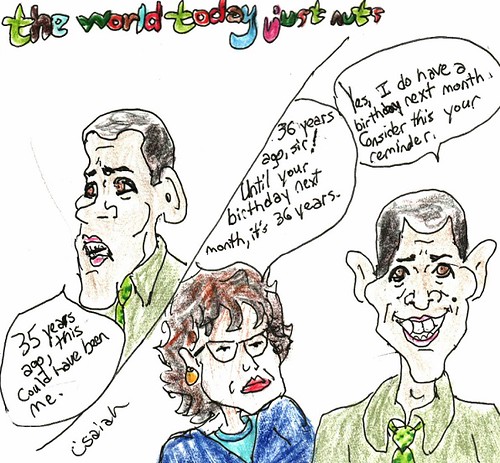
Isaiah's The World Today Just Nuts "The Birthday Reminder" went up Sunday.

the birthday reminder


Yes, if Barack speaks, it always has to be about him.

Former US House Representative and former Green Party presidential candidate Cynthia McKinney has a piece at Global Research which notes:


While many are preparing to rally in their hometowns against the Trayvon Martin murder verdict, I thought I’d encourage us on this page to develop a possible solution that could last more than the mere hours of a protest rally. Rallies serve their purpose, but only the development of a process whereby we all can functionally come together and work collectively on a new shared vision that includes everyone will put an end to the scourge that we continue to face.
I posted my sincere feelings here and many others did, too. I believe that we engaged in open and honest discussion here with everyone not agreeing. Except for the Zionist trolls who populate this site, I do believe that we began a process that our country as a whole really needs if we ever are to move forward together, building character, with integrity, for liberty and justice in our local and global communities.

So, I propose a Truth and Reconciliation Commission. I must admit that the idea I’m putting forward came to me in the form of a paper submitted by Dr. Mutulu Shakur, Tupac Shakur’s father figure, incarcerated as a political prisoner since the days of the Black Panther Party before it was cracked down upon by the FBI and others in COINTELPRO.

I like what she says and think it fits in with the piece we wrote at Third, "There Is No Black Leadership."  I think we need hope and a path to go down, not stationary anger. Cynthia is one of the few who could lead us to a better place.  So naturally, she's kept off TV.  

I think we've been blinded by anger before and are encouraged to be blinded today.  I don't believe the corporate media gives a damn about the African-American community so when I see the wall-to-wall (which Ava and C.I. dissected so brilliantly in "Media: The wall-to-wall so-called 'discussion'"), I feel that they're trying to distract and enrage us so we won't ask for our needs.


"Iraq snapshot" (The Common Ills):
Monday, July 22, 2013.  Chaos and violence continue, prison attacks and breaks dominate the news out of Iraq, this despite a Basra assassination, Moqtada al-Sadr calls out the violence, Barack's war on the press and whistle-blowers Ed Snowden and Bradley Manning continues, Helen Thomas passes away, and more.

How bad are things in Iraq today?  So bad that the issue was actually raised to State Dept press spokesperson Jen Psaki in today's briefing:


QUESTION: Iraq?

QUESTION: You don’t think that you’re trying to avoid anything here?

MS. PSAKI: I think this has become a game, so I’m moving on to the next question.

QUESTION: Yeah. Insurgents in Iraq attacked two prisons during the weekend and freed more than 1,000 prisoners, most of them from al-Qaida. Are you aware of that? And to what extent you are concerned?

MS. PSAKI: I’m not – I haven’t seen this report that you’re referring to, but I’m happy to look into it.

QUESTION: Well, still on Iraq.

QUESTION: Jen --

MS. PSAKI: Mm-hmm.

QUESTION: On Iraq?

MS. PSAKI: Mm-hmm.

QUESTION: Yeah. Okay. This morning, I saw Mr. Martin Kobler, the Special Representative of the United Nations Secretary General in Iraq. It’s his last day. He paints a very bad picture of what’s going on in Iraq. And the feeling – not from him, but from others – I’m getting that the United States actually is not involved. It’s looking sort of neutrally at all this violence that’s going on.

MS. PSAKI: Mm-hmm. Well, I would refute that, Said. We are deeply concerned by the levels of violence. We’re encouraged that many political and religious leaders have taken a strong stance against this violence, which is very important, and that they’ve continued to explore ways to address ongoing political and security issues. We welcome recent political developments, including the reciprocal visits in Erbil and Baghdad between Prime Minister Maliki and Iraqi Kurdistan Region President Barzani, discussions by Iraqi leaders to address issues arising from recent protests in western Iraq, and legislative initiatives in the Iraqi parliament.
In terms of our involvement, U.S. officials in Baghdad and Washington remain intensely engaged with senior Iraqi leaders to support their efforts to resolve differences through direct dialogue and the political process. The level of our engagement is reflected even recently by calls placed last week by Vice President Biden to Iraqi leaders, and we’ll continue to work with leaders to overcome the threat of terrorism and their efforts to bring justice to those who continue to perpetrate* such despicable crimes.


We should all be very disturbed that the State Dept spokesperson had no idea on Monday afternoon about the prison attacks Sunday evening.  Iraq has seen many prison breaks in the last year.  But yesterday saw two attacks which were rather spectacular:


Meanwhile in Iraq, NINA notes that unidentified gunmen began "simultaneously attacking the Taji and Abu Ghraib prisons" with gun fire, "improvised explosive devices and RPG launchers."  They also report that the military and the police ("supported with helicopters") were surrounding the prisons.  Jack Phillips (Epoch Times) adds:

Al Jazeera reported on its front page that the attack was taking place on Sunday night, and involved assailants with rocket-propelled grenades, but it did not offer more details.
The Associated Press also confirmed there were clashes at the prison on Sunday.
Charles Lister, with IHS Jane’s Terrorism & Insurgency Centre–an intelligence organization, wrote that a “senior ISIS commander claims Abu Ghraib & Taji prison attacks have been a success. Convoys of escaped prisoners now en route to ‘safety.’” At around 6 p.m., Lister added that “several jihadi sources claim fighting is over at Abu Ghraib.”


Jane Arraf (Al Jazeera -- report is text and video) notes of the attacks, "[Abu Ghraib prison] is now home to several high-ranking al-Qaeda prisoners, as is the prison in Taji.  It appears to be an attempt to free those prisoners."  All Iraq News reports that the prison attacks have been stopped.  Alsumaria adds that, during the attack, prisoners in Abu Ghraib rioted and burned portions of the prison.


Again, how does the US State Dept, spending billions in Iraq, not know of the events from Sunday.  Mohammed Tawfeeq (CNN) observes, "Security forces battled militants outside two major penitentiaries near the Iraqi capital of Baghdad and thwarted prison breaks, the Justice Ministry said Monday."  Press TV notes, "Initial reports said the attacks on prisons had been foiled, and no casualties had been reported."  But today, AFP reports, "Militants attacked two Iraqi prisons including the notorious Abu Ghraib in a bid to free inmates, sparking all-night clashes in which at least 41 people, officials said on Monday."  France 24 adds, "Commentors on micro-blogging website Twitter, including some accounts apparently operated by jihadists, claimed thousands of prisoners had escaped." National Iraqi News Agency reports on a press conference in Baghdad today in which MP Hakim al-Zamili declaring "that between 500 to one thousand prisoners escaped from Abu Ghraib prison."


What prompted the attacks?  No one knows at this point.  But Saturday, as NINA reported, Nouri had the army raid Badush Prison at dawn in Nineveh Province and that a prison source "explained that the inspections included all sections including the women's and events' prison, noting that those forces warned prisoners from the use of any of these arms and machines and mobile devices inside the compound. The source did not mention if these things had been confiscated or not."  It is possible that the raid on Badush Prison prompted the raids (out of concern for those in the two prisons -- out of concern that future plans would be foiled, whatever). 

 The Press Trust of India notes, "Iraq is witnessing its worst eruption of violence in five years." BBC News observes, "United Nations figures released earlier in July showed that more than 2,500 Iraqis were killed in violent attacks in the three months from April to June."  Through Saturday, Iraq Body Count counts 584 violent deaths for the month of July thus far.  Sunday on Al Jazeera, Jane Arraf offers observations on the violence.


Jane Arraf: And really, it's the scope of the targets, the widening of the targets, and the coordinated nature of the attacks such as the eleven car bombs that hit the capital last night that really have people worried.  When you think of the amount of coordination that would have to go into that, these security checks they bypassed, the sheer amount of money and then the suicide bombers who have been blowing themselves up lately, it all really points, according to most Iraqis, to an alarming rise in violence here that security forces can't handle.


Ahlul Bayt News Agency reports, "The main causes of terrorism in Iraq and other regional nations are not ignorant or jobless people, but the Global Arrogance, headed by the US and Israeli regime that have extremism under their control and use it in their own favors, Sheikh Khalid al-Mala told al-Alam on Monday."

Yesterday, we noted:

  All Iraq News notes cleric and movement leader Moqtada al-Sadr is calling for the people to protest the government's lack of response to the violence and sttes, "The silence of the people concerning the terrorist bombings, the people of other countries would revolt and call for toppling the government if their countries witnessed such bombings.  We witness strange silence over these bombings and we cannot grant the government another chance to improve the situation."


World Bulletin interprets Moqtada's statements as calling for the overthrow of Nouri al-Maliki.


Today saw the Mosul bombings, National Iraqi News Agency notes 3 homes were bombed in Falluja claiming the lives of 2 police members and 1 civilian, an attack targeting swimmers in Shirqat has left 1 Iraqi soldier and 2 civilians dead (and another civilian injured), a Falluja bombing injured 1 person, a Basra car bombing injured Sheikah Adnan al-Ghanim, a Falluja attack left 2 civilians dead, a Tikrit bombing claimed the life of 1 police officer and left four people injured, an armed clash with the military in Anbar left 2 people dead and two injured,  the corpses of 4 police officers were found in Mosul, a Ramadi roadside bombing claimed the life of 1 Sahwa,  an armed attack on a Ramadi police station resulted in 1 person dead and another injured, Sheikh Abdullah Sami Assi was assassinated in Kirkuk today during an armed attack on his convoy, and  1 police officer was shot dead in Falluja,  Alsumaria reports that a Ramadi police station was attacked today and one assailant was killed and another injured.


Turning to England,  Richard Dearlove is the former head of the UK's MI6.  RT reports that he has documented "new details behind the 'dodgy dossier'" used in England to make the case for war on Iraq and, while he had intended his writing to be published after his death, he's now considering publishing it sooner "depending on what Chilcot publishes."  Chilcot refers to John Chilcot who heads the Iraq Inquiry which is supposed to publish a report at some point (the report should have been published some time ago).   Andrew Mason (Iraq Inquiry Digest) observes, "As can be seen here and here, much of Dearlove’s evidence given in private to the Iraq Inquiry was heavily redacted before being published on their website."  Press TV adds, "According to the Daily Mail, sources close to Sir Richard say he accepts the inaccuracy of some MI6’s information on Iraq WMDs and that he believes the inquiry’s chairman Sir John Chilcot should investigate misleading statements by former British PM Tony Blair and his chief spokesperson and strategist Alastair Campbell about WMDs."


Turning to Barack Obama's war on the press.  Friday brought the news the Fourth Circuit of Appeals was bowing to the administration's insistence that New York Times reporter James Risen must reveal his source.  Confidentiality is important to reporting.  Sources may have many reasons for not going public.  Recognizing that, most news outlets have policies regarding confidential sources.  For example, this is the New York Times' policy:


The use of unidentified sources is reserved for situations in which the newspaper could not otherwise print information it considers reliable and newsworthy. When we use such sources, we accept an obligation not only to convince a reader of their reliability but also to convey what we can learn of their motivation – as much as we can supply to let a reader know whether the sources have a clear point of view on the issue under discussion.
In routine interviewing – that is, most of the interviewing we do – anonymity must not be automatic or an assumed condition. In that kind of reporting, anonymity should not be offered to a source. Exceptions will occur in the reporting of highly sensitive stories, when it is we who have sought out a source who may face legal jeopardy or loss of livelihood for speaking with us. Similarly they will occur in approaches to authoritative officials in government who, as a matter of policy, do not speak for attribution. On those occasions, we may use an offer of anonymity as a wedge to make telephone contact, get an interview or learn a fact. In such a case, the reporter should press the source, after the conversation, to go on the record with the newsworthy information that has emerged.
Whenever anonymity is granted, it should be the subject of energetic negotiation to arrive at phrasing that will tell the reader as much as possible about the placement and motivation of the source – in particular, whether the source has firsthand knowledge of the facts.
In any situation when we cite anonymous sources, at least some readers may suspect that the newspaper is being used to convey tainted information or special pleading. If the impetus for anonymity has originated with the source, further reporting is essential to satisfy the reporter and the reader that the paper has sought the whole story.
We will not use anonymous sourcing when sources we can name are readily available.
Confidential sources must have direct knowledge of the information they are giving us — or they must be the authorized representatives of an authority, known to us, who has such knowledge.
We do not grant anonymity to people who are engaged in speculation, unless the very act of speculating is newsworthy and can be clearly labeled for what it is.
We do not grant anonymity to people who use it as cover for a personal or partisan attack. If pejorative opinions are worth reporting and cannot be specifically attributed, they may be paraphrased or described after thorough discussion between writer and editor. The vivid language of direct quotation confers an unfair advantage on a speaker or writer who hides behind the newspaper, and turns of phrase are valueless to a reader who cannot assess the source.
Anonymity should not be invoked for a trivial comment, or to make an unremarkable comment appear portentous.

Let's be clear that it's not just journalists that use and endorse confidential sources.  Despite all their whining, Barack's Justice Dept also uses confidential sources.  From the DoJ's Office of the Inspector General's July 2005 report entitled "The Drug Enforcement Administration's Payments to Confidential Sources:"


The Confidential Source program is an important tool used by the Drug Enforcement Administration (DEA).1 DEA officials state that without confidential sources, the DEA could not effectively enforce the controlled substances laws of the United States. Confidential sources come from all walks of life and are significant to initiating investigations and providing information or services to facilitate arrests and seizures of drugs and cash. According to the DEA, it has approximately 4,000 active confidential sources at any one time.
Although confidential sources can be critical to an investigation, special care must be taken to carefully evaluate and closely supervise their use. Confidential sources can be motivated by many factors, including fear, financial gain, avoidance of punishment, competition, and revenge; therefore, the credibility of a source must be balanced against the information they provide. 

In a clear case of do-as-I-say-not-as-I-do, confidential sources are a-okay with the White House . . . when it's the Justice Dept's confidential sources.  Remember that.  Of the ruling compelling Risen to reveal his source,  Norman Solomon (ZNet) explains:


The part of the First Amendment that prohibits “abridging the freedom … of the press” is now up against the wall, as the Obama administration continues to assault the kind of journalism that can expose government secrets. 
Last Friday the administration got what it wanted -- an ice-cold chilling effect -- from the Fourth Circuit Court of Appeals, which ruled on the case of New York Times reporter James Risen. The court “delivered a blow to investigative journalism in America by ruling that reporters have no First Amendment protection that would safeguard the confidentiality of their sources in the event of a criminal trial,” the Guardian reported. 
The Executive Branch fought for that ruling -- and is now celebrating. “We agree with the decision,” said a Justice Department spokesman. “We are examining the next steps in the prosecution of this case.” The Risen case, and potentially many others, are now under the ominous shadow of the Appeals Court’s pronouncement: “There is no First Amendment testimonial privilege, absolute or qualified, that protects a reporter from being compelled to testify … in criminal proceedings.” 
At the Freedom of the Press Foundation, co-founder Trevor Timm calls the court ruling “the most significant reporter’s privilege decision in decades” and asserts that the court “eviscerated that privilege.” He’s not exaggerating. Press freedom is at stake.

Journalism can't be done with only approved leaks from an administration.  To be informed and inform the people, the press requires a variety of sources including whistle-blowers.  Attempts to strip whistle-blowing out of the process are attempts to destroy an informed public and, without that, then you have no democracy.  RT adds:

Next Risen will be expected to testify in the Espionage Act-case against Jeffrey Sterling, a former CIA official accused of disclosing details about a Clinton administration plan to put faulty nuclear weapon blueprints to Iran in an effort to slow down their race to acquiring a nuke. He previously said he’d refuse to speak of his source, however, which would now open up the possibility of being held in contempt of court.
Sterling is one of seven persons accused by President Barack Obama of spying under the Espionage Act, a World War One-era legislation that has previously been used only three times before this administration began targeting leakers.
Judge Roger Gregory, the only justice to vote in the minority, said compelling Risen to testify was a “sad” decision that posed a serious threat to investigative journalism, the Times reported.


The Espionage Act is one of the most ridiculous on the books.  It largely exists to try to frighten people from speaking out against conscription.  As History.com notes, the legislation "essentially made it a crime for any person to convey information intended to interfere with the US armed forces prosectuion of the war effort [. . .]."  PBS' American Experience explains, "It authorized stiff fines and prison terms of up to 20 years for anyone who obstructed the military draft of encouraged 'disloyalty'. [. . .] The Espionage Act was evidently effective in prosecuting the I.W.W. and any others opposing conscription.  In 1918, it was used to send labor leader and former presidential candidate Eugene Debs to jail for a decade, because of a speech he delivered."  How telling that it would become the go-to law for Barack's lousy administration.  'B-b-but, Barack cares about the press! Why, just last month, he was proposing a shield law!'  As the editorial board of the San Jose Mercury News reminds today:

The Obama administration's born-again belief in a free press was in response to a public backlash. Revelations that the FBI had secretly seized phone records and emails from reporters at the Associated Press and Fox News infuriated journalists, Congress and the public, prompting Obama to ask Holder for a policy review. The new policy would revive former practices of notifying media outlets when communications are being sought and would bar the use of search warrants to seize a reporter's records unless the reporter is under investigation for something other than his or her news gathering.

Of last week's ruling,  Eric London (WSWS) explains:


The ruling reinforces the US government’s assault on democratic rights. It is part of a wider campaign to intimidate or imprison anyone—journalists included—who attempts to make public information about the secret and illegal actions of the US government.
The Obama administration appealed a federal court ruling in favor of Risen to the Fourth Circuit appeals court, which is based in Virginia, underscoring the ruthlessness of its drive to silence all would-be leakers and whistle-blowers. Friday’s ruling comes in the midst of Washington’s international campaign to capture former National Security Agency contractor Edward Snowden, who has exposed details of the US government’s illegal spying operations against the entire US population and much of the rest of the world, and try him for espionage.


The NSA whistle-blower Ed Snowden remains in Russia.  Martin Walker (UPI) reports the European Union is "already calling him to testify, along with National Security Agency chief Gen. Keith Alexander and two other NSA whistle-blowers, Tom Drake and William Binney, in hearings designed to lead to new data privacy rules and data-sharing agreements between Europe and the United States."  Should he agree to testify, would he be able to make it there safely?  Or would the US government again force a plane down in an attempt to seize him?

The issue was raised at today's State Dept press briefing moderated by spokesperson Jen Psaki:


QUESTION: Okay, that would – so that would be – all right. So anyway, the EU foreign ministers have all come out with a statement calling for his release. Is that – does the United States support that position now that it’s more than just the Germans?

MS. PSAKI: I think I’ve stated our position on this and I don’t have anything more on it new for you today.

QUESTION: Okay. Can I just ask again my question from, what, 10 days ago?

MS. PSAKI: Mm-hmm.

QUESTION: Why is it taboo for you to say from the podium that you would like to see President – former President Morsy released?

MS. PSAKI: I just don’t have anything more for you on it, Matt.

QUESTION: So how do you define him? Is he deposed, is he former?

MS. PSAKI: Well, let’s – I think Lesley was jumping in here.


[. . .]

 
QUESTION: Do you have an update on Snowden’s whereabouts? And also, the Russian Interior Ministry is saying look, you want extradition, we want extradition, we’ve got two guys, terrorists, who are living in the United States and we want them back. And the U.S. doesn’t do anything, therefore this is double standards. Do you have anything on those? I can give you their names if you want.

MS. PSAKI: Mm-hmm. I’m happy to look into that. I mean, I think our policy on this has been that Mr. Snowden has been convict – or has been accused I should say, sorry – of three felonies. We believe he should be returned to the United States. We – the – my last understanding of this, and I believe this is up to date, is that he remains in the transit lounge of the airport there and that Russia still has the opportunity to do the right thing and return him to the United States, where he can face justice.

QUESTION: Are there continuing talks, or is it just kind of the status quo?

MS. PSAKI: They’re continuing. We remain in contact. I don't have any update for you on the last conversation. But this is obviously an issue that’s a priority and we remain in contact with – at the appropriate level.

QUESTION: Jen --

QUESTION: Just can I --

QUESTION: -- that’s was a very interesting Freudian slip you just made there. Is it the Administration’s position that Mr. Snowden is, in fact, guilty because he admitted to leaking this material?

MS. PSAKI: I think I corrected myself and said he was accused, which still warrants his return to the United States --

QUESTION: Yeah. But you started out by saying “convicted.”

MS. PSAKI: -- so he can face justice.

QUESTION: Okay.

MS. PSAKI: I corrected myself midstream.

QUESTION: So it’s not the Administration’s view that he is – right now that he is guilty of any crime?

MS. PSAKI: Well, you’re familiar with how our justice system works. I don’t think we need to do an education on that here.

QUESTION: No. I just want to make sure --

MS. PSAKI: The status is that he has been accused --

QUESTION: You --

MS. PSAKI: -- of three felonies --

QUESTION: Yes.

MS. PSAKI: -- and we believe he should be returned to the United States.

QUESTION: And tried for that?

MS. PSAKI: Correct.

QUESTION: But you do not assume or you do not believe right now that he is necessarily guilty.

MS. PSAKI: You are familiar with how our justice system works, Matt.


This afternoon Libertarian Philip Giraldi (Guardian) defended Ed against some of the more outrageous charges circulating:


There are a number of narratives being floated by the usual suspects to attempt to demonstrate that Edward Snowden is a traitor who has betrayed secrets vital to the security of the United States. All the arguments being made are essentially without merit. Snowden has undeniably violated his agreement to protect classified information, which is a crime. But in reality, he has revealed only one actual secret that matters, which is the United States government's serial violation of the fourth amendment to the constitution through its collection of personal information on millions of innocent American citizens without any probable cause or search warrant.
That makes Snowden a whistleblower, as he is exposing illegal activity on the part of the federal government. The damage he has inflicted is not against US national security, but rather on the politicians and senior bureaucrats who ordered, managed, condoned, and concealed the illegal activity.


At Truthout, it's noted just how ridiculous the US government is looking as it continues to try to destroy Ed Snowden, " Secretary of State John Kerry, along with UN nominee Samantha Powers, is threatening acts of war with Venezuela. The US has already violated international law by forcing down the plane of the Bolivian president. And now, President Obama is saying he may derail talks with Russian President Putin over Snowden."  Writing for the Boston Globe, former US Senator John Sununu notes some of the issues involved in Ed Snowden's disclosures:

Completely lost in this sea of ambivalence are the most important issues at stake: In their current form, what do these programs say about our society and our willingness to forgo what only a few years ago would be considered basic principles of personal privacy? Are we, in the momentous words of Franklin, sacrificing “essential liberty to purchase a little temporary security” and therefore deserving of neither? And once the sacrifice is made, can we ever go back?
You don’t have to condone Snowden’s leaks to believe that we are on a disturbing path.

Government power to demand vast troves of business records was at the heart of the filibuster I led to stop proceedings on the Patriot Act in 2005. We argued that the threshold for obtaining so-called “Section 215 subpoenas” — which grant access to a broad variety of business records and other material without judicial approval — was too low, that the gag order preventing business owners from talking to anyone about these subpoenas was too harsh, and that congressional oversight of the entire process was nonexistent.


At CounterPunch, Ray McGovern takes on former NSA Director Michael Hayden:

Writing as “CNN Terrorism Analyst,” Hayden read from the unctuous script previously used by “Meet the Press” host David Gregory on June 23 when he questioned Greenwald’s status as a journalist. Hayden claimed Greenwald deserves “the Justice Department’s characterization of a co-conspirator.”
But the principal target of Hayden’s ire was Snowden. After lumping him together with despicable characters like CIA’s Aldrich Ames, Robert Hanssen of the FBI, and others who spied for the U.S.S.R. – and then disparaging “leakers” like Bradley Manning – Hayden wrote, “Snowden is in a class by himself.”
But it is Michael Hayden who is in a class by himself. He was the first NSA director to betray the country’s trust by ordering wholesale violation of what was once the First Commandment at NSA: “Thou Shalt Not Eavesdrop on Americans Without a Court Warrant.” Not to mention playing fast and loose with the Foreign Intelligence Surveillance Act of 1978 and the Fourth Amendment to the Constitution.
While Hayden has implicitly offered a second-grader kind of excuse, that President George W. Bush and Vice President Dick Cheney “made me do it,” that does not let Hayden off the hook.
I have found it helpful lately to read the one-sentence Fourth Amendment during TV and radio interviews in order to provide necessary context and a backdrop against which viewers/listeners can gauge how the recent revelations about NSA operations comport, or do not, with the strictures in the amendment. Thankfully, the language is pretty straightforward and specific:
“The right of the people to be secure in their persons, houses, papers, and effects, against unreasonable searches and seizures, shall not be violated, and no Warrants shall issue, but upon probable cause, supported by Oath or affirmation, and particularly describing the place to be searched, and the persons or things to be seized.”


  Monday April 5, 2010, WikiLeaks released  military video of a July 12, 2007 assault in Iraq. 12 people were killed in the assault including two Reuters journalists Namie Noor-Eldeen and Saeed Chmagh. Monday June 7, 2010, the US military announced that they had arrested Bradley Manning and he stood accused of being the leaker of the video. Leila Fadel (Washington Post) reported in August 2010 that Manning had been charged -- "two charges under the Uniform Code of Military Justice. The first encompasses four counts of violating Army regulations by transferring classified information to his personal computer between November and May and adding unauthorized software to a classified computer system. The second comprises eight counts of violating federal laws governing the handling of classified information." In March, 2011, David S. Cloud (Los Angeles Times) reported that the military has added 22 additional counts to the charges including one that could be seen as "aiding the enemy" which could result in the death penalty if convicted. The Article 32 hearing took place in December. At the start of this year, there was an Article 32 hearing and, February 3rd, it was announced that the government would be moving forward with a court-martial. Bradley has yet to enter a plea. The court-martial was supposed to begin before the November 2012 election but it was postponed until after the election so that Barack wouldn't have to run on a record of his actual actions.  Independent.ie adds, "A court martial is set to be held in June at Ford Meade in Maryland, with supporters treating him as a hero, but opponents describing him as a traitor."  February 28th, Bradley admitted he leaked to WikiLeaks.  And why.


Bradley Manning:   In attempting to conduct counter-terrorism or CT and counter-insurgency COIN operations we became obsessed with capturing and killing human targets on lists and not being suspicious of and avoiding cooperation with our Host Nation partners, and ignoring the second and third order effects of accomplishing short-term goals and missions. I believe that if the general public, especially the American public, had access to the information contained within the CIDNE-I and CIDNE-A tables this could spark a domestic debate on the role of the military and our foreign policy in general as [missed word] as it related to Iraq and Afghanistan.
I also believed the detailed analysis of the data over a long period of time by different sectors of society might cause society to reevaluate the need or even the desire to even to engage in counterterrorism and counterinsurgency operations that ignore the complex dynamics of the people living in the effected environment everyday.


For truth telling, Brad's being punished by the man who fears truth: Barack Obama.  A fraud, a fake, a 'brand,' anything but genuine, Barack is all marketing, all facade and, for that reason, must attack each and every whistle-blower.  David Delmar (Digital Journal) points out, "President Obama, while ostensibly a liberal advocate of transparency and openness in government, and of the 'courage' and 'patriotism' of whistleblowers who engage in conscientious leaks of classified information, is in reality something very different: a vindictive opponent of the free press willing to target journalists for doing their job and exposing government secrets to the public."


On this week's Law and Disorder Radio,  an hour long program that airs Monday mornings at 9:00 a.m. EST on WBAI and around the country throughout the week, hosted by attorneys Heidi Boghosian, Michael S. Smith and Michael Ratner (Center for Constitutional Rights) topics addressed include Bradley Manning, attorney Rachel Lederman on Oscar Grant and Alfred McCoy on the long history of US government spying.


Michael Ratner: Sadly and unfortunately and to me shockingly, the judge upheld the charge against Bradley Manning of aiding the enemy.  I thought there was no evidence at all that he had actual knowledge that documents he was giving to WikiLeaks would go to "the enemy." But the judge felt otherwise.  I want to put the judge's decision in quick context.  It was on a motion to dismiss the charges and in that case the judge has a very low standard. She takes all of the evidence put in by the government as true, she doesn't take the defense evidence into consideration and she has inferences favorable to the government that she draws.  So it doesn't mean that she will necessarily convict Bradley Manning at the end of the trial but it doesn't bode well.  In my view, there was simply no evidence to say that Bradley Manning had actual knowledge that al Qaeda or al Qaeda in the Arabian Peninsula would read these documents.  In addition, and finally on this point, the judge ruled out that Bradley Manning had to have the specific intent to aid al Qaeda and  al Qaeda in the Arabian Peninsula.  I think that's required by the statute.  She said that it wasn't required.  I think she'll be reversed on appeal if she upholds the conviction in this case but that's a long time to wait.  The deleterious effects, already, of a decision like that on both whistle-blowing in the army as well as calling journalists and publishers like WikiLeaks or for that matter the New York Times and others as an indirect way of aiding the enemy tells us about the government's efforts to completely end any kind of transparency in this country -- a serious blow to free speech, democracy and informed citizens.


Emily Bazelon (Slate via Winnipeg Free Press) explains:

To justify Thursday’s ruling, prosecutors argued that "the evidence will show that the accused knowingly gave intelligence to the enemy." The proof was that some of the documents, once online, reached Osama bin Laden and were found on his computer. In other words, by giving the information to WikiLeaks, Manning was giving it to the terrorists. This is a shockingly broad interpretation of a law that was written too sweepingly. It implicates all kinds of people who publish things that could hurt U.S. interests by tarnishing our image abroad.
Journalists do this routinely; So do plenty of people on social media. It’s called free speech.
Most of the critics have no access to the kinds of damaging goods that Manning had. But now when they do, they will have to fear that publishing it is the legal equivalent of deliberately handing it to terrorists. As Benkler points out, it doesn’t matter if the publishing platform is WikiLeaks or The New York Times or Twitter. And this theory of aiding the enemy "is unprecedented in modern American history." You have to go back to the Civil War, and a case in which a Union officer gave a newspaper in Virginia rosters of Union soldiers, to find a case like Manning’s.


Rem Rieder (USA Today) voices similar sentiments:

Pursuing the "aiding the enemy" charge smacks more of revenge than justice. It's part of the Obama administration's record-breaking, way-too-enthusiastic and totally inappropriate use of the Espionage Act to go after leakers. It has prosecuted seven current or former government employees under the act. That's more than all previous administrations combined.
Mainstream journalists, not to mention all citizens who care about their access to important information, can take no solace in the fact that Manning is being prosecuted for leaking to the renegade outfit WikiLeaks rather than a traditional news outlet.


Lastly, Helen Thomas passed away Saturday at the age of 92.  She was one of the few journalists who questioned the Iraq War before it started and after it began.  (See Third's "Editorial: Helen Thomas and the importance of Iraq.")  Liz DiNovella remembers Helen at The Progressive and reposts an interview she did with Helen.  Those new to Helen Thomas or wanting to remember her can click here for Democracy Now!'s collection of interviews with Helen.]  Amy Goodman (Democracy Now!) noted today:


The trailblazing journalist Helen Thomas has died at the age of 92. Widely known as "the dean of the White House press corps," Thomas became the first woman assigned to the White House full-time by a news service when she began to cover the Kennedy administration. She went on to cover every president since until controversial comments on the Israel-Palestine conflict forced her to retire in 2010. Throughout the two-term Bush administration, she asked some of the most critical questions in the White House press newsroom. She challenged the administration on issues including the Iraq War and its massive civilian toll, the threat of an attack on Iran, the refusal to sign a cluster bomb treaty, the ongoing killings of Afghanistan civilians, and its critical support for Israel’s attacks on Gaza and Lebanon. In July 2007, President George W. Bush reverted to a presidential press conference tradition he had long ignored: giving Thomas the first question.
President George W. Bush: "Now, I will be glad to answer a few questions, starting with Ms. Thomas."
Helen Thomas: "Mr. President, you started this war, a war of your choosing, and you can end it alone, today, at this point, bring in peacekeepers, U.N. peacekeepers. Two million Iraqis have fled their country as refugees. Two million more are displaced. Thousands and thousands are dead. Don’t you understand? You have brought the al-Qaeda into Iraq."
President George W. Bush: "Actually, I was hoping to solve the Iraqi issue diplomatically. That’s why I went to the United Nations and worked with the United Nations Security Council, which unanimously passed a resolution that said disclose, disarm or face serious consequences. That was the message, a clear message to Saddam Hussein. He chose the course."
Helen Thomas: "Didn’t we go into Iraq..."
President George W. Bush: "It was his decision."
Earlier that year, Democracy Now! interviewed Thomas at the Media Reform Conference in Memphis. I asked her for her take on the consolidation of media control by a small number of corporations.
Helen Thomas: "I’d tell them, forget about all those profits, and help the country, that the media should be a public service. You cannot have a democracy without an informed people. And that should be their role. They can make their money everywhere else."


 wbai
law and disorder radio
michael s. smith
heidi boghosian
michael ratner