Wednesday, July 01, 2015

Bernie plays on fear of the other

Fake and shake Bernie Sanders is many things -- few of them good.

He has fooled a lot of people.

But not everyone.

Tom Hall (WSWS) reports:

Sanders combines his populist appeals with economic nationalism. Far from pursuing genuinely socialist politics, which is based on revolutionary internationalism, he opposes the international unity of the working class, calling instead for American workers to rally in defense of “their” national state against foreign capital.
The general thrust of Sanders argument can be summed up as the following: global trade undermines the sovereignty of the United States and results in the off-shoring of American jobs overseas to authoritarian regimes, resulting in declining living standards for American workers. As an alternative, Sanders proposes various protectionist measures.
This is the content of his stance on the Trans-Pacific Partnership (TPP), which he has joined congressional Democrats and trade union officials in opposing. A statement released by Sanders declared that the TPP would “undermine US sovereignty,” eliminate protectionist “Buy American” laws, and “reward authoritarian regimes like Vietnam.


 As usual, he's using fear of the other to score points.

How very telling.

"Iraq snapshot" (The Common Ills):

Tuesday, June 30, 2015.  Chaos and violence continue, the New York Times does more bad 'reporting,' they fail to provide the context for the LGBT community in Iraq when Hillary Clinton received an e-mail in July 2009, we note the context, we also note a comment on Posner which may indicate Hillary's frustrations with Barack Obama, and a little more.


Where there is wasted resources and bad reporting, there is the New York Times.

It's a fact the paper never seems to stop flaunting.

The ridiculous Peter Baker and Steve Eder rush forward to remind us of that today in an article about . . .

Well is there a point to it?

The State Dept released some of former Secretary of State Hillary Clinton's e-mails.

This is a paragraph in the blather Baker and Eder offer:

Her policy priorities come through in the messages as well. In July 2009, when an aide forwarded Mrs. Clinton a message about treatment of gays and lesbians in Iraq, both before and after the reign of Saddam Hussein, she wrote back quickly: “So sad and terrible. We should ask Chris Hill,” the American ambassador, “to raise w govt.”


No policy priorities come through in that paragraph.

They fail to establish anything and seem less like reporters and more like two dishy teens at first lunch.

"So sad and terrible," Hillary wrote.

About what?

Despite being paid to be reporters, neither Peter Baker nor Steve Eder care to share that with the readers.

"We should ask Chris Hill to raise w govt"?

Why?

The writers fail to establish what the communication was about or what was going on in Iraq at the time or even why the issue was raised?

Here's the reality piss panties Peter and Stevie can't tell you because they're too busy whoring and lying (for this you left the Washington Post, Peter?), life in Iraq had turned deadly for the LGBT community.

Under Nouri al-Maliki.

Not under Saddam.

Under Nouri al-Maliki.

It's a fact, quit whoring and lying, Peter Baker and Steve Eder.

Human trash is that which covers for the crimes of a thug.  By that definition, Peter and Steve are human trash.

Oh, C.I., you always blame Nouri!

Because I pay attention and I'm not in a coma.

And maybe if others paid attention as well, Baker and Eder wouldn't get away with this garbage.

July 2009 is when Hillary's suddenly learning of "so sad" life for Iraq's LGBT community.

Who's raising the issue?

Not the moronic New York Times, never the idiotic and homophobic New York Times.

But July of 2009 is when Ashley Byrne's "Saddam's rule 'better' for gay Iraqis" (BBC News) appears,


What else was the BBC offering as coverage that month?


From the July 7, 2009 snapshot:


Gay Life After Saddam is a documentary the BBC commissioned which was set to air Sunday, July 5th on BBC Radio 5 Live; however, the Wimbledon Men's Final ran late Sunday and the program has been rescheduled to air Sunday July 12th from nine to ten p.m. (1:00 to 2:00 p.m. PST).  Ashley Byrne did the investigative reporting for the documentary and, at the BBC, Byrne explains, "What is clear, and confirmed by separate evidence from various human rights groups, is that some gay men have been subjected to appalling violent abuse. . . . Gay men inside Iraq have been able to seek santuary in safe houses, thanks to the UK-based Iraqi Lesbian Gay Bisexual and Transgender (LGBT) group, which manages them from London.  The documentary team were granted exclusive access to one of the homes on the outskirts of Baghdad".  The people Byrne speaks to maintain it was easier to be a gay Iraqi when Saddam Hussein was in charge of Iraq.  So much for 'liberation' and 'democracy.'  Again, the specail has been rescheduled for this coming Sunday, July 12th. 


Now some whine, 'I'd love to listen but BBC's webpage says it's no longer available.'

How is that my problem?

You didn't pay attention in real time?  How is that my problem?

No, the special's no longer available.  It was six years ago.

But we did cover it in real time and we can offer this lengthy excerpt of the transcript we did of the program:


Aasmah Mir: Since the invasion six years ago a steep rise in sectarian violence has claimed thousands of victims throughout the country but this could just be the tip of the iceberg because murders and attacks against the lesbian, gay, bisexual and transgendered community are also on the increase but often go unreported. So what is happening to gay people inside Iraq? We've spoken to a range of people -- to those still inside the country and to those who fled to different parts of the world.  The names of victims appearing in this program have been changed to protect their identities.  Researchers from the US-based Human Rights Watch recently spent several months investigating the treatment of gay people in Iraq.
 
Scott Long: Today we're going to look at a new issue for us --
 
Aasmah Mir: The director of the organization LGBT program, Scott Long, outlined some of their findings at a briefing in New York.
 
Scott Long: I'm going to start by reading a testimony, or part of a testimony, from a man we spoke to who was 35-years-old.  He actually developed a severe speech impediment from strain and grief.  This is what he told us: "It was late one night in early April and they  came to take my partner at his parent's house.  Four armed men barged into the house. they were masked and wearing black.  They asked for him by name.  They insulted him and they took him in front of his parents.  He was found in the neighborhood the day after.  They had thrown his corpse in the garbage, his genitals were cut off and a piece of his throat was ripped out.  Since then, I've been unable to speak properly. I feel as if my life is pointless now.  I don't have friends other than those you see.  For years, it's just been my boyfriend and myself in that little bubble by ourselves.  I have no family now.  I can't go back to them."

Aasmah Mir: Back in Britain, I went to see asylum seeker Ali Hilli who runs a group called Iraqi LGBT.
 
Aasmah Mir: Hello Ali.
 
Ali Hilli: Hello Ashram, how are you?
 
Aasmah Mir: I'm fine thank you.  How are you?

Ali Hilli: Good thank you.
 
Aasmah Mir: Thanks very much for talking to us.
 
Aasmah Mir: While I was with him, Ali showed me some of the shocking video evidence of torture his group has been collecting. The images he showed me concerned attacks on transsexuals
 
Aasmah Mir:  People were -- had their heads shaved.  In this video we see one of the victims, his name is Ali also, he was a member of our group in Najaf, a trans person lived all his life as a transwoman.  They took him away.  They had his head shaved.  And they distributed this video everywhere in Iraq and we still don't have an idea
 
Aasmah Mir: And that's what we can actually see right now, he's sitting on a stool, dressed in female clothes, long hair and someone is shaving his head.
 
Ali Hilli: Yes and uh it's so degrading.
 
Aasmah Mir: Yeah.  How do you feel when you watch this kind of video because obviously you probably see a lot of it.  This is the first time I've seen anything like this and, you know, obviously I'm quite shocked by it.  But you, you must see this stuff all the time.  Do you still feel shocked by it or are you almost becoming -- getting used to it in a kind of way?
 
Ali Hilli: No, I will never get used to atrocities against humanity.  If I see the video for the first time, I'm quite shaken because the only thing that I-I afraid to catch is the moment of death. This is what I-I don't want to see in my life.   I-I can - I can bear anything, I can accept anything but to kill a human?  I just can't.
 
Aasmah Mir: We were granted exclusive access to one of the so-called safe houses set up and funded and managed by the London-based Iraqi LGBT group.  On the outskirts of Baghdad, in an anonymous street behind heavily curtained windows we found Kassim a man in his late thirties.  Kassim describes himself as a woman in a man's body.  He's had a lifetime of trouble coming to terms with his gender identity.  Kassim's been the victim of violence on several occasions most recently earlier this year
 
Kassim: One day, um, someone stopped his car by me and he said "Taxi" and I said, "Why?  Why taxi?" Where are you going?  And I said I was going to this certain place.  He took me to an empty house and put a white blindfold on my eyes and then put a gun to my head and I said, "Just give me a time to pray to God before you kill me."  And he said, "I won't give you time to pray."  And he threatened me and I wasn't moving because I was afraid that he would kill me with the gun and then finally he said, "Okay, I'll let you go for this time but your day will come where you will die
 
Aasmah Mir: Amil's a young Iraqi man whose seeking asylum in London.  A gay friend of his was killed by extremists in Iraq.
 
Amil: I used to have a friend, he was student with me and they find out he was gay and they kill him and they chop him like a -- like a lamb or I couldn't or I can't - I can't hardly say because it was really awful.  They kill him and they chop it him and they put him in front of the institute, the one I was studying, to show and to scare the people to not be gay or homosexual.
 
Aasmah Mir: Most shocking of the recent reports to emerge from Iraq is a form of torture used on gay men involving glue.  Hossein Alizadeh is the Middle East and North Africa researcher for the International Gay and Lesbian Human Rights Commission
 
Hossein Alizadeh: The most horrendous form of torture that I have heard and seen is what happened during March and April in Iraq.  Members of the Iraqi Shi'ite militia  al-Mahdi group, they went around posted lists, names of the people who were supposed to be gay and when they arrest them they basically use glue to shut down their digestive system -- the anus. Others who managed to escape go to the hospitals and the hospitals refuse treatment to those people because, again, they look gay or they're perceived to be gay.  So we had numerous cases -- I can tell you about fifty or sixty cases I've heard -- that have been tortured in that way.
 
Aasmah Mir: Rasha Moumneh is the Middle East researcher for Human Rights Watch
 
Rasha Moumneh: You know some of the gay men have actually talked about internet entrapment, a lot of men would be kidnapped, blackmailed for money.  We've talked to people whose partners have been killed in the most brutal of ways.
 
Aasmah Mir: And it appears that it is not just people who are gay, bi or transsexual who find themselves the target of violence
 
Ali Hilli: Anyone who's gay, who looks like gay, or have an effeminate behavior, certain Western dress, we've heard of so many examples of people who were, they were even married with children      
 
Aasmah Mir: There seems to have been an increase in violence in recent months but according to the London-based Iraqi LGBT the killings and torture go back a long way.  They claim more than 600 people have been executed since 2003.
 
Ali Hilli: There are so many other areas like villages, little towns, also big cities, we can't have people reach to or investigate about incidents.  Also sometimes security situation is quite very complicated, people can't travel often to check or find out what's happening in certain areas.  So I believe the number is far more higher than 600.  
 
Aasmah Mir: Gay people are seeking sanctuary from the violence in Iraq in all parts of the world.  At a secret location by the banks of the Seine in Paris we met Omar a twenty year old gay man who just weeks earlier had been facing death in Iraq. A small, slightly built young man, who looks younger than his age, told us his story.  At times clearly traumatized.
 
Omar: I was arrested and I was in retention and there I found five other gay persons.  We suffered torture.  There was the electrical way -- to use electricity to torture us.  And there's a position where my head is down through my legs -- and  my head is down, it's something horrible.  While you have another mean of torture using the belts -- you cannot imagine -- a normal person cannot imagine such torture.
 
Aasmah Mir:  I'm Aasmah Mir and you're listening to Gay Life After Saddam on BBC Radio 5 live. So what was life like for gay, lesbian, bisexual and transgendered people before the fall of Saddam Hussein
 
Scott Long: There was no possibility of leading a particularly public gay life. There are reports from Amnesty International that 2002 as Saddam was attempting to sort of shore up his Islamist credentials, before the invasion, he passed decrees mandating the death penalty for prostitution and for homosexual conduct.  We haven't actually seen those decrees and we can't confirm what they contain.
 
Aasmah Mir: This Iraqi student who wishes to remain anonymous now lives in New York
 
Anonymous: I had a pretty, you know, reasonable gay lifestyle under the table -- in terms of, you know,  circle of friends, gatherings, get-togethers, we'd get together at homes.  Before the war, there were a couple of bars, a couple of clubs that on weekends are pretty much publicly gay and everybody knew about it and we used to go and hang out there and that's fine as long as we don't take that out in the streets.
 
Aasmah Mir:  Ali Hilli was a young gay men in Iraq during the 1990s.  He has fond memories of the underground gay scene that flourished without much interference in Saddam's Baghdad.
 
Ali Hilli: Well we had - we had lots of theater actually plays that we were -- people always have to refer to the gay character which is always taken as a sense of humor in shows.  We used to go to -- to see lots of theaters and plays.  I don't know, for some reason there is always a gay character in these plays and I quite like it because I know some of the actors who are really gay themselves and we enjoy it because they really make the most of it.  They camp it up.  And there were lots of gay famous singers.
 
Aasmah Mir: Kassim remembers a better life under Saddam    .  
 
Kassim: Life was good, everything was okay.  There were clubs, cafeterias and we could choose where we sat.  We could choose any place to sit and meet other gays  and frankly compared to the current situation the times under Saddam were much better.
 
Aasmah Mir: Haider is an Iraqi seeking asylum in England.  He's been living in Huntersfield.  He left Iraq shortly after the US invasion six years ago.
 

Haider: If you respect yourself and live and you don't cause any problems nobody is going to kill you we didn't hear of anybody being killed because of his sexuality in Saddam's regime. Now after that, everything got worse, everything got fluctuated.  I fled from Iraq in 2003 because of one of the worst experiences I've had in my life. I was kidnapped for 9 days, they took me in a small car and they send me about to a place about half an hour.  I was.  I was eye-folded, they call it.  [. . .]  on the border of Baghdad. One of the officers there, he raped me. And then he said "if you're going to tell anyone from the rest of the gang, I will kill you directly." I was scared.  Just a one meal a day which is not enough. They were always telling us that they were going to kill you.


This is the context that Peter Baker and Steve Eder -- two people who are paid to do a job -- fail to provide.

The above is being covered by the BBC in July of 2009 when Hillary's having the issue raised to her in some form.

"Some form" because the New York Times fails to provide you with any context but it also fails to provide you with what the e-mail to Hillary said.


If you're among the many late to the party, SPOILER ALERT, it gets worse for Iraq's LGBT community in Nouri's second term as prime minister.


That's when he refuses to nominate anyone to head the Ministry of the Interior (over the police) so that he can control the Ministry.  He then sends Ministry employees into Iraqi schools to tell them that gay men are vampires who will drain their blood and kill them, that exposure to gay men will turn the children day, that gay men must be killed.

When word gets out on this and Alsumaria and Al Mada begin reporting on it, Nouri and his flunkies will deny that the Minister of Interior employees said any such thing.

But then Alsumaria and Al Mada get a hold of the hand outs the Ministry employees provided the students with.

Suddenly, the denials (lies) stop because the hand outs make clear that Nouri was trying (and succeeding) to instigate violence against Iraq's LGBT community with a pack of lies designed to frighten young people.

Now we could walk through that time period -- Goodness knows we owned the story in terms of English language coverage.  We were so good at covering it that Jim ends up showing me a US newspaper report and asks me to read it.  I do, I read along and it seems familiar and then the rhythm sets in and I recognize it as my own writing.  It was.  It appeared here word for word (four paragraphs) but that didn't stop a US newspaper from printing it as their own.

We could walk through that time period but, as Ben Taylor sings, "I'm not going to make you cry or break your heart, Girl, we don't have the time" -- "Wicked Way," written by Ben and David Saw, first appears on Ben's The Legend of Kung Folk [Part1 (The Killing Bite)].

But the point is that if you weren't paying attention then, you're exactly the type of person that Peter Baker and Steve Eder are playing for a fool with their article.

They're not even being fair to Hillary.

"So sad," written by Hillary, takes on a different context if you know what was taking place in July 2009.


Let's go over the e-mails briefly.  On July 6, 2009 at 8:33 a.m., Cheryl Mills forwards to Hillary "BBC: Saddam's rule 'better' for gay Iraqis"  Cheryl is rather infamous (thanks to Benghazi) so we'll assume most are familiar with that State Dept figure.

She is forwarding Hillary the BBC report we linked to at the top.  She's been e-mailed it by Richard Socarides.

Who?

From Wikipedia:


Richard Socarides (born 1954) is a Democratic political strategist, writer, commentator and a New York attorney. Socarides was named Head of Public Affairs for Gerson Lehrman Group in August 2013. He was a White House adviser under United States President Bill Clinton from 1993 to 1999 in a variety of senior positions, including as Special Assistant to the President and Senior Adviser for Public Liaison. He worked on legal, policy and political issues and served as principal adviser to Clinton on gay and lesbian civil rights issues. Under Clinton, he was Chief Operating Officer of the 50th Anniversary Summit of the North Atlantic Treaty Organization (NATO). Socarides also worked as special assistant to Senator Tom Harkin (D-Iowa). From 2000 to 2006, Socarides held senior positions at Time Warner, including at its divisions New Line Cinema and AOL.
Socarides has written extensively on political and legal topics in his regular column in The New Yorker, as well as for The Washington Post, The Wall Street Journal, and Politico. He is a frequent commentator on television.
Socarides is a Trustee of the State University of New York (SUNY), appointed by Governor Andrew Cuomo and of Antioch College, which he attended.

Socarides, who is openly gay,[1] was the founding president of Equality Matters in 2011. He is the son of the late Charles Socarides (1922–2005), a psychiatrist and psychoanalyst who was outspoken critic of the American Psychiatric Association's 1973 decision to remove homosexuality from its list of mental disorders. In 1992 the elder Socarides co-founded NARTH, in response to the American Psychoanalytic Association's 1992 decision to change its position on homosexuality.


Hillary's full response on Iraq (she moves on to other topics in her reply) is:

So sad and terrible.  We should ask Chris Hill to raise this w govt.  If we ever get Posner confirmed we should emphasize LGBT human rights.


If we ever get Posner?

Apparently, Hillary was frustrated with Barack Obama.

At this point, Posner wasn't even nominated for a post.


It would be two days after her e-mail exchange that Barack would nominate Michael Posner for the State Dept position of Assistant Secretary of State for Democracy, Human Rights and Labor.


At the end of February 2013, New York University Stern School of Business would announce Posner would be joining the faculty the next month.  From that press release:


Since 2009, Posner has served as the top U.S. diplomat on human rights as Assistant Secretary of State for Democracy, Human Rights and Labor at the U.S. Department of State. Prior to joining the State Department, Posner was the founder and president of Human Rights First, a non-partisan organization working to advance universal rights and American values at home and around the world.

Throughout his career, Posner has focused on the role of business and the private sector in respecting human rights. His experience across industries – from labor rights in the global supply chain, to freedom of expression in the information and communication sector, to security and human rights in the extractives industry – emphasizes that smart companies work to respect human rights not only because it’s the right thing to do, but because it helps them manage risk, create markets, and meet the expectations of consumers, investors and employees.

NYU President John Sexton said, “Having Mike join the NYU and Stern faculty as a professor and leader of the first-ever center on human rights at a business school is a powerful signal of NYU’s innovative approach to higher education and commitment to meeting the challenges of the 21st century. Mike’s leadership in the area of business and human rights at Stern is an example of the distinctive value that our global network university can provide.”

“Global businesses are confronting complex human rights challenges that demand approaches that go beyond ‘corporate social responsibility’. We need rules of the road that address companies’ responsibilities to respect human rights in their own operations,” said Posner. The center on business and human rights will convene major stakeholders in the business, academic, NGO, investment and government sectors; conduct academic research; and train business students. Posner added, “The center will seek to answer the hard questions 21st century companies face: What can companies do to respect human rights? What should they do? What are the smartest companies already doing?” Posner will teach at NYU Stern in the Business and Society Program Area beginning in the fall 2013 semester.

Posner began his advocacy career in 1978 and is recognized as a pioneer in the human rights movement. He has played a major role in shaping U.S. policy from inside and outside of government on issues ranging from refugee and asylum law and policy, national security and human rights, Internet freedom, and business and human rights. Before coming into government, he was active in several leading organizations in the field of business and human rights, including the Fair Labor Association, the Global Network Initiative, and the Voluntary Principles on Security and Human Rights. Posner holds a B.A. from the University of Michigan and a J.D. from the University of California, Boalt Hall.


The Guardian's coverage -- unlike the Times' -- of the e-mails noted Hillary's strained/skeptical relationship with Barack during the period covered in the e-mails.


Her "if we ever" remarks could feed into that pattern of frustration.

That's another prospect 'reporters' Peter Baker and Steve Eder missed.


(For those wanting to see the e-mails themselves, click here and they're the top two e-mails -- Hillary's is on top, Cheryl's is below.  Don't e-mail next month and say, 'They're not there!"  When next month's batch of e-mails are released, you may have to search.  I searched "Iraq" and used the dates July 1, 2009 through July 30, 2009.  The e-mails are from July 5, 2009.)


LGBT rights are human rights and should be defended by all.  On that point, Iraq and Afghanistan Veterans of America issued the following last week:


NEW YORK (June 26, 2015) — IAVA today applauded the U.S. Supreme Court ruling recognizing the equality of our LGBTQ members and their families. IAVA was the only national veterans organization to support the repeal of Don’t Ask, Don’t Tell (DADT) and it submitted an amicus brief arguing for overturning the Defense of Marriage Act (DOMA). We will continue to work with state, local and national policy makers to ensure an equality of benefits and dignity of our membership effected by today’s decision.


Note to media: Email press@iava.org or call 212-982-9699 to speak with IAVA CEO and Founder Paul Rieckhoff or IAVA leadership.

Iraq and Afghanistan Veterans of America (www.IAVA.org) is the leading post-9/11 veteran empowerment organization (VEO) with the most diverse and rapidly growing membership in America. Celebrating its 10th year anniversary, IAVA has repeatedly received the highest rating - four-stars - from Charity Navigator, America's largest charity evaluator.


Margaret Griffis (Antiwar.com) counts 98 violent deaths across Iraq today.

The plan was to go over counter-insurgency in this snapshot -- we might do it next time.  You were saved my pontificating on the weakness you convey when you continue to refuse to leave the bargaining table, but we may cover counter-insurgency next time.


Tuesday, June 30, 2015

The lying never ends

On Face The Nation (CBS) Sunday, the chair of the Bengazhi committee, US House Rep. Trey Gowdy, addressed Hillary Clinton's public claims regarding her e-mails:

Well, the significance, John, is it undercuts the three main points that Secretary Clinton made. She said that the public record was complete. You will remember in her single press conference she said that she had turned over everything related to work to the Department of State. We know that that is false.
She said the e-mails from Sidney Blumenthal were unsolicited. We know that that was false. So, so far, she also said that she had a single device for convenience. We now know that she had more than a single device. So every explanation she’s offered so far is demonstrably false.

Everything she has said publicly has been a lie.

How can she lie like this?

I'm not planning to vote for her but I did support her in 2008.

And I am so bothered by her non-stop lying.

I think now I was wrong to have supported her in 2008 at all.

I mean, maybe she becomes a bigger liar each year of her life.

Maybe.

But it's equally true she was that much of a liar back then and I was grossly wrong to have supported her.


"Iraq snapshot" (The Common Ills):

Monday, June 29, 2015.  Chaos and violence continue, a US Congressional delegation visits Iraq, Haider accepts a resignation, Sunni civilians remain targeted by their own government, and much more.


Al Bawaba carries one of today's most important stories:


At least 71 civilians have been killed and 90 injured since the beginning of Ramadan due to the repeated shelling of Fallujah city in Iraq’s western Anbar province, a local medical source said Monday.
On June 23, Anbar’s provincial council called on the Iraqi army to refrain from shelling civilian areas of Fallujah, which is currently held by the Daesh militant group.
Ahmed al-Shami, chief doctor at the Fallujah Educational Hospital, told Anadolu Agency that the hospital’s emergency room had received 71 dead and 90 injured, “mostly women and children,” since the beginning of Ramadan on June 18.


The War Crimes, the never ending War Crimes.


Oh, whatcha gonna do when time runs out on you
Run down, ghost town
Barren pastures all around

How y'gonna explain it to your grandkids
Where did the mountain go
How y'gonna tell them you sold it
Where did the mountain go

-- "Chalice Borealis," written by Carole King and Rick Sorensen, first appears on her Speeding Time


How you going to pretend a decade from now, as the world recoils in horror over the then-past crimes, that you didn't know what was going on?

Yes, the White House pretends not to know.

They have to.

These actions -- the Iraqi military bombing civilians homes in Falluja -- meet the legal definition of War Crimes.

Recognizing them means the White House would have to halt all arm shipments to Iraq.

That's even if you set aside the Leahy Amendment.

Treaties and international law recognized by the US government demands that the shipments be stopped if the government is attacking civilians.

So the White House looks the other way.

What's the American people's excuse?

And let's stop pretending that people don't know.

These bombings began under Nouri al-Maliki in January 2014.


They continue under Haider al-Abadi.

They got a flurry of western media attention briefly -- on September 13th when Haider announced they had stopped.

Then the western press, so silent on the bombings for months, rushed to cover the announcement.

And then fell back into silence when, the next day, September 14th, the bombings continued.

There is no excuse for the silence.

And ten years from now, lots of luck explaining that silence.

The youth can be very unforgiving.

They've often not experienced serious regret.

Things are often very clear cut to them.

And the fact that the left in the United States refused to call out the bombing of civilians in Iraq?


Lots of luck defending your silence then.


For 18 months and counting, these attacks on Sunni civilians, attacks carried out by the Iraqi military, have gone on.


Today, AFP reports:

Iraqi premier Haider al-Abadi has “retired” the army’s chief of staff, the most senior officer removed since jihadists overran large parts of the country last year, his spokesman said Monday.

General Babaker Zebari “has been retired” on Abadi’s orders, Saad al-Hadithi told AFP, without providing further details.


All Iraq News, citing a source in the Ministry of Defense, maintains that Zibari is the one who decided to retire and the decision was made "to enjoy retirement because he is getting too old."


Poor Haider, it could have been his big moment.

Could have been.

Dropping back to Saturday's snapshot:


The laughable Haider al-Abadi is in the news again today.  AFP reports:


Prime Minister Haider al-Abadi said Saturday that Iraqi forces made an “unauthorized” withdrawal from Ramadi last month, leading to the Islamic State of Iraq and Syria (ISIS) group’s takeover of the Anbar provincial capital.

“The withdrawal of the forces from Ramadi was unauthorized -- the orders were the opposite. The forces had to resist, and if they had resisted, we would not have lost Ramadi,” Abadi said in televised remarks.


I seem to recall a similar point made by US Secretary of Defense Ash Carter and how Haider and various underlings strongly objected to the remarks.
It's becoming obvious, by the way, that Haider is not in charge of the military.


And today, once it was revealed that the resignation was not on the orders of Haider, it just became even more obvious how little power Haider has over the military.

Speaking of little power, the US Defense Dept announced today:


Airstrikes in Iraq
Attack, bomber and fighter aircraft conducted 17 airstrikes in Iraq, approved by the Iraqi Ministry of Defense:
-- Near Beiji, two airstrikes struck an ISIL tactical unit and land features denying ISIL a tactical advantage, destroying an ISIL vehicle.
-- Near Habbaniyah, two airstrikes struck an ISIL logistics compound and an ISIL staging area.
-- Near Haditha, an airstrike struck an ISIL large tactical unit.
-- Near Makhmur, two airstrikes struck two ISIL tactical units, destroying an ISIL building and an ISIL heavy machine gun.
-- Near Mosul, two airstrikes struck two ISIL tactical units, destroying an ISIL building and an ISIL vehicle.
-- Near Sinjar, three airstrikes struck three ISIL tactical units and three ISIL heavy machine guns, destroying four ISIL buildings.
-- Near Tal Afar, five airstrikes struck four ISIL tactical units and three ISIL bunkers, and also struck land features to deny ISIL a tactical advantage. Two ISIL mortar firing positions, an ISIL heavy machine gun and an ISIL vehicle were destroyed.


All of these bombings, all these months of bombs dropped on Iraq, and it means nothing in terms of progress.  It's reducing the country to ruins but it's not accomplishing much of anything else.

That's because these strikes were supposed to free up space for the Iraqi government to work on a political solution.

But they haven't done that.

They didn't during Bully Boy Bush's 'surge' and they're not doing it during Barack's air strikes.


Alsumaria reports that Iraqi Vice President Ayad Allawi met with Kurdistan Regional Government President Massoud Barzani in Erbil today and the two issued a statement noting that the only way to successfully defeat the terrorists (Islamic State) is via a political solution and process that brings all segments of Iraq to the table and follows the Constitution.


Those who pay attention will note this is very similar to the 2011 through 2012 positions of Allawi and Barzani -- when they joined with many others (including Moqtada al-Sadr and Ammar al-Hakim) to insist on a political solution.


Nouri al-Maliki was prime minister then and it's a sign of how little has changed under Haider al-Abadi that we're seeing the same summer repeats play out yet again.


Another sign of how ineffective Barack's 'plan' is?  Sgt William Reinier (Fayetteville Observer) reports:

The 82nd Airborne Division took command of the Combined Joint Forces Land Component Command – Iraq, from the 1st Infantry Division during a transfer of authority ceremony in Baghdad, Iraq, June 28.

Yes, the bombings have gone on so long that it's time for a new US team to take over.


At what point does Barack demand Haider work on a political solution?

He's the one, June 19, 2014, who insisted the only answer was a political solution.

For basically a year now, he's been willing to send US troops into Iraq while looking the other way as no progress is made on the political solution.

He's risking American lives and doesn't have the guts to demand that Haider al-Abadi live up to his side of the effort?


And increasingly, this is resulting in more and more criticism.  La Salle University in Philadelphia's associate professor Michael J. Boyle (at the New Jersey Star-Ledger) notes:

In May, Secretary of Defense Ashton Carter caused a firestorm when he noted that the collapse of Iraqi government forces in Ramadi was not due to a lack of manpower or resources, but rather the "will to fight" ISIS. The Obama administration quickly swung into spin mode, calling the advances of ISIS a "setback" but insisting that the territory could be retaken soon. Yet the hard truth is that the recent gains of ISIS have laid bare the flawed assumptions of President Obama's Iraq strategy and the dishonesty with which it has been sold to the American people.

Since September 2014, the United States has engaged in an aerial bombing campaign against ISIS targets in Iraq and Syria, destroying more than 6,278 targets. The Obama administration rushed back into Iraq by a sense of moral outrage at the horrific abuses committed by ISIS, but its instinctive response – to crush a group described as an evil and a "cancer" by prominent administration officials – did not lend itself to an effective military strategy or produce a long-term plan to reconstruct the Iraqi state.  


The frustration with the White House mounts.

And while it refuses to address a political solution, others in the US government are not shy.

US House Rep Stephen Lynch is part of a Congressional delegation visiting Iraq currently.  Kimberly Atkins (Boston Herald) reports:


“We are trying to help the Sunni who are fighting with ISIS right now,” Lynch said.
But that help will require building a coalition strong enough to take on the terrorist network, a tough task of skillful diplomacy to bring together disparate groups — Shia fighters in Baghdad, Kurdish militia in northern Iraq and Turkish fighters battling ISIS on its border with Syria.
“They have not worked together, these three factions. There is very little trust there,” Lynch said. “But the military experts think they have to work together if they have any hope of beating ISIS.”


Senator Joe Donnelly is also part of the delegation and he tells Brian Francisco (Journal Gazette), "With more than 3,000 U.S. troops in Iraq and more on the way, I felt it was critical to hear directly from our commanders on the ground and our Iraqi allies Shia, Sunni, and Kurdish about the current strategy. We also discussed what role the U.S. and our coalition partners in the region should play going forward."


Say a little prayer till they all get home
I knew when we woke up
You would be leaving
You knew when you left me
It might be too long
That kiss on your shoulder
It's me looking over
Close to your heart
So you're never alone
Say a little prayer till they all get home

-- "Till They All Get Home," written by Melanie (Safka) and first appears on Melanie's Crazy Love


US House Rep Tulsi Gabbard is part of the delegation and she Tweeted the following:


  1. Thank you for welcoming us


Senator Tim Kaine Tweeted:


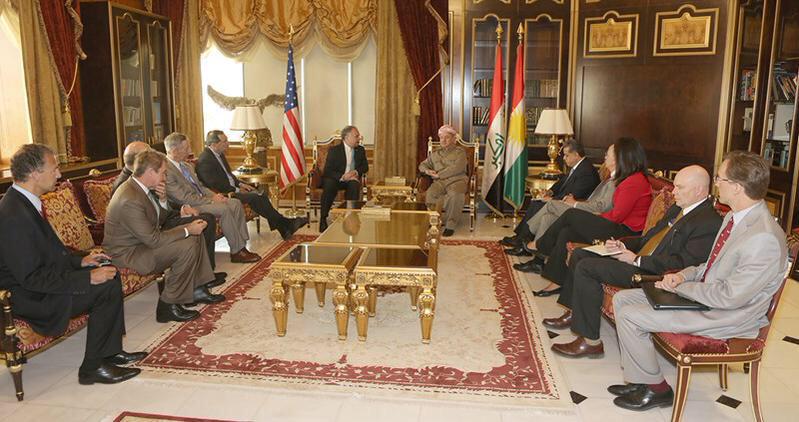
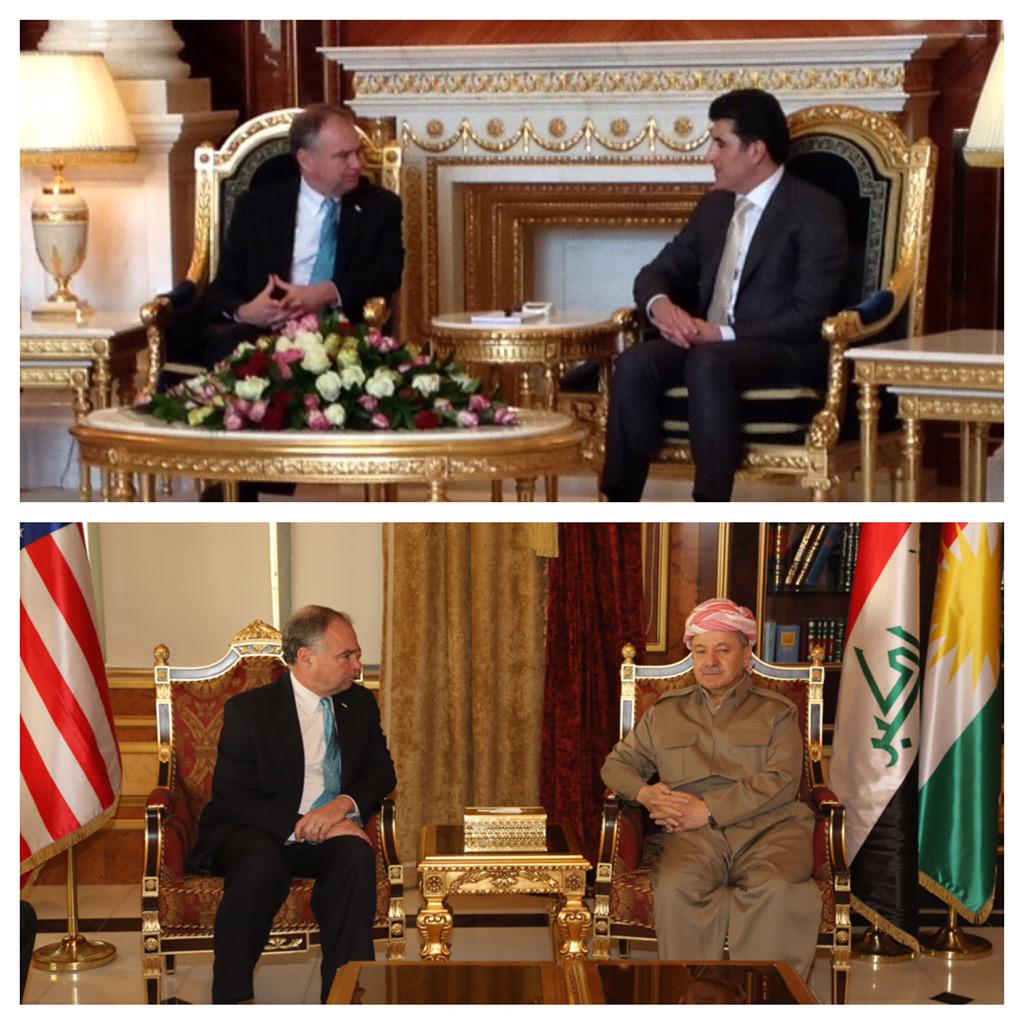
  1. CODEL was in Erbil yesterday. Met w/Kurdistan Regional Government PM & President


The delegation also includes US House Rep Brian Higgins, Tim McGovern and Peter Welch.


With Margaret Griffis (Antiwar.com) counting 157 violent deaths across Iraq today, a political solution is needed even more than a year ago.


Mosul fell over a year ago.  A Parliamentary committee has been tasked with determining what happened.  Mohammad Sabah (Al Mada) reports that Nouri al-Maliki has now twice refused to answer the committee's questions.  Such behavior should probably result in his being removed as one of Iraq's three vice presidents.


Sunday, June 28, 2015

That disgusting Paul Krugman


 God bless Trina, C.I. and Rebecca for calling out Paul Krugman's self-whoring in the age of Obama.

Fortunately, others are now speaking out.

Andre Damon, for example, has an explosive column WSWS:


Krugman then gets to the heart of the matter: “There has also been a sharp slowdown in the growth of overall health spending, which is probably due in part to the cost-control measures, largely aimed at Medicare, that were also an important part of health reform.”
For once, Krugman is telling the truth. As a recent exposé on Obamacare in Harpers magazine points out, “During the past few years, the growth in health care costs has actually slowed, thanks in part to a $716 billion cut in Medicare payments that was used to fund ACA subsidies. The cut is permanent and, as a result, Medicare payments to doctors and hospitals will be about 11 percent lower in 2021 than they would have been otherwise.”
In other words, the slashing of Medicare reimbursements for care providers has led them to ration care, leading untold numbers of elderly people to an early grave. This, Krugman insists, is “an important part of health reform.”
The cuts in Medicare reimbursement are only one means by which the Affordable Care act is leading to “reduced health care spending,” a euphemism for rationing care provided to working people. Dozens of major corporations and even municipalities have already used Obamacare to eliminate their group health care coverage and dump employees onto private exchanges.
In the final analysis, Obamacare is a right-wing health insurance mandate program designed to cut Medicare, force people to hand over money to health insurance companies through the threat of fines, shift an ever-greater burden of health care costs onto consumers, and encourage companies to slash employee health care benefits.
Krugman, a multimillionaire and professional defender of the financial elite, supports Obamacare because, not despite, of these realities.


For ObamaCare to be birthed, Medicare had to be severely injured.


"Iraq snapshot" (The Common Ills):

Saturday, June 27, 2015.  Chaos and violence continue, Corrine Brown provides the laughs, VA may start rationing care this fall, Haider al-Abadi attempts to explain the fall of Ramadi, and much more.


Former Maryland Governor Martin O'Malley is running for the Democratic Party's presidential nomination.  Friday, he gave a speech that is attracting attention. Dan Merica (CNN) reports:


Throughout the speech, his first detailed comments on global issues since announcing his candidacy last month, O'Malley criticized the way that foreign policy has been dealt with for years, an implicit critique of Clinton given her role as secretary of state during the first Obama administration. He particularly highlighted the war in Iraq and the 2012 terrorist attack in Benghazi, Libya, two events inextricably tied to Clinton.
"The invasion of Iraq -- along with the subsequent disbanding of the Iraqi military -- will be remembered as one of the most tragic, deceitful and costly blunders in U.S. history," O'Malley said at TruCon 2015, a foreign policy conference in Washington. "And we are still paying the price of a war pursued under false pretenses."


O'Malley has been on a streak of late and gave a speech this week to the Truman National Security Project -- a speech that offered a rallying cry, "No nation ever off-shored its way to greatness."

In the speech, O'Malley also addressed the issue of global warming:


Nowhere is this more collaborative approach more important than in confronting the growing and immediate challenge of severe climate change.
For years, the Pentagon has recognized global warming as an urgent national security threat.
Your organization’s leader—former Army Captain Mike Breen—put it best at a recent Congressional hearing, when he said:
“Over 97 percent of climate scientists say that man-made climate change is a reality.”
“As a combat leader, if 97 percent of my intelligence indicated that I was about to face a lethal danger that would risk the lives of my paratroopers—I would be committing unconscionable malpractice if I did not listen and act.”
Mike is right.
The energy technologies needed to combat climate change exist today—it’s only the political will that is lacking.
America can, and must, lead the way—by pursuing an ambitious plan to ensure our country is powered 100 percent by clean energy, by 2050.
Climate change is not only a very real existential threat to human life, it is also the greatest business opportunity to come to our country in a hundred years.
We must seize this opportunity by creating an American Green Jobs Agenda that is a match for the climate challenge.
We need to invest in resilience—from the Jersey Shore to California’s Central Valley.
We need to spur innovation—to develop cutting-edge technologies that will create jobs at home, and unlock new markets abroad.
We need to embrace new ideas at the state level, as we have in Maryland— where, in just eight years, we increased renewable energy capacity by 57 percent, became a clean-tech jobs hub, and cut carbon emissions by 10 percent.
America’s leadership and example are essential.
Because climate change is a global challenge—with global consequences. It is the transformation that transforms everything.
And by confronting this challenge, we can realize global economic opportunities—and job opportunities—for the United States.
We must partner with emerging markets, in our own hemisphere and beyond, to distribute renewable energy solutions and green design.
We must aggressively push for global emissions agreements in venues like the upcoming UN climate summit in Paris.
And we must seed, scale, and deploy American-made renewable energy technologies throughout the world.
To reduce mankind’s carbon footprint.
To preserve the living systems of this earth—for ourselves and our posterity.


That's where we could be.

Let's drop back to where we are.


"We're short -- we're short in '16," declared VA Deputy Secretary Sloan Gibson on Thursday regarding Hepatitis C care.  "I  -- You know, the budget's what, 650? six-hundred-and-fifty-million?  Somewhere in that neighborhood.  Six-hundred-and-fifty to seven-hundred-million dollars for '16 and-and that -- We won't -- That won't be adequate unless we ration that care."


Gibson was testifying before the US House Veterans Affairs Committee Thursday morning.


To avoid rationing care for Hepatitis C cases in 2016?


Gibson advised, "The other option is -- as we're doing right now -- is basically, when we run out of money to do it inside VA, we refer those to care under Choice and-and rely on that-that sort of safety valve."


The problems go beyond 2016.


Gibson insisted, "We're in a situation where we're going to have to start denying care to veterans because we don't have the resources to be able to pay for it.  And-and that's -- I don't think anybody wants to see that happen.  It will be a very -- a very unpleasant and unsatisfactory situation.

And that's not him talking about the 2016 budget or about Hep C.  That was in reply to US House Rep Julia Brownley's question about the current shortfall this year and what that means come August.


Over $350 million can be pulled from the Veterans Choice Program funds to cover costs that do not meet the criteria for Veterans Choice Programs, Gibson and the VA are insisting.


US House Rep Jeff Miller is the Chair of the House Veterans Affairs Committee.  In his opening remarks, he outlined many problems revolving around the newly announced 'shortfall' in the budget.  We're using his written statement and using it as written (with paragraph breaks) because a number of topics are covered in it and it will be easier to read and comprehend


Given the extensive pent-up demand for care that was exposed during last year’s hearings on wait time manipulation, VA had ample time to adjust its budgetary needs with the Office of Management and Budget to prevent what we are now seeing.  
In February through April of this year, Secretary McDonald appeared at four separate budget hearings.
Since those have concluded, the Secretary and I have met and spoken regularly on a number of important, emerging issues.
At no point in those hearings or in our subsequent discussions since, has the Secretary expressed to me that the Department had a budget shortfall of such a magnitude – one that threatens VA’s ability to meets its obligations to our nation’s veterans.
Nor did other VA leaders or officials communicate how much in the red VA was either - even though the Committee was informed late last week that the Department knew as early as March that there were giant disparities between the amount of money that VA was spending and the amount of money budgeted.
The only message that Congress received in March regarding the state of VA’s budget was the quarterly financial report VA submitted to the Appropriations Committee  for the first quarter of fiscal year 2015, which showed that VA was actually under plan in terms of its spend out rate.
Meanwhile, just two weeks ago VA proposed a plan – that Congress authorized at the Department’s urging - to transfer one hundred and fifty million dollars in fiscal year 2015 funding to support the continued construction of the replacement medical center project in Denver, Colorado.
VA also proposed an across the board recession of just under a one percent in fiscal year 2016 funds to devote to the Denver project – a proposal, by the way, that the Veterans Health Administration’s Chief Financial Officer told Committee staff last week that she did not even know about until after it had already been transmitted to Congress.
Those actions clearly show that VA leaders believe that moving forward with the Denver project – which is not scheduled to open to veteran patients until 2017 at the earliest - is a higher priority for the Department than ensuring that veterans who need care now are able to access that care.
I have come to expect a startling lack of transparency and accountability from VA over the last years; but failing to inform Congress of a multi-billion dollar funding deficit until this late in the fiscal year while continuing to advance what I believe are lower priority need that further deplete the Department’s coffers in support of a construction project that benefits no veteran for at least two more years is disturbing on an entirely different level.    
Earlier this week, VA issued a “fact sheet” that claims that VA “formally requested limited budget flexibility” in February and March and May of this year and, “plainly articulated” VA’s need for additional resources.
Buried on page one hundred and sixty seven of the second volume of VA’s budget submission is a single statement that reads: “[i]n the coming months, the Administration will submit legislation to reallocate a portion of Choice program funding to support essential investments in VA system priorities…”

Secretary McDonald repeated this statement in his budget testimony without providing any additional supporting details or justification and, to-date, no legislative proposal has been submitted by the Administration. 


Miller is the Chair and, thanks to Nancy Pelosi's shenanigans, the laughable Corrine Brown is the Ranking Member.


Thursday, I didn't have my Corrine-To-English translator ring on me so we'll just note a little bit of her opening remarks.


Ranking Member Corrine Brown:  The VA is facing a shortfall of 2.6 billion for veterans healthcare.  This shortfall must be address [sic] ammediately [sic].  We cannot put the health and lives of our veterans at ris [sic] by spending our time and attention pointing fingers and assigning blame.  VA will be facing an additional shortfall at the start of the next fistal [sic] year in October 


We have to stop there.

We have to.

Corrine goes on to say that the country is headed towards a government shutdown -- she uses shutdown twice.  Both times she probably would have been bleeped on TV.

She always invents her own words and here she took the "u" in "shutdown" and replaced it with an "i" both times she said it.

A government sh*tdown.

The fist time she said it, people were looking around.  Then she said, "Let me say that again, we are headed towards a government sh*tdown" and several on the Committee appeared to bite their lips to avoid laughing.

On her third time using the term, she did manage to say "shutdown."

Keep playing with the English language, Corrine, it works if you work it.


Corrine used her time to ask about fee based care and Choice.  Yes, Choice is fee based.  Many grasped that before Corinne's question but everyone grasped it after Sloane explained Choice.

Well . . .

Everyone but Corinne Brown.


After he finished describing it, she asked, "And Choice?"


A confused Sloan Gibson replied softly, "That is Choice."


Oh, Corrine Brown.

We're not done with the wig hatted Corrine but for now let's note an important exchange in the hearing.


US House Rep Ralph Abraham:  I was in a district last weekend and had three separate providers come up and say, "I haven't got my money.'  And this has been going on for two and three years.  So what are we doing about this, Secretary?  I know that you gave us some good figures before that the VISN 16 [South Central VA Health Care Network] -- of which I'm a part of 

VA Deputy Secretary Sloan Gibson:  Yes.

US House Rep Ralph Abraham: -- was doing better  --

VA Deputy Secretary Sloan Gibson:  Yes.

US House Rep Ralph Abraham (Con't):  -- but the word on the street, so to speak, is --

VA Deputy Secretary Sloan Gibson:  Yes. 

US House Rep Ralph Abraham (Con't):  -- there's still some issues out there.

VA Deputy Secretary Sloan Gibson: Two things.  First, of all, it's one of the advantages of Choice -- the provider gets paid by the third party administrator and that's consistently happening within thirty days.  We watch that and monitor that. VA is historically known to pay low and slow and, uh, that is not how you want to deal with your provider network --

US House Rep Ralph Abraham:  So we got something in place that --

VA Deputy Secretary Sloan Gibson (Con't): -- and so what we've done over the last nine months or so is-is organizationally consolidate.  We-we were -- We were organizationally doing this payment processing through twenty-one separate VISN headquarters in seventy different physical locations -- processing invoices for care.  And I would tell you, based on what we've heard, we were probably doing it in 150 different ways. And so we've consolidated organizationally.  We've be-begun to tackle the staffing issues, the process issues and the technology issues -- none of which were being tackled unless they were being addressed in some kind of a workaround situation and in some location somewhere.  We had, for example, locations where instead of establishing a call center that's available to handle inbound questions from providers about their payment, we'd have a processor that's processing a payment and the phone would ring, they'd answer the phone and-and, you know, doing business in a way that you'd never see in the private sector.

US House Rep Ralph Abraham:  Right.

VA Deputy Secretary Sloan Gibson: So we've now got that all organizational reporting.  We're seeing the times improve.  Part of what they're doing is they're sailing into a head wind.  They've got a 40% increase in invoices being presented for payment over last year.  Now the good news is-is they're processing a lot more invoices then they did a year ago.  But they're barely keeping up.


And now for what we'll call When Corrine Brown Attacks.


Ranking Member Corrine Brown: Uh-uh-uh -- May I respond to your comments because I don't think you was [sic] here when we spassed [sic] the prescription drug bill.  And when we passed it, WE DIRECTED THE SECRETARY NOT to negotiate the price of the drugs so that [popping and rolling eyes] was a part of the bill.

US House Rep Mark Takano:  Oh, Ms. Brown, I was -- 


Ranking Member Corrine Brown:  It would be illegal for the Secretary to uh-uh-uh address the issue.  [Entire Committee looks appalled at the crazy woman in the wig.  Corrinne notes it slowly.]  I'm just clearing up.  You waddn't even here when we did it.  But in addition to that, in the Affordable Care Act that is now standing, we are doing away with that doughnut hole that you talking 'bout so that seniors will not be out of pocket for that additional money.


US House Rep Mark Takano:  Ms. Brown, I was aware of that and I was merely trying to suggest 

Ranking Member Corrine Brown:  [Yelling to cut him off] The veterans --

US House Rep Mark Takano:  [Calmly] The VA is doing business in a better way 

Ranking Member Corrine Brown:  Well absolutely.  Thank you.


Like an old grizzly bear in a bad wig, Corrine went after another Committee member.

It should be noted that Takano is a Democrat, that Corrine was ripping into a Democrat.

And that Takano's concern was with the drugs the Hepatitis C patients were receiving.

But when a grizzly Corrine Brown gets angry, she snarls, growls and paws at her prey.


In New Zealand, there's concern over what the attack on Iraqi military leader means for New Zealand's Kiwi troops in Iraq.  Bevan Hurley (Stuff) reports:

A top Iraqi commander at Camp Taji was killed in an ambush at his home, according to reports, in a sign of deteriorating security at the base where Kiwi troops are stationed.
Iraqi media reported the officer, said to be a Lieutenant Colonel, was shot dead this week and a further 13 people have been killed by improvised explosive devices, rocket and gun fire in Taji since 143 Kiwi troops arrived May.


Meanwhile, Margaret Griffis (Antiwar.com) counts 68 violent deaths across Iraq on Friday.  And today the US Defense Dept announced:

Attack, fighter and remotely piloted aircraft conducted seven airstrikes in Iraq, approved by the Iraqi Ministry of Defense:
-- Near Baghdadi, an airstrike destroyed an ISIL excavator.
-- Near Huwayjah, two airstrikes struck two ISIL tactical units, destroying two ISIL buildings, an ISIL cache, an ISIL heavy machine gun and an ISIL vehicle.
-- Near Beiji, an airstrike struck an ISIL vehicle.
-- Near Habbaniyah, an airstrike destroyed an ISIL mortar tube.

  -- Near Tal Afar, two airstrikes struck an ISIL tactical unit and an ISIL heavy machine gun firing position, destroying an ISIL building.


Barack can drop bombs, he just can't lead on a political solution.  It's now a year since he insisted the only answer was a political solution and yet he's done nothing to arrive at one.

Struan Stevenson (The Hill) observes:


When Iraqi Prime Minister Haider al-Abadi assumed office in September 2014, many held high hopes that he would alter the sectarian policies of his predecessor Nouri al-Maliki, who alienated the Sunni population and facilitated the rise of ISIS. Nine months into his tenure, al-Abadi’s plan for national reconciliation lies in tatters, leaving many to believe that Iraq is now a failed state. Urgently needed judicial reforms have never been implemented, nor has Abadi supported the creation of a national guard to arm and train the Sunni tribes to fight against ISIS. These are major mistakes. Instead, al-Abadi has relied upon the brutal Iranian-backed Shi’ite militias, which operate outwith any official framework and openly target and discriminate against Sunnis and other ethnic minorities. 


The laughable Haider al-Abadi is in the news again today.  AFP reports:


Prime Minister Haider al-Abadi said Saturday that Iraqi forces made an “unauthorized” withdrawal from Ramadi last month, leading to the Islamic State of Iraq and Syria (ISIS) group’s takeover of the Anbar provincial capital.

“The withdrawal of the forces from Ramadi was unauthorized -- the orders were the opposite. The forces had to resist, and if they had resisted, we would not have lost Ramadi,” Abadi said in televised remarks.


I seem to recall a similar point made by US Secretary of Defense Ash Carter and how Haider and various underlings strongly objected to the remarks.

It's becoming obvious, by the way, that Haider is not in charge of the military.

Clearly, Nouri al-Maliki remains the defacto ruler and that's why Iraq is not progressing politically.


We've noted a POLITICO roundtable this week.  I recommend it and think it has a wide range of opinions.  At Foreign Policy, Peter D. Feaver is less impressed and offers a critique which includes:


The latest issue of Politico Magazine has a lengthy conversation between several experts on the subject of “Who Lost Iraq?” The piece, which puts the question to a dozen panelists, including veterans from both administrations, purports to be a comprehensive discussion, but I found it oddly incomplete and unsatisfying. In particular, I found it striking that the group did not address the long list of actions that the Obama administration took (and didn’t take) that plausibly contributed to the predicament in which we currently find ourselves. Bush’s actions and Iraqi actions are covered in some detail, and rightly so. But Obama’s? Not so much (except for a brief but trenchant summary from Kim Kagan).
For the record, let’s stipulate that the Bush administration will always bear some responsibility for the situation in Iraq, for good or for ill. Invading Iraq was a consequential step, one that President Bush likely would not have made if he had known then what we know now about Iraq. (Of course, that counterfactual is a logical impossibility, because the only reason we know what we know now is because the United States invaded — a fact that partisan critics consistently ignore.)

Let’s also stipulate that the Iraqis will always bear some responsibility for the situation. I would go further: They bear the lion’s share of the responsibility. U.S. leaders made many mistakes, but not nearly as many as Iraqi leaders did and continue to make.


Friday, June 26, 2015

Look at the rack on Justin Bieber!

I mean, really, what are we supposed to say?

Catch the photo here.

Does he think his ass crack is the new 'rack'?

I don't get the boy.

I never have.

To me, he's always showing up in photos with rappers.

They look like men, and there he is in the photos, a dewey little thing, always shirtless, like he's their piece of ass for the night.


The Bieb excitement has always failed to translate to me.


"Iraq snapshot" (The Common Ills):

Thursday, June 25, 2015.  Chaos and violence continue, the State Dept has "nothing on that" when asked about the arrest of a journalist, an Iraqi dies learning to fly an F-16, and much more.


Derek Jordan (Sierra Vista Herald Review) insists, "The Iraqi pilot whose F-16 fighter jet crashed north of Douglas Wednesday night was part of a group of Iraqis being trained by the Air Force to fly F-16s in the fight against Islamic State terrorists."

The training is part of the deal that comes with the F-16s and the training aspect was in place as far back as 2008.  It predates concerns over the Islamic State (you can check the reporting of Elizabeth S. Bumiller, among others, for reports on the F-16 deal).


US State Dept spokesperson John Kirby noted the time issue when asked about the death in today's State Dept press briefing:


QUESTION: On Iraq, specifically about this F-16 – Iraqi F-16 that crashed in Arizona, obviously part of the Iraqi pilot training program, have you reached out or has there been any contact with the Iraqi Government? Because there are rumors out there that the Iraqi pilot who died was actually someone named – and this is unconfirmed – Mohammed Hama, the son of a prominent Iraqi Air Force general, which is why I ask if there’s been any contact with the Iraqis to confirm his identity.


MR KIRBY: Well, first, our thoughts and prayers go to the family. This is a tragic accident, obviously. I don’t have any more detail about the identity of the pilot, and that’s something that I would, as you might understand, refer you to the Iraqi Government to speak to.


QUESTION: Since the State Department has authority over the foreign military sales of these jets, do you know when and how many jets are expected to be delivered – the F-16s are expected to be delivered to Iraq?


MR KIRBY: There’s – the whole program covered 36 jets, and as I understand it, they have taken possession of about a dozen of them. So there are still others in the program that still are in the delivery process.


QUESTION: Possession in the United States or possession --


MR KIRBY: Possession in the United States.


QUESTION: And putting on your old military cap there, were these brand new jets, or were these sort of repurposed, used jets?


MR KIRBY: I’d have to get back to you, Justin. I don’t know exactly what serial number they all had and how fresh they came off the assembly line.


QUESTION: Can I just follow up on that?


MR KIRBY: Yeah.


QUESTION: Several weeks ago, actually, it was mentioned that it was expected that the rest of these jets would be handed over to the Iraqis. Do you have a timeline on when that would happen?


MR KIRBY: I don’t have a timeline for the remainder that they don’t have. But obviously, it’s an ongoing sales program. It’s not being handed over to them. And I just don’t have a schedule of exactly what the deliveries are going to look like.


QUESTION: It was just I know that the Iraqi authorities were quite keen to get them up and running in Iraq, because obviously, all of the fight against ISIL.


MR KIRBY: Sure, sure. Yeah. I mean, everybody shares a sense of urgency about helping Iraq deal with the threats that the country is facing inside their borders. These jets are a component of that ability for them to fight ISIL, but I just don’t have any more detail on the schedule of deliveries.
Said.


QUESTION: John, these airplanes were supposed to be delivered some time back. What is the cause of delay? Is it lacking – a lacking training program? What is causing the delay in delivering these airplanes to Iraq?


MR KIRBY: Well, your question connotes that there is a delay. I mean, it’s a 36-aircraft buy, and typically, on a purchase that size they’re not all delivered all at once. As I said, they are in possession of about a dozen of them. There are others still in the delivery process. It’s not a matter of delay. This is a sort of – it’s not uncommon or atypical for – especially when you’re buying something as big as fighter jets, for it to --


QUESTION: Right.


MR KIRBY: -- for there to be a time component here in terms of when they’re delivered. So I wouldn’t necessarily say there’s been a delay. And again, they’re taking possession here in the United States. We’ve talked about that before, and that’s where the training is occurring.


QUESTION: To your knowledge, do the Iraqis – are the Iraqis able to get some Russian fighter jets, like Sukhois or old Sukhois or anything like this? Are they using now in their air force Russian-made fighter jets?


MR KIRBY: I am not an expert on the Iraqi order of battle and their air force. You’re asking can they? Of course they can. It’s a sovereign country. They can buy --


QUESTION: I understand they can --


MR KIRBY: But I don’t know what – I mean, that’s a great question for the Iraqis to speak to, the components and the elements of their air force. They expressed, obviously, a significant interest in the F-16, which is a very capable aircraft, obviously. And so we’re working with them on the delivery of those aircraft and training their pilots on how to fly them. That’s our focus, and the Iraqis can speak to the other things that they’re buying for their own national defense.


The Sierra Vista Herald Review portrays the program as necessary to combat the Islamic State because . . .

That state of the art air brigade the Islamic State has?

It's overkill in terms of response.

It's overkill in terms of expectations.

This week has seen a number of Iraqi commanders and military forces sound off in the press about the failures of Barack Obama.

The US President is far from mistake free.

But the criticism has been that he's not given enough weapons, that he's not given enough support?.

They do realize he's the President of the United States, right?

He's not serving the Iraqi people.

And when in history has any domestic military felt they had the right to whine that they weren't getting enough assistance from any other country?

Iraq's security forces are supposed to be responsible for the protection and safety of their country.


They've never managed to pull it off but it is their job.

Any assistance they may receive is just that: Assistance.


It's 'in addition to' -- the primary responsibility remains on them.

I don't fear the criticism is fair of Barack at all.

It's criticism rooted in greed and entitlement.

But mainly it's about refusing to take ownership of your own failures and instead pushing them off on others.

If the Iraqi military is unhappy with the equipment they have, they need to take that up with the Iraqi leaders and officials who have failed them.


Where are all those weapons they bought from Russia, for example?


October 9, 2012, with much fanfare, then prime minister and forever thug Nouri al-Maliki signed a $4.2 billion dollar weapons deal with Russia.  He strutted and preened and was so proud of himself.  Yet shortly after taking his bows on the world stage, and with Parliament and others raising objections, Nouri quickly announced the deal was off.


Then it was back on.

But the scandal refused to go away. As 2012 came to a close, the Iraq Times stated Nouri was offering up his former spokesperson  Ali al-Dabbagh and others to protect the truly corrupt -- the truly corrupt -- according to members of Parliament -- including Nouri's son who got a nice little slice off the deal.  These charges came from Shi'ite MPs as well as Sunnis and Kurds.  Even the Shi'ite National Alliance  spoke  out.  All Iraq News noted National Alliance member and one-time MP Wael Abdul Latif  called for Nouri to quickly bring charges against those involved in the corruption.

Never happened.

And the laughable Haider al-Abadi, new prime minister, supposedly committed to ending corruption, has yet to go after those officials who stole millions from Iraq.


So if you're part of the Iraqi security forces and you're unhappy with the equipment you have you can point fingers at two groups of people: (a) those security forces who tend to drop their weapons and abandon their tanks the minute they feel the Islamic State is looking at them and (b) the corrupt officials who used the billions in oil dollars not to protect the country but instead to line their own pockets.


As we've repeatedly noted, Iraq's annual revenues could make a billionaire -- each year -- out of nearly the entire estimated population.


Instead, year after year, so many Iraqis live in poverty.

The Iraqi people need an accounting of who's been stealing their money.


Margaret Griffis (Antiwar.com) counts 174 violent deaths across Iraq today.


Back to today's State Dept press briefing:


QUESTION: On Iraq – yeah. On Iraq, yesterday I asked about the arrest of a journalist by the Kurdish security forces. I don’t know if you have anything for the report for me. And a second one is there is a kind of a crisis of the President Barzani’s term. It will come to an end in August and there is a kind of a problem like how – what is going to happen. What is the position of United States Government? Would you prefer having an election despite the security challenges, or a status quo just to extend his term because of the security situation as they would claim that?


MR KIRBY: I don’t think we’re going to make statements from here about internal Iraqi politics.


QUESTION: But democracy is something that you – I mean, elections – you are – it’s something that you are talking about always.


MR KIRBY: Writ large, generally, yes. We’re in favor of government that is responsive and representative of the people that occupy a state, but I am not going to get into internal Iraqi politics and discussions from the podium.

QUESTION: What about the journalist arrest? Do you have that, any --


MR KIRBY: I don’t have anything on that, no.


The State Dept never has "anything on that" unless they're trying to shame a government the US opposes.  If it's Iran or Russia, they have plenty "on that."

But when it's a government that they're propping up, they never "have anything on that."


You may remember the days in April when they spent time shaming the governments that they didn't like as part of  'World Press Day' and how they even issued this statement:


The U.S. Department of State launched its fourth annual “Free the Press” campaign today as part of the Department’s efforts to honor the fundamental importance of a free and independent media in the days leading up to World Press Freedom Day on May 3.
As in years past, the Department will profile on a daily basis journalists or media outlets that are censored, attacked, threatened, disappeared or otherwise oppressed because of their reporting. The purpose of the campaign is to speak out for reporters who otherwise cannot; to call on governments to protect the right to free expression; and to emphasize our own commitment to promoting free expression here in the United States and around the world.
From April 27 to May 1, the Department Spokesperson will highlight emblematic cases of journalists or press outlets under threat around the world at the Daily Press Briefing. The cases will be profiled on www.HumanRights.gov and they will be tweeted out using the hashtag #FreethePress.
For more information, please contact Chanan Weissman at weissmanc@state.gov or 202 647 4043.
For more information on the State Department’s work on democracy, human rights, and labor rights follow @State_DRL or @HumanRightsGov, or visit http://www.state.gov/j/drl/


Yet two months later, asked about a journalist being arrested in Iraq, they have not one word to say,  they "have nothing on that."


Final topic,  David Bacon's latest book is The Right to Stay Home: How US Policy Drives Mexican Migration.  This is from Bacon's "California Appeals Court Rules Farm Worker Law Unconstitutional" (Working In These Times):


FRESNO, CA -- On May 18 in Fresno, California, the state's Court of Appeals for the 5th District ruled that a key provision of the state's unique labor law for field workers is unconstitutional.  Should it be upheld by the state's supreme court, this decision will profoundly affect the ability of California farm workers to gain union contracts.

At issue is the mandatory mediation provision of the state's Agricultural Labor Relations Act.  Using this section of the law, workers can vote for a union, and then call in a mediator if their employer refuses to negotiate a first-time contract.  The mediator, chosen by the state, hears from both the union and the grower, and writes a report recommending a settlement.  Once the Agricultural Labor Relations Board (ALRB) adopts the report, it becomes a binding union contract.

Associate Justice Stephen Kane, in a 3-0 ruling, said the law illegally delegates authority to the mediator.  The Fresno district of the appeals court is well known for its conservative bent.  United Farm Workers Vice President Armando Elenes immediately announced that the union would appeal the decision to the state Supreme Court.

The case has attracted the attention and support of some of the country's most powerful conservative and anti-union organizations.  Some have intervened to file briefs challenging the law.  Others have joined with the grower in this case, Gerawan Farms, in an elaborate campaign to remove the United Farm Workers as the bargaining representative for the company's workers.

Workers say they already feel the impact of the challenge to the law.  According to Ana Garcia Aparicio, "At this company we've had many issues and injustices. This is the reason it is so important for us that our contract be implemented."


Thursday, June 25, 2015

Fake ass Green Party?

So in 2008, they went with Cynthia McKinney and the incredibly White so-called Green Party thinks that was enough?

That one time got 'em off the hook?

At a time when Black Lives Matter is a rallying cry, the Greens are letting Jill Stein -- 2012's failed candidate -- act as though she is a shoe-in for the nomination?

And then they wonder why they struggle to attract voters of color?

Jill Stein had her chance and she failed.

She doesn't need another chance.

The party needs new blood and it would be great if they could field some real candidates -- maybe even one or two who was a person of color.


"Iraq snapshot" (The Common Ills):

Wednesday, June 24, 2015.  Chaos and violence continue. threats appear before Congress to offer that the US government just needs to drop bombs willy nilly and stop worrying about civilian deaths, as they call for killing they turn around and paint refugees as potential 'radicals' and threats, and much more.


This afternoon, a House Armed Services Committee held a hearing.

The Subcommittee Committee on Emerging Threats and Capabilities managed to do something every group holding a hearing longs to do -- establish clearly where the problem lies.

And the hearing did exactly that, the Subcommittee documented the Emerging Threats.

I'm not really sure though that they grasp that they did.

Appearing before the Subcommittee were the New American Foundation's Brian Fishman, the Washington Institute for Near East Policy's Michael Eisenstadt, RAND Corporation's Linda Robinson and the American Enterprise Institute's Frederick Kagan.

All four offered testimony and -- to one degree or another -- waived the Fifth Amendment.

It was a long hearing but, more importantly, it was a soul draining hearing.


While madmen sit up building bombs
And making laws and bars
They're gonna slam free choice behind us

Last night I dreamed I saw the planet flicker
Great forests fell like buffalo
Everything got sicker
And to the bitter end 
Big business bickered 
And they call for the three great stimulants
Of the exhausted ones
Artifice, brutality and innocence
Artifice and innocence
-- "Three Great Stimulants," written by Joni Mitchell, first appears on her Dog Eat Dog album

And when Robinson and Kagan especially competed to be 'smartest in the room,' you longed for them to stop cooperating with the Subcommittee and instead reply, "I refuse to answer on the grounds that it may incriminate me."

We often mock Fred Kagan here as being the "arm candy" of Kimberly Kagan.

We do that for two reasons.  One, when we started the joke, it was the rare press piece on Kimberly that couldn't work in 'she married to Frederick Kagan!' while the pieces on him could sail right by without ever noting her.  (That's sexism, for those of you on autopilot.)  Second, he's seen -- by some -- as so intelligent.  But he's not.  Kimberly Kagan is not someone I agree with very often -- we're on opposite sides of the political fence -- but she generally speaks -- I'm not talking soundbytes, I'm talking testimony, speeches, papers -- in a manner that acknowledges humanity.  For that reason alone, she's the smarter of the pair.

When Fred Kagan speaks, we're all just ants in his ant farm that he seems ready to toss in the trash, so bored has he become with humanity and living.

After nearly two hours, the hearing was finally drawing to a close when Kagan, baited by , had to show just how ugly he can be.

Yes, Kagan insisted, the US government did have a problem with the current plan or 'plan' for combating the Islamic State in Iraq.

The problem?

Too much effort was being made to not kill civilians.


Think I misheard?

Here's the exchange with US House Rep Doug Lamborn.  Let's listen in with horror.


US House Rep: Doug Lamborn:  Thank you all for being here and I'd like to ask you about our targeting of ISIS' assets.  The New York Times reported on May 26th that "American officials say they are not striking significant and obvious Islamic State targets out of fear that the attacks will accidentally kill civilians.  But many Iraqi commanders and some American officers say that exercising such prudence with airstrikes is a major reason ISIS has been able to seize vast territory in recent months in Iraq and Syria."  Dr. Kagan, would you agree with that assessment? And-and is it possible to step up aistrikes while still, uh, to the degree possible, uh, preserving civilians lives?


Frederick Kagan: Uh, I think that there is a trade off between deciding that you're going to have a more effective air campaign and accepting a higher risk of civilian casualties. I think if your standard for civilian casualties is low, you're probably going to have a very hard time increasing, uh, the intensity of the air campaign -- especially as long as you're not prepared to put forward air controllers on the ground, uh, which would be something that would mitigate that.  But I think that we have too high of a standard, uh, for -- from the standard of collateral damage for civilian casualties.  I think that, uh, the truth is this is a war and, uhm, we always try to minimize, uh, collateral damage and civilian casualty but, uhm,  a standard of effectively zero has done enormous harm to our ability to prosecute this war with the tools that we have at our disposal.


To make a few things clear . . .


When Kagan made his puzzling remarks to US House Rep Trent Franks that the US government had poor relations with the Sunnis in Iraq because of the US government's support for the Kurds in Iraq, I disagreed.  (Like Franks, who quickly changed the subject, I couldn't grasp what Kagan was attempting to say or the basis for that bizarre call.)  But as strongly as I disagreed, I could write it off as just disagreeing.

Second, Kagan is not just right wing, he's a neocon.  Part of one of the biggest neocon families (his brother Robert Kagan, his sister-in-law the dreadful Victoria Nuland, his father is Donald Kagan, etc.).  But his remarks are not a neocon attitude -- or not solely a neocon attitude.


The allegedly left Foreign Policy In Focus was arguing the same points Kagan was -- we called them out in the June 4th snapshot as well as in "Iraq: Failed follow ups and whining that bombs aren't being dropped quick enough" -- a point worth remembering for those of us on the left who might want to write Kagan's remarks off as something 'only the right could say.'


Third, the New York Times article was written by the Washington-based Eric Schmitt so we never took it or Schmitty to seriously.

"Many Iraqi commanders"?

Did you phone 'em, Schmitty?

Or did you maybe just put a finger on each temple and 'psychically' connect with them?

(I'm sure many Shi'ite commanders in the Iraqi military feel there's too much restraint when it comes to bombing Sunni areas.  We've seen, in Tikrit most recently, what Shi'ite forces can do in the name of 'liberation' to Sunnis and Sunni homes.  I'm just as sure that Schmitty himself did not speak to "many Iraqi commanders" -- though he did feel the need to 'give voice to them' -- or maybe just put words in their mouths?)


And for those who might want to insist that Schmitt got the byline but others could have spoken to Iraqi commanders?  Ben Hubbard was in Urfa, Turkey, Anne Barnard and Maher Samaan were in Beirut.  Only Omar al-Jawoshy was in Iraq (Baghdad).  No, I'm not picturing him rushing to and from commander for comments.


Returning to the horrific exchange:


US House Rep: Doug Lamborn:  Thank you all for being here and I'd like to ask you about our targeting of ISIS' assets.  The New York Times reported on May 26th that "American officials say they are not striking significant and obvious Islamic State targets out of fear that the attacks will accidentally kill civilians.  But many Iraqi commanders and some American officers say that exercising such prudence with airstrikes is a major reason ISIS has been able to seize vast territory in recent months in Iraq and Syria."  Dr. Kagan, would you agree with that assessment? And-and is it possible to step up aistrikes while still, uh, to the degree possible, uh, preserving civilians lives?


Frederick Kagan: Uh, I think that there is a trade off between deciding that you're going to have a more effective air campaign and accepting a higher risk of civilian casualties. I think if your standard for civilian casualties is low, you're probably going to have a very hard time increasing, uh, the intensity of the air campaign -- especially as long as you're not prepared to put forward air controllers on the ground, uh, which would be something that would mitigate that.  But I think that we have too high of a standard, uh, for -- from the standard of collateral damage for civilian casualties.  I think that, uh, the truth is this is a war and, uhm, we always try to minimize, uh, collateral damage and civilian casualty but, uhm,  a standard of effectively zero has done enormous harm to our ability to prosecute this war with the tools that we have at our disposal.


Does Fred Kagan get that reducing civilian casualties is not a nicety but a legal requirement of war?

It doesn't appear that he does.

The people of Mosul have been occupied by the Islamic State for over a year and, by Kagan's argument, it might be time to just drop bombs on all of Mosul to stamp IS out.

It would kill thousands of Iraqi civilians in the process but Fred wants "a more effective air campaign and [is] accepting [of] a higher risk of civilian casualties."


Fred feels the US government has "too high of a standard, uh, for -- from the standard of collateral damage and civilian casualty."

Now the reality is that many civilians have been killed by the ongoing US airstrikes in Iraq.

Apparently not enough kills for Fred Kagan who needed to take something home to mount on the wall, but there have been many and a few even have been well documented in the press.


So this notion that the US is leading the way when it comes to protecting human life is a fantasy that exists only in the deranged mind of Frederick Kagan.

But how deranged do you have to be to hold that fantasy as truth while also feeling it's a bad thing?

The US is not a leader in things to do or emulate (it is as flawed as any other country) but if it were why would that be a bad thing?

If the US government was actually setting a standard for protecting human life, as Kagan seems to think, why would that be a bad thing?

The Subcommittee on Emerging Threats found a serious one today -- if they're paying attention.  His name is Frederick Kagan and he has little-to-no respect for human life.


Strong and wrong
You lose everything
Without the heart
You need
To hear a robin sing
Where have all the songbirds gone?
Gone!
All I hear are crows in flight
Singing might is right
Might is right!

Oh the dawn of man comes slow
Thousands of years
And here we are...
Still worshiping
Our own ego

Strong and wrong

-- "Strong and Wrong," written by Joni Mitchell, first appears on her Shine album.


From there it was time to move on to Jordan.


Linda Robinson wanted to talk about refugees fleeing violence.

She wanted to see them as varmint.

People who invoke sympathy from many due to their hardships are, too Linda Robinson, a "long term threat, not just a humanitarian issue,"

As she yammered on, I was left to wonder what the hell she knew about Jordan?

Jordan has done a great deal for refugees.

But, sorry, they have not done nearly enough.

She wants "possibly international organizations" to "get more involved" with the refugees to avoid them becoming radicalized and "I doubt these people are going to eventually go home so this poses a very critical, long term threat."

Fishman tried to smooth it over by noting "many of them are going to become citizens of Jordan."

Which only again begged the question, do they know what the hell they're talking about.

Jordan's not made Iraqi refugees citizens.

More to the point, Jordan doesn't even allow them to work legally in the country.

They can be kicked out for working and the government refuses to issue them work permits.

If Linda Robinson is so damn worried about the refugees fleeing to Jordan becoming radicalized, she should just stop talking, she just sit her ass down and keep her mouth closed because she clearly doesn't know a damn thing and should let someone else speak.

Aid?

Charity?

That's not the answer.

Yes, it can get refugees through a harsh winter, for example.  It can provide immunizations.

But refugee camps are supposed to be temporary lodging.

You're not supposed to be a lifelong refugee.

Hosting refugees is not the same as granting them asylum.

You want to help them?

Grant them asylum.

Make them citizens.

Which may have been the point Fishman was dancing around and trying to word it delicately so that Linda Robinson did not come off like the raving idiot that she so clearly is.

Iraqis fleeing violence do not need to be kept in refugee camps which are the equivalent of cages.

Allow them to work, grant them work permits.

Allow them a path to citizenship if that's what they're choosing.

But if you want to radicalize the youth -- Linda Robinson's big fear -- then the easiest way in the world is to prevent refugees from working, have children grow in refugee camps (or slums) in families dependent upon tiny morsels of charity and, in that, you will have all the ingredients to create suicide bombers and more.

Lebanon and Syria have not been heaven on earth for Iraqi refugees (even before the Syrian conflict broke out).  I'm not trying to scapegoat Jordan.

And friends in Jordan have been personally helpful to me on several occasions on the Iraqi refugee issue.


But what was thought to be temporary early in the Iraq War is now long lasting.

Jordan needs to rethink its policies.

It needs to be providing a path to citizenship.

There are some Iraqi refugees in Jordan today who are on their tenth year -- their tenth year -- of asylum (or 'asylum' because I think you do more than host refugees if you're providing asylum).

These people want a life.

And the rules preventing them from having a life in Jordan are real and need to be addressed.

And possibly that can't happen in Jordan.

That may be true.

I've heard arguments from friends in Jordan that various other issues at play mean this is all that can be offered.

If that's the case, then Jordan is not providing asylum and should not be expected to.

It's a way station and nothing more.

So recognize it as such and get seriously to work on relocating these refugees to a host country where they can have a path to citizenship and they can work legally without fear of fines or deportation.


Linda Robinson wants to throw money at the problem.


She's tossing a few dimes at the homeless and declaring the problem solved.

(The ongoing wars have been a great distraction for America allowing it to avoid the ever increasing homeless population in the United States.)


From his statements to the Subcommittee, I get the idea Fred Kagan would be thrilled if a drone destroyed his home because someone thought a terrorist was present -- he'd be gloating about how at last the US government was not fretting over civilian casualties.

But I have to wonder if Linda Robinson would be happy in a refugee camp?

If she wasn't allowed to work in a field she was trained and educated in but was instead one of many refugees struggling to make it, maybe working the black market, would she be so very happy?


Or if, because she was a foreigner, she was seen as a "critical, long-term threat," would she wake with a smile on her face every day?

It's really amazing how when people like Linda Robinson and Fred Kagan speak of other people, they so quickly strip those people of their humanity and reduce them to faceless non-humans who don't have the right to expect safety or employment or to even pursue happiness.


As the two made clear in their testimonies today, they themselves are the biggest emerging threats currently.


Kimberly Kagan participates in a roundtable discussion on Iraq at POLITICO that is worth reading.


Middle East Eye reports:


Anbar’s provincial council has called on the Iraqi army to refrain from shelling civilian areas of the Islamic State (IS) controlled city of Fallujah, according to a Tuesday statement released by the council.
"Many innocent civilians – especially children, women and elderly people – lost their lives in recent months after security forces shelled [residential areas of] Fallujah," the council asserted.
According to the statement, local residents have been prevented from leaving the city by IS militants.
A medical source told Anadolu Agency that Fallujah General Hospital had received the bodies of seven civilians on Tuesday, along with eight injured, "including women and children".


These are the bombings then-prime minister and forever thug Nouri al-Maliki began in January of 2014.

These are the bombings that have left thousands of civilians dead and wounded.

These are the bombings targeting residential neighborhoods.

And, yes, these are the bombings that new prime minister Haider al-Abadi announced he ended on September 13, 2014.


But these are the same bombings that then continued on September 14, 2014.

They've never stopped.

They meet the legal definition of War Crimes.

These are killing and wounding Sunnis.

And these bombings are being carried out by the Iraqi military.

For almost a year-and-a-half, these bombings have taken place and they have received very little press attention.

When Haider made his announcement, however, that received massive press attention -- it even got praise from a United Nations representative.

They'd all been silent as this had taken place but once Haider declared it over, they suddenly rush to note it . . .

only to fall silent when the bombings continued the next day.

I don't know if they get this or not, but this does meet the legal definition of a War Crime and their silence offers them no immunity, they're just as culpable as anyone else -- especially a UN official who's the special envoy to Iraq.

I think his silence could actually qualify for prison time.

Margaret Griffis (Antiwar.com) reports 109 violent deaths across Iraq today.