Happy Thanksgiving!!!!
Okay, I'm thankful for the right to disagree.
And for being able to read people I can disagree with.
I like Michael Tracey's Tweets and often agree with them. But sometimes we don't agree and sometimes he leaves me confused.
Has he written about this or just Tweeted?
Senator Bob Menendez has been strongly against the Iraq War before it started.
He voted against it.
He has repeatedly called for US forces to be redeployed out of Iraq.
He's called out our support for the Nouri al-Maliki government in 2014 -- a stance that many of us believe led to the court issues that resulted in a mistrial.
SO I don't see how he is "one of the most incorrigible hawks in the senate" as Michael says.
"
Iraq snapshot" (THE COMMON ILLS):
Wednesday, November 22, 2017. As many go on holiday in the US, school
is still in session for the US State Dept (child soldiers) and US
Ambassador to the United Nations Nikki Haley (reality) while the biggest
story for Iraq is that the IMF now controls the country.
Currently, Iraq is planning to hold elections in May. One factor that might influence voting?
Iraq's further loss of sovereignty.
The International Money Fund released the following yesterday:
IMF Mission on Iraq
November 21, 2017
End-of-Mission press releases
include statements of IMF staff teams that convey preliminary findings
after a visit to a country. The views expressed in this statement are
those of the IMF staff and do not necessarily represent the views of the
IMF’s Executive Board. Based on the preliminary findings of this
mission, staff will prepare a report that, subject to management
approval, will be presented to the IMF's Executive Board for discussion
and decision.
- The Iraqi authorities and IMF staff continued discussions on the third review of the Standby Arrangement.
- Good progress towards reaching agreement on a draft 2018 budget in line with the program.
The Iraqi authorities and the staff of the International Monetary Fund
(IMF) continued discussions in Amman from November 17 to 21, 2017 on the
third review of Iraq’s 36-month Stand-By Arrangement (SBA). The IMF
Executive Board approved the SBA on July 7, 2016 (See
Press Release No. 16/321), and completed the second review on August 1, 2017 (See
Press Release No. 17/311).
At the end of the mission, Mr. Christian Josz, Mission Chief for Iraq,
issued the following statement:
“The Iraqi authorities and IMF staff continued discussions on the third
review of the SBA and made good progress towards reaching agreement on a
draft 2018 budget in line with the SBA.
“During the discussions, the team met with Acting Governor of the Central
Bank of Iraq (CBI), Dr. Ali Mohsen Ismail Al-Allaq, Acting Deputy Minister
of Finance, Dr. Maher Johan, Deputy Minister of Planning, Dr. Qasim Enaya,
Financial Adviser to the Prime Minister, Dr. Mudher Saleh, Chairman of the
Board of Supreme Audit, and officials from the ministry of finance, CBI and
the ministry of oil. The team would like to thank the Iraqi authorities for
their cooperation and the open and productive discussions.”
IMF Communications Department
MEDIA RELATIONS
PRESS OFFICER: Randa Elnagar
Phone: +1 202 623-7100Email: MEDIA@IMF.org
"In line with the program."
Iraq now has to discuss their budget -- get permission from the IMF -- and it has to be "in line with the program."
This is exactly what Grand Ayatollah Ali al-Sistani warned about.
But Hayder al-Abadi knew better, or thought he did.
He's prime minister.
For now.
He's never been popular.
He's considered a lazy Nouri al-Maliki.
He hasn't ended corruption.
He persecutes the Sunnis. He persecutes the Kurds.
He's riding a light wave of popularity because the US-led coalition has
bombed and bussed -- yes, and bussed -- many of the Islamic State
fighters out of Iraq.
And already the wave of popularity is fading.
Now this.
Now the Iraqi people have to see that Hayder al-Abadi sold out the
country's future. And they know the Grand Ayatollah publicly warned
about a deal with the IMF. They know that he warned about it
repeatedly, over and over.
But Hayder went through with it.
And now Iraq has to bow before the IMF, Hayder has turned the country into debt slaves.
That's going to be hard to run on.
Nouri still wants to be prime minister. That's just the sort of thing
Nouri can exploit to thin out Hayder's Shi'ite support (at present,
Hayder has no support except for Shi'ites and Turkmen). Even Nouri
didn't do that, even he didn't sell out Iraq's rights and future.
This is big news that will become bigger news.
It attacks the reality of Iraq and the image of the Iraqis. It's a major blow to belief, to pride, to nationality.
Let's go to yesterday's US State Dept press briefing with spokesperson Heather Naurert:
QUESTION: Thank you. The head of Kurdish foreign relations has
asked the U.S. to appoint a special envoy to mediate between Baghdad and
Erbil. What’s your response to that request?
MS NAUERT: Yeah. So we certainly heard about that idea to
appoint a special envoy. We believe at this point that this is an issue
that can be worked out internally, that it can be worked out between
Baghdad and Erbil and don’t feel that it’s necessary to appoint some
sort of United States envoy in some sort of new position to handle this.
We have close relationships with the Kurds and with the central Iraqis.
We will continue to try to facilitate conversations but we just don’t
feel that an envoy is necessary to have – to appoint.
QUESTION: Well, I’m sure the Kurds do, otherwise they wouldn’t have asked, and a point in fact for example --
MS NAUERT: I’m – Laurie, I’m not aware of a formal request to
appoint an envoy. I’ve heard of this report. I’m not aware of a formal
request. But look, I mean, every nation, every dispute around the world
could ask us to appoint an envoy. We think that countries can work out
some issues on their own. There’s a very long history here. These folks
have lived together, have fought together, have raised families
together; we think that they can probably work it out on their own as
well.
QUESTION: And one party has committed genocide against the other
not so long ago. But yesterday, the Kurdistan government called on the
international community to press Baghdad to lift the punitive measures
that it has imposed on the Kurds, like the closure, for example, of the
Erbil and Sulaymaniyah airports. So what have you done in that regard to
facilitate the opening of those airports, which is a necessity?
MS NAUERT: Sure. We have lots of conversations to try to
facilitate some sort of an agreement on the part of Baghdad and Erbil.
Brett McGurk was just there; I believe it was late last week. He met
with both Barzani and also with the prime minister, Abadi, both in
Baghdad and in Erbil last week. He made calls over the weekend.
Secretary Tillerson was on the phone over the weekend. He spoke with
both Mr. Barzani and Abadi over the weekend. So, I mean, that’s a very
high level of support that we have trying to help facilitate things –
for things to improve in Iraq. I don’t know that there’s that much more
that we can do. But we call on the governments to sit down and have a
conversation together and work this out.
QUESTION: As a result of all that talking, has Baghdad made any commitment on when those airports will be reopened?
MS NAUERT: The last thing that I have on that is just we’re
going to work to continue to press for the opening of any remaining
airports that are closed.
.
Great -- and when will they address the blockade Baghad's imposed that
prevents medicine from going into the KRG? Or the attempts to arrest
those who supported a peaceful referendum?
Staying with the State Dept, Secretary of State Rex Tillerson is in the
news. At issue? Iraq, Burma and Afghanistan getting a pass on using
children as soldiers.
The issue was raised at yesterday's State Dept press briefing.
QUESTION: When the Secretary made a
decision on whether to designate Iraq, Burma, and Afghanistan as not
employing child soldiers, did he do so on a technical basis or on a
political one?
MS NAUERT: Yeah, yeah. No, on a technical basis really. He made
the decision after considering – let me back up for a second. When these
designations are made there’s a lot information that comes in. It’s
information that comes in from NGOs, sometimes from post, sometimes from
the Intelligence Community, a lot of different – sometimes open source
material. A lot of information flows in and we take a look at it all and
try to make sure it’s all accurate and credible.
I want to be clear about the importance of using the Child Soldier
Prevention Act. And we announced our list earlier this year, in the
summer. We all know why it’s in the news. It’s in the news because there
was a dissent memo. That’s why it’s in the news today. But essentially
this is an incentive – the act is itself – for governments to prevent
the unlawful recruitment and use of child soldiers. No one in the United
States Government likes the idea of the use of child soldiers. It is
abhorrent, okay? We will not designate to – we will not hesitate to
designate any country as ineligible for assistance if a statutory
standard for listing would be met in the future. Okay.
In June, the Secretary determined that there were eight countries that
met the statutory requirement to be identified under the Child Soldier
Prevention Act, and let me list those countries, if I may: Democratic
Republic of Congo, Mali, Nigeria, Somalia, South Sudan, Syria, Sudan,
and Yemen. That’s both South Sudan and Sudan. So those countries all
were put on that list because we know that they use child soldiers. When
it came to looking at Burma and also Iraq and also Afghanistan, the
Secretary made the decision to not have those countries on the list
because he considered the credibility of all the information that was
available to him from all of those multiple sources. He reviewed all the
facts and he felt that he made the decision to not have those countries
on the list as justified pursuant to law.
QUESTION: Now, as you know – well, maybe I shouldn’t ask this one since it was yours. Did you want to ask this one?
MS NAUERT: Go ahead and follow up before --
QUESTION: Well, just a quick question on the credibility thing.
MS NAUERT: Yeah.
QUESTION: Both the human rights report issued by the State
Department and the trafficking report, I believe, argued that they do
use and recruit child soldiers. So why did the Secretary not find his
own institution’s reports lacking credibility in this regard?
MS NAUERT: I think part of it has to do with the numbers in the
reports, and I’m not going to be able to say much beyond that. There are
countries that use lots and lots of children. There are countries
where, just as a general matter, where you may have heard from one
source, among the many sources that I mentioned, where maybe one source
might say that they heard a child had been a border guard. I’m just
making that up, but something of that sort. And if we can’t corroborate
that information and it is a child who’s listed under a certain
government, that government wouldn't necessarily make the list. If we
can’t back up that information, if it is a report that only lists one or
two, the belief was on the Secretary’s part to not put those types of
countries on this list.
QUESTION: Isn’t one too many?
MS NAUERT: It’s a good question. That’s a fair question. Look, I
can tell you that he took a technical look at that and that’s the
decision he made.
QUESTION: The reason that I asked --
QUESTION: He’s recently visited the three capitals concerned.
MS NAUERT: I’m sorry?
QUESTION: He’s recently visited three capitals concerned, Kabul, Baghdad, and Naypyidaw.
MS NAUERT: Right.
QUESTION: Did he bring up this issue with the leaders of those countries?
MS NAUERT: I think – I’m not sure what – I don’t have the entire
readout of the meetings in Afghanistan and also in Iraq. As you well
know, I was not there. In the meetings in Burma, there are huge issues
to be discussed. Not that this is not important, okay, but some of the
things that they have to do is talk about the biggest issues at hand,
and that is the more than 600,000 Rohingya who have been forced to flee
that country because they’ve been pushed out, because women have been
raped, because children have been killed, and all of that. You know the
story. Perhaps he did bring it up in some of the conversations; I can’t
get into the details of all the diplomatic conversations. But these are
the types of things that come up regularly in our diplomatic
conversations with various countries around the world.
QUESTION: Just one follow-up, if I may. I asked a question about
isn’t one too many not just rhetorically, but according to the memo
which we have, which my colleagues obtained and published --
MS NAUERT: Which memo?
QUESTION: The memo unanimously from the State Department staff,
including all the clearances on it, said that the statutory standard was
that – was met by even one child soldier, and therefore I don’t – if
you doubt your own reports, I can’t argue with that, but if you have
sufficient credibility in your reports to publish them and to find that
there are, in these cases, at least one, and if the statutory
requirement, according to your own internal memo, says one is too many
and triggers the requirement, I don’t understand why you wouldn’t go
ahead and do it, partly because you also have the ability to issue
waivers afterwards to spare countries the consequences of it.
MS NAUERT: That’s the President’s decision, waivers are.
QUESTION: Right.
MS NAUERT: I don’t have the statutory language in front of me,
so I don’t want to quote from that or read that back to you, because I
just don’t have it.
QUESTION: But you said that it was a technical decision. So --
MS NAUERT: Yeah, and that was the decision that the Secretary made. Okay.
QUESTION: The question of --
MS NAUERT: Look, I’m not an expert on this matter. Admittedly, I
am not an expert on child soldiers, and nor am I a lawyer. I can do the
best to give you the information that I have.
QUESTION: The question on this also is that he disregarded the
recommendation, I mean, as Arshad said, by essentially all of the
bureaus that would have sort of equity in this; they all recommended
that these countries be on the list, and he disregarded their
recommendations. So what was it that he felt made it worthwhile for him
to disregard the recommendations of all the bureaus?
MS NAUERT: Well, I think getting more to the point is that when
people disagree here in this building, there is a channel for that, and
that is the dissent cable memo. Four or five of them, to my
understanding, are issued every year when – and that is where people in
the building who have a different point of view than the Secretary can
write up, and that information goes into his office, and he can review
that and decide to take that into consideration, he can go along with it
and agree with it, or he can decide to go his own – or he can decide to
make his own decision. The Secretary did that. He made his own decision
on this, but it was not without reviewing the information that came
from all the various bureaus and individuals. Okay.
QUESTION: Heather, can I just clarify? Are you saying that they were left off the list because they have a smaller number or --
MS NAUERT: I’m not – I’m not saying that. I’m just saying --
QUESTION: -- or is it because they’re making improvements, which was noted --
MS NAUERT: Well, and that’s another thing where improvements can
be made. For example, we have a close working relationship with Prime
Minister Abadi in Iraq. We were just talking about that. Prime Minister
Abadi has taken great strides in not only making the military more and
more professional, holding people to account, and trying to ensure or
ensuring that there aren’t child soldiers serving in their various
militias and militaries. So we look to those governments as taking – as
they take better steps in the right direction.
QUESTION: But in the law, it doesn’t say if they’re taking those steps that they can left off the list.
MS NAUERT: Again, I don’t – I’m sorry, I don’t have the law in
front of me. I should have it in front of me, and unfortunately I don’t.
So --
Jason Szep and Matt Spetalneck (REUTERS) report:
A
confidential State Department “dissent” memo, which Reuters was first
to report on, said Tillerson breached the Child Soldiers Prevention Act
when he decided in June to exclude Iraq, Myanmar, and Afghanistan from a
U.S. list of offenders in the use of child soldiers. This was despite
the department publicly acknowledging that children were being
conscripted in those countries. [tmsnrt.rs/2jJ7pav]
Keeping the countries off the
annual list makes it easier to provide them with U.S. military
assistance. Iraq and Afghanistan are close allies in the fight against
Islamist militants, while Myanmar is an emerging ally to offset China’s
influence in Southeast Asia.
One is too many.
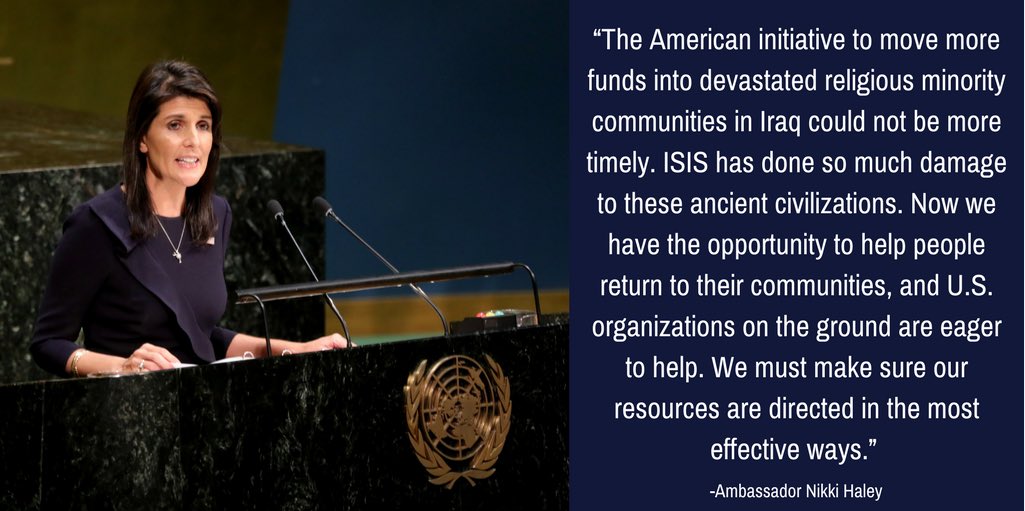
But the State Dept is not the only one getting schooled. US Ambassador
to the United Nations, Nikki Haley, also learns that school is still in
session.
Daniel McAdams Retweeted Nikki Haley
Daniel McAdams added,
Exactly. The targeting of Christians in Iraq began long ago and the
same militias now roaming Iraq are the same ones who attacked the
Christians.
The following community sites -- plus Jody Watley, BLACK AGENDA REPORT,
the ACLU, DISSIDENT VOICE, THE GUARDIAN, LATINO USA and NPR -- updated:
xxx