Wednesday, December 27, 2017

Iraq

Isaiah's THE WORLD TODAY JUST NUTS "Joan Walsh fired"

joanwalsh


Youssef Mohammed, speaker of the Kurdistan autonomous region parliament, resigned on Tuesday in protest over the monopoly of politics, economy, land, wealth and others by “specific factions” instead of allowing fair sharing.

During a news conference to announce his resignation, Mohammed said that Kurdistan is passing through “very difficult” circumstances and citizens are suffering.

Political authorities, on the other hand, are antagonizing the public and this should be stopped, not supported, he declared.


This is more for show from Goran – the CIA’s political party in the KRG.
 
It’s meant to sew strife and mistrust which can further divide the Kurds so they can’t be a united front.
 
From Henry Kissinger on forward, the US has feared a united front from the Kurds.  They’ve known they can break promises with no problems as long as Iraq could be divided.
 
I find it interesting, by the way, this for-show.
 
Goran actually walked out on Parliament already.  I guess he missed that memo.
 
 
It’s all the stranger because, in resigning, he spoke of how he hasn’t been able to do anything for two years now.
 
One would have assumed that would have resulted in a much earlier resignation.


"Iraq snapshot" (THE COMMON ILLS):
Wednesday, December 27, 2017.


XINHUA insists, "The hard-won victory in 2017 over the terror group Islamic State (IS) by Iraq is overshadowed by a growing conflict with the Kurds [. . .]"

And REUTERS notes that the US government insisted, December 5th, that only 3,000 ISIS members remained in Iraq and Syria but today insists the number has fallen to 1,000.


"Hard-won victory," XINHUA insisted on Tuesday.


That would be the same Tuesday that KURDISTAN 24 reported:

Contrary to the Iraqi Prime Minister’s announcement of the end of the Islamic State (IS) in Iraq in early December, the extremist group’s sleeper cells continue to launch attacks and claim lives. 
IS extremists have killed and injured 40 people while attacking the Iraqi security forces and Iranian-backed Hashd al-Shaabi in south and west of Kirkuk. 
 The extremists appear to have been hiding in the Sunni-populated areas of southern and western Kirkuk. 
 According to the statements of the Iraqi army commanders, IS group have launched surprise attacks in Sharia’a, Riyadh, Hawija road and some other areas in southern Kirkuk.


"Victory!"

Or something.

In other news of 'success,' . . .

Cycle of violence continues with fighters in 2017 killing families linked to abuses from 2014. Until proper justice is done for abuses in we will continue to see acts of vigilante revenge


Oh, those peaceful Yazidis.

Hard to believe, right, that the Yazidis could ever have teamed up with a neocon p.r. firm.

They're so pure.

And so innocent.

Trapped on a mountain (of their own making) somewhere -- even all this time later.

Turning to US politics, . . .

If Ralph Nader hadn’t run for president in 2000, might Gore have won, his administration not sat on a memo such as “Bin Laden determined to strike in US”, thus avoiding 9/11, the wars in Iraq and Afghanistan, ISIS, and so forth?


But Ralph Nader did run -- and had every right to run.

What might have been different if Al Gore had selected a better running mate?

Joe Lieberman?

Defeated in a 2006 Democratic primary.

Joe Lieberman?

Neocon Joe?

And let's not forget that the war on Iraq was also part of Bill Clinton's administration.

Or that Al Gore initially supported the war on Iraq in the lead up (he would denounce it before the illegal war started but he signaled support early on).

In March of 2003, the ongoing Iraq War started.


And let's blame Ralph Nader.

Not the Joe Liebermans.

Nor the Democrats in the Senate who voted for it (Hillary Clinton, John Kerry, John Edwards, Dianne Feinstein . . .).

Let's blame Ralph Nader.

Not the media that lied and whored.

And isn't it funny how, all this time later, we pretend that the lying just happened?

We pretend like the owners own wants and desires didn't influence the coverage.

Blame Ralph Nader.


It's his fault for running for president.

I denounced Ralph in 2000.  For a number of reasons.

But I never suggested that he didn't have a right to run.

I never suggested that he needed to drop out of the race.

That's not how it works in a democracy.


But pretending Ralph is the problem allows you to forget how Al Gore couldn't make the case to the American people clearly.

Was he harmed by the media?  Of course.  That's to be expected.

But when he took his message to the American people, it wasn't a good one.  It wasn't strong.

That's on him.

He had enough money to get around the media (I donated to Al's campaign).

But he was a weak candidate.

Blame Ralph, blame Jill, blame this, blame that.

Never hold the losing candidate accountable for their own errors, apparently.

Jackson Lears, in the latest edition of THE LONDON REVIEW OF BOOKS, notes how weak candidate Hillary was:

This approach animates Autopsy: The Democratic Party in Crisis, a 33-page document whose authors include Norman Solomon, founder of the web-based insurgent lobby RootsAction.org. ‘The Democratic Party’s claims of fighting for “working families” have been undermined by its refusal to directly challenge corporate power, enabling Trump to masquerade as a champion of the people,’ Autopsy announces. But what sets this apart from most progressive critiques is the cogent connection it makes between domestic class politics and foreign policy. For those in the Rust Belt, military service has often seemed the only escape from the shambles created by neoliberal policies; yet the price of escape has been high. As Autopsy notes, ‘the wisdom of continual war’ – what Clinton calls ‘global leadership’ –
was far clearer to the party’s standard bearer [in 2016] than it was to people in the US communities bearing the brunt of combat deaths, injuries and psychological traumas. After a decade and a half of non-stop warfare, research data from voting patterns suggest that the Clinton campaign’s hawkish stance was a political detriment in working-class communities hard-hit by American casualties from deployments in Iraq and Afghanistan.
Francis Shen of the University of Minnesota and Douglas Kriner of Boston University analysed election results in three key states – Pennsylvania, Wisconsin and Michigan – and found that ‘even controlling in a statistical model for many other alternative explanations, we find that there is a significant and meaningful relationship between a community’s rate of military sacrifice and its support for Trump.’ Clinton’s record of uncritical commitment to military intervention allowed Trump to have it both ways, playing to jingoist resentment while posing as an opponent of protracted and pointless war. Kriner and Shen conclude that Democrats may want to ‘re-examine their foreign policy posture if they hope to erase Trump’s electoral gains among constituencies exhausted and alienated by 15 years of war’. If the insurgent movements within the Democratic Party begin to formulate an intelligent foreign policy critique, a re-examination may finally occur. And the world may come into sharper focus as a place where American power, like American virtue, is limited. For this Democrat, that is an outcome devoutly to be wished. It’s a long shot, but there is something happening out there.


The problem wasn't Jill Stein.

The problem was Hillary Clinton.

Who never should have run in 2016.

It's amazing how the tired little Hillary had to rush home every evening.

We criticized Bully Boy Bush for that in 2000 -- or some of us did.  Little boy needed his own pillow and bed.  Wanted to be president but was too weak to campaign.

And then in 2016, we saw the same thing with Hillary.

She never should have run.

Eight years prior, she was branded a racist by Barack Obama and the media.

Eight years prior, he hung her vote for the Iraq War around her neck.  Used that vote to come from behind in October of 2007 and become the front runner.  And was very clear in September and October of 2007 that he was going to do that.

But eight years later, when she was still insisting that (a) her vote wasn't wrong and (b) that Bully Boy Bush had misled her, she's the candidate to go with?

Hillary is the problem.

More to the point, so is Ben Landis.

Oh, Ben, thanks, big boy, for your big old Tweet on Iraq.

Your only Tweet, in fact.

This illegal war has lasted over 14 years (15th anniversary is this coming March).

And you can't pay attention to it, can you?

You can't call for it's end.

But you can suddenly remember the ongoing war to trash . . . Ralph Nader.

Last time I checked, Ralph didn't vote for the Iraq War, didn't cheerlead for it, didn't call for it.


While celebrating the holidays at home, let us not forget the service members spending Christmas abroad. I was fortunate enough to spend this Christmas with some of the brave heroes serving in Iraq from California & across our nation. Happy holidays & thank you for your sacrifice

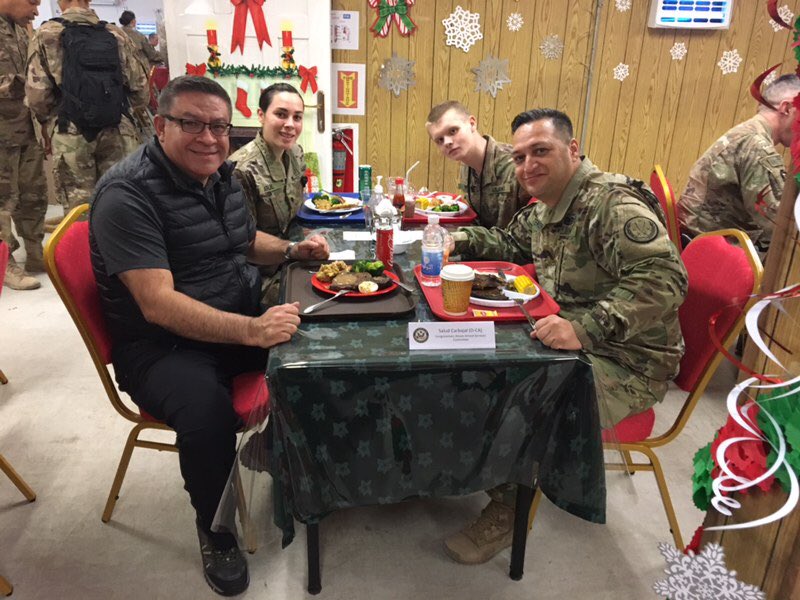


Oh, look, it's US House Rep Carbajal.  In Iraq.  This week.

Because the Iraq War hasn't ended.

Because US troops remain in Iraq.

A reality that some might consider addressing.

Not Senator Dianne Feinstein, of course.  She didn't go to Iraq.  She still hasn't noted that a Californian died in Iraq last week -- not even on her Twitter feed.


New content at THIRD:


Isaiah's THE WORLD TODAY JUST NUTS "Joan Walsh fired" went up Saturday (she's now got a contract with CNN, to update) and he has another comic that will go up shortly.

Saturday, December 23, 2017

She selected him

Don't blame Canada, blame Hillary.

  Retweeted
Since there seems to be confusion about who to thank for Trump: reminder that the DNC was caught red-handed conspiring with media elites to "elevate" Trump - who won GOP primary after receiving an unprecedented $2B in free airtime.


She wanted Donald Trump to run against.

Her campaign used their media connections and friends to elevate him.

And she still lost.

Against her chosen and selected opponent, she still lost.

What a loser.

It's all on her.

She needs to stop blaming others.


"Iraq snapshot" (THE COMMON ILLS):
Friday, December 22, 2017.  Hayder al-Abadi continues to offer no leadership in Iraq, the League of Righteous threatens the US, journalists remain under attack in Iraq, and much more.


As noted last week, Sarah Idan, facing death threats, has fled Iraq.  She competed in this year's Miss Universe representing Iraq.  Prior to the competition, she and Adar Gandelsman, Miss Israel, took a selfie.

Remember how Miss Iraq and Miss Israel posed together to model coexistence at the Miss Universe pageant? Well, Miss Iraq's family was just forced to flee Iraq due to death threats. She has nonetheless refused to take down the photo.


 In the midst of the backlash and death threats, Sarah Tweeted the following:


I’m not the first nor the last person to face prosecution over a matter of personal freedom. Millions of Iraqi women live in fear.


She spoke with CNN yesterday.


Here’s TV interview I did this morning with


Eric Levenson and Yasmin Khorram (CNN) report:


She said she was "a little bit disappointed" in the Iraqi government because they have not said anything official about the incident and no one has reached out to her. "For me the whole thing is strange," she told CNN. "I was expecting like at least a statement from the government saying, OK we approve, or we don't approve, but I haven't heard anything yet."


Hayder al-Abadi is the prime minister of Iraq.

He could have stepped forward.  He could have offered leadership.

But he's not a leader and he's a thug himself.

The whole thing brings to mind 2015, when REUTERS' journalist Ned Parker was reporting accurately and the response was attacks from the various mobs in Iraq -- mobs Hayder has now made part of the armed forces.

Over the airwaves of Iraqi TV, Ned's life was threatened.

And Hayder had not a word to say in Parker's defense.

Even worse, he made a single statement on the topic when it was taking place, a statement that further incited anger at Ned Parker leading Ned to leave Iraq for his own safety.


Other than that, Hayder was silent until April 16, 2015 when he was visiting DC.  From that day's snapshot:


While ignoring hard hitting questions from Twitter, they couldn't ignore the journalists present and, after Iran, the most asked of topic was Ned Parker.


Barbara Slavin: And also, one of our colleagues, Ned Parker, recently has left because of threats against Reuters for reporting what happened in Tikrit.  Will you issue a statement in Arabic protecting journalists for reporting what goes on in Iraq.  Thank you.

Haider al-Abadi: As with Mr. Parker, Ned Parker, I've known him for many years.  I heard this story while he was still in Baghdad.  My natural fact, a spokesman for my office has given me a message and he told me Ned Parker feels threatened and asked what sort of threats he had received? We want more information so that I can take action about these people who have threatened him.  I haven't received anything on that, to be honest with you. I asked for protection of his office -- to increase protection of his office -- and we did.  But all of the sudden, I'd heard he left. I know he sent a message he wants to meet me in Washington but unfortunately my program is, uh -- I didn't even have time to talk to my wife yesterday. [Begins chuckling.]  So I don't think I would talk to Ned instead of my wife.

And a statement in Arabic?

I-I think my office issued a statement. In English?  Okay, we translate.

What followed was an embarrassing and shameful round of laughter.

This isn't a laughing matter.

When the guffaws finally died down, the next question returned to the topic but with less 'jolly' and 'funnin'.'


Jennifer-Leigh Oprihory: [. . .] But piggy backing on the last question about Ned Parker, I was just wondering if you could briefly comment as to your take on the current state of press freedom within Iraq?  And also, in terms of going and taking action in response to Parker's being chased out of the country, what steps are you planning -- or are there any steps planned to institute protections for international press covering your country?  During your address, you said, and I quote, "A free society needs a free press."  And so I was just wondering if that would extend to foreign press as well?

Haider al-Abadi: Well I think if you look at the Iraqi press first, I think they're free to criticize.  I think that number one   institution which is being criticized in Iraq is the government.  We don't even reply to them.  We don't do anything. I drop charges against all-all media.  But I ask the media to have their own self-discipline.  That's important.  The media shouldn't be free to accuse others falsely.  They should respect freedom of others.  Freedom of speech is there but -- We need facts. But I refuse so far -- and I hope I continue on that -- you never know what office does.  Office usually corrupts people, right?  But I hope it doesn't corrupt me.  We keep on respecting the freedom of the press, we keep on protecting it.  As to the foreign press, as far as I know, there's no limitation on them, no restrictions.  They're free even to go to our --within our military unit.  I think we went to that extent to allow free reporting from the fronts.  I remember when the US army was there in 2003 [that's when Haider returned to Iraq after decades of exile in England], they had embedded journalists and they were restricted to what they were reporting.  I very much respect that.  I hope I can have that power to do that but unfortunately I cannot do it now.  It's so free, the situation in Iraq.  Now I'm not sure if Mr. Parker, why he has left.  To be honest with you, I didn't have the story from him.  He wrote something to me.  I cannot see why he left.  Was he really threatened?  Or he felt he was threatened?  I know some -- some Facebook thing and social media has mentioned him in a bad way but the-the thing I've seen -- in actual fact, they were condemning the government in the first place, not him.  They were condemning me as the prime minister to do something about it -- rather than him.  I know some of these, they want to use these things to just criticize the government in the same way when they accuse the coalition of dropping help to [the Islamic State] or accuse the coalition of killing Iraqis falsely.  In actual fact, what they're trying to do -- trying to criticize the government for its policies. They don't want the government to seek the help of the coalition -- international coalition or to work with the US.  But to -- I think me, as prime minister, the safety of the Iraqi people, the interests of the Iraqi people is number one [. . .]


He continued to babble on and avoid the question.


Ned Parker appeared on today's Morning Edition (NPR -- link is audio, text and transcript) and here he's discussing, with host Steve Inskeep,  the Reuters report and what followed.


NED PARKER: Well, our team on the day that Tikrit was liberated, they called me during the day and said we've witnessed an execution by federal police of a detainee in the street, and it was a mob mentality. And they could only stay a few minutes because it was such a crazed scene. I think our people feared for their own safety.
So when they came home that evening, we had a huge debate about, do we report this? Is this too sensationalist? It's one incident. But when we looked at the whole picture, we also saw a body being dragged by a group of Shiite paramilitaries. We had photos of this, which we published, and there had been looting and arson of areas that surround Tikrit. So we felt that we had to report what happened there, that if we didn't, we wouldn't be meeting our obligation to report fairly and impartially about the critical issue right now, what happens when security forces enter an area that has been under Islamic State control, that is Sunni and then has predominantly Shia security and paramilitary forces enter?


INSKEEP: This is the most basic job of a war correspondent; go look at a war and report exactly what you see.


PARKER: Right. And this was a test case for the government. The Iraqi government and the U.S. government have spoken about the importance of post-conflict stabilization operations in Iraq.


INSKEEP: What happened after you published this story?


PARKER: It was picked up everywhere. I think it was seen because of what our correspondents witnessed - this execution, which was horrific - where they watched two federal policemen basically trying to saw off the head of a suspected Islamic State fighter to cheers from federal police. Our story became really the example of what went wrong in Tikrit, and it was published on April 3. The night of April 5, on Facebook on a site associated with Shiite paramilitary groups and political forces, a picture of myself went up calling for Iraqis to expel me. It quickly received over 100 shares and comments, including better to kill him than expel him.

INSKEEP: Did it blow over?


PARKER: No, it only got worse. I did go out and try to have meetings with some people, different prominent Iraqis, about it. And then on Wednesday night on the channel of Asa'ib Ahl al-Haq, which is a prominent Shiite political party and paramilitary group, my face is the backdrop as the anchor talks, and he actually waves also a printout of my face and talks about how I should be expelled from the country and then proceeds to read a letter from an Iraqi living in the United States who also again calls for me to expel and describes Reuters as trampling upon the dignity of Iraq and Shiite paramilitary groups. And after that, there's no way I could've stayed in the country both for myself and for my staff. My presence was polarizing the situation, so I left the next day.


[. . .]

PARKER: Prime Minister Abadi last Thursday, the day after the broadcast against Reuters and myself, he gave a speech in public where he spoke in very broad strokes against a journalist who had been in Tikrit and had reported on the execution and the lootings and arson and implied perhaps some of the journalists who had been there had even been there deliberately to smear the government and the Shiite paramilitary forces on...

INSKEEP: This is the same prime minister who was installed with the support of the United States recently and who's visiting Washington?

PARKER: Right, and on the eve of his visit, a statement was issued by the prime minister's office in English talking about the need to protect and respect journalism in Iraq, including Reuters, and the statement referred to the incident involving myself and Reuters. But that statement was only put out in English and until now, it has not come out in Arabic.

INSKEEP: So he's sympathetic to you in English and something else in Arabic entirely.


PARKER: We're still waiting for the statement to come out in Arabic. It hasn't yet.


Hayder's a lackey, he's no leader.  And things really have not improved for the press since 2015.  He has threatened the television network RUDAW.  At the start of this year, RUDAW noted:


Iraq’s Prime Minister Haider al-Abadi says Kurdish media have encouraged the killing of Iraqi troops and therefore they’re committing war crimes. The reality is that the Kurdish media, chief among them Rudaw, have worked to uncover crimes committed by Iraqi forces and militia groups, most recently in the war against ISIS. You know a media outlet has done something right when you’ve to make up accusations and look for an excuse to shut it down.

Iraq’s media commission has also advised government institutions, especially the military, to prevent Rudaw teams from carrying out their work anywhere in the country and seize their staff and equipment. Iraqi authorities, Mr. Abadi among them, must remember that Rudaw reporters and cameramen risked their lives to cover their operations against ISIS in Mosul, Qayyarah, Baiji, Ramadi and Fallujah round the clock. One of the network’s most prominent anchors Shifa Gardi lost her life in Mosul when she was trying to tell the world the crimes of this extremist group against the Iraqi people.


Iraqi military and government officials, including Mr. Abadi himself, often appeared on Rudaw and conveyed their messages to the world. With its multilingual media platforms Rudaw has been a major source of news for the outside world. Rudaw television featured Iraqi soldiers in their drive for the liberation of their country. And when hundreds of thousands of civilians were displaced or massacred by ISIS Rudaw was always on the forefront to carry their voices to the world.

[. . .]


It is ludicrous that Mr. Abadi is now accusing the Kurdish media of inciting violence while his government threatens to shut down Rudaw. Not only is this a major affront to freedom of press, it is nothing but a step by yet another Iraqi leader to stifle freedom of press. Some of the recent victories in the battle have perhaps given Baghdad this air of confidence that it could remove the free media as the final barrier to absolute rule.


If he indeed is worried about incitement of violence Mr. Abadi should perhaps look into myriads of radio and television channels that spew out sectarian hatred day and night without any regulation or oversight. His government should try to close down those social media pages that encourage revenge killings in broad daylight. A reliable media outlet in Iraq is a rare thing. Most are owned and steered by militia groups, political parties, businessmen and clerics who have fanned the flames of Iraq’s sectarian war with deadly consequences.


And, as noted yesterday, The Committee to Protect Journalists issued their yearly analysis and Iraq was at the top of the list when it came to number of journalists killed in 2017.

What many observers didn't seem to grasp, or maybe didn't care, was that a common threat would not erase problems.  The Islamic State took hold in Iraq because of very real grievances -- these included, but were not limited to, the persecution of Sunnis and the refusal to treat the KRG as a partner in the government.

The common threat of ISIS put many things on hold.  For example, Shi'ite cleric and movement leader Moqtada al-Sadr put his protests against corruption on hold.  But Hayder's insisted the Islamic State is conquered in Iraq.  So the common threat is gone.


RUDAW reports:

A press freedom and protection organization says “threats against journalists will worsen” even though ISIS has largely been ousted from in Iraq and Syria.

The Committee to Protect Journalists (CPJ) predicted released on Thursday after a mission to Erbil and Lebanon in March that a post-ISIS Middle East would come with the “emergence of militias, political pressure, censorship, and sectarianism that would pose a threat” to journalists in a new report.

"I don't think the end of [Islamic State's] presence in Syria will bring any opportunities for Syrian journalists, says Abdalaziz al-Hamza, co-founder of Raqqa is Being Slaughtered Silently (RBSS), a citizen journalist group that covered atrocities under ISIS rule. “Threats against journalists will worsen.”

Co-founder, Ragaz Kamal of 17Shubat for Human Rights, a local Iraqi rights organization told CPJ that journalists in Iraq face threats threefold from “armed groups that have gained political cover, like the PMF, political parties and authorities because of their job.”

“None of these groups tolerate criticism and they are rarely held accountable for their actions against journalists,| Kamal added. “ The end of [Islamic State] will not change much for journalists in either Iraq or Kurdistan."

Rahman Gharib, coordinator of an Iraqi freedom of press organization highlighted the dangers that such militias pose, mentioning the case of Arkan Sharifi, a Kurdish cameraman working with the Erbil-based Kurdistan TV who was stabbed to death by a number of unidentified gunmen in the town of Daquq south of Kirkuk.

Rudaw's 2016 coverage of the liberation of Mosul has been commended and syndicated by major US news networks including CNN, Fox News, and ENEX, a European TV network.

"Not only do militias threaten journalists, they also identify them on a sectarian basis as Sunni, Shia, Kurds, Arabs,” Gharab said. “Journalists are threatened, harassed, and sometimes killed. Arkan Sharifi for example, was killed by the PMUs," he added, referring to the Popular Mobilization Forces, the mostly Iran-backed militia including Hashd al-Shaabi that works alongside the Iraqi military.


Now let's move to the topic of militias:

It is clear that certain units of Iraq’s Shiite Muslim militias are still very active. The battle against the IS group has not yet ended in Syria. In Iraq, the country’s prime minister, Haider al-Abadi, declared victory over them in early December. As a result of the latter, a message came during the weekly prayers in Najaf last Friday: The highest clerical authority for Shiite Muslims in Iraq, Ali al-Sistani, said that now that the Islamic State group had been defeated, it was time to integrate the militias into the existing Iraqi security forces. Al-Sistani also warned against the militias participating in upcoming federal elections, in a statement read by his representative, Abdul-Mahdi al-Karbalai.


That's Mustafa Habib reporting for NIQASH yesterday.  Let's also note this from his report:

Last Saturday in the city of Karbala, during a ceremony celebrating victory over the IS group, Qais al-Khazali, who heads another Iran-loyalist group, the League of the Righteous, announced that they now had three new enemies: Israel, the US and Saudi Arabia. The latter, in particular, is trying to deceive the Iraqi government, al-Khazali said, with the instigation of better diplomatic relations.
In his speech al-Khazali didn’t forget to thank Iran and the military group, Hezbollah, for their support to Iraq either. This is a common sentiment among leaders of the Iran-loyal militias.

Just two days afterwards, al-Khazali appeared again, this time in a video in the south of Lebanon, near the border with Israel. Dressed in military clothing, al-Khazali said his fighters were ready to stand with the Lebanese and Palestinian people, after the US government’s decision to recognise the disputed city of Jerusalem as Israel’s capital. 


The League of the Righteous?


Dropping back to the June 9, 2009 snapshot with the realization that some who looked the other way in real time will now be outraged:


This morning the New York Times' Alissa J. Rubin and Michael Gordon offered "U.S. Frees Suspect in Killing of 5 G.I.'s." Martin Chulov (Guardian) covered the same story, Kim Gamel (AP) reported on it, BBC offered "Kidnap hope after Shia's handover" and Deborah Haynes contributed "Hope for British hostages in Iraq after release of Shia militant" (Times of London). The basics of the story are this. 5 British citizens have been hostages since May 29, 2007. The US military had in their custody Laith al-Khazali. He is a member of Asa'ib al-Haq. He is also accused of murdering five US troops. The US military released him and allegedly did so because his organization was not going to release any of the five British hostages until he was released. This is a big story and the US military is attempting to state this is just diplomacy, has nothing to do with the British hostages and, besides, they just released him to Iraq. Sami al-askari told the New York Times, "This is a very sensitive topic because you know the position that the Iraqi government, the U.S. and British governments, and all the governments do not accept the idea of exchanging hostages for prisoners. So we put it in another format, and we told them that if they want to participate in the political process they cannot do so while they are holding hostages. And we mentioned to the American side that they cannot join the political process and release their hostages while their leaders are behind bars or imprisoned." In other words, a prisoner was traded for hostages and they attempted to not only make the trade but to lie to people about it. At the US State Dept, the tired and bored reporters were unable to even broach the subject. Poor declawed tabbies. Pentagon reporters did press the issue and got the standard line from the department's spokesperson, Bryan Whitman, that the US handed the prisoner to Iraq, the US didn't hand him over to any organization -- terrorist or otherwise. What Iraq did, Whitman wanted the press to know, was what Iraq did. A complete lie that really insults the intelligence of the American people. CNN reminds the five US soldiers killed "were: Capt. Brian S. Freeman, 31, of Temecula, California; 1st Lt. Jacob N. Fritz, 25, of Verdon, Nebraska; Spc. Johnathan B. Chism, 22, of Gonzales, Louisiana; Pfc. Shawn P. Falter, 25, of Cortland, New York; and Pfc. Johnathon M. Millican, 20, of Trafford, Alabama." Those are the five from January 2007 that al-Khazali and his brother Qais al-Khazali are supposed to be responsible for the deaths of. Qassim Abdul-Zahra and Robert H. Reid (AP) states that Jonathan B. Chism's father Danny Chism is outraged over the release and has declared, "They freed them? The American military did? Somebody needs to answer for it."


Somebody sure should have answered for it.

But, remember, Barack's 'scandal' free -- according to the press.

Not only did Barack betray the fallen, his 'big deal' (which did not serve US interests) only resulted in the release of one living British citizen.  The other four were dead and the corpses turned over.


Peter Moore, the only one released alive, was a computer tech working in Iraq. Four British bodyguards were protecting him. The bodyguards were McMenemy, Jason Swindlehurst, Alec MacLachlan and Jason Cresswell. The families of the four have continued to publicly request that Alan McMenemy be released.


Barack entered into an agreement that did not benefit the US or Iraq. He freed known killers from prison. Killers of Iraqis, killers of American citizens. There was nothing to be gained by that act for Iraq or the US. At some point, history will ask how Barack Obama thought he was fulfilling his duties of commander in chief by making such an ignorant move?


In the meantime, let's remember that the same League now threatening the US is the one Barack freed from prison.


The following community sites updated: