Tuesday, May 08, 2018

Predators come out to play

The Mother of All G-Men


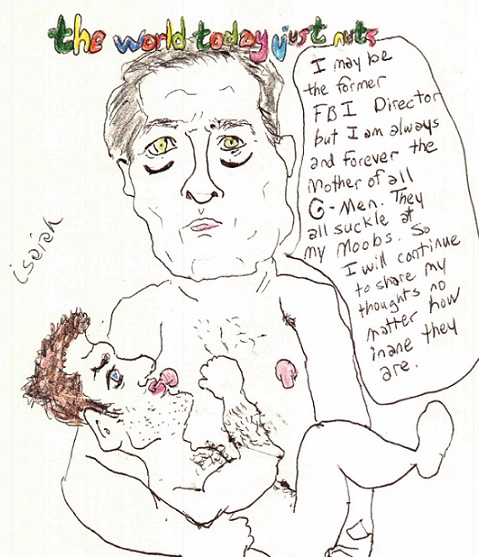
 Isaiah's THE WORLD TODAY JUST NUTS "The Mother of all G-Men" which kind of reminds me of an album cover -- a Red Hot Chili Peppers album cover.


Do you live near the coast?  Ready to see more alligators?  How about wolves?  Kashmira Gander (NEWSWEEK) reports:

 
Thanks to conservationists, large predators are venturing back to the hunting grounds they dominated before their populations were decimated by humans. The knock-on effects of this, according to a new study, includes alligators at the beach, killer whales in rivers, and mountain lions in grasslands.
Sightings of predators in areas they are not generally found have risen in recent years due to successful conservation projects, a new study in the journal Current Biology highlighted. 
Brian Silliman, professor of marine conservation biology at Duke's Nicholas School of the Environment, who led the study, said in a statement: "We can no longer chalk up a large alligator on a beach or coral reef as an aberrant sighting.
"It's not an outlier or short-term blip. It's the old norm, the way it used to be before we pushed these species onto their last legs in hard-to-reach refuges. Now, they are returning."


“The assumption, widely reinforced in both the scientific and popular media, is that these animals live where they live because they are habitat specialists," Silliman said. "Alligators love swamps; sea otters do best in saltwater kelp forests; orangutans need undisturbed forests; marine mammals prefer polar waters.
"But this is based on studies and observations made while these populations were in sharp decline. Now that they are rebounding, they’re surprising us by demonstrating how adaptable and cosmopolitan they really are.”
 
 
.So now they can return to areas that they once roamed through.  I’m picturing a lot of “the dingo ate my baby” in the near future. 
 
Good for the animals that they’re no longer at risk of dying out.  But let’s be honest that this will put humans – especially children – more at risk.  A wolf?  A child might think it’s a dog.  Especially a little two or three year old child. 
 
Let’s go back to yesterday’s topic “When the sun is gone ” because I noted how it’s a transformation and I saw Mindy Weisberger (LIVE SCIENCE) which has to be the best explanation of what will happen.


The length of a star's life span depends on its size. Our sun is a yellow dwarf with a diameter of around 864,000 miles (1,390,473 kilometers), or about 109 times the size of Earth, according to NASA. Yellow dwarf stars live for about 10 billion years, and at 4.5 billion years old, our middle-age sun is about halfway through its lifetime.
 
Once its hydrogen supply is depleted, the sun will start consuming its heavier elements. During this volatile and turbulent stage, vast quantities of stellar material will hurtle into space as the sun's body expands to 100 times its current size, becoming a red giant. Then, it will shrink down to a tiny, extremely dense white dwarf star, about Earth-size.


That’s pretty intense.


"Iraq snapshot" (THE COMMON ILLS):


Tuesday, May 8, 2018. Only four days until Iraq hold elections.


Mohammed Ebraheem (IRAQI NEWS) reports, "Iraqi security authorities denied on Tuesday media reports about an attack against a parliamentary candidate and three policemen in Diyala governorate." Regardless of their veracity, whispers and shouts dominate Iraq as the country gears up for yet another round of national elections.


. successfully run simulation exercises ahead of the parliamentary elections on 12 May. The tests covered the counting of votes, secrecy of the ballot and the security of the voting process


May 12th, elections are supposed to take place in Iraq.  Ali Jawad (ANADOLU AGENCY) notes, "A total of 24 million Iraqis are eligible to cast their ballots to elect members of parliament, who will in turn elect the Iraqi president and prime minister."  RUDAW adds, "Around 7,000 candidates have registered to stand in the May 12 poll, with 329 parliamentary seats up for grabs."  AFP explains that the nearly 7,000 candidates includes 2014 women.  THE SIASAT DAILY adds, of the nearly 7,000 candidates, "According to the electoral commission, only 20 percent of the candidates are newcomers." Ali Abdul-Hassan and Sinan Salaheddin (AP) report, "Iraqi women account for 57 percent of Iraq’s population of over 37 million, according to the U.N. Development Program, and despite government efforts to address gender inequality, the situation for Iraqi women has declined steadily since 2003.  According to the UNDP, one in every 10 Iraqi households is headed by a widow. In recent years, Iraqi women suffered further economic, social and political marginalization due to decades of wars, conflict, violence and sanctions."    RUDAW also notes that 60 Christian candidates are competing for the five allotted minority seats.  How do they elect the prime minister?  This comes after the general election and is based on who won seats in the election.   Abdulrahman al-Rashed (AL ARABIYA) explains, "To win the premiership, a candidate needs to win the majority of the votes, i.e. the votes of 165 MPs out of 329. Since it is a multi-party system, it is almost impossible to win these votes without sealing political alliances. The governorate of Baghdad is the most important one because it is the largest with 69 seats."  The chief issues?  Mustapha Karkouti (GULF NEWS) identifies them as follows, "Like in previous elections, the main concerns of ordinary Iraqis continue to be the lack of security and the rampant corruption."  Sunday, RUDAW explained that the electoral commission "so far fined 210 candidates for violations of commission guidelines."


As noted in the April 3rd snapshot, pollster Dr. Munqith Dagher has utilized data on likely voters and predicts that Hayder al-Abadi's Al-Nasr will win 72 seats in the Parliament, al-Fath (the militias) will get 37 seats, Sa'eroon (Moqtada al-Sadr's new grouping) will get 27 seats, Nouri al-Maliki's State of Law will get 19 seats, al-Salam will get 18 seats (KDP and PUK parties for the Kurds), Ayad Allawi's Wataniya will get 15 seats. There are others but Dagher did not predict double digits for any of the other seats. The number are similar for the group of those who are extremely likely to vote (Hayder's seats would jump from 72 to 79 seats).  Other predictions?  The Middle East Insstitute's Fanar Haddad insists to Sammy Ketz (AFP) that the post of prime minister will come down to one of three people: Hayder al-Abadi (current prime minister), Nouri al-Maliki (two time prime minister and forever thug) or Hadi al-Ameria "a leader of Hashed al-Shaabi, a paramilitary network that played a pivotal role in defeating IS. Ameri comes from Diyala province and is a statistics graduate from Baghdad University. He fled to Iran in 1980 after Saddam executed top Shiite cleric Ayatollah Mohammed Baqr al-Sadr. The 64-year old is widely viewed as Tehran's favoured candidate."


Some see Hadi al-Ameria as too divisive to be prime minister yet he possess the key trait required for a prime minister in Iraq.  Andrew England (FINANCIAL TIMES OF LONDON) explains:


Mr Ameri’s links to Iran date to 1981 when he left Iraq to fight Saddam Hussein’s regime in the Iran-Iraq war and helped found the Iran-backed Badr Brigade militia. Badr is the dominant force in the Hashd, which is estimated to have up to 120,000 fighters. He returned to Iraq after the US-led invasion toppled Saddam and paved the way for Iraq’s Shia majority to dominate politics. He became a MP and continued to head Badr at a time when militias proliferated in the post-invasion chaos. 


No one who grew up in Iraq is good enough to become prime minister, obviously.  Every person selected has been a coward who fled the country, lived outside of it for years, and only returned after the US-led invasion.  Hadi al-Ameria is just as big a coward as so many others.  He too can represent Iraq today . . . now that others took out Saddam Hussein.

Why do so many do like Nouri al-Maliki and nurse grudges?  Because they are so pathetic -- these grown men -- that they were unable to fight Saddam and had to depend upon fighters from other countries to topple Hussein.  This is an embarrassment and there's no way they can deny reality, so they nurse a grudge and try to punish others the way they wish they had been able to punish.  Impotency, one of the greatest indicators of conflict.

Though 'qualified' by current standards, not everyone's buying a ticket on The Hadi al-Ameria Express.   Ali Mamouri (AL-MONITOR) notes:

With Iraq's parliamentary elections around the corner, the different factions of the Popular Mobilization Units (PMU) grouped under the Fateh coalition banner face great challenges. These obstacles might eventually lead to internal divisions, decreasing the coalition’s chances of victory in the elections, to say the least.
On one level, Ayatollah Ali al-Sistani, the most influential religious and social leader in Shiite circles, opposes PMU participation in the elections, saying the organization’s name is being exploited for electoral gains.
Sistani’s office said in a May 4 statement, “No one is allowed to exploit the religious reference’s title or any other title dear to the hearts of Iraqis for electoral gains,” in reference to the PMU’s victories against the Islamic State (IS).
This is not the first time that Sistani has clearly opposed the PMU’s participation in elections. In his Friday sermon on April 27, Sistani spokesman Abdel Mehdi Karbalai affirmed Sistani’s position and his rejection of candidates who invoke victories against IS in the elections. The PMU was formed following Sistani's 2014 fatwa calling on Iraqis to join the security forces to stop IS after the terrorist organization occupied Mosul and moved toward Baghdad.


Turning to another issue . . .


In ’s parliamentary elections, we only hear about women in the media, not from themselves. Not a single party has started a major rally led by a female politician.


Female candidates have been targeted with smears; however, that's not an excuse for not interacting with potential voters.

Other issues including the continued lack of improvement in Iraq.  ALJAZEERA notes:

The increasing poverty rate is among the campaign issues.
Years of war and political instability have left communities in ruins, and the oil-dependent economy is in decline.

But many Iraqis doubt the election will lead to changes they desire.


With no improvements, many lives are left at risk.  RELIEF WEB notes:


  • Heavy rainfall and thunderstorms have been affecting the country over the past few days causing flash floods.
  • Media reported, as of 8 May, that four people have been killed in Dohuk city (Dohuk Governorate, Iraq) and 50 homes have been damaged due to the overflow of Hishkaro River. They also reported, as of the same date, that the flash floods also affected nearby refugee camps.
  • Over the next 24 hours, more heavy rain with local thunderstorms is forecast to affect the northern areas of the country, including the areas already affected.


When you spend no money to improve public infrastructure, when poor sewage means that rains result in flooding, you are not protecting the community.  The corruption in Iraq has allowed various officials to get rich while the standard of living and safety has gotten worse.  The flooding should stand as a reminder of how nothing has been achieved year after year.


In other news, Poland's Ambassador to Iraq is already an improvement over any US Ambassador.

Head of Minister , welcomed New Polish Ambassador to Iraq Ms. Beata Pęksa, to exchange views on the situation of Iraq, process of dialogue & negotiations bt Baghdad-Erbil & Iraq's upcoming parliamentary elections.


Every time you blinked during Barack Obama's two terms as president of the United States, he was naming another man to be ambassador to Iraq.  Man.  Somehow he couldn't find a qualified woman.  Over and over, he couldn't find a qualified woman.  This despite the changes it might have made in Iraq.  Women's rights were stripped away by the fundamentalist thugs the US put in charge.  Nouri al-Maliki, for example, refused to appoint women to his Cabinet at one point.  A female ambassador could have made a difference.  But Barack always had trouble finding qualified women -- this despite MS. Magazine embarrassing itself by insisting Barack was what feminism looked like.


Lastly . . .


BREAKING: A federal appeals court has blocked the Trump administration’s bid to transfer an American held by the US military in Iraq since September to another country.


New content at THIRD


The following community sites -- plus BLACK AGENDA REPORT -- updated:


  • Monday, May 07, 2018

    When the sun is gone


    Isaiah's THE WORLD TODAY JUST NUTS "First Slut"

    first slut


    Stormy needs to sail away like a bad rain cloud already.


    Stories like this depress me like crazy:


    Scientists agree the sun will die in approximately 10 billion years, but they weren't sure what would happen next... until now.
    A team of international astronomers, including Professor Albert Zijlstra from the University of Manchester, predict it will turn into a massive ring of luminous, interstellar gas and dust, known as a planetary nebula.
    A planetary nebula marks the end of 90% of all stars active lives and traces the star's transition from a red giant to a degenerate white dwarf. But, for years, scientists weren't sure if the sun in our galaxy would follow the same fate: it was thought to have too low mass to create a visible planetary nebula.


    Why does that bother me so?
     
    I’ll be dead.  My kids will be dead.  Any grandkids I have will be dead.
     
    And this is really rather glorious, the way it will transform.
     

    But still, it does make me sad.  But I’m the type who gets sad when I pass a Toys R Us or any other store that’s closing. 


    "Iraq snapshot" (THE COMMON ILLS):
    Monday, May 7, 2018.

    Mina Aldroubi (THE NATIONAL) reports, "Gunmen shot dead Faruq Zarzur Al Jubouri, a 45-year-old candidate loyal to Vice President Ayad Allawi, at his home in the town of Qayyarah, 70 kilometres from Mosul, the former ISIS bastion in northern Iraq. ARAB NEWS adds that ISIS has claimed responsibility for the assassination today.  Sunday, AL MADA noted that there had been 15 assassination attempts on candidates this election cycle.


    May 12th, elections are supposed to take place in Iraq.  Ali Jawad (ANADOLU AGENCY) notes, "A total of 24 million Iraqis are eligible to cast their ballots to elect members of parliament, who will in turn elect the Iraqi president and prime minister."  RUDAW adds, "Around 7,000 candidates have registered to stand in the May 12 poll, with 329 parliamentary seats up for grabs."  AFP explains that the nearly 7,000 candidates includes 2014 women.  THE SIASAT DAILY adds, of the nearly 7,000 candidates, "According to the electoral commission, only 20 percent of the candidates are newcomers." Ali Abdul-Hassan and Sinan Salaheddin (AP) report, "Iraqi women account for 57 percent of Iraq’s population of over 37 million, according to the U.N. Development Program, and despite government efforts to address gender inequality, the situation for Iraqi women has declined steadily since 2003.  According to the UNDP, one in every 10 Iraqi households is headed by a widow. In recent years, Iraqi women suffered further economic, social and political marginalization due to decades of wars, conflict, violence and sanctions."    RUDAW also notes that 60 Christian candidates are competing for the five allotted minority seats.  How do they elect the prime minister?  This comes after the general election and is based on who won seats in the election.   Abdulrahman al-Rashed (AL ARABIYA) explains, "To win the premiership, a candidate needs to win the majority of the votes, i.e. the votes of 165 MPs out of 329. Since it is a multi-party system, it is almost impossible to win these votes without sealing political alliances. The governorate of Baghdad is the most important one because it is the largest with 69 seats."  The chief issues?  Mustapha Karkouti (GULF NEWS) identifies them as follows, "Like in previous elections, the main concerns of ordinary Iraqis continue to be the lack of security and the rampant corruption."  Sunday, RUDAW explained that the electoral commission "so far fined 210 candidates for violations of commission guidelines."


    As noted in the April 3rd snapshot, pollster Dr. Munqith Dagher has utilized data on likely voters and predicts that Hayder al-Abadi's Al-Nasr will win 72 seats in the Parliament, al-Fath (the militias) will get 37 seats, Sa'eroon (Moqtada al-Sadr's new grouping) will get 27 seats, Nouri al-Maliki's State of Law will get 19 seats, al-Salam will get 18 seats (KDP and PUK parties for the Kurds), Ayad Allawi's Wataniya will get 15 seats. There are others but Dagher did not predict double digits for any of the other seats. The number are similar for the group of those who are extremely likely to vote (Hayder's seats would jump from 72 to 79 seats).  Other predictions?  The Middle East Insstitute's Fanar Haddad insists to Sammy Ketz (AFP) that the post of prime minister will come down to one of three people: Hayder al-Abadi (current prime minister), Nouri al-Maliki (two time prime minister and forever thug) or Hadi al-Ameria "a leader of Hashed al-Shaabi, a paramilitary network that played a pivotal role in defeating IS. Ameri comes from Diyala province and is a statistics graduate from Baghdad University. He fled to Iran in 1980 after Saddam executed top Shiite cleric Ayatollah Mohammed Baqr al-Sadr. The 64-year old is widely viewed as Tehran's favoured candidate."


    A new development this election cycle is the switch to electronic voting.  Little thought has been given to securing the vote.  And there are already efforts in place to manipulate the vote.  RUDAW reports:

    The Iraqi parliament’s security and defense committee says it has received intelligence suggesting some political parties are trying to sabotage voting machines ahead of the May 12 election so that electronic voting is scrapped and replaced with the manual system.

    The committee said these parties will sabotage the devices an hour before polling stations open so that the commission will have to count votes by hand. It called on the election commission and security forces to secure the devices.

    Hakim Zamli, head of the committee, told Rudaw his colleagues have visited some Iraqi regions and found there is an agreement between the heads of polling stations and some unnamed political parties to sabotage electronic voting devices.

    The committee has urged the election commission not to count the votes at polling stations where the devices do not work.


    On the electronic voting, Omar Sattar (AL-MONITOR) reported last month:

    Yet the supposed advantages of electronic vote counting and sorting have not prevented some of those on the country’s electoral lists from expressing anxieties about the new scheme. It is feared that Iraq’s lack of experience, capacity and modernization when it comes to such a system might bring the results into doubt and under dispute, especially among losing parties or those with fewer seats in the new parliament.
    In a meeting with Al-Monitor, the vice president of Iraq’s Electoral Commission, Rizkar Haji, discussed the details of the electronic system. He said, “This system was prepared by the previous commission [whose members were replaced in November], which contracted with the South Korean company Miru [Systems] to import equipment for the electronic counting, as well as 40 Korean experts to implement and maintain the devices.”
    He said voters this year will “use a special [rubber] stamp instead of the customary pen to indicate their chosen candidate or list, and the devices will only read this stamp.” He said the electronic counting and sorting system is integrated into a box that receives ballots "and sorts them immediately.” 


    As the election nears, more and more make their exact opinions known.  Friday, Grand Ayatollah Ali al-Sistani made remarks against corruption and gong backwards which have been rightly interpreted as remarks against former prime minister and forever thug Nouri al-Maliki.


    Who does the US government want to win the elections?  Gregory Aftandilian (ARAB WEEKLY) offers:


    Although the United States has avoided publicly taking sides in Iraq’s May 12 parliamentary elections, Washington clearly hopes that Prime Minister Haider al-Abadi will prevail. Abadi has worked closely with US forces in helping to defeat the Islamic State (ISIS) and is seen as the best hope among Shia politicians of keeping Iran’s influence at a minimum.
    Every Iraqi prime minister since the 2003 US-led invasion has been a Shia. These prime ministers have often tried to refashion themselves into political figures who go beyond their sectarian base. For example, former Prime Minister Nuri al-Maliki tried to create the persona of an Iraqi nationalist with his State of Law coalition. Shias and non-Shias alike have regarded them essentially as Shia politicians.

    One of Maliki’s chief problems was that he so alienated and marginalised the Sunnis that many of them grew susceptible to the entreaties of ISIS, which helped it seize large parts of Iraq in the summer of 2014. The success of ISIS that summer led to Maliki’s political demise — at least temporarily.

    Nouri's past is repeatedly noted in article after article.  For example, AL-ARABIYA reports:

    The Iraqi Shiite leader Muqtada al-Sadr has slammed former Iraqi Prime Minister Nouri al-Maliki for suggesting the formation of an absolute majority policy in the coming new government, in the wake of the awaited parliamentary elections due next week.
    Sadr said that he is currently against an absolute majority policy, adding - in a hint to Malaki - that some “illusioned politicians” believe that they can have absolute majority policy to continue with their corruption further.

    Blamed for the widespread corruption and divisive policies that contributed to the collapse of the Iraqi military and the rise of Islamic State, Maliki lost the premiership to fellow Dawa Party member Haider al-Abadi after a 2014 election.


    Since Nouri led the country to the brink, it's not surprising so many are noting his failures.


    It's a shame they couldn't note these failures before but when the US government supports someone, the press falls in line.  That would certainly explain Tamer el-Ghobashy and Mustafa Salim's ridiculous claim for THE WASHINGTON POST that Hayder's going to be win big in Mosul -- he's going to sweep Mosul!  Mosul?  The city that remains in ruins after 'liberation'?  Who are the sources?  Excuse me, outside of the US State Dept, who are the sources?


    Stupidity is in the air.  Ronan Farrow's laughable WAR ON PEACE 'book' has earned praise from the usual crowd of non-readers such as Bill Maher.  In the real world, a scan of any page is likely to result in discovering a serious error.  For example, this is on page 61:


    Critics argued that he benefited from events out of his control -- like al Qaeda leader Moqtada al-Sadr declaring a unilateral ceasefire.


    Moqtada al-Sadr is not Sunni.


    al Qaeda is a Sunni organization.

    Moqtada al-Sadr is a Shi'ite cleric and movement leader.


    With an election later this month, Iraq could be at a key turning point. Muqtada al-Sadr, a prominent Shia cleric, may shed light on the country's future with his next steps. Read ’s analysis here:


    At the Carnegie Endowment for International Peace website, Mehiyar Kathem writes:


    Shia cleric Muqtada al-Sadr is attempting to transform Iraq’s politics. Hailing from one of the country’s revered clerical families, the forty-four-year-old politician enjoys an enviable position as leader of Iraq’s Shia poor. The son of the late Grand Ayatollah Mohammad Sadeq al-Sadr, the young leader came of age under the U.S. occupation and has become one of Iraq’s most important political figures. Championing antipoverty and secular-oriented politics, Sadr is regarded highly across a large swath of Iraqi society. Exposing the failures of Iraq’s sectarian political system and making calls for widespread reform, Sadr’s recent deliberations represent a shift from the sectarianism that has wracked the country. Politically influenced by common grievances, Sadr has positioned himself to challenge the vested interests of Iraq’s political elites. Now, Sadr is increasingly playing the role of national statesman by working to build national and regional alliances, particularly with Saudi Arabia, and has also reached out to secular and Sunni groups in Iraq. By tapping into a resurgent Iraqi nationalism, he is threatening the sectarian political order. The electoral coalition Sairoun, established to contest parliamentary elections in May this year, is composed of Sadr’s chosen candidates, the Iraqi Communist Party, and secular political activists. Sadr’s efforts to counter the Shia elite’s stranglehold over the Iraqi state and stem Iran’s encroaching influence in the country is consolidating his position in Iraq as an anti-establishment reformist figure.
    Not since 2003 has there been such an opportunity for political reform. The defeat of the self-proclaimed Islamic State, the retaking of Kurdish Regional Government (KRG)–held territory by the central government, a strengthened national army, and improved relations with its Arab neighbors have contributed to a positive outlook for Iraq. Yet, while the country’s politics is changing, not much else has improved for Iraqis. The delivery of basic state services continues to be abysmal, and major frontline institutions have been hollowed out by years of endemic corruption. Iraq’s faltering infrastructure—which has not seen any notable progress—is unsettling Sadr’s base of Shia poor and the Iraqi population, whose social and economic conditions continue to be characterized by harrowing levels of impoverishment. According to the Iraqi government, 33 percent of Iraq’s poor do not have access to safe drinking water, and 29 percent of poor individuals aged ten years and over are illiterate. In what could be a key turning point, Sadr’s next steps may shed light on Iraq’s future.


    While at The Century Foundation's website, Thanassis Cambanis writes:

    In the fifteen years since the American invasion toppled Saddam Hussein from power, Shia cleric Moqtada al-Sadr has distinguished himself from other emerging Iraqi leaders with his endurance, iconoclasm, and unpredictability. He has cut a bedeviling and at times magnetic figure in his country, and he is one of the few sectarian leaders whose popularity has crossed sectarian lines.
    Through war, flips of allegiances, involvement in corruption, and military victory and defeat, Sadr has managed to preserve his maverick image as a stubbornly independent man deeply committed to his principles, even as those principles shift over time. Now, with the May 12 Iraqi elections approaching, he is trying to parlay his reputation as a nationalist free-thinker into a movement that can transform Iraq’s political system.

    In fact, Sadr has fashioned himself into an unlikely tribune of reform in Iraq. A persistent thorn in the side of foreign powers and Iraqi politicians alike, the graying forty-four-year-old is now trying to radically reshape his country’s politics. He has freshly renounced religious sectarianism, building an alliance with Communists and secular reform activists.1 He has attacked Iraq’s corrupt spoils system, with slogans such as “corruption is terrorism” that resonate with millions of disenchanted Iraqis. His unorthodox electoral campaign joins Shia partisans, Communist ideologues and some of Baghdad’s secular elite. Sadr’s popularity, hard power, and unifying message make him a direct threat to Iraq’s political class.


    Isaiah's THE WORLD TODAY JUST NUTS "First Slut" and "The Mother of all G-Men" and "The Scope of the Investigation" went up Sunday.