NASA has named three students the winners of the Artemis Moon Pod Essay Contest for their creative visions of a pioneering journey to the Moon. Nearly 14,000 students entered the contest, each competing for the grand prize: a trip to NASA’s Kennedy Space Center in Florida, where they will witness the first launch of the Artemis era.
NASA invited students to envision themselves leading a crew, or “pod,” on a mission to the Moon’s South Pole, and capture these ideas in their essays. NASA and Future Engineers, an online platform for student challenges, launched the contest in September 2020 for K-12 students nationwide. The contest’s goal is to encourage the Artemis Generation – kids growing up during the era of NASA’s return to the Moon – to think ahead about the human and technological needs of a lunar expedition. What types of tools or technologies would they bring to the Moon? Who would they include in their “pod” of crewmembers? What would they leave behind for future lunar crews to use?
Grand-prize winning essays in the three, grade-level-based categories are:
- Kindergarten through fourth grade category: Austin Pritts of Wolcott, Indiana.
- Fifth through eighth grade category: Taia Saurer of Laguna Beach, California.
- Ninth through 12th grade category: Amanda Gutierrez of Lincoln, Nebraska.
“I want to extend my congratulations to the amazing Artemis Moon Pod Essay winners. NASA shares your excitement for humanity’s return to the Moon, and we are so inspired by your creative ideas for how to lead that expedition.” said Kathy Lueders, associate administrator for the Human Exploration and Operations Mission Directorate (HEOMD) at NASA Headquarters. “Get your boots ready, because you are the next era of space explorers – the Artemis Generation.”
Students across the nation wrote in to share their visions of a weeklong mission to the Moon’s South Pole. Over 1,000 educators, professionals, and space enthusiasts served as volunteers for the first round of judging, and selected 155 semifinalists in March 2021. The list was narrowed further to nine finalists in April. A panel of four judges, including two from HEOMD and two from the agency’s Office of STEM Engagement, conducted virtual interviews with the finalists about their essays and ideas before choosing the three winners.
Pritts’ essay, “My Mission to the Moon,” tells the tale of a daring Moon Pod crew consisting of a test pilot/navigator, chemist, and mechanical engineer who establish a permanent lunar research facility powered by Kilopower Reactor Using Stirling Technology (KRUSTY).
In “One Week on the Moon – The Artemis Adventure,” Saurer’s vision for the Moon Pod mission calls for a four-person crew – including the first woman to step onto the Moon – to build a habitat for future astronauts using a combination of lunar soil and a fibrous fungal material called mycelium.
Gutierrez’s composition, “Dream Big Moon Pod,” follows the adventure of a three-person crew of a chemist, hydrologist, and astronautical engineer as they install an Endothermic Electrolysis Reactor (EER), designed to provide fuel and oxygen for future crews at the Moon’s Shackleton Crater.
“I can’t tell you how inspiring and energizing it’s been to read these essays and see the students’ enthusiasm and creativity in action,” said Mike Kincaid, NASA’s associate administrator for the Office of STEM Engagement. “The future of space exploration is in good hands.”
The contest was a collaborative effort between NASA’s Office of STEM Engagement and the Human Exploration and Operations Mission Directorate, in partnership with the online platform Future Engineers.
Through Future Engineers, the grand prize winners will have the opportunity to travel with their families to NASA’s Kennedy Space Center in Florida to see the first launch of NASA’s Space Launch System rocket and Orion spacecraft during the uncrewed Artemis I mission. On this first flight of the Artemis program, the Orion spacecraft will travel beyond the Moon, nearly 280,000 miles away from Earth – farther than any spacecraft built for humans has ever traveled – during a three-week mission.
The 13,898 essays submitted to the Moon Pod Essay Contest will fly on a USB flash drive aboard Artemis I, and NASA will provide each student who participated a signed certificate. Each semifinalist will get the chance to learn even more about Artemis through a series of virtual Artemis Explorer Sessions with NASA experts, along with an Artemis prize pack filled with fun educational materials. The contest’s nine finalists also will have the chance to travel with a parent to the agency’s Johnson Space Center in Houston to learn more about lunar exploration.
The Moon Pod Essay Contest aligns with NASA’s Artemis Student Challenges, an ongoing collection of engineering and technological design challenges allowing students worldwide to learn about human spaceflight topics and technologies.
Future Engineers hosts online innovation challenges for K-12 students. In 2014, Future Engineers launched its inaugural 3D printing in space challenge, sponsored by the American Society of Mechanical Engineers Foundation with technical assistance from NASA, which produced historic achievements including the first student-designed 3D print in space. Through the support of the U.S. Department of Education's Small Business Innovation Research Program, Future Engineers launched a multi-challenge platform in 2018 capable of hosting Science, Technology, Engineering, Art, and Math (STEAM) challenges of all kinds.
For more information on NASA’s Office of STEM Engagement, visit:
-end-
Katherine Brown
Headquarters, Washington
202-358-1288
katherine.m.brown@nasa.gov
Congratulations to Austin Pritts, Taia Saurer and Amanda Gutierrez. They should be very proud of themselves.
And staying on the topic of NASA, let's move over to Mars.
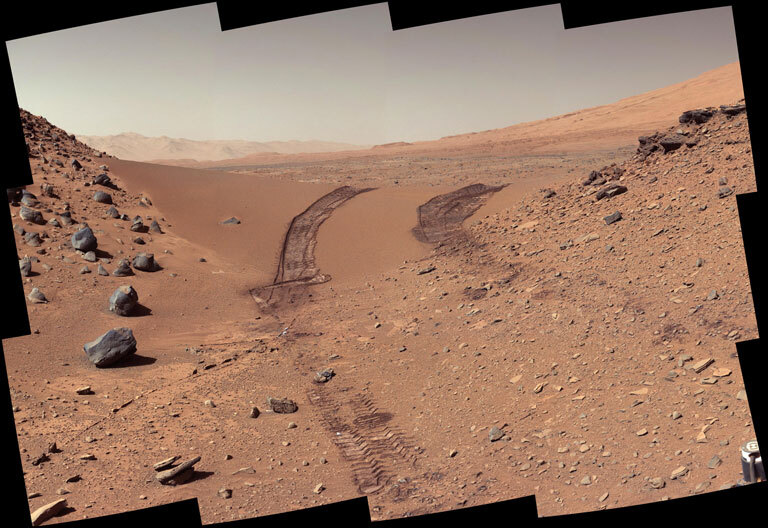
Curiosity's Color View of Martian Dune After Crossing It: This look back at a dune that NASA's Curiosity Mars rover drove across was taken by the rover's Mast Camera (Mastcam) on Feb. 9, 2014 – the 538th Martian day, or sol, of Curiosity's mission. Credits: NASA/JPL-Caltech/MSSS. Full image and caption ›
A NASA team has found that organic salts are likely present on Mars. Like shards of ancient pottery, these salts are the chemical remnants of organic compounds, such as those previously detected by NASA’s Curiosity rover. Organic compounds and salts on Mars could have formed by geologic processes or be remnants of ancient microbial life.
Besides adding more evidence to the idea that there once was organic matter on Mars, directly detecting organic salts would also support modern-day Martian habitability, given that on Earth, some organisms can use organic salts, such as oxalates and acetates, for energy.
“If we determine that there are organic salts concentrated anywhere on Mars, we’ll want to investigate those regions further, and ideally drill deeper below the surface where organic matter could be better preserved,” said James M. T. Lewis, an organic geochemist who led the research, published on March 30 in the Journal of Geophysical Research: Planets. Lewis is based at NASA’s Goddard Space Flight Center in Greenbelt, Maryland.
Lewis’s lab experiments and analysis of data from the Sample Analysis at Mars (SAM), a portable chemistry lab inside Curiosity’s belly, indirectly point to the presence of organic salts. But directly identifying them on Mars is hard to do with instruments like SAM, which heats Martian soil and rocks to release gases that reveal the composition of these samples. The challenge is that heating organic salts produces only simple gases that could be released by other ingredients in Martian soil.
However, Lewis and his team propose that another Curiosity instrument that uses a different technique to peer at Martian soil, the Chemistry and Mineralogy instrument, or CheMin for short, could detect certain organic salts if they are present in sufficient amounts. So far, CheMin has not detected organic salts.
Finding organic molecules, or their organic salt remnants, is essential in NASA’s search for life on other worlds. But this is a challenging task on the surface of Mars, where billions of years of radiation have erased or broken apart organic matter. Like an archeologist digging up pieces of pottery, Curiosity collects Martian soil and rocks, which may contain tiny chunks of organic compounds, and then SAM and other instruments identify their chemical structure.
Using data that Curiosity beams down to Earth, scientists like Lewis and his team try to piece together these broken organic pieces. Their goal is to infer what type of larger molecules they may once have belonged to and what those molecules could reveal about the ancient environment and potential biology on Mars.
“We’re trying to unravel billions of years of organic chemistry,” Lewis said, “and in that organic record there could be the ultimate prize: evidence that life once existed on the Red Planet.”
While some experts have predicted for decades that ancient organic compounds are preserved on Mars, it took experiments by Curiosity’s SAM to confirm this. For example, in 2018, NASA Goddard astrobiologist Jennifer L. Eigenbrode led an international team of Curiosity mission scientists who reported the detection of myriad molecules containing an essential element of life as we know it: carbon. Scientists identify most carbon-containing molecules as “organic.”
“The fact that there’s organic matter preserved in 3-billion-year-old rocks, and we found it at the surface, is a very promising sign that we might be able to tap more information from better preserved samples below the surface,” Eigenbrode said. She worked with Lewis on this new study.
Analyzing Organic Salts in the Lab
Decades ago, scientists predicted that organic compounds on Mars could be breaking down into salts. These salts, they argued, would be more likely to persist on the Martian surface than big, complex molecules, such as the ones that are associated with the functioning of living things.
If there were organic salts present in Martian samples, Lewis and his team wanted to find out how getting heated in the SAM oven could affect what types of gases they would release. SAM works by heating samples to upwards of 1,800 degrees Fahrenheit (1,000 degrees Celsius). The heat breaks apart molecules, releasing some of them as gases. Different molecules release different gases at specific temperatures; thus, by looking at which temperatures release which gases, scientists can infer what the sample is made of.
“When heating Martian samples, there are many interactions that can happen between minerals and organic matter that could make it more difficult to draw conclusions from our experiments, so the work we’re doing is trying to pick apart those interactions so that scientists doing analyses on Mars can use this information,” Lewis said.
Lewis analyzed a range of organic salts mixed with an inert silica powder to replicate a Martian rock. He also investigated the impact of adding perchlorates to the silica mixtures. Perchlorates are salts containing chlorine and oxygen, and they are common on Mars. Scientists have long worried that they could interfere with experiments seeking signs of organic matter.
Indeed, researchers found that perchlorates did interfere with their experiments, and they pinpointed how. But they also found that the results they collected from perchlorate-containing samples better matched SAM data than when perchlorates were absent, bolstering the likelihood that organic salts are present on Mars.
Additionally, Lewis and his team reported that organic salts could be detected by Curiosity’s instrument CheMin. To determine the composition of a sample, CheMin shoots X-rays at it and measures the angle at which the X-rays are diffracted toward the detector.
Curiosity’s SAM and CheMin teams will continue to search for signals of organic salts as the rover moves into a new region on Mount Sharp in Gale Crater.
Soon, scientists will also have an opportunity to study better-preserved soil below the Martian surface. The European Space Agency’s forthcoming ExoMars rover, which is equipped to drill down to 6.5 feet, or 2 meters, will carry a Goddard instrument that will analyze the chemistry of these deeper Martian layers. NASA’s Perseverance rover doesn’t have an instrument that can detect organic salts, but the rover is collecting samples for future return to Earth, where scientists can use sophisticated lab machines to look for organic compounds.
News Media Contact
Andrew Good
Jet Propulsion Laboratory, Pasadena, Calif.
818-393-2433
Andrew.C.Good@jpl.nasa.gov
-- Written by Lonnie Shekhtman, NASA’s Goddard Space Flight Center, Greenbelt, Md.
I like that first image, by the way, at the top. Note who took that photo? The legendary land rover Curiosity. :D Now a video.
That video covers the same subject as the press release above.
"Iraq snapshot" (THE COMMON ILLS):
Thursday, May 20, 2021. Turkey continues to terrorize Iraq, Mustafa al-Kadhimi remains inept one year later, and much more.
At WSWS, Andre Damon observes:
Around the world, millions of people are shocked and outraged at the brutal terror bombings, ethnic cleansing and communal violence being carried out by Israel, a US client state, against the people of Gaza.
Two hundred and twenty-seven people, including 63 children, have been killed in Israel’s ten-day-long assault on Gaza, a figure nearly 20 times higher than the number of Israelis killed in the conflict.These crimes are committed using American armaments, funded by American tax dollars, and with the approval of the American government. They are facilitated by arms deals and military alliances created behind the backs of the American population and orchestrated to facilitate the predatory interests of the US financial oligarchy.
On Monday, after a week of murderous bombardment of the Gaza’s civilian population, US president Joe Biden began a telephone discussion with Israeli President Benjamin Netanyahu by declaring, in the words of the official readout, “The President reiterated his firm support for Israel’s right to defend itself against indiscriminate rocket attacks.”
When on Tuesday Biden visited Dearborn, Michigan, the city with the nation’s highest percentage of Arab American residents in the United States, he was greeted by thousands of people protesting the crimes Israel is committing with US support.
Asked if he would take a question on the conflict from a reporter as he was test-driving a new Ford truck, Biden replied, “No, you can’t. Not unless you get in front of the car as I step on it.”
Journalists laughed at his comments. They sucked up hard. They should have been disgusted. But they throw their itty-bitty, baby egos out the window when the insult comes from one of their higher ups. At that point, they just lick the boots.
So busy spit polishing, they never seemed to grasp just how offensive Biden's remarks are. The Israeli government is terrorizing the Palestinians. Can Joe be asked a question? Only if you're willing for him to drive you down in the vehicle he's in.
The way, right before the start of the Iraq War, Rachel Corrie was killed? That's how she was killed on March 16, 2003. She was protesting on behalf of the Palestinian people and an Israeli miliatry bulldozer ran over her.
Is that what Joe's threatening?
Oh, by all means, laugh it up.
How embarrassing.
How shameful.
Tom Elliott Tweets:
As you watch these reporters giggle in delight at Biden's playing with this car, remember - regardless of your view on Israel/Palestine - that there's a savage war going on for which Biden bears direct responsibility. Seems, at least, to be bad optics to being playing with toys.
So that's one point with regards to Andre Damon's article.
The second point?
Is WSWS ever going to note the Kurds in Iraq? Is their hatred of the Kurds just going to mean they continue to be silent?
More 'reports' of Turkey 'neutralizing' Kurds in Iraq. Murdering them. Claiming they're terrorists. Invading Iraq on the ground and dropping bombs from war planes.
How did we get to the point where the Israeli government could so openly and wantonly murder Palestinians? By people looking the other way for years. By the press ignoring the realities.
What's it going to take for the press to wake up to what the Kurds are doing?
Most of them covered for nearly 100 years -- covered for Turkey, looked the other way with regards to the Armenian genocide that Turkey carried out.
Steve Sweeney (Australia's GREEN LEFT) reports:
Hundreds of Kurdish villagers have been forced to flee their homes in the semi-autonomous Kurdistan region of Iraq due to Turkish bombing — and are being replaced by jihadists imported from Syria.
An agricultural worker from Barwari Bala in the mountainous Duhok province, which borders Turkey, told the Morning Star that he had abandoned his land and home due to the intensity of the aerial bombardment.
“Every day, every night, for the past weeks we are being bombed. Our lands are being destroyed: we cannot grow our crops,” he said.
“Nearly all of us have left — there is nothing for us. Our future is being destroyed, and they give our homes to Daesh [Isis].”
“We are civilians: farmers, children. Why are they doing this? The world does nothing to help because we are Kurds. Everyone wants to kill us.”
He insisted that there had been no guerilla fighters in the villages — Turkey’s pretext for invasion — but added that the people supported the banned Kurdistan Workers Party (PKK), which Turkey deems a terrorist group, as the only force preventing a genocide.
“If I see them, I hug them,” he said. “Without them, Turkey would kill us all.”
Turkey’s illegal invasion of Iraqi Kurdistan, codenamed Operation Claw Lightning, started on April 23, the anniversary of the start of the Ottoman Armenian genocide in 1915, during which 1.5 million men, women and children were systematically exterminated.
Why the silence from WSWS? Were the Kurds anti-Trotsky or have some long ago beef with SEP? Maybe Eric London could write an article about that -- another long winded confusing article, as Mike pointed out.
The Kurds are being attacked. This is genocide. Turkey is carrying it out in Iraq and Syria as well as within the Turkish borders.
The United Kingdom's Boycott Turkey notes:

Podcaster Peculiar Blend wonders:
To hear the Turkish government tell it, they never kill or injure civilians in Iraq. It's always terrorists, according to them. To hear the Turkish government tell it, the Armenian genocide never happened. Cableee3 points out:

Turkish soldiers on 18 May reportedly shot Şahap Şendol, a 23 old shepherd and Celil Ekinci, aged 17, in the Derecik district of Turkey’s eastern province of Hakkari (Colemerg), which borders Iraq.

The incident took place at around 07:00 am on Tuesday in a rural area near the village of Hacı Bey. The soldiers on duty along the Turkey-Iraq border reportedly fired on Şendol and Ekinci ‘without warning’.
As both were wounded by the gunfire, they were taken to a hospital in Iraqi Kurdistan. Whilst Şendol was wounded in his hand and released from hospital, the treatment of 17-year-old Ekinci, who was wounded in his stomach, continues.
The Peoples’ Democratic Party’s (HDP) MP for Hakkari Sait Dede announced the incident in his social media posts, sharing the footage that was recorded at the scene of the incident.
Turkey gets away with it. They get away with attacking anyone. Even Americans on US soil. Barack Obama was president then and he looked the other way. Sorry, Barack, diplomatic immunity does not cover assaults. Those people should have been charged and put on trial. They should not have been allowed to slip out of the country.
Meanwhile, Mina Aldroubi (THE NATIONAL) reports:
Weapons in Iraq are not the solution to the crises the country is facing, Prime Minister Mustafa Al Kadhimi said as he encouraged citizens to participate in the upcoming elections to create a change for the better.
Iraq faces serious issues, from a dilapidated healthcare system, corruption and war-battered economy, to the task of reining in armed groups that operate outside the state's authority.
The country has witnessed dozens of assassinations and targeted killings of activists and reporters in recent months by unknown gunmen, the latest was Ihab Al Wazni who was murdered last month in the southern city of Karbala.
"There is anarchy in Iraq’s planning system that has caused the accumulation of a large number of problems. The use of weapons is not the solution, rather elections and a large voter turnout is needed to change for the better,” Mr Al Kadhimi said during a visit to the southern governorate of Wasit.
Anarchy, huh?
Well, Mustafa, you've had a year and what have you done?
It was May 7, 2020 that Mustafa became prime minister. A year later, what can he claim to have accomplished?
No killed of activists has been brought to justice. The report, the government report, remains suppressed, he's the one refusing to release it -- despite repeated, public promises. The Iraqi people continue to suffer.
Turkey has set up a base in Iraq and Mustafa won't address that. He was supposed to be a one term prime minister -- by his own statements -- but instead he's trying to get a second term -- even going so far as to form a conditional alliance with cleric Moqtada al-Sadr.
What has he accomplished?
Lawk Ghafuri noted May 6, 2020 what Mustafa was planning:
The highlights of Iraqi PM-designated Mustafa al-Kadhimi’s cabinet agenda:- - Improve Iraqi security forces - Improve #Iraq’s economy - Develop diplomatic ties - Fighting corruption
What has he done? You could say "develop diplomatic ties" if you ignored that fact that his recent flurry of phone calls have to do with his attempts to shore up support for a second term.
The following sites updated:
-
-
-
-
-
PRODIGAL SON concludes10 hours ago
-
-
-
Beef?10 hours ago
-
-
dynasty10 hours ago
-
-
Sinead and Prince10 hours ago
-
Jeffrey Epstein's Circle of Sewage10 hours ago
-
The Vampire Academy and The Flash10 hours ago
-
-