Saturday, October 02, 2021

Shame on NASA

If you've read this site for the last ten years you know the best description for me to NASA is "fan."  I am a fan.  I applaud NASA regularly.  So it pains me to have to call them out but they've done a very shameful thing.  SMITHSONIAN MAGAZINE reports:


NASA says they do not plan to rename the multi-billion-dollar James Webb Space Telescope, despite concerns from astronomers, the public, and agency employees. James Webb, who was an influential figure at NASA during the 1960s and 1970s, participated in the systematic discrimination against gay and lesbian employees during his tenure at the agency. The controversy has many calling on NASA to rethink the name of the the $10 billion telescope, which is set to launch in December.

"At best, Webb's record is complicated," says Chanda Prescod-Weinstein, a cosmologist at the University of New Hampshire, to NPR’s Nell Greenfieldboyce. Prescod-Weinstein, who co-authored an opinion article in Scientific American on the subject, says, “And at worst, we're basically just sending this incredible instrument into the sky with the name of a homophobe on it, in my opinion."


This makes all the efforts to make up for past discrimination questionable.


Their efforts to recognize my race in retrospect is meaningless if today, in 2021, when they know homophobia is wrong, they're willing to name the telescope after a homophobe.


To me, that just says that if they could get away with it, they'd be naming things after known racists.


My race was marginalized at NASA in the 60s, the 70s, the 80s . . . Today's efforts to make amends are not sincere if they still think it's okay to honor homophobes.


Discrimination is discrimination.  Hate is hate.  NASA's actions make it appear that they grasp that society today will not tolerate racism and that's the only reason that they're making amends.  If they were truly concerned about doing the right thing, as they pretend, then they wouldn't be glorifying a homophobe.

"Iraq snapshot" (THE COMMON ILLS):

Friday, October 1, 2021.  Iraqis take to the streets as The October Revolution continues while in the US the war on journalism, freedom of speech and the First Amendment gets very little attention.


The war on Iraq has led to many other wars.  Julian Assange is part of that war.  WIKILEAKS published truths about Iraq that the US government didn't want known, that the US government had lied about.  Monday April 5, 2010, WIKILEAKS released US military video of a July 12, 2007 assault in Iraq. 12 people were killed in the assault including two REUTERS journalists Namie Noor-Eldeen and Saeed Chmagh.  Lies is what the US government had served up for ten years -- they lied to the American people, to REUTERS, to the whole world.  Tell the truth and watch them go after you.  It's appalling.  And now we've learned that the CIA plotted to kidnap Julian Assange and to assassinate him and that's appalling.  


Ed Snowdem Tweets:

BIG: On Sunday, a new report claimed the US secretly considered killing Julian Assange, and laid criminal charges against him primarily to "legalize" a kidnap operation. Now the former CIA Director who pushed the scheme has—in a failed damage control effort—confirmed it is true.


And he's linking to Michael Isikoff's Tweet:


Says the ACLU's : Pompeo “just verified the truth of the story. Because the only reason to prosecute someone is that they revealed legitimate classified information."


Jeffrey St. Clair (COUNTERPUNCH) explains:

The news that the Trump inner circle considered assassinating Julian Assange came as a shock to MAGA land, but not to anyone else who’d been paying the slightest attention to Trump’s hand-picked CIA director Mike Pompeo, who had publicly declared Wikileaks, and its founder, “a non-state hostile intelligence service.” As reported last week by Yahoo News, in the spring of 2017, just a few months after taking office, Trump himself asked the CIA to develop plans for whacking Assange. He demanded several options to choose from.  And the CIA promptly complied, developing several “sketches” for extracting Assange from the Ecuadoran embassy in London and disposing of the irksome journalist.

Of course, Trump had spent much of the previous year singing the praises of the Australian muckraker, as Wikileaks posted troves of damning emails and documents from the DNC and HRC’s campaign itself, disclosures which may have tipped the election to Trump. These campaign-stump encomiums to Assange by Trump led many of Assange’s supporters to believe that Trump might pardon Assange. But loyalty is fleeting in Trump World and it now seems likely that if Trump had pardoned Assange it would have been as the prelude to a hit.

Even though Obama’s crackdowns on whistleblowers rivaled Nixon’s in their ferocity, he backed off from indicting Assange, even after the DNC hacks, perhaps fearing that it might have left a permanent blemish on his record. Whether he, too, secretly contemplated covert actions against Assange is not yet known. Though both Hillary and Democratic Party insiders like Bob Beckel openly mused about droning both Assange and Edward Snowden.

Trump, however, showed no such fussiness or hesitancy.  Within weeks of Trump’s inauguration, the CIA’s new leadership team of Pompeo and “Bloody” Gina Haspel were plotting new ways to covertly disrupt Wikileaks. These efforts intensified after Wikileaks announced that it had acquired a huge set of files containing the CIA’s own hacking tools, which it had dubbed Vault 7.

One of the problems for Trump and Pompeo faced was that federal law would have required a presidential finding in order to initiate any kind of action against Assange and they preferred to go after him without leaving any documentary trail. Pompeo’s devious solution was to declare Wikileaks “a non-state hostile intelligence service,” a classification that magically turned Assange and Wikileaks from a “target of collection to a target of disruption,” without any inconvenient oversight from the congressional intelligence committees.

By summer it seems the assassination option had been supplanted by a rendition scheme, where Assange would be abducted from the Ecuadoran embassy, transferred to a third party, and then taken to the United States for interrogation and eventual trial. The problem was that Assange had not been indicted by the Justice Department and his kidnapping would likely endanger any future trial. As a consequence, Pompeo and Trump urged Jeff Sessions to expedite filing charges against Assange, which the Justice Department secretly did a few months later. As the weeks ticked by, Pompeo even considered renditioning Assange to a CIA black site, where he would receive the customary treatment of torture, interrogation, and perhaps even elimination.

The CIA’s obsession with Assange showed distinct signs of collective paranoia and its plans for neutralizing him quickly devolved from the sinister to the absurd, including bizarre scenarios involving car crashes and gun battles with Russian agents on the streets of London, all of this being spun out while the Congress, the FBI and a Special Prosecutor were probing the ties between the Trump campaign and Wikileaks. Sharper than a serpent’s tooth is the ingratitude of a potentate on the ropes.

Naturally, the explosive Yahoo report has received almost no attention in the mainstream US press. Even after the revelations of the Church Report, the fact that the CIA continues to kill people (or contract out their killing) remains a forbidden topic. George Carlin’s old routine about the 7 dirty words you can’t say on TV, left out the dirtiest word of all: assassination.

There are, of course, other, quieter ways to kill and Biden, no less eager to claim Assange’s head than Trump, seems to have settled on a more insidious method: allowing Assange to waste away in the dark chambers of a prison, whether in Belmarsh, where he is now confined, or, if extradited, in some even more austere Supermax in the American outback.


It's outrageous.


What's also outrageous is that outlets largely ignore the news and that certain outlets, WSWS being one, when they cover the story leave it at that.  They ignore the targeting of Laura Poitras and Glenn Greenwald, the move to strip them of their rights by insisting they weren't journalists, they were "information brokers."  The US government plotted against journalists.  The US government declared war on journalism and on the First Amendment.  That's a big story.


Jimmy Dore speaks with Glenn Greenwald in the video below.


Jimmy highlights one of Mike Pompeo's embarrassing public appearances in the video above.  Caitlin Johnstone offers this analysis of Pompeo:

Mike Pompeo is a literal psychopath. He chuckles about lying, cheating and stealing with the CIA. He defends murderous sanctions and openly admits to using them to foment civil war in empire-targeted nations. He defends assassination. He strongly implied the US would interfere in UK politics if Jeremy Corbyn became Prime Minister. And yet somehow he escaped the Trump administration the mass media so despised with nary a scratch of media criticism on him.

This is because Mike Pompeo, as full of centipedes and demon spawn as his enormous head may be, is highly representative of the mainstream US power establishment. He is the embodiment of the empire’s values. He’s just one of its less-subtle representatives.


Moving to the topic of 'helping,'  many rightly condemn the International Money Fund.  Some insist, however, thta it helps struggling countries.  Sarah Lazare (IN THESE TIMES) covers reality:

Loans from the International Monetary Fund (IMF) have been widely criticized for saddling poor, desperate cash-strapped countries with debt, while requiring a host of damaging reforms as a condition, from the gutting of public health systems to the imposition of austerity measures. 

But on top of the debt principal itself, and the interest rates countries must pay on that principal, there is a lesser-known — yet deeply pernicious — cost that is tacked on for those countries most in need: surcharges.

Surcharges are extra fees that are imposed on borrowing countries on top of all the other costs, ostensibly to incentivize countries to pay back their debts more quickly, and to protect the finances of the IMF. But according to a new report from the Center for Economic and Policy Research (CEPR), a left-leaning think tank, these fees are predatory and punishing, imposing devastating costs on countries that — by definition — are most desperate for funds.


Despite raking enough money each year to make every Iraqi -- all forty million according to the CIA estimate (Iraq's not had a population census in decades) -- a millionaire many times over, Iraq went begging to the IMF.  Shi'ite cleric Grand Ayatollah Ali a-Sistani warned against doing that.  


As elections approach, al-Sistani has been urging Iraqis to participate in the upcoming elections.  THE NEW ARAB looks at the issue of women's quotas:


 As Iraq gears up for the approaching elections, one of the most noticeable developments is the fierce competition growing over the women's quota. Women have been allocated one out of the three parliamentary seats in every electoral district, and the fight is on to win these seats, especially in the north and west of the country, a region bearing the scars of the "War on Terror" and which has yet to see a return to stability.

According to the new election law in Iraq, the women's quota will ensure that the number of female MPs (83) will equal the number of electoral districts in the next parliament.

According to the Iraqi electoral commission, there are over 900 female candidates out of a total number of around 3,500 for the elections due to take place in October. Among the candidates are dozens of women who will be competing for seats in Anbar, Nineveh, Saladin, Kirkuk, Diyala, Baghdad and Babel. This will be the fifth parliamentary election since the American invasion in 2003.


Iraq's elections typically have some violence around them.  Dler S. Mohammed (KURDISTAN 24) reports on one measure being taken with the hope of tamping down on any violence:

The Supreme Security Committee for Elections in Iraq announced on Wednesday that all of Iraq’s airports and border crossings will be closed for three days during the October 10 parliamentary elections. 

“All Iraq’s airports, border gates will be closed for three days, starting October 9 until the morning of October 11,” Brigadier Ghaleb al-Attiyah, the committee’s spokesperson, told the Iraqi News Agency. 

In addition to these closures, al-Attiyah also said that the movement of vehicles between Iraqi provinces will also be limited and the use of motorbikes inside the cities will be prohibited. 

“The movement of vehicles inside the cities will be allowed during those three days to facilitate the movement of the voters between their homes and the polling centers,” he said. “Special procedures have also been taken to help the disabled people vote.” 

Al-Attiyah said that the security committee is prepared for election day and emphasized that it has reviewed all possible security challenges it might face. 


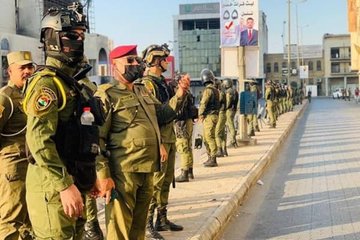
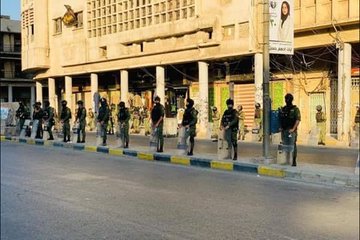
Security?  No security measures protected the protesters who are part of The October Revolution.  In fact, security forces are the ones who harassed them, who stalked them, who injured them and who killed them.  That's reality.  Another reality?  Not one person has gone to prison for any of that, not even for murdering the civilian protesters.  Layal Shakir (RUDAW) reports:

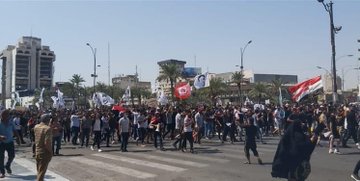
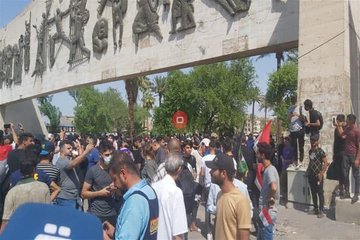
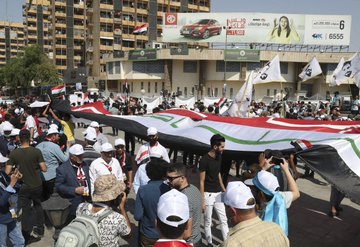
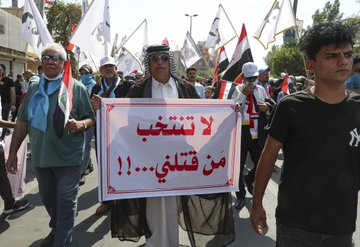
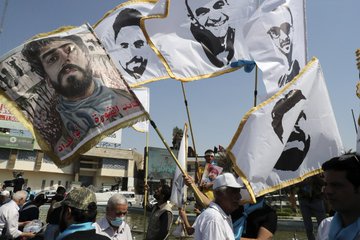
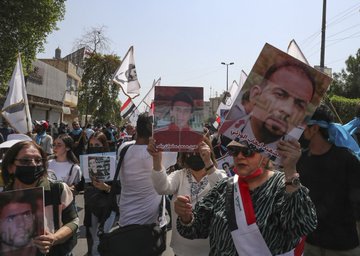
Hundreds of Iraqis demanded justice for demonstrators killed during the 2019 October (Tishreen) protests at a rally in Baghdad on Friday, the second anniversary of the protest movement and just over a week ahead of parliamentary elections. 

“This is my son. He went after his rights, his country … he was killed,” Muhamad al-Zubaidi, carrying a photo of his son, told Rudaw’s Dildar Harki.

The Tishreen protests condemned state corruption, failing public services, and high unemployment. They lasted several months and were met with violence and repression from state forces and militias backed by Iran that left at least 600 dead and thousands wounded. 

The protests forced the resignation of Prime Minister Adil Abdul-Mahdi, reforms to the electoral law, and the October 10 parliamentary election that is taking place a year ahead of schedule. Abdul-Mahdi’s replacement Mustafa al-Kadhimi vowed to bring to justice those responsible for killing protesters and activists, but few arrests have been made.

The Opposition Forces Gathering, an umbrella group that was birthed from the Tishreen protests, called Iraqis to return to the streets for the anniversary.

Young protesters paraded around the square, carrying the Iraqi flag and chanting, “Ten die, a hundred die, we insist on the cause.”

Though the elections were a protest demand, many on Friday were calling for a boycott, carrying posters that read “Voting for the same people will turn the country into a slaughterhouse” and “Do not vote for those who killed me.”


ESTE Tweets:

Hundreds of Iraqis rally to mark protests anniversary #Esta #Iraq #IraqElections


On the anniversary of the October 2019 protests, known in Iraq as the "October Revolution," thousands gathered in Baghdad's Tahrir Square.
Image
Image
Image
Image


Iraqis marked two years since the anti-government Tishreen protests rocked Baghdad, nine days before the elections. Camera: Sabah Arar/AFP #Iraq
Image
Image
Image
Image


The early elections have only been scheduled because of the brave protesters. The October Revolution  kicked off protests in the fall of 2019 and forced the prime minister to step down and early elections to be announced.  As ARAB WEEKLY notes, "Tens of thousands of Iraqi youths took to the streets to decry rampant corruption, poor services and unemployment. Hundreds died as security forces used live ammunition and tear gas to disperse crowds."  This is what forced the resignation of one prime minister and has led to national elections which are supposed to take place October 10th.  (Members of the Iraqi military will vote October 8th.  Two election simulations have been carried out by the IEC and the third and final one will take place September 22nd.)    that the candidates for Parliament include 951 women ("close to 30% of the total number of candidates") who are running for the 329 seats.  Halgurd Sherwani (KURDISTAN 24) has reported Jeanine Hannis-Plasschaert, the Special Representiative in Iraq to the United Nations Secretary-General Antonio Guterres, declared that Iraq's "Female candidates face increasing levels of hate speech, violence, and blackmail intended to force them to withdraw their candidacy." 


Sinan Mahmoud (THE NATIONAL) counts 3,249 people in all seeking seats in Parliament  BROOKINGS notes this is a huge drop from 2018 when 7,178 candidates ran for office.   RUDAW is among those noting perceived voter apathy, "Turnout for Iraq’s October 10 parliamentary election is expected to be a record low, with a recent poll predicting just 29 percent of eligible voters will cast ballots." Human Rights Watch has identified another factor which may impact voter turnout, "People with disabilities in Iraq are facing significant obstacles to participating in upcoming parliamentary elections on October 10, 2021, due to discriminatory legislation and inaccessible polling places, Human Rights Watch said in a report released today. Without urgent changes, hundreds of thousands of people may not be able to vote.  The 36-page report, “‘No One Represents Us’: Lack of Access to Political Participation for People with Disabilities in Iraq,” documents that Iraqi authorities have failed to secure electoral rights for Iraqis with disabilities. People with disabilities are often effectively denied their right to vote due to discriminatory legislation and inaccessible polling places and significant legislative and political obstacles to running for office."  And Human Rights Watch Tweets:


“Every election day is the most depressing day for me,” said Suha Khalil, 44, who uses a wheelchair said she has never participated in an election. “Everyone goes to vote and I am stuck at home waiting for the day to end.” #IraqElection Take action: bddy.me/3optQAG
Image


Another obstacle is getting the word out on a campaign.  Political posters are being torn down throughout Iraq.  Halgurd Sherwani  (KURDiSTAN 24) observes, "Under Article 35 of the election law, anyone caught ripping apart or vandalizing an electoral candidate's billboard could be punished with imprisonment for at least a month but no longer than a year, Joumana Ghalad, the spokesperson for the Iraqi Independent High Electoral Commission (IHEC), told a press conference on Wednesday."  And there's also the battles in getting out word of your campaign online.  THE NEW ARAB reported weeks ago, "Facebook is restricting advertisements for Iraqi political parties and candidates in the run-up to the country's parliamentary elections, an official has told The New Arab's Arabic-language sister site."

THE WASHINGTON POST's Louisa Loveluck Tweeted: of how "chromic mistrust in [the] country's political class" might also lower voter turnout.  Mina Aldroubi (THE NATIONAL) also notes, "Experts are predicting low turnout in October due to distrust of the country’s electoral system and believe that it will not deliver the much needed changes they were promised since 2003."  Mistrust would describe the feelings of some members of The October Revolution.  Mustafa Saadoun (AL-MONITOR) notes some of their leaders, at the recent  Opposition Forces Gathering conference announced their intent to boycott the elections because they "lack integrity, fairness and equal opportunities."  Distrust is all around.  Halkawt Aziz  (RUDAW) reported on how, " In Sadr City, people are disheartened after nearly two decades of empty promises from politicians." 


How to address apathy?  Ignore it and redo how you'll count voter turnout.  RUDAW reports, "raq’s election commission announced on Sunday that turnout for the election will be calculated based on the number of people who have biometric voter cards, not the number of eligible voters. The move will likely inflate turnout figures that are predicted to hit a record low."  As for the apathy, John Davison and Ahmed Rasheed (REUTERS) convey this image


Iraq’s tortured politics are graphically illustrated in a town square in the south, where weathered portraits displayed on large hoardings honor those killed fighting for causes they hoped would help their country.

The images of thousands of militiamen whose paramilitary factions battled ISIS hang beside those of hundreds of young men killed two years later protesting against the same paramilitaries.


After the election, there will be a scramble for who has dibs on the post of prime minister.  Murat Sofuoglu (TRT) observes, "The walls of Baghdad are covered with posters of Iraq’s former leaders, especially Nouri al Maliki and Haidar al Abadi, as the country moves toward its early elections on October 10. Both men however were forced out of power for their incompetence, and yet they are leading in the country’s two powerful Shia blocks."  Outside of Baghdad?  THE NEW ARAB explains, "However, in the provinces of Anbar, Saladin, Diyala, Nineveh, Kirkuk, Babel and the Baghdad belt, candidates have focussed on the issue of the disappeared and promised to attempt to find out what happened to them."


Shi'ite cleric Moqtada al-Sadr has 90 candidates in his bloc running for seats in the Parliament and one of those, Hassan Faleh, has insisted to RUDAW, "The position of the next prime minister is the least that the Sadrist movement deserves, and we are certain that we will be the largest and strongest coalition in the next stage."  Others are also claiming the post should go to their bloc such as the al-Fatah Alliance -- the political wing of the Badr Organization (sometimes considered a militia, sometimes considered a terrorist group).  ARAB WEEKLY reported, "Al-Fateh Alliance parliament member Naim Al-Aboudi said that Hadi al-Amiri is a frontrunner to head the next government, a position that can only be held by a Shia, according to Iraq’s power-sharing agreement."  Some also insist the prime minister should be the head of the State of Law bloc, two-time prime minister and forever thug Nouri al-Maliki.  Moqtada al-Sadr's supporters do not agree and have the feeling/consensus that,  "Nouri al-Maliki has reached the age of political menopause and we do not consider him to be our rival because he has lost the luster that he once had so it is time for him to retire."


In one surprising development, Dilan Sirwan (RUDAW) has reported: "Iraq’s electoral commission aims to announce the results of the upcoming parliamentary elections on October 10 within 24 hours, they announced on Thursday following a voting simulation."


Meanwhile, as October begins, Margaret Griffis (ANTIWAR.COM) notes, "At least 149 people were killed, and 110 more were wounded during September. In August, at least 122 people were killed, and 110 were wounded."


The following sites updated:


Thursday, September 30, 2021

NASA's Jupiter mission

I spend a lot of time on NASA's Mars mission because I find it so interesting but NASA does have other missions. The Jupiter mission is now in the news. Denise Chow (NBC NEWS) reports:

 
NASA is set to launch a spacecraft next month on the agency's first mission to a group of asteroids near Jupiter.
The Lucy space probe is scheduled to lift off on an Atlas V rocket from Cape Canaveral Space Force Station in Florida on Oct. 16. The 12-year mission is designed to give scientists an up-close view of the so-called Trojan asteroids, which share their orbits around the sun with the largest planet in the solar system.
NASA's Juno spacecraft has been circling Jupiter since 2016, but this will be the agency's first expedition to study two swarms of space rocks at the gas giant — one group that orbits the sun ahead of Jupiter and another that trails behind the planet.


Charlie Wood (POPULAR SCIENCE) notes:

 
The scientists behind the mission think of themselves as cosmic paleontologists, naming the mission after the renowned “Lucy” skeleton, which revealed a new chapter of human evolutionary history. The Lucy spacecraft will chase down a handful of Trojan asteroids, fossil-like fragments left over from Jupiter’s formation that the gas giant has harbored in two gravitationally protected zones for the last 4.6 billion years. From Earth, the Trojans show up only as specks of light. The $981 million mission represents NASA’s bid to examine the planetary fossils up close.
“Whatever Lucy finds will give us vital clues about the origin of our solar system,” said Lori Glaze, the director of NASA’s Planetary Science Division, at a press conference on Tuesday.
More than a dozen spacecraft have journeyed to asteroids before (a few particularly daring machines have even snagged samples), but most previous missions have visited at most two asteroids or comets. Lucy will fly by four times as many targets.


And SCI TECH DAILY adds:

 
NASA has tested the functions of Lucy, the agency’s first spacecraft to study Jupiter’s Trojan asteroids, filled it with fuel, and is preparing to pack it into a capsule for launch Saturday, October 16, 2021.
Named after characters in Greek mythology, these asteroids circle the Sun in two swarms, with one group leading ahead of Jupiter in its path, the other trailing behind it. Lucy will be the first spacecraft to visit these asteroids. By studying these asteroids up close, scientists hope to hone their theories on how our solar system’s planets formed 4.5 billion years ago and why they ended up in their current configuration.
“With Lucy, we’re going to eight never-before-seen asteroids in 12 years with a single spacecraft,” said Tom Statler, Lucy project scientist at NASA Headquarters in Washington. “This is a fantastic opportunity for discovery as we probe into our solar system’s distant past.”


Here's a video report.


I'm sure it will be an interesting mission that will gather a lot of new information. I'm just more interested in Mars. Maybe because of all the cartoons and movies over the years about Mars. Mars just seems familiar to me. I get excited when I see a headline with Mars in it or an anchor on TV announces the start of a report on Mars.


"Iraq snapshot" (THE COMMON ILLS):

 Thursday, September 20, 2021. Iraq gears up for elections as the US seems determined to destroy free speech.


IANS reports, "The Iraqi ministry of health reported on Wednesday 2,254 new COVID-19 cases, raising the nationwide caseload to 2,000,869."  It's a world wide pandemic.  In the United States, the number has passed 43 million.  The pandemic hasn't ended.


But a bevy of corporations that need to leech out more money and a Congress that doesn't give two s**ts about the people contribute to a false sense of safety, a belief that the pandemic has ended or is winding down.  No one knows what's happening next. That means, yes, it could be winding down.  It also means that we may be a masked society this time next year or even longer

It's a world wide pandemic.  It's a time that we really should be grasping the need for Medicare For all (which, actually, most Americans favor) and our so-called representatives should be working to create.  It's also a time when we should feel a need to help one another.


Instead, we get the hateful Amanda Marcotte.  How much does one awful person get to survive?  Her racism hurt her book but didn't silence her.  Her toxic hatred of anyone religious hasn't seen outlets turn away from her.  I know she poses as a Hillary Clinton supporter but I also remember what she said in 2007 and 2008 and I also remember that her choice was the well known womanizer Grabby Hands Edwards.  We all know how that went down.  


Nothing stops that awful Amanda.  She's making hateful statements and it may seem new to some people.  It's not new.  We look back now and we remember things much more fondly than they really are/were.  A friend has a documentary that'll be airing on PBS next month.  It's on a topic we've long discussed here.  The reality of the way gays and lesbians were treated.  I'm not referring to LGBTQ because back then the understanding wasn't expansive enough to include all.  But it did acknowledge gay men and lesbians.  And it deemed them sick, mentally ill.  Readers of THE NEW YORK TIMES were told that over and over.  Educated people were told by their news media that lesbians and gay men were sick.  The struggle for rights and recognition was much harder than we sometimes remember.  And I also remember the hatred similar to what Amanda's currently spewing when the 'gay disease' began emerging in the 1980s.  AIDS wasn't a gay disease but that's how it was covered by many news outlets.  And the hatred was out there publicly.  Amanda should be ashamed of herself for offering hatred at the masses.  History, if it remembers her at all will not judge her kindly.


Her hatred, please note, can be expressed.  It's always allowed.


And I am fine with that because I do believe in free speech.  But fear and hatred are now targeting our basic rights -- including free speech.  Big Tech continues to attack our rights and they are urged on by Congress.  


Jonathan Turley notes:


YouTube continued the expansion of corporate censorship on the Internet with the encouragement of leading Democratic leaders. The company has banned channels associated with anti-vaccine activists like Joseph Mercola and Robert F. Kennedy Jr. Once again, rather than rebutting or refuting claims made by others, many sought to silence those with opposing views. YouTube will not allow people to hear views that do not comport with an approved range of opinions.  The move magnifies concerns that we are seeing the emergence of a new type of state media as private companies conduct censorship operations barred by the Constitution for the government to conduct directly. This move comes days after Sen. Elizabeth Warren (D., Mass.) asked Amazon to steer customers to “true” books on subjects like climate change to avoid their exposure to “disinformation.” It also follows YouTube censoring videos of jailed Kremlin critic Alexei Navalny before Russia’s parliamentary elections. The move helped Putin and his authoritarian government crack down on pro-Democracy forces.
The Google-owned site is now openly engaged in viewpoint regulation to force users to view only those sources that are consistent with the corporate agenda. Facebook banned misinformation on all vaccines seven months ago and Twitter regularly bans those questioning vaccines.

These companies are being encouraged by many on the left to expand censorship.


As Elaine noted last night, "It's outrageous.  In the name of 'safety,' they're destroying free speech.  This will not end people's suspicions or doubts.  Censorship never does.  It's appalling.  Shame on people who support this.  Today it's this group, tomorrow it's another.  Pretty soon, there is no free speech. "


Exactly.


Go back a few decades and my calls for equality would be censored.  Hell, in college, I was censored for calling out apartheid in South Africa.  Censored and attacked by the campus newspaper.  Not once, but an entire semester.  It only raised awareness on the reality of apartheid, it only taught students how damaging and out of control the press could be.  They were in the wrong, running a feature on a student from that area and quoting the student on how "good" Blacks had it and how "fair" and "caring" the system of apartheid was.  It was an offensive article.  The paper should have never run those quotes.  And could easily have done a profile on the asshole without printing (and endorsing) his views on apartheid.  But they chose to run it -- that's free speech.  I chose to respond with a letter - caustic, yes.  The thing about a biting wit is that some feel the bite more than others.  Free speech meant that they could air their offensive views and that I could respond with an indictment of apartheid.  That was the start of the semester.  Instead of letting it die, they (the newspaper students) spread rumors about me (I was sleeping with the editor of the paper which makes it even more disgusting) and every new edition all semester carried letters attacking me.  Letters that the paper urged the writers to write, that in three cases, the staff wrote for the letter writers.  


Because there is some fairness, there was pushback.  Huge.  And the paper had a ton of letters that they hadn't run.  I learned of that as did others and the paper was under pressure as the semester wound down to publish this huge response that they had hidden and ignored.  They tried to get out of it by asking me to instead write a column for them on the issue.  I insisted they run the letters.


Speaking out about the rights of people with HIV was not a popular position and those of us who did speak out were attacked.  In today's climate, we could be censored.  Throughout my life I've taken positions which, right now in 2021, are popular but when I took them in real time, were positions you got attacked for.  


That semester in college, I don't think most students on campus -- at least the ones I knew -- had thought a great deal about apartheid.  If we didn't have free speech, they never would have thought more about it.  I was never bothered by the various attacks from the paper and its staff. It wasn't about me.  It was about an important issue.  And we need to discuss and debate important issues.  We need to be willing to disagree.  


We won't progress without it.  Joe Biden rightly talked about how the TV show WILL & GRACE did a great deal to change attitudes about LGBTQ people.  It did.  Representation in media matters.  A nation that used the media to 'educate' people that LGBTQs were sick and needed mental care owed the people better representation so that we could move beyond that sickness.  The sick were never the gay men and the lesbians, the sick were the people who swallowed hatred from the media.


I know it's hard to stand up and I know it's hard to question.  But that's what we need to do.  We need to consume the media while asking what this story is really about.  If we'd done that with the claims of WMDS, a lot more people would have been opposed to the Iraq War.  The media says it so it must be true?  That's a stupid opinion.  You may be the most educated person in the world but if you accept what the media tells you unquestioningly then you are a stupid person.  


Harvey Weinstein's actions were known for years and years.  And people covered for him.  Favors were called in to protect him.  He was done in not by a brave press.  He was done in because he had alienated so many people.  He wanted Academy Awards and went overboard at best.  It's amazing that Berry Gordy may have cost Diana Ross the Academy Award with an ad campaign that some tsk-tsk-ed looked like he was trying to buy an Academy Award when, a few decades later, Harvey would turn the Academy Awards into a blood sport.  He would work overtime paying people to help him destroy Ron Howard's film or this person's film.  He made it blood sport.  And he amassed one enemy after another.


That's what did him finally.  No more favors left to call in because too many in the industry had turned against him.


I don't see a lot of bravery in Harvey's takedown -- no bravery in the press (I see bravery in Rose McGowan) -- I see them finally filing stories that were always known but weren't told because of what happened behind the scenes.


We need free speech.  We're not a democracy without it.


Our country took a huge hit after 9/11.  Fear was used to turn people against 'others' -- Arabs, Muslims, foreigners, truth tellers, you name it.  Now the pandemic is being used to attack free speech.  As someone who has often been ahead of the curve on issues, I do not support censorship.  If what YOUTUBE Is doing right now had been in place in 1961, I wonder how much attention the brave leaders of the Civil Rights Movement would have received.  The answer is never to silence others.  Let them say what ever they want.  Let Amanda be as hateful as she wants to be.  Let that idiot promoting apartheid make the hideous remarks he did.  But let us have free speech so that we can counter it.  Don't play the judge of what we can say or what positions we can hold.  Let us make the case and sort it out in the public square.


That's Jimmy Dore addressing the CIA's plot to assassinate WIKILEAKS publisher Julian Assange.  


Defending Julian from persecution is not a popular position with some in the US.  There's an idiot who keeps e-mailing me hateful e-mails about how Julian "hacked the 2016 election" and she means he hacked the voting machines, she honestly believes that.  Blame it on a crazed media and MSNBCers who whisper and insinuate.  Julian didn't hack the voting machines.  Hillary lost because Hillary ran a lousy campaign.  If she'd campaigned in the 2016 general election like she did in the 2008 primaries, she would have won.  Her loss is on her.


Julian's blamed for many things.  And defending him means you get attacked.  Comes with the territory.  I was asked during a meet-up with students a week or so ago why I loved Julian?


I don't love him.  I don't hate him.  I don't know him.  I don't need to know him to know that what's being done is wrong.  And we don't just defend the people we like if we believe in freedom and fairness.  I get that WSWS plays that game.  But that's not how you ever bring about real change.  


What has been done to Julian and what is being done to Julian is wrong.  We need to be calling out our government.  We should also think about how much money -- our tax dollars -- is being spent on this continued persectuion?


Julian Assange came on everyone's radar for publishing the truth about the Iraq War.  He has been a casualty of the Iraq War.  If you don't speak out and demand justice, it's very likely that Julian could end up a fatality of the Iraq War.  I'm not willing to let that happen.  Are you?


Whistle blower Daniel Ellsberg Tweets:


Biden should drop his appeal to extradite Julian Assange and dismiss all charges against him, on the new disclosures that Assange has been subjected to the same governmental crimes that led to the dismissal of my own prosecution half a century ago. 1/


Changing topics, we'll note this Tweet:


A top cleric in #Iraq is urging people to vote in the parliamentary #election. Take a closer look:


Mina Aldroubi (THE NATIONAL) reports:

Iraq’s top Shiite cleric Ayatollah Ali Al Sistani on Wednesday called on the public to head to the polls on October 10 and vote for a new government.

The country will hold early elections – a key demand of the protesters who have taken to the streets since October 2019 – which will allow the politician who secures the most support from parliamentary blocs to form a government.

“The supreme religious authority encourages everyone to participate consciously and responsibly in the coming elections,” said Mr Al Sistani’s office.

“Although it is not without some shortcomings, it remains the best way to achieve a peaceful future and avoids the risk of falling into chaos and political obstruction,” it said.


AFP observes:


Initially expected in 2022, the vote was brought forward in a rare official concession to autumn 2019 protests, when tens of thousands of Iraqis took to the streets to demonstrate against crumbling public services and a government they decried as corrupt and inept.

Hundreds died in months of protest-related violence.

But the ballot has generated little enthusiasm among Iraq’s 25 million voters, while the activists and parties behind the uprising have largely decided to boycott the ballot.

The early elections have only been scheduled because of the brave protesters. The October Revolution  kicked off protests in the fall of 2019 and forced the prime minister to step down and early elections to be announced.  As ARAB WEEKLY notes, "Tens of thousands of Iraqi youths took to the streets to decry rampant corruption, poor services and unemployment. Hundreds died as security forces used live ammunition and tear gas to disperse crowds."  This is what forced the resignation of one prime minister and has led to national elections which are supposed to take place October 10th.  (Members of the Iraqi military will vote October 8th.  Two election simulations have been carried out by the IEC and the third and final one will take place September 22nd.)    that the candidates for Parliament include 951 women ("close to 30% of the total number of candidates") who are running for the 329 seats.  Halgurd Sherwani (KURDISTAN 24) has reported Jeanine Hannis-Plasschaert, the Special Representiative in Iraq to the United Nations Secretary-General Antonio Guterres, declared that Iraq's "Female candidates face increasing levels of hate speech, violence, and blackmail intended to force them to withdraw their candidacy." 


Sinan Mahmoud (THE NATIONAL) counts 3,249 people in all seeking seats in Parliament  BROOKINGS notes this is a huge drop from 2018 when 7,178 candidates ran for office.   RUDAW is among those noting perceived voter apathy, "Turnout for Iraq’s October 10 parliamentary election is expected to be a record low, with a recent poll predicting just 29 percent of eligible voters will cast ballots." Human Rights Watch has identified another factor which may impact voter turnout, "People with disabilities in Iraq are facing significant obstacles to participating in upcoming parliamentary elections on October 10, 2021, due to discriminatory legislation and inaccessible polling places, Human Rights Watch said in a report released today. Without urgent changes, hundreds of thousands of people may not be able to vote.  The 36-page report, “‘No One Represents Us’: Lack of Access to Political Participation for People with Disabilities in Iraq,” documents that Iraqi authorities have failed to secure electoral rights for Iraqis with disabilities. People with disabilities are often effectively denied their right to vote due to discriminatory legislation and inaccessible polling places and significant legislative and political obstacles to running for office."  And Human Rights Watch Tweets:


“Every election day is the most depressing day for me,” said Suha Khalil, 44, who uses a wheelchair said she has never participated in an election. “Everyone goes to vote and I am stuck at home waiting for the day to end.” #IraqElection Take action: bddy.me/3optQAG
Image


Another obstacle is getting the word out on a campaign.  Political posters are being torn down throughout Iraq.  Halgurd Sherwani  (KURDiSTAN 24) observes, "Under Article 35 of the election law, anyone caught ripping apart or vandalizing an electoral candidate's billboard could be punished with imprisonment for at least a month but no longer than a year, Joumana Ghalad, the spokesperson for the Iraqi Independent High Electoral Commission (IHEC), told a press conference on Wednesday."  And there's also the battles in getting out word of your campaign online.  THE NEW ARAB reported weeks ago, "Facebook is restricting advertisements for Iraqi political parties and candidates in the run-up to the country's parliamentary elections, an official has told The New Arab's Arabic-language sister site."

THE WASHINGTON POST's Louisa Loveluck Tweeted: of how "chromic mistrust in [the] country's political class" might also lower voter turnout.  Mina Aldroubi (THE NATIONAL) also notes, "Experts are predicting low turnout in October due to distrust of the country’s electoral system and believe that it will not deliver the much needed changes they were promised since 2003."  Mistrust would describe the feelings of some members of The October Revolution.  Mustafa Saadoun (AL-MONITOR) notes some of their leaders, at the recent  Opposition Forces Gathering conference announced their intent to boycott the elections because they "lack integrity, fairness and equal opportunities."  Distrust is all around.  Halkawt Aziz  (RUDAW) reported on how, " In Sadr City, people are disheartened after nearly two decades of empty promises from politicians." 


How to address apathy?  Ignore it and redo how you'll count voter turnout.  RUDAW reports, "raq’s election commission announced on Sunday that turnout for the election will be calculated based on the number of people who have biometric voter cards, not the number of eligible voters. The move will likely inflate turnout figures that are predicted to hit a record low."  As for the apathy, John Davison and Ahmed Rasheed (REUTERS) convey this image


Iraq’s tortured politics are graphically illustrated in a town square in the south, where weathered portraits displayed on large hoardings honor those killed fighting for causes they hoped would help their country.

The images of thousands of militiamen whose paramilitary factions battled ISIS hang beside those of hundreds of young men killed two years later protesting against the same paramilitaries.


After the election, there will be a scramble for who has dibs on the post of prime minister.  Murat Sofuoglu (TRT) observes, "The walls of Baghdad are covered with posters of Iraq’s former leaders, especially Nouri al Maliki and Haidar al Abadi, as the country moves toward its early elections on October 10. Both men however were forced out of power for their incompetence, and yet they are leading in the country’s two powerful Shia blocks."  Outside of Baghdad?  THE NEW ARAB explains, "However, in the provinces of Anbar, Saladin, Diyala, Nineveh, Kirkuk, Babel and the Baghdad belt, candidates have focussed on the issue of the disappeared and promised to attempt to find out what happened to them."


Shi'ite cleric Moqtada al-Sadr has 90 candidates in his bloc running for seats in the Parliament and one of those, Hassan Faleh, has insisted to RUDAW, "The position of the next prime minister is the least that the Sadrist movement deserves, and we are certain that we will be the largest and strongest coalition in the next stage."  Others are also claiming the post should go to their bloc such as the al-Fatah Alliance -- the political wing of the Badr Organization (sometimes considered a militia, sometimes considered a terrorist group).  ARAB WEEKLY reported, "Al-Fateh Alliance parliament member Naim Al-Aboudi said that Hadi al-Amiri is a frontrunner to head the next government, a position that can only be held by a Shia, according to Iraq’s power-sharing agreement."  Some also insist the prime minister should be the head of the State of Law bloc, two-time prime minister and forever thug Nouri al-Maliki.  Moqtada al-Sadr's supporters do not agree and have the feeling/consensus that,  "Nouri al-Maliki has reached the age of political menopause and we do not consider him to be our rival because he has lost the luster that he once had so it is time for him to retire."


In one surprising development, Dilan Sirwan (RUDAW) has reported: "Iraq’s electoral commission aims to announce the results of the upcoming parliamentary elections on October 10 within 24 hours, they announced on Thursday following a voting simulation."


A new endorsement may get some attention.  Karwan Faidhi Dri (RUDAW) notes:

A senior official from the Kurdistan Workers’ Party (PKK) on Tuesday said they endorse the Patriotic Union of Kurdistan (PUK) in Iraq’s October 10 parliamentary elections and called on people to vote for the party. 

Cemil Bayik claimed to PKK-affiliated Sterk TV that the Turkish government is trying to weaken Sulaimani’s ruling PUK by targeting PKK members in the province.

Voters in Sulaimani “have to abolish this plan. No matter what ideology they have - whether they are affiliated to the PUK or not - everyone should want the PUK to emerge strong in these elections so that the games of the enemy do not work,” he said. 

The PKK has enjoyed good relations with the PUK for two decades, but its relationship is thorny with the PUK’s main rival, the Kurdistan Democratic Party (KDP) which enjoys strong economic ties with Turkey.

The KDP dismissed the PKK's endorsement of the PUK. Jaafar Imniki, a member of the party's politburo, told Rudaw's Shaho Amin on Wednesday that Bayik "has no business in Iraqi elections at all."


The following sites updated: