Wednesday, September 21, 2022

What they fear is coming next

FORBES has a report that Joe Biden needs to read:

Omicron spawn BA.2.75, dubbed “Centaurus,” seemed like the COVID variant to watch this summer—one with the potential to wreak unprecedented havoc later in the year.

The World Health Organization announced in July it was tracking the concerning new variant, which had been identified in 10 countries, including the U.S., and was gaining ground against other transmissible strains of the virus like BA.5 in India.

But Centaurus is no longer a threat, Dr. Raj Rajnarayanan, assistant dean of research and associate professor at the New York Institute of Technology campus in Jonesboro, Ark., told Fortune.

Instead, one of its children, BA.2.75.2, has outcompeted it, eliminating Centaurus as a threat—but replacing it with a more formidable one.

It’s one to watch this fall, he says—for more reasons than one.

‘Extensive escape’

Among the concerning traits, BA.2.75.2’s spike protein binds to human cells tightly—better than any other variant so far, Rajnarayanan says. By doing so, it makes it more difficult for antibodies to successfully attack. And it’s picking up mutations that make it more similar to BA.5 and the deadly Delta variant of late 2021.

It’s just “a couple of mutations away from picking up increased transmission speed,” Rajnarayanan said.

To make matters worse, the new variant shows “extensive escape” ability, according to a new preprint paper released this week by researchers at the Imperial College in London and the Karolinska Institute in Sweden. The paper has not yet been peer reviewed but has been widely cited by experts.


He was an idiot to announce the pandemic was over.  It truly is his "Mission Accomplished" moment and he truly is as stupid as Bully Boy Bush was.


"Iraq snapshot" (THE COMMON ILLS):

Tuesday, September 21, 2022.  COVID isn't over, Mustafa al-Kadhimi is in the US, and much more.


RACHEL MARTIN, HOST:

Is the pandemic over? Here's how President Biden answered that question Sunday on CBS' "60 Minutes."

(SOUNDBITE OF TV SHOW, "60 MINUTES")

PRESIDENT JOE BIDEN: The pandemic is over. We still have a problem with COVID. We're still doing a lot of work on it. It's - but the pandemic is over

MARTIN: The president's surprise pronouncement is not going over well with some people, including folks at high risk from COVID and those suffering from long COVID. Some of them staged a protest Monday outside the White House as a result. Here's one demonstrator, Hannah Davis (ph). She told NPR she got COVID in 2020 and that she is experiencing long-term symptoms.

HANNAH DAVIS: I am extremely disappointed in Biden's comment that the pandemic is over. There is absolutely not enough attention on the long-term effects of this disease.

MARTIN: NPR health correspondent Rob Stein is with us this morning. Hi, Rob.

ROB STEIN, BYLINE: Good morning, Rachel.

MARTIN: Clearly, as we heard, some people who are especially vulnerable feel like the pandemic is not yet over. The president is saying it is. You are talking with the public health experts. What are they saying?

STEIN: The short answer from many of the experts I've been talking with is a pretty definitive nope, not even close. While things are certainly way better than they were, say, a year ago, all you need to do is take a look at the number of lives that are still being lost every day to know that COVID is far from being in the rearview mirror. Here's William Hanage at the Harvard T.H. Chan School of Public Health.

WILLIAM HANAGE: Four hundred deaths a day - is that what we're going to be happy with? I think we have to recognize that we still have a big public health problem, regardless of whether or not President Biden says the pandemic is over.

STEIN: If the number of people dying at this rate continues, nearly 150,000 could die from COVID in the next year, and that doesn't even count all those ending up in the hospital and all the lives being upended by the virus - you know, kids missing school, workers missing work, plans being derailed. And the big concern is the president's statement comes at what could be a pivotal moment in the fight against the virus.

MARTIN: A pivotal moment being what?

STEIN: Winter is coming, bringing big fears of yet another winter surge. So the administration is struggling to convince people to once again roll up their sleeves to get new boosters to protect them against omicron. Most people eligible for the first boosters never got them, and declaring the pandemic over is not a great selling point for the new ones. Here's Michael Osterholm from the University of Minnesota.

MICHAEL OSTERHOLM: We need to get as many people in this country as possible vaccinated with the new boosters. And we already knew we had a challenge to accomplish that, but by declaring the pandemic over, there will be many people who say, well, why do I need to get it?

STEIN: Osterholm and others are especially worried about older people, who are the most likely to die from COVID. And that's not all. Critics say declaring the pandemic over could also make it even harder to convince Congress to approve billions of dollars more to make sure the country has plenty of tests, vaccines and treatments to fight omicron and potentially some new variant that could emerge.


It was neither an accurate nor smart thing for Joe to say.  Trina covered the topic again last night at her site.  At USA TODAY this morning, former US Surgeon General Dr. Jerome Adams has a column entitled "No, Mr. President, the COVID-19 pandemic isn't over — even if your administration is over it."  Louise Franco (NATURE WORLD NEWS) observes:

The so-called self-made declaration received a mixture of public reactions.

Biden's announcement came a week after the World Health Organization (WHO) said that the end of the COVID-19 global outbreak is already "in sight."


Biden campaigned on being a president who would “follow the science.” But capitalists only trust science when it suits their agenda, and capitalist interests often shape what science gets funded, conducted, or published in the first place. 

Take, for instance, the CDC. In February 2022, it shifted its recommendations to focus on new “community levels,” which are determined by the level of Covid-19 hospitalizations in a given county. By this metric, more than half of all U.S. counties are at a “low” community level, and only 13.3 percent are “high.” Prior to February, the CDC’s recommendations for individual and community level precautions were based around community transmission levels, which are based on the total number of cases, not hospitalization. Currently the transmission levels are “high” or “substantial” for more than 93 percent of all counties in the United States — close to the inverse of the new “community level” system.

By simply changing definitions and the schema for coloring in a map, the CDC created a rationale for a lifting of all kinds of public health requirements. A focus on hospitalization rates tracks collective burden on only the hospitals, ignoring the serious impact the virus can have on individuals even when it doesn’t require a hospital visit. It also places an increased burden on people who are extra vulnerable to the virus (either due to immune system issues or other health problems) and their family members, who will need to take extra precautions as a result of the lower level of caution in the community overall. Businesses and public institutions are able to cite these guidelines as justification for lifting protections, which will only result in more people getting infected.

Joe Biden and the bourgeoisie might be ready for the pandemic to be over, but that doesn’t mean Covid-19 has gone away. Capitalist interests, using the fact that people are tired of living in a pandemic as a justification, benefit from going “back to normal,” no matter the cost to the working class and the medically vulnerable. Short term profit interests take priority, regardless of the likely long term consequences of widespread Long Covid. This is one of the recurring contradictions of capitalism, which only a planned, worker-controlled economy that prioritizes the long term wellbeing of everyone can avoid. 


Biden is on a streak of talking “straight from the shoulder,” as he once said, on Taiwan, the pandemic, ex-President Donald Trump’s extreme MAGA supporters and whether Vladimir Putin should be leading Russia.

But each time he lays down the law, some White House official, Democratic lawmaker or political ally explains that the President didn’t actually say what everyone heard him say, or that he didn’t actually mean what he appeared to.   

Now, all the mopping up is raising the question of whether the walk-backs are doing more damage than the President’s initial frankness by undermining his authority.   


Ja'han Jones (MSNBC) points out, "Of all people, Biden and his administration should know the lack of masks doesn’t indicate a lack of risk. After all, Biden and first lady Jill Biden tested positive for covid over the summer. What's more, when a federal judge struck down the administration’s mask mandate for public transportation, for example, the ruling didn’t suddenly make it safer for people not to mask up. And neither do Biden’s comments."  Bruce Y. Lee (FORBES) argues, "Look up the definition of a pandemic, which I covered for Forbes in 2020. It’s when a novel pathogen, that’s a virus or other microbe completely new to humans, is being transmitted simultaneously in multiple countries. Until either of these conditions changes, you can’t really declare the pandemic over. This may occur sometime in the near future, perhaps 2023, but hasn’t been achieved yet. But there was the President of the U.S., who’s not a scientist or medical expert, at the Detroit Auto Show, which was not a scientific setting, making a statement about something that should have been left for real science and real scientists to decide."


Meanwhile, Iraq's figure head is in the US.

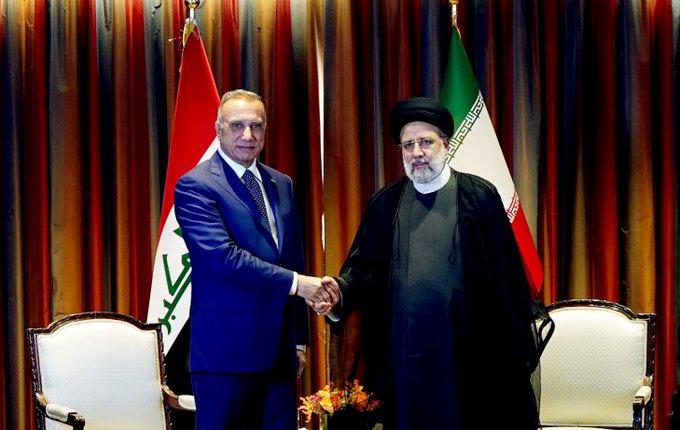
Iraqi PM Mustafa al-Kadhimi met Iranian President Ebrahim Raisi on the sidelines of the UN summit in New York, discussing Iraq’s role “in achieving regional security and stability” – statement 📸: Kadhimi's office/Twitter
Image

Iraqi Prime Minister Mustafa Al-Kadhimi arrived in New York, the United States on Tuesday to take part in the 77th United Nations General Assembly, according to a statement from his media office.

In addition to delivering his remarks, Kadhimi is set to meet with a number of heads of state and top government officials as well as representatives of international organizations on the sidelines of the event, a government statement read on Monday.

This is the first time that Kadhimi is representing Iraq in the General Debate. President Barham Salih has previously delivered the country’s statements in the previous UNGA.

Some more Tweets.


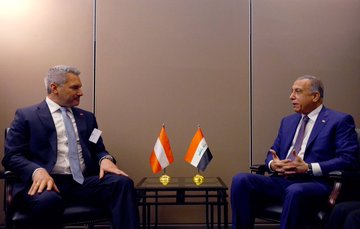
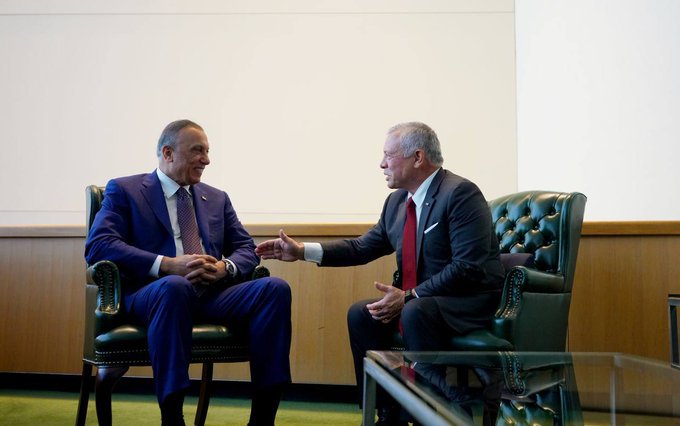
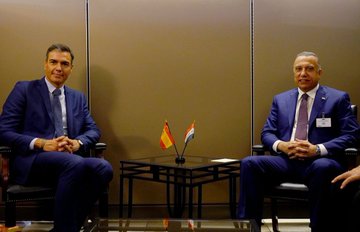
The Iraqi Prime Minister Mustafa Al-Kadhimi meets with the Jordanian King, the Spanish Prime Minister and the Austrian Chancellor in New York, on the sidelines of his participation in the work of the United Nations General Assembly. #UNGA #Iraq
Image
Image
Image
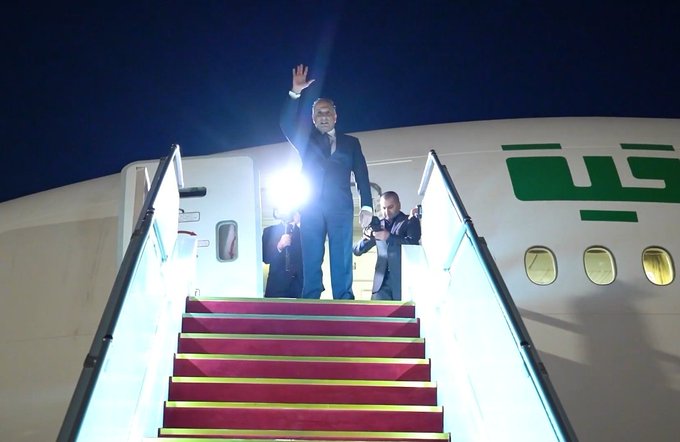
Mustafa Al-Kadhimi leaves to the US. The last 2 times the Prime Minister left Baghdad, chaos broke up, 3rd time is the charm? #Iraq
Image


His ascension to the top seat was made possible by a carefully-constructed deal struck between Iraq’s various power brokers. For the Sadrists, he was the ideal candidate who could serve their interests under the guise of an ‘independent technocrat.’ This relationship became more explicit when Kadhimi called Sadr the “leader of the resistance” and defended Sadrist politicians against corruption allegations.

Kadhimi’s nomination was agreed upon by Iraq’s anti-US political factions based on several hard conditions: that, as prime minister, he would organize early elections, expel all foreign military forces from Iraq, and expose the factions that had killed protesters during the 2019 civil unrest.

Initially, the PMF factions consisting of Kataeb Hezbollah and other anti-US parties, vehemently opposed Kadhimi’s nomination, claiming he was a “US puppet.” It has been reported that these factions came to terms with his nomination after their allies in Iran advised them that no further delays in the government formation process were feasible.

Immediately after Kadhimi came into office, pro-western, Gulf-sponsored media such as Al-Hadath and Al-Hurra started polishing his image by presenting him as the savior of Iraq.

In one of his first public appearances, Khadimi called his brother to inform him that he would not tolerate the use of their relationship for personal benefit. To his detractors, it was pure theater: to cast himself on a national scale as an anti-nepotism and anti-corruption figure. They pointed out that Kadhimi, a Shia, was equating his actions to that of Ali Ibn Abi Talib – one of Shiism’s, and Iraq’s, most revered religious personalities – declining his brother’s (Aqeel Ibn Abi Talib) request for money. This was one of the many photo ops that would mark Khadimi’s time in office.

What if anything, has Kadhimi achieved?

All strategic decisions made by Abdul-Mahdi that could have positively altered the course of Iraq’s economy and international relations, were overturned by Kadhimi. Any serious efforts by the previous government made in quest of real autonomy were abandoned.

Under the new prime minister, the China deal was set aside and Kadhimi instead proposed to enter a ‘strategic partnership’ with Jordan and Egypt that would essentially amount to handing over Iraq’s oil wealth in exchange for basic commodities, while indirectly normalizing with Israel.

Over the same period, he signed an $8 billion deal in the White House with General Electric, the very same US corporation that had reaped billions of dollars in profits since 2003 by sabotaging the reconstruction of Iraq’s electrical grid.

Under Khadimi’s watch, the construction of the Grand Faw Port was outsourced to a defunct South Korean corporation, while ignoring a lucrative Chinese proposal. This move, for all practical purposes, killed a strategic project that should have been a game changer for the Iraqi economy.

As of today, hardly any progress has been made in the construction of the port that was to become one of the top ten global ports. This is a realm that the Chinese have mastered as part of their ambitious BRI project to connect shipping and transportation routes throughout Asia. But Kadhimi gave it to the Koreans.

During Kadhimi’s tenure, for extended periods, Iraq’s government has neglected to pay salaries to millions of civil servants. This was unprecedented in the country’s post-2003 history, despite the various calamitous crises Iraq has faced in the past 19 years.

In yet another violation of the agreement that brought him into office, Kadhimi did not expel US troops from Iraq, but rather, provided them with an opportunity to re-brand their “boots on the ground.” While a few US soldiers departed, around 4,000 military personnel remain in Iraq in “advisory roles” – that number provided courtesy of the prime minister’s office.

But the move that perhaps struck hardest at Iraqi people’s daily lives was Kadhimi’s support for devaluating the Iraqi dinar. In December 2020, the Iraqi government, following World Bank instructions, devalued the dinar by 23 percent against the US dollar.

For a country that relies heavily on imports, this meant a steep hike in consumer prices. Overnight, millions of Iraqis were plunged into poverty. As of today, the rate of the dinar has not been restored, despite the fact that oil prices have skyrocketed to over $100 per barrel.

It is clear that rather than serving Iraqi interests, Kadhimi is following the US playbook. From his relations with regional states, to his choice of strategic economic partners, to his servitude to western-led austerity proposals, the prime minister has yet to take a step that benefits a sovereign Iraq.


Arabic social media is buzzing with the assertion that the last two times a sitting prime minister was visiting the US, there was broad violence in Iraq.  Meanwhile Sinan Mahmoud (THE NATIONAL) reports:

A rift is widening among Iran-backed political groups in Iraq over how to deal with the Shiite cleric Moqtada Al Sadr's demands before a crucial meeting to solve months of political deadlock over forming a new government.

Mr Al Sadr withdrew his movement from national politics after an increasingly bitter row with the Co-ordination Framework, a coalition of mainly Iran-backed parties which suffered major losses in elections a year ago.

He now wants parliament to be dissolved and has suggested keeping caretaker Prime Minster Mustafa Al Kadhimi and President Barham Salih in office to oversee a second round of early elections.


While in the US, Mustafa might dash over to the US State Dept and introduce himself to officials as well as the press since they don't seem to know who he is.  Despite all the turmoil in Iraq currently, you have to fall back to August 17th -- over a month ago -- for Iraq to pop up in the daily press briefings:


QUESTION: Yeah, on Iraq, please. As you well know, the power struggle in Iraq is worsening. And given the fact that U.S. has – the stake is high for the United State, are you taking side? Are you in touch with some party in Iraq? Are you doing something in this regard?

MR PRICE: We are not taking sides. We are prepared to work with the government that puts Iraqi sovereignty and the best interests of the Iraqi people at the heart of its agenda. We hope to see a government form that does just that and a government that is able to deliver for the best interests of the Iraqi people.


New topic, Margaret Kimberley Tweets:


Join me and on Thursday, 9/22 at 8pm eastern time.
Quote Tweet
Matt Hoh for Senate
@MatthewPHoh
·
Please join @freedomrideblog and me for a conversation this Thursday! us02web.zoom.us/webinar/regist
Image

That's tomorrow.

New content at THIRD:


The following sites updated:


  • Monday, September 19, 2022

    Stacey Abrams showed her true nature

    miss moqtada

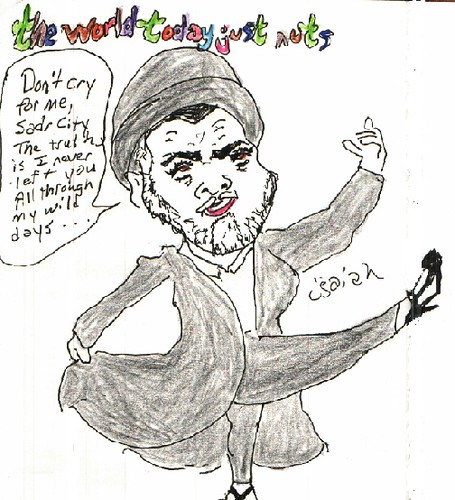
    Isaiah's THE WORLD TODAY JUST NUTS "Miss Moqtada Entertains" went up Saturday. I love it.

    I am disgusted with Stacey Abrams.  There was no need for her to do what she did:


     Georgia gubernatorial candidate Stacey Abrams spoke Sunday at the Atlanta church of a pastor who previously told a Baltimore congregation to make gay people "uncomfortable in [their] sin."

    New Birth Missionary Baptist Church senior pastor Jamal H. Bryant, who has repeatedly praised the antisemitic Nation of Islam leader Louis Farrakhan, promoted Abrams' visit on Twitter a couple of times over the last few days, saying her visit would be "historic" and that she will be the "next governor" of Georgia.

    In the middle of his church service, Bryant invited all the young girls in the congregation to come to the front of the sanctuary to listen to Abrams speak, lavishing praise on Abrams during his introduction of her.

    I don't expect self-loathing lesbian Laura Flanders to call her out.  Remember back in 2008 when Laura refused to call Barack out for bringing homophobes on stage at a campaign event -- including 'conversion' types?

    Yeah, Laura looked the other way.  No one should.  I was born in Atlanta, I was raised there.  There is no need for her to be trolling homophobic churches.  There are plenty of churches.  She made a choice to do this and it was outrageous.

    The reality is that she's never done a thing with her life.  She is the most unaccomplished 'politician' in the world.  At least she's stopped whining that her last election was "stolen."  

    But now she's embracing homophobes.  That tells us all we need to know about her.


    "Iraq snapshot" (THE COMMON ILLS):

    Monday September 19, 2022.   The fluff and spin continues while a pilgrimage concludes in Iraq -- Nouri took part in the pilgrimage while Moqtada hid away -- and much more.


    Yesterday, Katie Halper spoke with journalists Mish Rahman and Ahmed Twaij about the realities of colonialism (Ahmed's family is from Iraq).  The Windrush Scandal was mentioned in the conversation and it's a more recent example of the way the colonialism harms.


    From The Joint Council for the Welfare of Immigrants:

    Who are the Windrush generation? 

    The ‘Windrush’ generation are those who arrived in the UK from Caribbean countries between 1948 and 1973. Many took up jobs in the nascent NHS and other sectors affected by Britain’s post-war labour shortage. The name ‘Windrush’ derives from the ‘HMT Empire Windrush’ ship which brought one of the first large groups of Caribbean people to the UK in 1948. As the Caribbean was, at the time, a part of the British commonwealth, those who arrived were automatically British subjects and free to permanently live and work in the UK.  

    What is the Windrush scandal?  

    The Windrush scandal began to surface in 2017 after it emerged that hundreds of Commonwealth citizens, many of whom were from the ‘Windrush’ generation, had been wrongly detained, deported and denied legal rights. Guardian journalist Amelia Gentleman investigated and began reporting their experiences. As these shocking stories hit the headlines, Caribbean leaders took the issue up with then-prime minister, Theresa May. 

    There was widespread shock and outrage at the fact that so many Black Britons had had their lives devastated by Britain’s deeply flawed and discriminatory immigration system

    The injustice isn't over. Join us today to hear how you can fight discriminatory and unfair immigration rules.

    Join us

    Why did the Windrush scandal happen?  

    Commonwealth citizens were affected by the government’s ‘Hostile Environment’ legislation - a policy announced in 2012 which tasked the NHS, landlords, banks, employers and many others with enforcing immigration controls. It aimed to make the UK unlivable for undocumented migrants and ultimately push them to leave.  

    Because many of the Windrush generation arrived as children on their parents’ passports, and the Home Office destroyed thousands of landing cards and other records, many lacked the documentation to prove their right to remain in the UK. The Home Office also placed the burden of proof on individuals to prove their residency predated 1973. The Home Office demanded at least one official document from every year they had lived here. Attempting to find documents from decades ago created a huge, and in many cases, impossible burden on people who had done nothing wrong. 

    Falsely deemed as ‘illegal immigrants’ / ‘undocumented migrants’ they began to lose their access to housing, healthcare, bank accounts and driving licenses. Many were placed in immigration detention, prevented from travelling abroad and threatened with forcible removal, while others were deported to countries they hadn’t seen since they were children.  

    Their harmful and unjust treatment provoked widespread condemnation of government’s failings on the matter, with calls being made for radical reform of the Home Office and the UK’s immigration policy. In response to these demands, then Home Secretary, Sajid Javid announced in May 2018 that the Home Office would commission a ‘Windrush Lessons Learned Review’.  

    The scandal is far from over

    For those who have been affected by the Windrush scandal, justice has still not been done. There is a huge backlog of cases still to be resolved. The Windrush compensation scheme is a failure - it is complex to navigate, there is a lack of free legal advice, claims take months to process and compensation offers are insultingly small.

    And the policies that led to this scandal are still in place. The 'Hostile Environment' - which bars those without the right papers from the safety net we all rely on - hasn't even been suspended for the duration of the Covid-19 outbreak, in spite of repeated calls for it, from those affected by the rules.

    The Government promised to find the root causes of the Windrush scandal and learn lessons from it. Wendy Williams, Her Majesty’s Chief Inspector of the Constabulary, was tasked with carrying out an independent review. We, along with many others including lawyers, immigration advisors, local authorities, employers and charities, submitted evidence into what had happened, and why.

    The review was finally published on 19 March 2020 - nearly two years since the scandal hit the headlines. The review makes absolutely clear that the Windrush scandal was not an accident, but the inevitable result of policies designed to make life impossible for those without the right papers. 

    This, coupled with decades of immigration legislation explicitly aimed at reducing non-white immigration from the Commonwealth, destroyed the lives of many black and minority ethnic British people. 

    An action plan that is still not delivering

    In September 2020, the Home Office published an action plan, which the Home Secretary claimed would ‘deliver for the Windrush generation’ and usher in ‘people-focused policies’ at the department.

    In practice, however, the plan lacks substance, is full of evasive language, and wilfully misinterprets recommendations from Wendy Williams' report. There is a failure to address the most important issues - like the hostile environment - head on, and there is a clear determination to maintain the status quo. 

    A report by the Home Affairs Select Committee, an influential group of MPs, in November 2021, found that only 5.8% of the people who are believed to be eligible for compensation have received a payment. And shockingly, 23 people have now died, never having seen a penny of the compensation they were owed. 

    And an independent report in March 2022 warns the department is running the risk of another Windrush-style scandal, if it fails to act now to make meaningful change to its culture, systems and policies.

    We must continue to fight for justice for the Windrush Generation, and hold the Home Secretary to her promise to 'right the wrongs' which led to this scandal. Read more about the Windrush Lessons Learned Review


    We'll come back to THE KATIE HALPER SHOW in a minute, but first, a related story on immigration -- this time dealing with Iraq:

    According to a new report published on September 15 by seven humanitarian groups, up to one million displacement-affected Iraqis don't have key civil documents. The lack of such documents hinders their access to public services and increases the risk of poverty and exclusion.

    The document Life in the Margins -- published by the Danish Refugee Council (DRC), the Norwegian Refugee Council (NRC), and the International Rescue Committee (IRC), among others -- noted that nearly five years after the declaration of the war's end, access to civil documentation remains strongly limited for displaced families in Iraq.

    Internally displaced people (IDPs) who have no access to government offices, families allegedly affiliated to the Islamic State (IS) and families headed by a woman, in particular, face multiple challenges in requesting civil documentation.

    Risk of exclusion from services

    The organizations stressed that, though progress has been made since 2019 in the release of civil documentation since the number of paperless people has decreased, those still without crucial forms of identification are at constant risk of exclusion from key public services, including access to healthcare and education.

    Out of the million internally displaced people and returnees lacking civil documentation in 2022, about half did not possess two fundamental documents and a quarter did not have at least three.

    Missing documents included those proving residence, marriage, birth, death and the new Iraqi unified identity card, which is fundamental to get monthly food rations.

    Bureaucratic and administrative barriers, shortcomings in the Civil Affairs Directorates (CAD) in releasing documentation and requirements for security clearance over alleged affiliations to the Islamic State are all factors contributing to a complex network of obstacles reported by agencies in preventing vulnerable people from obtaining the documents they need.

    A third of the families interviewed in informal sites had members without legal identity papers.

    In the informal sites of Bzebez and Kilo 7 in Anbar and in those around Mosul, more than three-fourths of unregistered students interviewed by NRC in 2022 said they were not attending school mainly because they did not have the required documents.

    Appeal to provide essential documents

    "These households have been relegated to the margins of society without key pieces of civil documentation, which compounds and reinforces other vulnerabilities," said James Munn, country director for NRC in Iraq. "Without your identity papers you can't access services, you can't freely move through checkpoints, and you can't move beyond five years of suffering since the declared end of the conflict."

    The humanitarian groups are asking the Iraqi government, the governments of donor countries and leaders of the humanitarian response to commit to helping these people finally obtain the fundamental documents they have a right to possess.


    Also noted in the conversation with Katie Halper, the idiots behind the overrated play HAMILTON  -- even free on DISNEY+ during the pandemic, it couldn't attract viewers.  Earlier this month, Carla Sosenko (NEWSWEEK) explained:


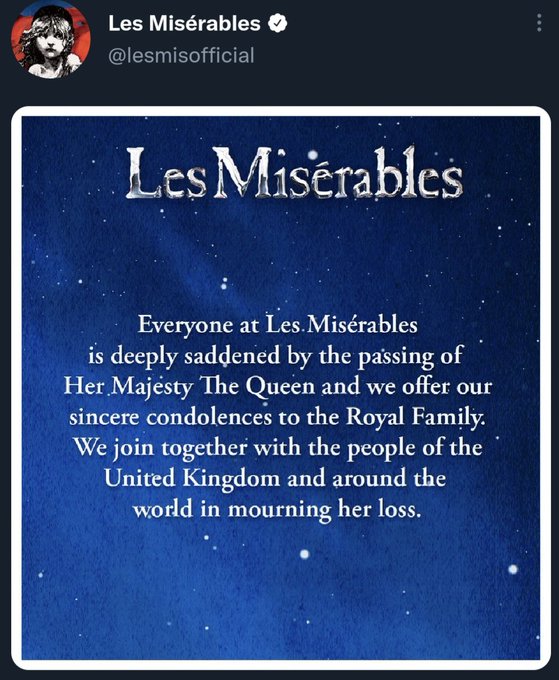
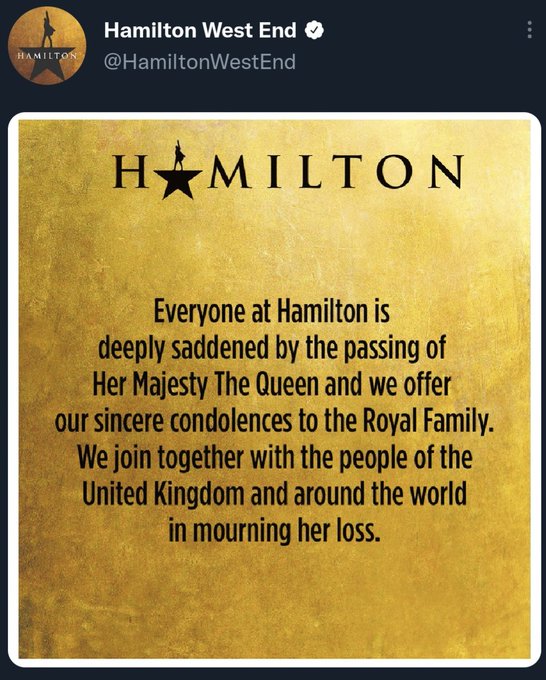
    Fans of the Broadway megahit Hamilton love the show for a lot of reasons, including its inherently revolutionary spirit. It is, after all, about the Revolutionary War, and the United States' Founding Fathers. So people were confused yesterday when, after Queen Elizabeth II died, London's West End production of the show tweeted out a fond tribute to the monarch.

    "Everyone at Hamilton is deeply saddened by the passing of Her Majesty The Queen and we offer our sincere condolences to the Royal Family," the verified Hamilton West End Twitter account posted on September 8. "we join together with the people of the United Kingdom and around the world in mourning her loss."

    Lin-Manuel Miranda's magnum opus, which won the 2016 Pulitzer Prize and a staggering 11 Tony Awards, is based on author Ron Chernow's 2004 biography, Alexander Hamilton. Miranda's work famously critiques colonialism at every turn, perhaps most notably in its purposeful casting of BIPOC performers—including Miranda himself as Hamilton, Leslie Odom Jr. as Aaron Burr, Renée Elise Goldsberry, Phillipa Soo and Jasmine Cephas Jones as the Schuyler sisters, and Christopher Jackson as George Washington—and its feminist themes.

    One of its most well-known and pointed numbers, "You'll Be Back," sung by an irate and offended King George III—Jonathan Groff originated the role on Broadway and was nominated for a Tony—portrays a monarch who cannot tolerate America's petulance and quest for independence, and illustrates just how far he'll go to exact revenge on his ungrateful subjects.


    George sings to the American revolutionaries, "You'll be back, soon, you'll see/You'll remember you belong to me. You'll be back, time will tell/You'll remember that I served you well. Oceans rise, empires fall/We have seen each other through it all. And when push comes to shove/I will send a fully armed battalion to remind you of my love."

    Understandably, some fans were confused by the Twitter page's diffident tone toward a monarch who is a direct descendant of George III. (Her father was King George VI.)

    Revolutionary spirit?  The spirit of a bunch of spaded show dogs, that's all the people behind HAMILTON are.


    Bad Writing Takes Tweets:


    As a mark of respect for the passing of Her Majesty Queen Elizabeth II (1926-2022) the plots of Les Misérables and Hamilton will be altered so that the monarchy were the good guys.
    Image
    Image


    At WSWS, Chris Marsden writes:


    Many people have been convinced that they should grieve over the death of a 96-year-old monarch who embodies class oppression and hereditary privilege. Such a mass phenomenon requires explanation.

    In Britain above all, the ruling class has attributed extraordinary historical significance to the late queen, designating her as the representative and even “grandmother” of the nation, the embodiment of duty and personal sacrifice who supposedly shared the painful experiences of generations, beginning with World War II. The queen was “a fixed point of grace and civility in the consciousness of nation and Commonwealth,” the Observer editorialises. “The public’s remarkable reaction to the death of Elizabeth II is a corrective to the myth of British decline, to the fantasy that we are irreconcilably divided,” declares the Telegraph.

    This is an appeal to confused emotions designed to rally workers behind a myth of national unity and an equally mythical version of the queen, to buttress their own fractured rule in the face of the unprecedented class divisions tearing society apart.

    Likewise, the world’s media and politicians have combined to portray this event as one of major import. Elizabeth Windsor served as monarch and head of state in Britain for 70 years. But anyone watching TV or reading a newspaper could be forgiven for thinking she was honorary queen of the world.

    Almost 100 presidents and heads of government will be in Westminster Abbey for the one-hour funeral ceremony, including US President Joe Biden and First Lady Jill Biden. The list of attendees betrays the imperialist character of the entire affair.

    Right-wing political filth including Brazilian President Jair Bolsonaro and Sri Lankan President Ranil Wickremesinghe will be honoured guests, while no invite was extended to Russia, Belarus, Myanmar, Syria, Venezuela, Afghanistan and other regimes targeted for hostile action by British, US and European imperialism. Chinese Vice President Wang Qishan’s attendance provoked howls of outrage at “appeasement” from within the Tory government and from Labour peers.

    It is in pursuit of the shared interests of the imperialist powers that world leaders have lined up behind the British bourgeoisie in its efforts to assign world historic significance to the death of the queen. She has come to symbolise for them what the monarchy has always symbolised in the UK—the representative not of feudalism but of the existing capitalist social order, of inherited wealth and privilege amid vast social inequality, of “stability”, “order”, patriotism and every form of political backwardness.

    The assembling of members of mostly long deposed “royal families” from across Europe and around the world is not merely a survival from the past, but proof that “monarchs” still play a political role for the bourgeoisie even in the 21st century.

    Millions in the UK have been made a captive audience, with hagiographic media reports, delivered in the necessary solemn tones, forcing the entire country to show their respects whether they like it or not. State-orchestrated intimidation has therefore played an essential role in reinforcing the apparent “national consensus” that the queen’s passing must be mourned by all—exemplified by the arrest of several people protesting peacefully against the institution of monarchy.

    There is, in addition, the assiduous manipulation of confused popular sentiment. Among most workers, nostalgia, misplaced empathy, and respect for the queen as an individual are more significant elements than patriotism, nationalism, and support for the monarchy as an institution in shaping identification with the rigamarole surrounding her death.

    There is also a definite element of genuine but misdirected grief in a country that has lost over 200,000 loved ones to the pandemic, without any of the official national mourning afforded to Elizabeth Windsor, who died peacefully in her bed from old age. The hundreds of thousands queueing to see her lying in state have passed by the UK’s National COVID Memorial Wall, covered in hand-painted hearts representing lives lost needlessly to COVID-19. 


    Turning to Iraq . . .


    The presence of Nouri al-Maliki, the former prime minister of Iraq, on the route of the Arbaeen Hosseini procession


    Former prime minister and forever thug Nouri al-Maliki took part in the pilgrimage -- one of approximately 21 million Shi'ites who did.  Moqtada didn't take part.  Moqtada couldn't take part.  Sometimes there are people more unpopular and more hated that Nouri.  Instead, Moqtada followed the pilgrimage on Twitter.


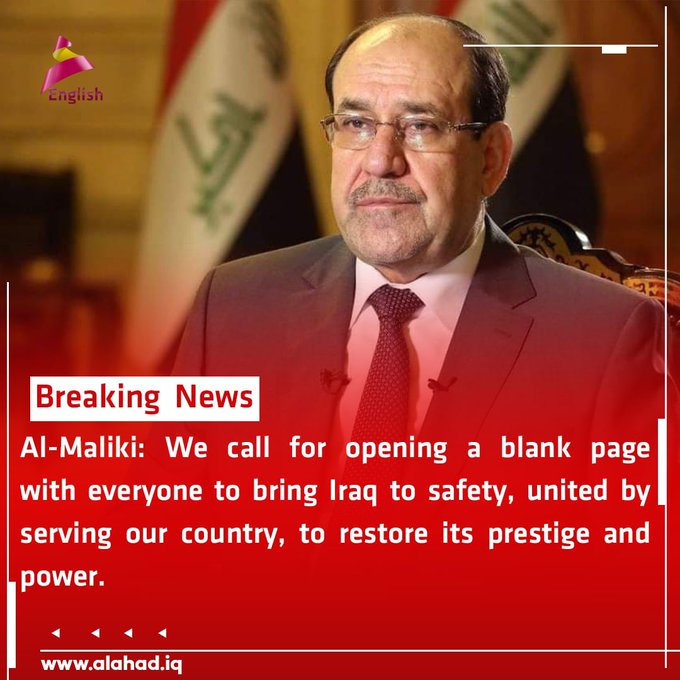
    Al-Maliki: We call for opening a blank page with everyone to bring Iraq to safety, united by serving our country, to restore its prestige and power. #Iraq
    Image


    New government?

    October 10th, nearly a year ago, Iraq held elections.  Yet they have still not named a president or prime minister.  All these months later, the political stalemate continues. RUDAW reports:


    Iraq’s political climate is currently experiencing its most difficult period since the US invasion of the country around a decade ago, Prime Minister Mustafa al-Kadhimi said Saturday while expressing hope that  stability in the country emerges victoriously. 

    “Iraq is going through a political crisis that may be the most difficult crisis after 2003,” Kadhimi said during the Shiite Arbaeen pilgrimage, adding that solutions must be found to overcome the crisis and “move towards a secure and stable Iraq.” 

    Millions of Shiite followers from around the world embark on a journey annually towards Iraq’s holy Shiite city of Karbala to attend the Arbaeen pilgrimage, a Shiite ritual marking the end of a 40-day mourning period for the death of Imam Hussein, the grandson of the Prophet Mohammed, in 680 AD.

    “My call to all political forces in Iraq is to let us take inspiration from this Arbaeen ceremony and to put Iraq and all the Iraqis in mind,” the Iraqi premier continued. 

    The political instability in Iraq has reached staggering depths with the country entrenched in deep political turmoil as different factions in Baghdad have been unsuccessful in reaching an agreement to form a government, almost a year after early elections in October 2021. 


    So what's on the agenda now?

    There are calls for 'snap' elections.  Even though it's thought that were it decided tomorrow to hold elections, the process could take four to six months -- printing ballots, et al.  


    Idiot and cult leader Moqtada al-Sadr wants snap elections.  He also wants Parliament dissolved -- the current Parliament immediately.  Does he not grasp that an election law has been required prior to each election?  So, for 'immediate' elections, Parliament would need to reconvene at least long enough to pass an election law.


    The Judiciary has made clear that the Constitution must be followed and that it cannot dissolve the Parliament because only the Parliament has that power.  


    He's also an idiot because he seems to think he'll do better in a new election.  No.  He's antagonized countless Shi'ites.  He's made himself look worse than the militias -- which is only one of the Shi'ite rivals he has -- only one.  He commanded his cult to turn out.  While they did (to a degree) most Iraqis sat out the election outside of the KRG -- in fact, most Shi'ites sat out the election.  Voter turnout is officially at 41% -- 'officially' because, anticipating a low turnout, prior to the election -- sensing a low turnout, the government reconfigured how they'd count the turnout and eligible voters.  


    Moqtada's stunts in the last month have angered many Shi'ites.  Arabic social media is filled with assertions from those who sat out the 2021 election that they will vote in a new election just to send a message to Moqtada.


    ASHARQ AL-AWSAT reports:

    The Shiite pro-Iran Coordination Framework carried out over three days last week negotiations with Sunni and Kurdish forces to form a new government in Iraq.


    The Framework is keen on forming the new cabinet as its rival, cleric Moqtada al-Sadr, head of the Sadrist movement has yet to comment on the efforts.


    The Framework held talks with the Sunni Azm and Sovereignty alliances and the Kurdish Democratic Party and Patriotic Union of Kurdistan.


    Leaks to the media confirmed speculation that the Sunnis and Kurds have set a number of conditions to join the Framework in the new government.


    It remains to be seen whether the Sadrists and Framework will meet after the Arbaeen commemoration on Saturday.


    An informed source told Asharq Al-Awsat that the negotiations between the Framework, Sunni and Kurdish forces are not official, rather the latter two parties are “testing the waters” with the former to see whether it would achieve repeated demands that have been ignored for years.


    The source said the negotiations are significant because they go to show how far Sadr’s former allies – the Sunnis and Kurds – have grown distant from his movement.


    RUDAW adds:

    Gharib al-Muradli, another Coordination Framework MP, told Rudaw that a total of 183 MPs have signed the petition, which also includes Kurds, Sunnis, and Turkmen.

    Iraq continues to be shrouded in uncertainty and political instability triggered by the current parliament’s failure to form the country’s next government due to political disagreements, almost a year after the early elections in October.

    Under Iraq’s constitution, the dissolution of the parliament can only be done through an absolute majority of its members, or upon the request of one-third of its members.

    Isaiah's THE WORLD TODAY JUST NUTS "Miss Moqtada Entertains" went up Saturday night.  Stan's "Matteo Lane is hilarioue," Wally's "THIS JUST IN! FAT JOKES FROM AMERICA'S PRINCESS!," Betty's "Meghan McCain, you do not have the right to self-harm," Stan's "DO REVENGE, Flabby Viola, Sally Field and THE FLYING NUN" and Mike's "Russell Brand, Chris Hedges" posted earlier as did the following: