Thursday, August 18, 2011

The Help II

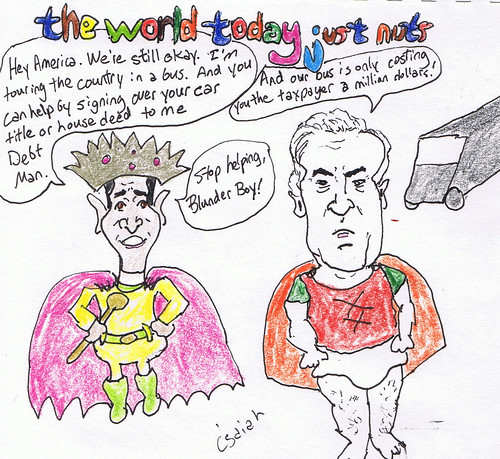
"Isaiah's The World Today Just Nuts "Debt Man and Blunder Boy""
debt man and blunder boy


I love the comic.

I don't love all the e-mails. The Help.

I did not say, "Go see the movie, you'll love it!!!!" Yesterday, I wrote:


If you've got reservations about seeing the film, I do understand that. And maybe you've got a better way to spend two hours. But if you're on the fence, please consider seeing it. Any reservations you have will probably be wiped away by the three performances I mentioned. I think those three performances are so strong that the film will become a classic that people point to as an example of great acting and an involving film.


I stand by that.

I had reservations and if I hadn't seen it with my oldest son and, honestly, through his eyes, I would not have enjoyed it.

But there are three amazing performances and great ones from the others as well.

I went over all the issues that could arise in yesterday's post.

So I'm a little surprised by some of the e-mails.

I also think there's a lot of snobbery going on on.

Sorry.

And there's some foolishness as well.

One idiot (that's the only word) wrote me that Lie Face Melissa Harris Parry hates the film. Really? Why?

Because she was confused since she has a White mommy?

I don't give a damn what that lying woman thinks.

But the snobbery is disturbing.

As for foolishness, who is expecting a documentary. It's an entertainment film. Do you not know the three act structure for film scripts?

(I didn't. Dinners at C.I.'s -- and parties -- tend to educate you on it because she has so many friends in films -- actors, directors, producers, studio execs, etc -- coming over and they all talk shop. And it's rare that one of them won't pitch a problem with a script to C.I. and she'll be talking "plot point" and other terms I don't grasp. But I do grasp the three act structure, the mid-point and how at minute seven into the film you have an incident that hurls the action forward.)

This is entertainment.

And for some the topic won't be entertaining. I get that. I explained yesterday that I would have avoided the film because I didn't expect it to be entertaining.

But if you hate the film, hate it for what it is not for some goofy 'analysis' that Melissa Harris Parry spewed while, no doubt, busy plotting her next marriage.


"Iraq snapshot" (The Common Ills):
Thursday, August 18, 2011. Chaos and violence continue, Iraqi children continue suffer, autism is on the rise in Iraq, Turkey's prime minister appears to be declaring war on northern Iraq, and more.
Starting with the Libyan War, we noted some things in the August 10th snapshot that we'll note again. Black Star News (via San Francisco Bay View) notes that "the entire Black population" of Misrata has been driven out of the city by the so-called rebels and cites this Wall St. Journal report where the rebels boast of being "the brigade for purging slaves, black skin." Were George W. Bush still illegally occupying the White House, there would be a huge outcry over that. Instead it's little reported. Black Star News states the New York Times has ignored the racism of the so-called rebels of the Transitional National Council and the attacks on Black Libyans:
If the case was reversed and Black Libyans were committing ethnic cleansing against non-Black Libyans, does anyone believe that the people who now control the editorials or the news pages at the New York Times would ignore such a story? Evidently, it doesn't bother the sages at the Times that Black Libyans are specifically being targeted for liquidation because of their skin color.
Instead, the New York Times is busy boasting of its support for NATO's bombing campaign -- as in a recent editorial -- which this week alone is reported to have killed 20 civilians. The Times has also ignored Rep. Dennis Kucinich's call to the International Criminal court (ICC) to investigate NATO commanders on possible war crimes in connection to Libyan civilians killed.
The Times can't write about the ethnic cleansing of Black Libyans and migrants from other African countries because it would diminish the reputation of the 'rebels,' who the Times have fully embraced, even after the ICC also reported that they too have committed war crimes. Instead, the Times is comfortable with the simplistic narrative, "al-Qaddafi bad," "rebels good," regardless of the fact that the Wall Street Journal also reported the rebels are being trained by former al-Qaeda leaders who were released from U.S. custody in Guantanamo Bay.
Yesterday, Glen Ford (Black Agenda Report) wrote an important piece which includes:

The mostly black town of Tawurgha has fallen to NATO-backed rebels after a long siege, according to al-Jazeera, the Qatar-based media mouthpiece for the rebels. It is an event only racists could celebrate, a triumph of hate and Euro-American arms and money over an enclave of dark-skinned Libyans descended from Africans once sold in the town's slave market. As the Wall Street Journal reported on June 21, the road to Tawurgha (sometimes spelled Ta-wer-gha), 25 miles from the port of Misurata, is punctuated by rebel graffiti vowing to "purge slaves, black skin." Previously, Benghazi-based rebels methodically cleansed Misurata's black neighborhoods, warning residents never to return to their jobs or classrooms.

Rebels claimed Tawurgha's defenders used civilians as "human shields" during the final assault -- the stock phrase deployed to justify massacres of non-combatants. President Obama has, in effect, been arming a racist lynch mob and calling them freedom fighters.

Government forces earlier claimed to have recaptured Misurata, itself, along with other battlefield victories, reports that are mirrored by rebel boasts of progress in encircling the capital city, Tripoli, and its 1.5 million people. The pace of military activity has quickened, dramatically, with the September 27 expiration of the Euro-American "mandate" in Libya approaching. NATO has stepped up bombing of pro-government towns along a wide front, throwing every available unit of feuding rebel forces into the fray in hopes of achieving regime change before the deadline. Rebel claims to have captured the town of Brega are in dispute. According to the rebel high command, the oil port was once defended by a brigade of "Chadian" soldiers -- another "black African" threat that Amnesty International and other outside observers found to be totally fictional. The rebellion appears to run on Africanophobia.

Saturday the Black Is Back Coalition will be holding an International Day of Action Against the Wars on Africa and African People. The chair of the coalition, Omali Yeshitela, spoke with Glen Ford on this week's Black Agenda Radio (here for that broadcast) which airs on Progressive Radio Network each Monday from 4:00 to 5:00 pm EST. Click here for a list of actions in the US and around the world. Excerpt of interview:
Omali Yeshitela: The fact is there are more than 700 US military bases around the world and then you count all the other imperialist powers and what is necessary for them to do at this moment to try and maintain the status quo to try and maintain an imperialist dominated world that extracts so much value that half the people on the planet live off less than two-US-dollars a day. That is what people around the world, in the process right now as we speak are struggling to overturn. And that is why there are all these wars that are going down -- in fact, a situation of permanent warfare that the imperialists have to be engaged in to try and maintain the status quo. And then particularly in cities throughout the imperialist countries themselves, like the United States, and what we're seeing happening in England and France and places like Belgium and Germany where there are growing internal colonies such as that exists with us and with the Mexican people and the so-called Indians it is a crucial question and right now history is being turned right-side-up and those who've been historically so oppresed, now are determing what progess -- real progress is in the world today. And Back Is Black is a part of this process and is calling on everybody else who is genuinely interested in ending wars to stand on the side of these oppressed peoples and to oppose the imperialist attempt to maintain the status quo which is oppressive and exploitive.
Glen Ford: And of course economic warfare is at least as deadly as the shooting kind.
Omali Yeshitela: It's at least. In fact, the economic warfare that I just mentioned, you know that half the people on the earth living on two-US-dollars a day, that is extraordinary. And this poverty that's responsible for disease and death plagues us in some places where there are more natural resources that the imperialists are extracting where people ought to be doing well but they cannot do well because those resources are being sucked out and they are filling super markets throughout the US and other places like that and pocket books on Wall Street and the board rooms [. . .]
Glen Ford: And this might be another expanded struggle for the Back Is Black Coalition -- focusing on convincing people that economic aggression is also a kind of warfare.
Omali Yeshitela: It is because the problem that we have is that even when people are looking at England as an example and I say that because it's quite topical obviously and they can see young people who are rising up and burning shops and things like that, what has to be recognized is that economic warfare, that is a form of violence too, people can see the shop being burned and they say that is violence but the economic warfare, where people are deprived of the right to live and to live in dignity that is a form of warfare and that is debiliating as you know and crushing not only to the human body but also to the human spirit. And it is something that we in the Back Is Black Coalition find unacceptable and that's why we have to do August 20th as an international day of action against the wars on Africa and African people worldwide.
Turning to the Iraq War, Scott Horton (Antiwar Radio) discussed it with Antiwar.com's Jason Ditz. Excerpt:
Scott Horton: Let's talk about the Iraq War. I know it's the summer of 2011 and as far as most people are concerned there's no such thing anymore. But I know better than that and I was wondering if you could give us the latest. I saw that there were a string of bombings over the weekend, right?
Jason Ditz: Right we had one of the deadliest days in over a year in the war and we've had bombings pretty much on a daily basis and the Obama administration is still talking about how they're open to the idea of staying if only they're asked which is a somewhat disingenuous comment because they've been demanding to be asked for several months now.
Scott Horton: Yes, as we've covered on the show. And now help me understand exactly where we're at in that process because it seems like Nouri al-Maliki had said, 'Okay, you can keep some trainers because I can give you that without turning it over to the Parliament first.' Did that stick?
Jason Ditz: It seems like that much has stuck but it looks like there's still a push for more. And whether they get more or not remains to be seen.
Scott Horton: And now when they say some trainers, how many is that? Do you know?
Jason Ditz: We don't know. It's not been clear at all how many they're talking but it's a lot.
Scott Horton: Well now I wonder if Maliki making that decision himself is what Ryan Crocker the now Ambassador to Afghanistan was talking about in these WikiLeaks cables when he was saying that Maliki is turning towards dictatorship. This was written up by John Glaser at the Antiwar.com Blog. He had some WikiLeaks here, did you see this?
Jason Ditz: Yeah and that could be part of it but I think that Maliki made a much broader grasp for power than that. He's still the acting Defense Minister, the acting Interior Minister, he's also the Public Security Minister. He's kept all of the ministries that have any control over any armed forces or law enforcement group. So he's very much been consolidating power for awhile and the effort to cut Parliament out of the decision on the US troops is one more step along the way.
Scott Horton: Well now and so what kind of noise is the Parliament making about whether they're going to go along with inviting more troops? Or would they really have to? I mean, they do have to go to the Parliament on that, don't they?
Jason Ditz: Theoretically they should have to go to the Parliament but it's not clear if they would or not. Of course, in the US, when the Status Of Forces Agreement was passed in 2008, there was a little bit of a question of whether or not President Bush should go to Congress about it and he just decided, no, he wasn't going to and that was pretty much the end of that. So it seems like there hoping to go the same way with the Iraqi Parliament and just cut them out of the process --
Scott Horton: They never held a referendum.

Jason Ditz: Right. The 2008 vote was narrowly passed with the promise of a referendum within six months bringing the question to the Iraqi people and that referendum, years later, never happened. So it was a pretty ugly battle at the time and it's probably going to be a much uglier battle this time around.
Scott Horton: Yeah, well, you know it's really too bad that we can't read Nouri al-Maliki's mind. I wish I could but it seems to me like there's at least a good chance that he's more or less playing the same script that he played in 2008 which is 'okay, okay, I'll try to convince them to let you keep all these bases, I'll do my very best' then by the end of the year, time is up, you gotta' sign and they sign a deal no bases and everybody out by the end of the year 2011. And I'm kind of thinking this is maybe what's going on here he's playing smart politics and telling the Americans, 'You know, I'm doing my very best to oblige you, I'm trying to get permission out of these guys but so far I'm having trouble.' But then again, I guess, it's not hard to imagine that he needs our help
Jason Ditz: Certainly and the US troops are going to be there largely to prop him up. So it's not hard to imagine that he would see that as a good thing
On the topic of withdrawal or not withdrawal, The Boston Globe's editorial board concludes, "Billions of dollars and thousands of lives later, the story of the war in Iraq is not yet in the history books. The war continues, and this week's news is a reminder that the notion of mission accomplished is no better understood today than it was in 2003." And possibly this lack of clarity for the board is why they can't call for an end to the war? The lack of clarity, no doubt, also explains why they aren't able to count. 15. Not fourteen. 15 US soldiers died in the Iraq War in the month of June (they are each noted in the editorial we did at Third, use the link). Unlike the Boston Globe, Courtney Kube (NBC News) gets the number of US soldiers who died in June from the Iraq War correct and Kube notes the dangers are still present in Iraq:
The continued danger to U.S. military men and women deployed in Iraq was brought home to an NBC News team at the beginning of this month. Pentagon correspondent Jim Miklaszewski, cameraman Jim Long and I were at Victory Base in Baghdad when insurgents began launching rockets at the complex. As the sirens blared and an announcer warned of "Incoming!" an enlisted soldier ran by and said, "Here we go again." He later explained that the enemy has been "peppering" Victory with rockets lately and showed off several places where shrapnel had pocked blast walls and shattered windows.
NBC News also notes that Sgt Mark Cofield's death July 17th was the most recent US military Iraq War death and quotes his sister Sara Cofield saying, "Mark was my rock. He was my brother, he was my world. He raised me." In July, Alyssa Chin (KKTV -- link has text and video) reports that the fallen's father and brother are also serving and she spoke with family and friends of Mark
Cofield.

Alyssa Chin: This is a man who was promoted to sergeant just 18 months after training.

Sara Cofield (Sister): You never thought it would be you. You always thought you were the lucky one to have all three of them come back. So . . . [whisper] that was hard.

Alyssa Chin: Friends and family are left wondering exactly what happened overseas to Sgt Mark Cofield, a man they watched grow up?

Suzi Dixon (family friend): This just comes so close to home and it just hits your heart and it makes it all real.

Liz Cameron (neighbor): There's going to be such a hole in this community's heart because Mark was all about love.

Alyssa Chin: According to those who knew him best, the 25-year-old excelled at everything. A hockey player for most of his life, he competed for Rampart High School. While in Iraq, he started running marathons and even won a few.

Samantha Wolf (family friend): Mark had one of the biggest hearts of anybody I've ever met.

Ester Mabry (family friend): He had the strength and compassion that normally you don't see together.

Alyssa Chin: While gathered in the Cofield home, stories and memories of Mark overflow with smiles, love, and warmth. But his sister Sara will remember him most for the times they shared together.

Sara Cofield: I'm proud to say that my brother served, that's a good thing. He not only was a soldier and served our country and will be missed as a part of it but he'll be missed as a brother, and as a son, and as a friend.


In the face of such losses, you'd hope news outlets could at least be honest but that's apparently too much to hope for. ABC6 News notes, "159 soldiers from Minnesota are getting ready to head to 'deployment training' before being sent to Kuwait. The Minnesota National Guard's 2nd Battalion, 135th Infantry are heading overseas to help with the troop drawdown from Iraq. This group of soldiers are part of the second largest deployment of National Guard troops since World War 2." Really? For the withdrawal? The one supposed to take place December 31, 2011? Then they'd only need to deploy until then, right? Matt Peterson (Austin Daily Herald) adds, "Though Spc. Trevor Kolb of Austin has been enlisted in the Minnesota National Guard for two years, he's going to find out a lot more this fall. Kolb, along with the second largest deployment of the Minnesota National Guard since World War II, is going to Kuwait for one year." For a year? So it's not about a December withdrawal. Imagine that. In fact, it's about using Kuwait as a holding tank -- which was discussed in a 2008 Senate Foreign Relations Committee hearing. Did no one pay attention? Apparently not.
Turning to the ongoing violence that is Iraq, Reuters notes 1 Iraqi soldier was shot dead in Mosul (three more injured), 1 man was shot outside his Mosul home, a Baghdad raid by Iraqi forces resulted in 2 suspected being killed and 2 soldiers being killed (three more soldiers were injured), a Baghdad roadside bombing injured two people, and all that follows took place Wednesday night -- a series of Baghdad home invasions targeting police officers resulted in the death of 1 police officer and two people being injured, a Baghdad roadside bombing left three people injured, another Baghdad roadside bombing claimed the life of 1 police officer (and left another injured) and a Tarmiya car bombing claimed the lives of 2 of Brigadier Tawfiq Ahmed's bodyguards and left seven people injured.
Yesterday the Turkish military launched another air bombing on northern Iraq. The Guardian notes, "The jets hit 60 suspected rebel targets in the mountainous region near the border with Turkey late on Wednesday as well as targets on Mount Qandil, along the Iraqi-Iranian border, where leaders of the rebel group Kurdistan Workers' party, or PKK, are believed to be hiding." The paper also notes that the Turkish government will discuss the PKK today in a national security meeting. The Telegraph of London reports that "168 rounds of artillery" were used by Turkish warplanes and that, "In Baghdad, the Iraqi government objected to the attacks, but also said rebels should not launch attacks from its territory aimed at Turkey." Sebnem Arsu (New York Times) quotes a written statement from the command of the Turkish Army, "Similar actions of the Turkish Armed Forces inside and outside the country will continue in a determined way until the North of Iraq would be turned into a secure residential area and the terror organization that uses the area as a launch pad for attacks would be eliminated." So the Turkish plan is to bomb the northern region into a residential area? Not sure how that works. Ivan Watson and Yesim Comert (CNN) state Turkish Prime Minister Recep Tayyip Erdogan has declared "a new period is starting" in this ongoing crisis and "Rebels from PKK have claimed responsibility for a series of attacks over the last month, including a Saturday ambush near the southeastern province of Sirnak that killed at least three soldiers. In a statement e-mailed to CNN, the PKK also claimed responsibility for last week's sabotage of a natural gas pipeline between Turkey and its eastern neighbor Iran." Bloomberg News quotes Erdogan stating, "We're at the end of words, our patience due to Ramadan is over."

The PKK is one of many Kurdish groups which supports and fights for a Kurdish homeland. Aaron Hess (International Socialist Review) described them in 2008, "The PKK emerged in 1984 as a major force in response to Turkey's oppression of its Kurdish population. Since the late 1970s, Turkey has waged a relentless war of attrition that has killed tens of thousands of Kurds and driven millions from their homes. The Kurds are the world's largest stateless population -- whose main population concentration straddles Turkey, Iraq, Iran, and Syria -- and have been the victims of imperialist wars and manipulation since the colonial period. While Turkey has granted limited rights to the Kurds in recent years in order to accommodate the European Union, which it seeks to join, even these are now at risk." The Kurdistan Regional Government in Iraq has been a concern to Turkey because they fear that if it ever moves from semi-autonomous to fully independent -- such as if Iraq was to break up into three regions -- then that would encourage the Kurdish population in Turkey. For that reason, Turkey is overly interested in all things Iraq. So much so that they signed an agreement with the US government in 2007 to share intelligence which the Turkish military has been using when launching bomb raids. However, this has not prevented the loss of civilian life in northern Iraq. Back to Aaron Hess, he noted, "The Turkish establishment sees growing Kurdish power in Iraq as one step down the road to a mass separatist movement of Kurds within Turkey itself, fighting to unify a greater Kurdistan. In late October 2007, Turkey's daily newspaper Hurriyet accused the prime minister of the KRG, Massoud Barzani, of turning the 'Kurdish dream' into a 'Turkish nightmare'."

W.G. Dunlop (AFP) reports that "new neutral arbitrators" are needed in Iraq to handle disputes between Kurdish and Arab forces (which is actually repeating what the RAND Corporation's recent report, "Managing Arab-Kurd Tensions in Northern Iraq After the Withdrawal of U.S. Troops," stated, see the July 26th snapshot) and that tensions will increase without someone to fill the role currently filled by the US military. From the article:


Major Ali Jassem al-Tamimi, an Iraqi army representative to the NCCC, was confident the centres would continue to function after the US withdrawal, but conceded that disputes may arise.
"We expect that after the US withdrawal, we will work in the same way and... the same effort will continue, but there might be some small conflicts between one side and another," Tamimi said.
Captain Massud Hussein, representing the peshmerga, agreed with Tamimi, but added that the situation "will be improved for the better if they (the Americans) stay."

The US stepped into the mediation role when the central government in Baghdad and the KRG government were at loggerheads with each hurling accusations at one another. It's very easy to paint it now as the military of each group not getting along but the issue was much larger than that.
On the second hour of The Diane Rehm Show July 17, 2009, Moises Naim, Yochi Dreazen and David Ignatius were Diane's panelists and during the discussion of Iraq, Moises noted the reality side-stepped today.
Moises Naim: And the Kurdish prime minister yesterday said that the Kurdish autonomous region was closer to going to war with the central government than ever before, since 2003, since the US invasion. And that points, as Yochi said, to the tensions about the divisions -- federalism, they're trying to find out what is the divisions of authority, power between a centralized government and a regional government. And this is a region that is quite different in its governance, in its function, in its economy, in its politics, than the rest of the country.
As noted in Diane's discussion, things are very tense between the central government in Baghdad and the Kurdish Regional Government. Anthony Shadid (Washington Post) reports, "In separate interviews, Prime Minister Nechirvan Barzani and the region's president, Massoud Barzani, described a stalemate in attempts to resolve long-standing disputes with Iraqi Prime Minister Nouri al-Maliki's emboldened government. Had it not been for the presence of the U.S. military in northern Iraq, Nechirvan Barzani said, fighting might have started in the most volatile regions." Quil Lawrence (NPR's All Things Considered) reported this afternoon on the tensions quoting Barzani, "Whoever wants to get ahead in Iraqi politics does so by criticizing the Kurds." On territorial disputes and what may have been an attempt by al-Maliki's government to enroach on Kurdish territories June 28th, Lawrence quotes Barzani stating, "Our problem is that we do not believe there is any political will in Baghdad to solve this problem."
In that All Things Considered report, Quil Lawrence provided this background, "Most recently, on June 28th, Nechirvan Barzani says, Iraqi army soldiers arrived in the mostly Kurdish town of Debaga, northwest of Kirkuk, at around 2:00 in the morning. Citizens filled the streets to prevent the Iraqi army from passing. And a mostly Kurdish division of the Iraqi army arrived and blocked the road, essentially putting Kurdish and Arab units of the same army on opposite ends of machine gun barrels. It took 24 hours to resolve the issue, and the Arab unit eventually withdrew." A month later, August 17, 2009, Deborah Amos (All Things Considered) reported on the plan US Gen Ray Odierno (then the top US commander in Iraq) has proposed to both the KRG and the central government in Baghdad: US troops would go into northern Iraq and patrol with Iraqi forces and the Kurdish Peshmerga as a three-way joint-force in what was hoped to be team building exercises. And the RAND Corporation report released at the end of last month noted the need for these team building exercises to continue but noted that the US State Dept is not equipped to take over from the US military to continue them.
The potential conflict between the each side's military is underscored today as Alsumaria TV reports, "Peshmerga Minister of Kurdistan Regional Government Jaafar Mustapha warned on Wednesday against Kurds boycott to the Iraqi Army for it has become a 'central army', he argued. Kurds have no longer any power in the Iraqi Army. The incidents that are occurring in the regions where Iraqi army is deployed especially in Diyala have never occurred at the time of Baath, Peshmerga Minister said." Sean Kane (Foreign Policy) wonders, "Will the phasing out of the U.S. role mean, as one leaked U.S. intelligence report suggested, that without strong and fair third party influence tensions along the Arab-Kurdish line may quickly turn to violence? Or is too much being made of the transition in what was always intended to be a temporary mechanism?" Baram Subhi (niqash) notes that some are hopeful about the Golden Lions, "The Golden Lions unit is composed of almost 400 members from three different security forces operating in Kirkuk: the Iraqi army, the local police forces and the Iraqi Kurdish military force known as the Peshmerga. The tripartite force, which eventually hopes to increase its number to 1,000, was the idea of Ray Odierno, former commander of US forces in Iraq, who hoped a joint force like this one might help put an end to ethnic clashes in the area."
Last week, the UN Assistance Mission for Iraq (UNAMI) and the Office of the High Commissioner for Human Rights released [PDF format warning] "2010 Report on Human Rights in Iraq." The plan here was to cover a section each of the five days. Thursday I forgot so we're grabbing it today and tomorrow. On the 10th, we covered journalists, we covered the prisons in the August 9th snapshot with women and Iraq's LBGT community was covered in the August 8th snapshot). Today we're focusing on the reports findings regarding the children of Iraq. 2010 saw at least 194 Iraqi children killed in violence wih another 232 injured. This is the violence of bombings and shootings,etc. This is not the violence of domestic abuse. For example, March 26, 2010 saw 23 children killed in Baquba bombings. There are rumors that young children are recruited to take part in armed conflict and an 11-year-old would-be suicide bomber caught in Ramadi April 6, 2010 described how three men recruited him. Iraqi children also die from the actions of the Iraqi and US armies. These deaths come in home invasions and in bombings. Iraqi children are also at risk of being killed by cluster bombs and landmines that are currently "contaminating 1,700 square kilometres of land" in Iraq. In 2006, the Iraqis Ministry of Health partnered with the World Health Organization to conduct the Iraqi Mental Health Survey of Iraqi children. The survey found "that almost half of those surveyed had experienced a war related trauma."
Children continue to be prime kidnapping targets in Iraq wih at least 31 kidnapped in 2010 (those numbers only cover ten of Iraq's eighteen provinces).
Iraqi children can be found in the jails and prisons of Iraq. And often, they're held with adults -- 520 boys and girls shared facilities with adults (those figures do not include the Kurdistan Regional Government) and "759 boys and girls were held in facilities for convicts. Numerous children, some of them extremely young, are deprived of their liberty and a child-friendly environment merely because their mothers, with whom they stay, are detained and imprisoned."
Iraqi schools face vandalization and destruction and violence prevents 2 million children from attending school. For those schools able to hold classes, they're overcrowded. The report notes, "Thousands of children with disabilities remain without access to schools, and the children of internally displaced families face a lack of educational facilities." October 31, 2010, Our Lady of Salvation Church in Baghdad was attacked. Following that, "it was reported that many Christian schools, often sharing the same grounds as their churches, cancelled classes for several weeks out of fear of a similar attack."
The report notes, "The Government of Iraq received from the World Bank a loan of $100 million US dollars over the next 30 years to boost school construction. However, the current capacity of the government to implement construction works and issues of availability of land, are hindering the progress of the school construction programme."
The report notes that children beggars in the KRG may be Arabs who came o the region with their families who were escaping violence elsewhere in Iraq. The KRG has created "homes for children who are either homeless or are unable to live with their families for various reasons" and these homes are in all three provinces but the report notes there needs to be more programs that could integrate these children back "into society." The KRG has also created juvenile police stations in all three provinces and all three also "have reformatories or detention centres for children where convicted children are kept. During visits, UNAMI assessed the living conditions as satisfactory in all three reformatories and one detention centre. The rooms are big and clean with natural light and ventilation. Overcrowding is not a problem. children housed in these facilities expressed satisfaction with the quality of food. However, educational, social and play activities are few and are not really adequate or geared for children."
Today Suha Sheikhly (Al Mada) reports on an autistic child in Iraq. Sheikhly encountered 8-year-old Hisham in the airport. His mother was told that autism had become more common in Iraq and that "the reason given for the rise in autism cases is the toxic minerals in the environment such as mercury and lead" and the war has spread these minerals. When Hisham was beginning to walk and teeth it was noticable to his mother that had difficulty with language and social skills. The article explains that the doctors do not see autism as "crazy" or deformity but as a mental illness and that Iraqi children with autism have special needs. Hisham's mother was told that the increased levels of mercury and lead in the environment was the likely cause and she believes this because behind the family's home are piles of scraps, "remnants of the military". Iraqi doctors recommend 40 hours of education a week for autistic children and do not recommend leaving the child in a vacuum (alone) or parked in front of the TV for long hours. A study of autism in Iraq by the Uniiversity of Cambridge found that there were 75 cases per ten thousand people aged five to eleven years old.


Wednesday, August 17, 2011

The Help


what us diet


Hillary supporter here but Isaiah's correct. Don't tell us that we have to face severe cuts and still expect us to fork over billions for the Iraq War. Enough all damn ready, bring the troops home from the illegal war.

"Flim-Flam Man Without A Plan On The Lam - Marco Rubio, Chris Christie, Paul Ryan, Sarah Palin - Come On Down" (Hillary Is 44):

Barack Obama says he has a miracle cure-all plan for the economy but he’ll release it in September in yet another nation abusing speech. Hey, leave Obama alone – he’s on vacation, vacation, vacation.

* * * * * *

JammieWearingFool had us laughing yesterday because we read some familiar words from here at Big Pink and some New York news:

“Indeed, spending any resources in states that haven’t gone Republican in a generation means Obama’s in deep trouble.

It’ll be interesting to see what kind of behind-the-scenes meetings occur at Chez Clinton while Obama’s off golfing in Martha’s Vineyard. Democrats might want to use that time to figure out a way to usher this boob out the door gracefully unless they want to join him on the sinking ship.”

What is that JammieWearingFools referring to? The PUMA P.A.C. people (giving away (yup, free) Hillary 2012 bumper stickers) will love the news. Here is what the Jammie people are referring to and yup, you’re reading correctly, it’s New York State:

“President Obama’s job approval ratings are the worst they’ve ever been in the Empire State, but voters here are still sticking with him in 2012, according to a new Siena College poll released today.

The poll finds that just 36% of New Yorkers approve of Obama’s job performance — a 17-point plummet from the 53% rating he received in May. Meanwhile, 63% of voters give the president a negative job performance rating.

“His job performance has not fallen, it has tanked,” said Siena pollster Steven Greenberg.

“Even Democrats are evenly divided. For the first time since March, fewer than half of voters say they are prepared to re-elect the president.” [snip]

“If the Democratic National Committee has to spend money competing in New York for the presidential victory next year, they are in big trouble,” Greenberg said. “Because if they are competing in New York, which is a two-to-one Democratic state, that does not bode well for them nationally.”

As to why New York voters would vote for Obama even though they think he stinks? Don’t bet the condo on that. [On the other hand, the idiot left cannot be underestimated in their stupidity.]

Now I want to talk about The Help. My oldest wanted to see the film The Help directed by Tate Taylor. It was on my 'maybe' list. Maybe because do I really want to watch Black women onscreen playing the help during a previous era?

I don't mind the blues. But there are people my age (and the generation before) that have no use for the blues and most of the time you'll hear comments about how we're trying to move beyond that. The blues captures a period that we hope to have moved beyond.

My son wanted to see it because he thought it looked interesting and he wasn't concerned about the era so much as he was excited to see Blacks on screen in a non-Tyler Perry film. (My son hates Tyler Perry films. As do I. They're so dumb and play for a dumbed down audience demonstrating that he's got a lot of self-hatred.)

So we checked with my other two kids and they didn't want to see it. My middle son had already made plans with a friend and my youngest made me pull up the movie's site and her attitude was, "No, thank you." (She wants glamor even at this age. That's why her Diana Ross doll is her favorite doll.)

So I wasn't expecting much (besides conflicted feelings on my part) but I really did enjoy the film.

To be honest, it was only watching my son laugh and enjoy it that made me start to. It was seeing him take it as a movie and a new experience that freed me of all the judgments of what it was tied to.

It's an interesting story with amazing performances all around but I especially praise Viola Davis, Octavia Spencer and Bryce Dallas Howard.

Everyone is great (Allison Janney's in the cast, for example), but those three were the stand outs for me.

If you've got reservations about seeing the film, I do understand that. And maybe you've got a better way to spend two hours. But if you're on the fence, please consider seeing it. Any reservations you have will probably be wiped away by the three performances I mentioned. I think those three performances are so strong that the film will become a classic that people point to as an example of great acting and an involving film.


"Iraq snapshot" (The Common Ills):

Wednesday, August 17, 2011. Chaos and violence continue, Turkish military planes bomb Iraq, Moqtada al-Sadr says there will be "war" with the US, Libyan War coverage returns to Flashpoints, and more.
Starting with the Libyan War, yesterday on KPFA Flashpoints Radio again spoke with their special correspondent in Libya, Mahdi Nazemroaya. (Click here for KPFA archives, here for Flashpoints Radio website -- Flashpoints airs live from 5:00 to 6:00 pm PST, Monday through Friday). Excerpt:
Kevin Pina: The world attention has turned back to Libya after NATO kills more than eighty civilians in a bombing raid on the town of Ziltan. The toll includes 33 children and 20 women according to our special correspondent on the ground. This comes on the heels of new reports that say Britian will have spent more than $420 million waging war in Libya by mid-September while the price tag to the US tax payer is an estimated $1 billion. And joining us once again from Tripoli, Libya is our special correspondent Mahdi Nazemroaya. Mahdi is also a research assistant with the Centre for Research on Globalization based in Montreal, Canada. Mahdi, welcome back to Flashpoints on Pacifica Radio.
Mahdi Darius Nazemroaya: Thank you, Kevin.
Kevin Pina: So Mahdi, give us an update. We know we haven't spoke for a couple of weeks here. Tell us what has happened. There have been tremendous developments on the ground there, many claims by NATO, by the so-called 'rebels,' of victories. There have also been claims of massacres by NATO. And, finally, I understand Amnesty International actually doing something and calling for an investigation into an attack on civilians.
Mahdi Darius Nazemroaya: Alright. Well since March 8th, there's been very heavy bombings here. Specifically one that's come to a lot of attention which resulted in the heaviest casualties that are known in one day -- civilian casualties was the attack on Ziltan. Which took place, Ziltan is a district near Misrata. And 85 people were killed, including 33 children, 32 women and 20 men. And many of the civilians were also wounded very heavily and taken to hospitals either in the district or brought here to Tripoli. It was bombed, according to NATO, at 11:30 [p.m.] local time on August 8th. And there was further bombings several hours later at 2:34 [a.m.] on August 9th. So there were, I believe, three sets of bombings.on August 8th at 11:30 p.m., about, and ending at 2:34 a.m. on the followng day. In between that what resulted was a lot of people who came to the rescue of the bombed people were also bombed. So that is why the casualties are very high. [. . .], the military spokesperson of Operation United Protection for NATO has claimed that they bombed a military area but all the evidence on the ground has shown the usual civilians homes, farmers homes and civilians. And it resulted in 3 days of mourning here in Libya and the mainstream media challenged the Libyan government on the numbers. I think they lost sight of the fact that civilians were heavily hurt. And I've seen some of the children, I've talked to the victims there. It is very distrubing. Children now in the morning jump up instead of getting up. So Ziltan was bombed. Now there's been heavy fighting in the west. There's been heavy fighting in Misrata. The Libyan government has annouced here in Libya that Misrata has been freed. Liberated. The Libyan military entered there yesterday. And there was heavy gun fighting there. And now they've left Misrata. It's been freed. And they didn't stay in their positions in Misrata because NATO would bomb them and they're afraid of this. So they only moved in and moved out. Now west of here there's been fighting. Before I start on the fighting, I want to announce also that the local TV stations were again bombed exactly when Ziltan was bombed, as well as a concrete factory and a cultural center in al-Khams and some local municipal community buildings. At the same time that this happened, also, Human Rights Watch arrived. A few days earlier, Human Rights Watch arrived on the ground here in Libya, they sent representatives from the head office in New York. I was actually asked to go to a meeting involving members of the Human Rights Watch. I didn't go. It was at the Al Mehari.
There's much more (the segment's over 30 minutes). We always do an excerpt and we also need to excerpt briefly another segment. Dr. Khaled Al Bazelya is the head of Libyan Television's LEC division (their English language channel). Kevin Pina spoke with him about the NATO attacks on Libyan TV for the last three weeks, resulting in the deaths of 3 journalists, with twelve more injured. "We are professional journalists. We have nothing to do with -- We are not politicians. We just transfer the news," Dr. Khaled Al Bazelya explained. "[. . .] We report what we see. We ask the International Journalist Association and Human Rights to look into this issue because journalists should be protected all over the world." Kevin noted the silence on the attacks.
Kevin Pina: Reporters Without Borders has not commented at all on the bombing of Libyan journalists.
Dr. Khaled Al Bazelya: They didn't comment, no.
Kevin Pina: What about the Committee to Protect Journalists in New York? Have they commented at all?
Dr. Khaled Al Bazelya: No, not yet. Not yet. Although the news has been transmitted by CNN, by AP, by Reuters, by most of the agencies. They all reported this incident and our statement on the inicdent We are a very peaceful people. We want peace. But we are a part of an organization that reports the truth.
[. . .]
Kevin Pina: Now of course NATO after the attack on Libyan Television said that they were halting the voice of terrorism of the Gaddafi regime. How do you respond to that?
Dr. Khaled Al Bazelya: Well I don't know. I don't understand this philosophy at all. I mean, a journalist is a journalist. You see that the reports are coming from Tripoli from the New York Times and the Washington Post, they have journalists from all over the world. The best of the world is in Tripoli at the moment and we give them the freedom, the freedom for their rights, the freedom. So we should be given the same as their journalists, as the French, the Italians, the British, the Americans. That's what we are asking for. We are journalists and we should be treated the same.
Attacking journalists is a War Crime. When US forces attacked journalists in a Baghdad hotel, Amy Goodman wrote about it and talked about it. Non-stop. In the 2000s, she also talked about (and wrote about) NATO bombing Serbia TV. But Barack's in the White House and Amy Goodman will do her little headline so that when Barack's out of office, she can claim she covered it. But gone are actual segments decrying the attacks on journalists. Repeating, that is a War Crime, bombing journalists is a War Crime.
Turning to Iraq, a day after everyone's reported on Leon Panetta, Secretary of Defense, commenting on the US government's desire to keep US troops in Iraq beyond 2011, the Defense Department issues a press release. A Tweet AFP's Prashant Rao highlighted actually said it all.
Mina Al-Oraibi
AlOraibi Mina Al-Oraibi
by prashantrao
In addition, click here for Xinhua's text and audio report of the Clinton and Panetta Road Show/Eye Sore. Barbara Starr (CNN) reports on another US official making remarks about continuing the Iraq War, US Maj Gen Jeffrey Buchanan, "Buchanan also confirmed the United States is informally talking to Iraq about a continued U.S. troop presence in the country after the end of this year. He didn't rule out that troops could find themselves in combat in a new arrangement, but emphasized the expectation is Iraq will ask for help with training its troops."
Though The Nation and The Progressive are either unwilling or unable to inform their niche readers about the serious discussions taking place to extend the war, Bill Van Auken (WSWS) lays down some hard truths today:
Washington is determined to continue pursuing the aims that motivated the invasion of 2003: domination of Iraq and its oil wealth and the use of Iraqi territory to project US military power throughout the region. Increasingly, US control over Iraq has been severely undermined by Iran's substantial influence as well as by growing economic interests of other powers, including Turkey and China.
This is why the Pentagon and the Obama administration -- Obama's campaign pledges about ending the US war in Iraq notwithstanding -- are determined to maintain a military grip over the country.
Whether or not the Maliki government is able to secure a negotiated deal for extending the stay of US troops, Washington has worked to assure itself a continued military role. In eight years of occupation, the US has deliberately limited the capacities of the Iraqi military, leaving it without an air force or a navy and consequently the ability to protect the country's borders. US air power will continue to control the Iraqi skies no matter what decision is taken by Iraq's parliament.
Also exploring what's taking place currently is CODEPINK's Medea Benjamin (OpEdNews):
"If we have not gotten our troops out by the time I am President, it is the first thing I will do," he thundered in the fall of 2007. "I will get our troops home. We will bring an end to this war. You can take that to the bank."
But don't count on cashing that check. The Washington Post brings the unsurprising news that Iraqi leaders have agreed to
begin talks with the U.S. on allowing the foreign military occupation of their country to continue beyond this year -- re-branded, naturally, as a mission of "training" and "support." The move comes after an increasingly public campaign by top White House and military officials to pressure Iraqi leaders into tearing up the Status of Forces Agreement they signed with the Bush administration, which mandates the removal of all foreign troops by the end of 2011.
As with any relationship, saying goodbye is always the hardest part for an empire. The U.S. political establishment has long desired a foothold in the Middle East from which it could exert influence over the trade of the region's natural resources. Remember, Iraq has lots of oil, as those who launched the invasion of the country in 2003
were all too aware . They aren't too keen on giving that up.
And as is to be expected when one maintains the most powerful -- and expensive -- military in world history, there are strong institutional pressures within the Pentagon for maintaining the status quo. Peace may be good for children and other living things, but it's boring for generals -- especially politically ambitious ones -- and bad for bomb manufacturers.
And extension or withdrawal was seriously addressed yesterday on TV thanks to The NewsHour (PBS -- link offers audio option, video and text). Excerpt:

MARGARET WARNER: Do they think it [violence] is related to the fact that, just two weeks ago, on Aug. 3, the Baghdad government, the Maliki government, and the U.S. announced that they were going to enter formal talks about extending the U.S. presence?

ANNIE GOWEN: Well, I think that's -- everybody has been holding their breath, you know, all the Iraqi citizens and the Americans here as well. I mean, that's like the $64,000 question here, which is, are the American troops going to go in total by the deadline? There's 46,000 here now, far fewer than were here during the surge in '07. But, you know, they're talking about maybe a force of 10,000 trainers that could stay, but, really, nobody knows. And the Iraqis haven't made a decision. And the American Army officials are just waiting for them to sort of agree behind the scenes as to what they're going to even ask for.

AFP reports that radical cleric and Tubby Toon Moqada al-Sadr issued a statement declaring if US forces remain in Iraq beyond December 31, 2011 "there will be war." The statement was issued online where Moqtada likes to cultivate a presence with tweens (mentally) as he self-styles as a gentler despot, the older brother you're thankful you never had. It's there, for example, where he attacked a supposed ally this week. Monday's snapshot noted, " Carnegie Middle East Center's Maria Fantappie sees additional problems between the political groupings and their leaders [. . .]" -- and she noted the growing gulf between Nouri and Moqtada al-Sadr. She may be the only one featured in a US outlet to note it. It's getting wider and more public. Al Rafidayn reports Moqtada al-Sadr's latest "Dear Moqtada" missives included a question from a follower about the Minister of Electricity Ra'ad Shalal al-Ani who resigned yesterday. Moqtada shares that he feels Ra'ad Shalal al-Ani got off easy and that a simple resignation is not enough for the level of betrayal. He goes on to suggest that there is "a network" of corruption within Nouri's Cabinet. Strong words for supposed allies.
Staying with the Cabinet, there are vacancies. The vacancies were noted in the Hillary & Leon: A Love For Tax Dollars yesterday.
Mina Al-Oraibi
AlOraibi Mina Al-Oraibi
by prashantrao
From yesterday's snapshot: "With violence on the rise and Iraq seeing its worst day of violence, Nouri al-Maliki is desperate to change the narrative. AFP reports today that his 'media advisor' Ali Mussawi declared today tha Nouri had just 'appointed Saadun al-Dulaimi as interim minister of defence.' Because during all this violence, Iraq has had no Minister of Defense. Nouri was supposed to name one and Parliament approve one. He never did. He was also supposed to name a Minister of National Security and a Minister of Interior. Those are the three security ministries. But Nouri never has named them. He gave the posts to himself instead. And he's done a bang-up job . . . if increased violence was the goal." Reidar Visser (Gulf Analysis) walks through the meanings of the appointment:
The significance of the appointment relates to two levels. Firstly, in terms of the architecture of the second Maliki government, it means Maliki could be seen as moving towards consolidating a situation in which no regular parliament appointments may take place for some time with respect to the security ministries: In early June he appointed Falih al-Fayyad of the Jaafari wing of the Daawa movement as acting minister of state for national security, whereas Maliki himself continues as acting interior minister. This is a different scenario from what happened in 2006, at which time it was precisely the security ministries that held up the completion of the government after the first posts had been allocated in May, but a solution was subsequently found and the full cabinet was approved by parliament in June.
Secondly, at the political level, the latest move is a clear rebuke to the secular Iraqiyya, which has lately signalled unhappiness about the direction in which the second Maliki government is evolving. Whereas Dulaymi may technically belong to the Unity of Iraq faction (which has technically been enrolled in Iraqiyya recently), it is very clear that Dulaymi is not the candidate of the leadership of Iraqiyya. In other words, he is what Maliki sometimes describes as a "Sunni candidate" rather than an Iraqiyya candidate. The more this kind of sectarian logic gets reified in the Iraqi government, the more we get back to the political atmosphere of 2006 when sectarian violence was at its height.
The problem with what Maliki is doing is that he continues to act as a strongman with a parliamentary majority in a context where it has been proved time and again that he doesn't.
Reidar Vissar notes Falih al-Fayyad is interim Minster of National Security. That's the first time that's appeared here because I missed it. And that's not "I missed it because I had other things to juggle and forgot to include it." I missed it, I wasn't even aware of it. Though neither al-Fayyad or al-Dulaymi hold real positions, I would've included the puppet's puppets had I know of it but I didn't. My apologies.
Puppet's puppets is not just a phrase, it's what they are. Neither was confirmed by Parliament. They have no power. They do what Nouri tells them are they're gone. While the Parliament (rightly) noted in the Minister of Electricity scandal that they had the power to fire not Nouri, these two puppets weren't confirmed by Parliament. Technically, they don't really exist. Nouri can dismiss them at any time. The positions remain unfilled not just because they are "temporary" or "acting" but because they were never confirmed by Parliament. With that confirmation, Ministers have a bit of power on the Council and can go against Nouri (and have). Without it, they sit at the table only as long as Nouri allows them to. They follow his orders, his commands and failure to do so means losing their position. So Nouri has managed a power-grab yet again.
Parliament never should have allowed him to move from prime minister-designate (November) to prime minister (end of December) without having formed a Cabinet as the Constitution dictates. There's no measure in the Constitution that allows them to return him to the post of prime minister-designate but they can call for a no-confidence vote. If they really wanted US forces out of Iraq, they'd do so immediately and vote in someone new.
Mohammed Tawfeeq (CNN) observes "a flurry of attacks" took place in Iraq today. Reuters notes a Baghdad attack in which a stationary shop owner was killed and three customers were injured, 2 Kirkuk roadside bombings claimed 1 life and left five people injured, a Kirkuk bombing apparently targeting the Kurdistan Democratic Party which injured two security guards, a Mosul grenade attack which left three people injured, a second Mosul grenade attack which left a child injured, 1 man shot dead in a Mosul market and a Mosul roadside bombing which claimed the life of 1 police officer and left another injured. In addition, Mohammed Tawfeeq notes, "A suicide bomber rammed an explosives-laden car into the house of Gen. Tawfeeq Ahmed, chief of police of Tarmiya, about 50 kilometers (more than 30 miles) north of Baghdad. Two people were killed, and seven others were wounded, but the officer was not in the house when it was attacked, and the structure was badly damaged."
That was far from the only violence. Seyhmus Cakan (Retuers) reports 12 Turkish soldiers were killed (that number is disputed in some reports) and the Turkish government states it was by the PKK (Kuridstan Workers Party -- a group who advocates for and fights for an independent Kurdish nation) so they sent military planes over northern Iraq to bomb the mountains. Today's Zaman adds, "NTV news channel says some 15 warplanes took off from a Turkish base to strike at bases from where PKK launch attacks on Turkish targets. CNN-Turk television says Turkish F-16s were involved in the raids." Joe Parkinson (Wall St. Journal) adds, "According to a spokesman for the outlawed Kurdistan Workers Party, or PKK, Turkish F16 jets bombed rebel encampments in Iraqi territory near the Iran border for around two hours Wednesday evening local time. He said he had received no reports of deaths or injuries but that the 'bombing was very heavy'."
Meanwhile US airstrikes in Iraq continue and Press TV discussed (link has text and video) that with Iraq War veteran and March Forward's Mike Prysner:
Pres TV: US is not simply suppose to carry out unilateral operations let alone air strikes in Iraq, so how could such attacks happen against the security pack between Baghdad and Washington?

Prysner: This is just another example of the myth about Iraqi sovereignty. Unites States' government seeks to exert as much dominance over the Iraqi government as is possible. Large blocks of the Iraqi government are only empowered because of the backing of Washington, as any government elected under an occupation, orchestrated by the occupation, would be. These attacks being carried out reveal the type of colonial relationship between the US government and the Iraqi government, where it doesn't really matter what is on the books and what is on paper. The US government will continue to essentially do what it wants in that region.

Pres TV: There are numerous indicators that the US has planned a long term stay in Iraq, why do you think the US wants to keep its troops there despite the strong opposition by the people of Iraq?

Prysner: If the US government was telling the truth, and the only reason they went into the war in Iraq was to find these weapons of mass destruction, to prevent an attack to the United States, and to bring freedom and democracy to the Iraqi people, if that was true, the US government not in any way would be trying to extend the occupation, but they are very much trying to extend the occupation and that is because they went to war in Iraq for profit, for the control of its resources, for the strategic advantage of having a US military base to continue their military presence in the region. That is why they want to stay. Because the gains they hoped to make by invading and occupying Iraq which are; controlling its economy, reaping massive profit off of its resources, and having a base of military presence to attack and exert dominance over the rest of the region, will not be accomplished if the US military simply withdraws right now it is too fragile and too much of a risk for the US government to take.


Tuesday, August 16, 2011

Desperate Housewives

Three e-mails asking me why I haven't commented on the news that Desperate Housewives upcoming season will be its last?

Comment how?

I have no idea what's going to happen on the show in it's just announced final season.

I can tell you my fear. The knowledge that it is the last season means that it focuses on the core and ignores Renee.

Vanessa Williams being added to the cast is the only reason I watched the show. And I was all for her having to be rotated in big stories and small stories. But if they don't give Renee a really big story this season, all she was was a token.

That's reality.

I don't give a damn about Felicity Huffman and her b.s. marriage. I don't care about her White, White problems. Someone needs to tell her to grow the hell up, that America's in a recession and no one gives a damn about her whining.

Bree is an interesting character (and actually rich and appreciative of the fact unlike Felecity's character). Terri Hatcher remains the actress on the show. She's vastly underestimated despite the fact that regardless of what Susan's called on to do, Hatcher makes it believable. If there's one reason I'm especially glad I finally watched the show it was to see what a strong actress Terri Hatcher's become.

But I fear we'll be all about boring Felicity and her boring marriage and her boring problems and 'oh she's so brave' b.s.

So those are my thoughts on a season I haven't watched yet.


"Iraq snapshot" (The Common Ills):

Tuesday, August 16, 2011. Chaos and violence continue, Public Vagrants Hillary Clinton and Leon Panetta team up to beg for tax payer money, Iraq finally gets a Minister of Defense . . . sort-of, a War Criminal has his appeal denied, the media shuts out Ron Paul and much more.
One of the insitutional 'victims' of the Iraq War has been the US State Dept.US Secretary of State Hillary Clinton and various supporters are lamenting in public but not for what's been done to the State Dept, not for how it's been harmed, just to try to squeeze a few bucks out of the system. It's very disgusting, it's very tacky. But that's hallmark of Barack's administration, now isn't? Walter Pincus (Washington Post) reports late today, "With insurgent violence continuing in the country and all U.S. combat forces still scheduled to leave by the end of the year, State has taken over a $230 million Army contact with L-3 Communications to allow intelligence services to continue through the end of May 2012, five months after military personnel are expected to leave."
Ooh this could get messy
But you don't seem to mind
Ooh don't go telling everybody
And overlook this supposed crime
-- "Hands Clean," written by Alanis Morissette, first appears on her Under Rug Swept
State will now be over military intelligence. Jane Harman, Anne The Pig Face Marie Slaughter and all the others don't give a damn about what that means. Rightly or wrongly, in other countries the US State Dept is often seen as a cover for CIA operatives. That belief has justified a great deal of violence against the US State Dept over the years. Now idiots and lunkheads have decided to spray paint a big bulls eye on the back of all State Dept employees. Thank you, Barak Obama.
Michele Kelemen (NPR's All Things Considered) reports that Hillary went to the National Defense University with Secretary of Defense Leon Panetta so both could whine in public like little beggars. Hillary and Robert Gates (former Secretary of Defense) pulled that little stunt before too. Under the Bush administration, State was sidelined and its influence was chipped away at to build up Defense. State will not be restored to its proper position by playing hand maiden to the Defense Dept nor by taking on Defense tasks and roles. If State is to be restored to its previous position -- a supposed goal of Hillary's -- this is not how you make it happen. Hillary and Leon wanted to boo-hoo from the script which says, "We'll say it's making us look bad internationally! This inability of Congress to come to terms on economic matters!" No, it make it appear you don't know your damn place or your damn role.
Jane Harman is now a private citizen and she can self-embarrass all she wants -- we've all seen the hair, right? Panetta and Clinton are not private citizens. (A) If their concerns were real, airing them in public doesn't help the situation. (B) Their concerns aren't real (or they wouldn't be airing them) but an attempt to manipulate the American people. Hillary's remarks are laughable, she's become the Beggar Woman of DC or possibly the capitol's Little Match Girl, "Spare change for coffee? I've almost got bus fair, could I get a dollar?"
"We have an opportunity," she declared today, "right now in the Middle East and North Africa that I'm not sure we are going to be able to meet, because we don't have the resources to invest in the new democracies in Egypt and Tunisia, to help the transition in Libya, to see what happens in Syria and so much else." It doesn't cost a dime to "see what happens" anywhere as a spectator. The US "opportunity" in Libya does not appear to be the "opportunity" the people of Libya want as evidenced by the fact that the little CIA-staged and backed uprising that was going to last a few weeks is now over five months old. Most of all, don't talk about opportunities for the State Dept -- which is supposed to be about diplomacy -- when what you're doing is trying to sell a military budget for the State Dept in Iraq. Fortunately Barack Obama doesn't have the votes necessary in the Senate or House still. That's what this is all about.
Plan B to continue the Iraq War. Though it's been discussed publicly, the press has largely ignored it. Should the White House and Nouri be unable to come to an agreement to keep US forces on the ground in Iraq beyond December 31, 2011, troops and contractors get moved from the umbrella of Defense to the umbrella of State and the switch puts them under the Strategic Framework Agreement which makes it 'legal' and means it requires no additional agreements or treaties. It's the militarization of diplomacy and the brain child of Samantha Power who discovered and promoted the loophole in the transition period between the 2008 election and Barack being sworn in January 2009.
Someone needs to remind Leon Panetta that the rate of military suicide, the rate of military sexual assault and so much more that Robert Gates was always 'working on' never improved under Gates and if he's got time to plead for State Dept money, he damn well better have solved the many problems of the Defense Dept. If not, he needs to sit his ass down and get to work doing the damn job he said he wanted. If Congress had any real desire for progress on those issues, they'd start setting deadlines for these jabbering figureheads, such as, "We want to see a 10% reduction in military suicides in six months, a 25% reduction in a year. We expect you to meet that reduction or to teder your resignation, Mr. Panetta."
Robert Burns (AP) interviewed Hillary and Leon today and writes in his report:
Clinton said Americans should understand that in addition to preserving military strength, it is in the nation's security interests to maintain the State Department's role in diplomacy and development. She suggested that the political stalemate over spending cuts has put that in jeopardy.
Appointed officials should understand their role. You're a public servant, save the lectures and especially the fear tactics. Learn your place and learn it damn quick. If you want to preserve "diplomacy" you don't militarize it. We're not stupid children, we're the citizens of the United States and you are and will remain answerable to us while you are our public servants. Quit your bitching, quit your whining and get to work. Your break's over. You want Americans to make do with so much less while still wanting your inflated budget. No, not going to happen. Get to work,shut your mouths, stop your scare tactics. You're not appointed to offer a running commentary on Congress. If you have time to do that, you need to tender your resignation because you clearly are MISUSING GOVERMENT RESOURCES. You do understand that's a crime, right? So just stop your whining, do your damn job and stop trying to scare the American people.
Let's stay with 'withdrawal' and move over to the White House's preferred plan: A new agreement with Iraq that keeps US forces on the ground in Iraq beyond 2011. Press TV (link has text and video) spoke with Iraqi Democrats Against Occupation's Sabah Jawad about the US government's efforts to continue to occupy Iraq:
Press TV: Every time there is talk of Americans leaving Iraq, we are witnessed to a new wave of violence, do you see any links here?

Jawad: Yes, I mean it is definitely there is a link that makes Americans desperate to stay in Iraq, and especially since the expiry of their stay in Iraq is fast approaching, through the end of the year, and they want to stay and they want to put pressure on the Iraqi government and the Iraqi government they can't decide it because of the political process and possibly have completing statements by governments and participants of the political process regarding the stay of the American troops. Most of them actually support the extension of troops particularly the Kurdish parties and some other parties and the government and we see now these atrocities that they are committing and ongoing actually as we approach the final few weeks of the deadline and this is very clearly the policy of United States. They want to show that the Iraqi forces, security forces are not capable of maintaining law and order. Therefore they need the American presence there. They're proposing that the 20,000 American troops remain in Iraq and this is on top of the 16,000 stuff, and the biggest embassy in the world in Baghdad, and also for the foreseeable future there would be in control of the Iraqi air space. They will be based in seven to nine military bases which are near airports in Iraq. Therefore they will call the shots regarding the air space as well. They don't want to leave, particularly at this moment; they see a lot of popular uprisings against Arab regimes. They want to be there to keep an eye on the situation and so on. So they are desperate not to leave but the Iraqi people are determined actually, they have a popular resentment against the Americans, and I just remind you that one foreman at defense secretary in United States has said that the Iraqi people hate us and they could read the situation very proper. The Iraqi people hate the occupations and they will not stay silent until the last American soldiers leave Iraq.

Press TV: Why is it that the US wants to stay in Iraq despite, as you mentioned as well, the growing opposition from the people of Iraq themselves?

Jawad: Well, America as you know it's facing a huge crisis political and military crisis and financial crisis in the United States. They want to remain in Iraq because they invested millions and billions of dollars to prolong the occupation to maintain the occupation and to support their so called moderate regime in the Arab world they don't want to sacrifice that. In fact one of the closest which has been exposed as one of the negotiating points with the Iraqi government are the military bases they are going to have in Iraq beyond 2011. There will be seven or nine huge military bases between 40 and 275 acres each and these they will rent from the Iraqi government with the sum of less than one dollar a year and that would show they actually want the Iraqi government to pay for the continuous occupation of their land, before the Americans used to pay for their forces to stay in Iraq.
Al Sabaah speaks with an unnamed Iraqi government source who feels that there will be "long negotiations" and that then Iraq will keep the US military in Iraq as "trainers." MP Zuhair Araji goes on the record for the paper and states his belief that Iraq needs "trainers" and that this "need must be recognized" and states that Iraq lacks experience with protecting and patrolling the airspace, with radar equpiment and that the Iraqi Navy also needs addition help. He calls 20,000 US forces remaining too many and unreasonable. While so many US outlets ignore what's taking place (now publicly taking place), the Philadelphia Inquirer runs Patrick Kestra's "Iraq war hasn't faded as an issue for everyone:"
When was the last time you spared a thought -- any thought, good or ill -- for the war in Iraq?
It isn't actually over, the war, though it is easy to forget that, given the paucity of U.S. news coverage. Insurgents struck three Iraqi cities only yesterday, killing at least 60 in what analysts think was an attempt to ratchet up the terror level as the U.S. and Iraqi governments discuss a continued American presence in the country past 2011.
That's right: Odds are that U.S. troops will still be in Iraq in 2012, two years after the ballyhooed 2010 withdrawal of the last combat brigade.
And yet, for most of us, the Iraq war is so 2004.
The Voice of Russia (link is audio) offers an analysis from a retired Lt Gen of Russia's Foreign Intelligence Services.
Lt Gen Gennady Yevstafyev: Sunnis want Americans to get out completely because they could recover their influence in the country. Shiah groups, including the group of the present Prime Minister Maliki, are so dependent on the American military presence that they would be very much interested to retain it as long as possible. Each side is trying to play its strong card and I am afraid the card which is played involves all this explosions.
Dan Murphy (Christian Science Monitor) observes, "What's needed is for Maliki and his allies to find a political answer to the still significant numbers of Iraqis who feel the country's current order is hostile to them. That's an answer that Iraq – and the US, with spending of nearly $800 billion the conflict so far and the loss of more than 4,000 soldiers' lives – has been groping toward for almost a decade now." From Susan Sontag's Regarding the Pain of Others:

Awareness of the suffering that accumulates in a select number of wars happening elsewhere is something constructed. Principally in the form that is registered by cameras, it flares up, is shared by many people, and fades from view.
Yesterday Iraq was slammed by bombings. It was violence on a massive scale and it might seem that, in the days that followed, little else out of Iraq could appall. That would be a mistaken belief as Hamid Ahmed (AP) proves with his report of armed assailants storming a Sunni mosque in Youssifiyah late yesterday "during evening prayers," grabbing seven people and dragging them out of the mosque only to murder them "execution-style." All seven assassinated were men and Sahwa ("Awakenings," "Sons Of Iraq"). Michale S. Schmidt (New York Times) recounts the assault, "Around 8 p.m., gunmen dressed in military uniforms stormed into a mosque in the city of Yusufiya, just south of Baghdad. The gunmen read off the names of seven people who had been loyal to the United States and joined the Awakening movement, took them outside the mosque and executed them. After the execution, the gunmen told the people gathered in the mosque that they were from Al Qaeda in Mesopotamia and then left." Annie Gowen and Asaad Majeed (Washington Post) differ on the last sentence and offer instead, "The assailants left a note saying the killings were carried out by the Islamic State of Iraq, a Sunni extremist group affiliated with al-Qaeda."


As noted in yesterday's snapshot, a church in Kirkuk was bombed, no houses of worship were shown any respect. Alsumaria TV notes, "Kirkuk police imposed intensified security measures around churches in Iraq on account of targeting Saint Ephrem's Church in central the city on Monday. A security source told Alsumarianews that the intensified measures were taken on account of information warning of armed groups' attacks against Kirkuk's churches especially that three churches were targeted in the last two weeks."

Aswat al-Iraq speaks
with MP Younadim Kanna who states, "The weakness of the security bodies, especially the intelligence ones, and the postponement of the settlement of the dossier of the Security Cabinet Ministers, had been one of the main reasons for the security violation that took place on Monday." John Pontifex with Aid to the Church in Need explains:

ANOTHER church in the Iraqi city of Kirkuk has been bombed bringing the tally to three within less than two weeks.
Nobody was hurt in the explosion which took place today (Monday, 15 August 2011) at 1.30am local time.
Parish priest Father Gewargis Elias was lucky to escape with his life when security staff spotted a vehicle carrying suspicious devices and ordered him out of St Ephrem's Syrian Orthodox Church just minutes before the blast.
Reporting the incident, Archbishop Louis Sako of Kirkuk told Catholic charity Aid to the Church in Need: "Today they attacked the church. Who knows if tomorrow they will attack the clergy or the people?"
The archbishop was speaking after St Ephrem's became the third church in Kirkuk to be attacked so far this month.
Almost exactly two weeks earlier, again early in the morning, car bombs exploded at Holy Family Syrian Catholic Church and the nearby Evangelical church.
At least 13 people in homes close to Holy Family Church were injured -- mostly slightly.

Al Rafidayn counts 307 "killed and wounded." That manner of counting is common in Iraq and seems to treat both the dead and wounded seriously as opposed to US accounts which often -- intentionally or not -- send a message of 'only wounded' in the coverage. Michael S. Schmidt and Yasir Ghazi's report carried by the Boston Globe opens with, "Insurgents across Iraq launched their most significant and wide-ranging attacks in months yesterday, killing 89 people and wounding at least 315 in the most violent day in Iraq this year." In his own paper (New York Times), that fact is relegated to paragraph three.

With violence on the rise and Iraq seeing its worst day of violence, Nouri al-Maliki is desperate to change the narrative. AFP reports today that his 'media advisor' Ali Mussawi declared today tha Nouri had just "appointed Saadun al-Dulaimi as interim minister of defence." Because during all this violence, Iraq has had no Minister of Defense. Nouri was supposed to name one and Parliament approve one. He never did. He was also supposed to name a Minister of National Security and a Minister of Interior. Those are the three security ministries. But Nouri never has named them. He gave the posts to himself instead. And he's done a bang-up job . . . if increased violence was the goal.
Whether or not Nouri can make some interim Minister of Defense or not is debatable. Nothing in the Constitution allows for it. With Parliament pushing back on his attempt to fire the Minister of Electricity (they maintained that such a firing would be their job, not Nouri's), it will be interesting to see if they pursue this. As the hot months began in 2010, Nouri did fire the Minister of Electricity and decree that the Minister of Oil would fill both posts; however, not Parliament wasn't meeting. They are now and make take on Nouri's move. Per the Constitution, Nouri can only nominate. The Parliament can confirm or deny any nominee.
The spokesperson lies that Iraqiya submitted no suggestions to Nouri. Attempts to blame Iraqiya for Nouri's inability to govern are rather weak but, in fact, Iraqiya did float a name for that post: Tareq al-Hashemi. Someone who should be easily confirmable since he's currently the vice president of Iraq. Though al-Hashemi was receptive to the idea and made noises about stepping down as v.p. if he became Minister of Defense, State of Law wouldn't have him in the post and the idea was killed.
Legal or not, Nouri's appointment is hardly one that will inspire confidence that Iraq is now on focus in terms of Defense. AFP explains Saadun al-Dulaimi will serve in his new 'interim' post and may or may not remain in his current post Minister of Culture.
Reuters notes today's violence includes a Mosul roadside bombing which injured two Iraqi soldiers, a Mosul roadside bombing which claimed the life of 1 police officer with three more injured and, dropping back to Monday night, a Mussayab mortar attack injured eight police officers.
A number of Iraqi 'leaders'are breathing a little easier today. That's because the issue of dual nationalities was raised in Parliament and, Al Mada reports, efforts to decree that you could not serve in the Iraqi government if you held dual citizenship were rejected by the political blocs with the Sadr bloc leading the way. Presumably an admission that Moqtada al-Sadr now holds both Iraqi and Iranian citizenship. Were the murder charges -- still on record -- ever pushed and the arrest warrant -- which still exists -- ever exercised, Moqtada would have more security in Iran from Iraq if he held Iranian citizenship. It's one thing to ask a country to extradite a non-citizen but there are many more extradition barriers when a country is asked to turn over one of their own. If Moqtada does indeed hold dual citizenship (there's no proof that he does but the Sadr bloc leading the objection on this issue raises suspicions), he would not be the only Iraqi political figure who does. Most outlandish in the 2010 elections may have been the American citizen who ran for office. Ayad Allawi, Nouri al-Maliki, Ahmed Chalabi and many of the other one-time exiles who returned to Iraq after the US-invasionin 2003 hold dual citizenship -- or more than just Iraqi citizenship. (Chalabi's rumored to hold more than just "dual" citizenship.)

While the leaders can all agree they don't want to give up their pledged loyalties to other countries, they can't come together on the national council. That's a security body. It does not exist. The US pushed for its creation. Why? It was to be a consolation prize for Ayad Allawi. His Iraqiya won the March 7, 2010 elections but the US was never going to allow him to be prime minister. Nouri had already given his promise to keep US forces in Iraq beyond 2011 and he was the US puppet the White House wanted to keep. That's why they threw up road blocks when the UN delicately and gingerly proposed the creation of a temporary body to oversee Iraq. In February 2010, Parliament was dead. Nouri as prime minister was dead. Jalal Talabani and the two vice presidents were dead. All of them saw their terms expire. A caretaking government was the answer. But a caretaking government would not have allowed Nouri the opportunities to influence the election both before and after the voting and a caretaking government (temporary) would not allow Nouri to hold Iraq hostage for nine months until everyone agreed he could remain as prime minister.

Iraqiya won the election. The US came up with -- and Vice President Joe Biden promoted -- the national council. It doesn't exist in the Constitution and it would require Parliament passing laws and the Nouri-controlled Supreme Court might still render a decision saying it was illegal.

But in the early days of November, the political blocs met in the KRG and signed off on the Erbil Agreement which allowed Nouri to become prime minister-designate and called for the creation of the national council. Nouri was named prime minister-designate (but not officially by Jalal Talabani who wanted to screw with the Constitution and give Nouri additional time to form a Cabinet -- once the president names you prime minister-designate, per the Constitution, the clock begins ticking and you have 30 days to form a Cabinet; failure to do so means someone else will be named prime minister-designate). Nouri immediately trashed the Erbil Agreement. Jalal Talabani hosted a series of house parties this summer and one last month found the parties all agreeing to return to the Erbil Agreement.

No sooner was this announced -- and while Jalal was still taking public bows -- then State of Law (Nouri's political slate) began lodging objections in Parliament to the national council. Al Mada reports that while KRG President Massoud Barzani is praising the prospect of a national council, State of Law is launching accusations that Ayad Allawi wants it to create a "private government" within Iraq.
Turning to the US, convicted War Criminal Steven D. Green is back in the news. Green was convicted May 7, 2009 of the gang-rape of 14-year-old Iraqi Abeer Qassim Hamza al-Janabi, her murder, the murder of her five-year-old sister and the murders of both of her parents. The War Crimes took place in Iraq where Green was serving with the US military. Green was the ringleader and part of the plan was to blame the War Crimes on 'insurgents.' By the time the War Crimes were discovered, Green had already been discharged. The War Criminal was sentenced to life in prison only after the civilian jury appeared split on whether or not to sentence him to the death penalty. Many would breathe a sigh of relief that they didn't receive the death penalty, especially when they couldn't refute the rape or murder charges due to eye witness testimony from other participants. Green even admitted to them in his statements asking for a lesser sentence as he whimpered at the mercy of the court:
What I am about to say is completely my own. No one told me what to say. No one wrote this for me. Not my lawyers, not the government, not anybody.
My feelings of remorse are directed solely towards the victims, and towards the family of the victims, who I do not deny are victims themselves.
I am truly sorry for what I did in Iraq and I am sorry for the pain my actions, and the actions of my co-defendants, have caused you and your family. I imagine it is a pain that I cannot fully comprehend or appreciate. I helped to destroy a family and end the lives of four of my fellow human beings, and I wish that I could take it back, but I cannot. And, as inadequate as this apology is, it is all I can give you.
I know you wish I was dead, and I do not hold that against you. If I was in your place, I am convinced beyond any doubt that I would feel the same way. And, if I thought it would change anything, or if it would bring these people back to life, I would do everything I could to make them execute me. I also know that you think I am evil, and I understand that as well, and even though I do not think that you want to hear this, I have to tell you that despite the evil that I have done, I am not an evil person.
Before I was in the Army, I never thought I would kill anyone, and even after I was in the Army, but before I went to Iraq, I never thought I would intentionally kill a civilian. When I was in Iraq, something happened to me that I can only explain by saying that I lost my mind. At some point while I was in Iraq, I stopped seeing Iraqis as good and bad, as men, women, and children. I started seeing them all as one, and evil, and less than human. When that happened, any natural, learned, or religious morality, that normally would have stopped this, was gone.
But I see now that I was wrong, and that Iraqis are human beings, and that despite differences of race, religion, culture, and language, they are still human. And that at their core, they have the same feelings, emotions, and needs as Americans. It was wrong to kill Iraqis, just like it was wrong to kill Americans, just like it is wrong to kill anyone, and I am very sorry.
Most of all I am sorry for the deceased, but aside from them, I am the most sorry for the boys whose family are gone. I know what we did left a hole in their lives, and scars on their minds, and that there is no making up for that. I only hope for them that they can somehow, and I don't know how, move forward, and have a good future despite the nightmare in their past that I helped create. They have my apologies and my prayers, as meaningless as they must seem.
The Government is not going to execute me, as I am sure you wish they would, but there is really no chance that I will step foot outside of prison for as long as I live. I know that if I live one more year or fifty more years that they will be years that Fahkriya, Kassem, Abeer, and Hadeel won't have not matter where I am. And even though I did not learn their names until long after their deaths, they are never far from my mind. But in the end, whether in one year or fifty, I will die, and when I die I will be in God's hands. In the Kingdom of God where there will be justice, and whatever I deserve, I will get. On the day of judgment, God will repay everyone according to his works, and affliction and distress will come upon every human being who does evil. I know that I have done evil, and I fear that the wrath of the Lord will come upon me on that day. But, I hope that you and your family at least can find some comfort in God's justice.
I see now that war is intrinsically evil, because killing is intrinsically evil. And, I am sorry I ever had anything to do with either.
And, I cannot say this enough times, whether or not you can ever forgive me, and I don't see how you could, I am and will always be sorry for what I did.

He was allegedly sorry for raping a young girl, for murdering her, for murdering her five-year-old sister and for murdering the girls' parents. But not so sorry that he thought he deserved a prison sentence. As he read his little please-have-mercy-and-give-me-a-brief-prison-sentence plea, Abeer's family wasn't buying his little act. Renee Murphy reported on the events in the court room for WHAS11:
Renee Murphy: I mean, they came face to face with the killer. Once again, the only thing different about this time was that they were able to speak with him and they had an exchange of dialogue and the family is here from Iraq and they got to ask Steven Green all the questions they wanted answered. They looked each other in the eye. Green appeared calm and casual in court. The victims' family, though, outraged, emotional and distraught. Now cameras were not allowed in the courtroom so we can't show video of today's hearing but here's an account of what happened. [Video begins] This is a cousin of a 14-year-old Iraqi girl raped and killed by Steven Green. He and other family members in this SUV were able to confront Green in federal court this morning. Their words were stinging and came from sheer grief. Former Fort Campbell soldier Steven Green was convicted of killing an Iraqi mother, father and their young daughter. He then raped their 14-year-old daughter, shot her in the head and set her body on fire. Today the victim's family was able to give an impact statement at the federal court house the young sons of the victims asked Green why he killed their father. an aunt told the court that "wounds are still eating at our heart" and probably the most compelling statements were from the girls' grandmother who sobbed from the stand and demanded an explanation from Green. Green apologized to the family saying that he did evil things but he is not an evil person. He says that he was drunk the night of the crimes in 2006 and he was following the orders of his commanding officers. In his statement, Green said if it would bring these people back to life I would do everything I could to make them execute me. His statement goes on to say, "Before I went to Iraq, I never thought I would intentionally kill a civilian. When I was in Iraq, something happened to me that I can only explain by saying I lost my mind. I stopped seeing Iraqis as good and bad, as men, women and children. I started seeing them all as one, and evil, and less than human." Green didn't act alone. His codefendants were court-martialed and received lesser sentences. Green will be formally sentenced to life in prison in September. [End of videotape.] The answers that Green gave were not good enough for some of the family members. at one point today, the grandmother of the young girls who were killed left the podium and started walking towards Green as he sat at the defendant's table shouting "Why!" She was forcibly then escorted to the back of the court room by US Marshalls. She then fell to the ground and buried her face in her hands and began to cry again. The family pleaded with the court for the death sentence for Green. but you can see Green's entire statement to the court on our website whas11.com and coming up tonight at six o'clock, we're going to hear from Green's attorneys.
Repeating, he could have been sentenced to death. The jury split on that. Instead, he got a prison sentence. Demonstrating that he was not at all remorseful for the rape or murders, he immediately began preparing an appeal. Today AFP reports that War Criminal Steven Dale Green's appeal has been denied. AP quotes from Judge Boyce F. Martin Jr.'s opinion, "Green's claim that the district court lacked jurisdiction over him fails because his discharge from the Army was valid." Let's hope War Criminal Green thinks about his actions before his next appeal. He stalked a young girl prior to breaking into her home to rape her and to kill her, to kill her sisters and to kill her parents. He murdered four people. He raped 14-year-old Abeer. Nothing, not his his courtroom demeanor, not his statements in court or to the press have conveyed remorse or even basic awareness of his crimes and how awful they were.
Turning to campaigns, the Ames Iowa Straw Poll (Republican poll determining momentary attitudes towards would be candidates a year before the presidential election) was Saturday, Michele Bachmann came in first, Ron Paul second. Ron Paul is the only declared candidate at present of any party who is calling for an end to the wars. Ava and I tackled PBS' obsession with the poll Sunday. Both Mark Shields and Gwen Ifill included Ron Paul in their gas baggery (20 minutes and 50 seconds on Friday's show about a poll that hadn't even been taken -- the poll would be Saturday). As Ava and I noted of the Ron Paul inclusion, "For those who mistake that as progress, let's note reality. Judy Woodruff interviewed Ron Paul for The NewsHour last month. For over a week, that interview was the most popular feature at The NewsHour website each day. They have never seen numbers like that before. So, yes, they will give Ron Paul his token mention now." Other outlets, as Adam Kokesh documented on Adam vs The Man last night, did not feel the need to include Paul. Part of Adam's segment included a small clip from CNN's Reliable Sources.

Roger Simon: He lost to Michele Bachman by 9/10s of 1 percentage point. In a straw poll that doesn't -- isn't supposed to pick winners but is supposed to tell us which way he wind is blowing, that's a good as a win. So we had a tie for first. But where is he on the morning shows this morning? Where are all the stories analyzing what it means that Ron Paul essentially tied for first place at Ames?
Howard Kurtz: And what the reason that he's essentially being ignored is?
Roger Simon: The media doesn't believe that Ron Paul has a hoot in hell's chance of winning the Iowa caucuses, winning the Republican nomination or winning the presidency, so we're going to ignore him.
To stream the full segment of CNN's Reliable Sources with Howard Kurtz, click here. Monday, Roger Simon explored the topic further in his POLITICO column noting, "Bachmann appeared on five Sunday shows following Ames. Paul appeared on none. POLITICO's Kasie Hunt was one of the few reporters to do a separate story on Paul's showing at the straw poll, but to most of the media he remained an exotic, unworthy of attention." Keach Hagey (POLITICO) quoted Ron Paul's campaign manager Jesse Benton stating, "We were turned down by all the Sunday talk shows, including 'Fox News Sunday,' which promised us an interview. And we were turned down by all the shows today." (For any wondering, Adam's commentary isn't included because much of it depends upon what was flashed onscreen behind him while he spoke. So I'd have to do a transcript and explain what was going on. If you can stream it, click here.)